Lebanon’s Rahi, Audeh Slam Politicians for Failing to Elect New President

Maronite Patriarch Beshara al-Rahi during Palm Sunday mass. (Markazia)
TT

Lebanon’s Rahi, Audeh Slam Politicians for Failing to Elect New President

Maronite Patriarch Beshara al-Rahi during Palm Sunday mass. (Markazia)

Lebanon’s Christian religious leaders slammed on Sunday politicians for failing to elect a new president, amid a vacuum that has continued for five months and despite recent attempts to revive efforts to agree on a candidate.

During the Palm Sunday mass, Maronite Patriarch Beshara al-Rahi called on politicians to “destroy the sin of corruption, self-interest and egoism” and to elect a president.

He said the best politicians are those who are committed to telling the truth and realizing that the power entrusted to them is for service.

The true politician is a servant, and when he does not perform his duty, then he is a bad politician, the patriarch stressed.

Rahi said the politicians, especially deputies, “must know that the guarantee of a just policy is the election of a president who possesses these characteristics who can set straight state institutions.”

He announced that the Patriarchate is preparing for a spiritual retreat for Christian MPs in Harissa on April 5 when “they will pray for Lebanon and its salvation from its political, living, economic and financial crises.”

Greek Orthodox Archbishop of Beirut Elias Audeh said during his Sunday sermon that Lebanon is “full of leaders, politicians, deputies, and rulers who only care about their interests, and work only according to their affiliations.”

“They are not ashamed of what they have brought the country to,” he added.

“Institutions are blocked, civil servants are on strike, billions of liras are wasted and they are begging for help. How can they live without conscience and sleep without worry?” he said.

He stressed that Lebanon needs real leaders.

“We need people who think and have a vision of a cause to defend, not politicians who abuse power and the people,” Audeh added.

Lebanon has been without a president since Michel Aoun's term ended on Oct. 31. MPs have not been able to elect a successor even though 11 parliamentary electoral sessions have been held to agree on a candidate.

According to the Lebanese constitution, the 128-member legislature requires a majority of two-thirds (85) to elect a president in the first round, and then in the second round, a candidate can be elected by a simple majority of 65 lawmakers.

During the 11 parliamentary sessions, Hezbollah, Amal and Free Patriotic Movement lawmakers quit the meeting before the second round of voting, leading to a loss of quorum.

Meanwhile, the head of Hezbollah's parliamentary bloc, MP Mohammed Raad, called Sunday on all political forces to prioritize the national interest in order to save the country.

He stressed the need to elect a president without waiting for foreign orders.

“We are not aspiring to take power in this country, but we are keen to see an authority capable of meeting the aspirations of the people. We refuse unilateral decisions in managing people's affairs,” Raad said.

The deputy said Hezbollah is open to dialogue.


UN Experts Urge Israel to Protect West Bank Olive Farmers

Palestinian volunteers douse an olive tree set on fire by Israeli settlers, near the village of Turmus Ayya, north of Ramallah, in the Israeli-occupied West Bank on October 16, 2026.  Ahmad Gharabli, AFP
Palestinian volunteers douse an olive tree set on fire by Israeli settlers, near the village of Turmus Ayya, north of Ramallah, in the Israeli-occupied West Bank on October 16, 2026. Ahmad Gharabli, AFP
TT

UN Experts Urge Israel to Protect West Bank Olive Farmers

Palestinian volunteers douse an olive tree set on fire by Israeli settlers, near the village of Turmus Ayya, north of Ramallah, in the Israeli-occupied West Bank on October 16, 2026.  Ahmad Gharabli, AFP
Palestinian volunteers douse an olive tree set on fire by Israeli settlers, near the village of Turmus Ayya, north of Ramallah, in the Israeli-occupied West Bank on October 16, 2026. Ahmad Gharabli, AFP

UN rights experts on Monday called on Israel to protect Palestinian farmers in the West Bank as settler attacks worsen with the annual olive harvest.

"Palestinian farmers must be protected and able to access their land safely. Yet, year after year, the violence, destruction and restrictions intensify," the experts said in a statement.

"The olive harvest should be a time when farmers can enjoy, in safety and dignity, the food and livelihoods their nature and land provide, not another season of fear, loss, violence and destruction."

The experts urged Israel to ensure that its forces protect Palestinian farmers from settler attacks and refrain from interference with their access to land. They also urged the international community to "exercise maximum pressure to protect Palestinian civilians", reported AFP.

Israel has occupied the West Bank since 1967. About 500,000 Israelis live in the West Bank, alongside three million Palestinians.

Violence is surging in the territory ahead of Israel's bitterly fought October 27 elections. The vote coincides with Palestinians' annual olive harvest which has been repeatedly disrupted by Israeli settlers as Prime Minister Benjamin Netanyahu seeks to shore up his pro-settlement right-wing base.

According to the UN humanitarian agency OCHA, 178 settler attacks related to the 2025 olive harvest were recorded in the West Bank, affecting 88 Palestinian communities.

More than 6,000 trees and saplings were "vandalised", it said -- nearly double the number in 2024 and the highest figure in six years.

"The olive harvest is an essential source of food, income and livelihood for thousands of Palestinian families," the UN experts said.

"Olive trees take years to mature and can sustain families for generations. Their destruction deprives families of far more than a single harvest: it undermines local food systems, cultural practices and ways of life, as well as the right to food and the food sovereignty of Palestinian communities."

The seven signatories to the statement include Sofia Monsalve Suarez, special rapporteur on the right to food; and Francesca Albanese, special rapporteur on human rights in the occupied Palestinian territories.

The special rapporteurs are independent experts mandated by the Human Rights Council. They do not speak for the United Nations itself.


UK Urges Firms Not to Take Part in E1 Settlement Tender or Risk Sanctions

Israeli settlers (foreground) harvesting olives confront a Palestinian family outside the settlement of Alei Zahav, near the Palestinian town of Kafr al-Dik in the Israeli-occupied West Bank, on October 13, 2026. (AFP)
TT

UK Urges Firms Not to Take Part in E1 Settlement Tender or Risk Sanctions

Israeli settlers (foreground) harvesting olives confront a Palestinian family outside the settlement of Alei Zahav, near the Palestinian town of Kafr al-Dik in the Israeli-occupied West Bank, on October 13, 2026. (AFP)

British foreign minister Ed Miliband on Monday urged companies and individuals not to proceed with bids for the E1 West Bank settlement project on Monday, warning those involved in the ‌construction of ‌illegal settlements could face ‌sanctions.

"We ⁠urge businesses and ⁠individuals not to proceed with bids for E1 construction tenders," Miliband said in a statement. "They should be ⁠aware of legal ‌and ‌reputational consequences, including the risk ‌of involving themselves in ‌serious breaches of international law."

The E1 project would bisect the Israeli-occupied West Bank and ‌cut it off from East Jerusalem, fragmenting ⁠the ⁠land Palestinians hope will form the heart of a state.

Many Western states and campaign groups have opposed the project over concerns that it could undermine a future peace deal with the Palestinians.


Syrian State Media: Armed Groups Ban UN Delegation from Entering Sweida

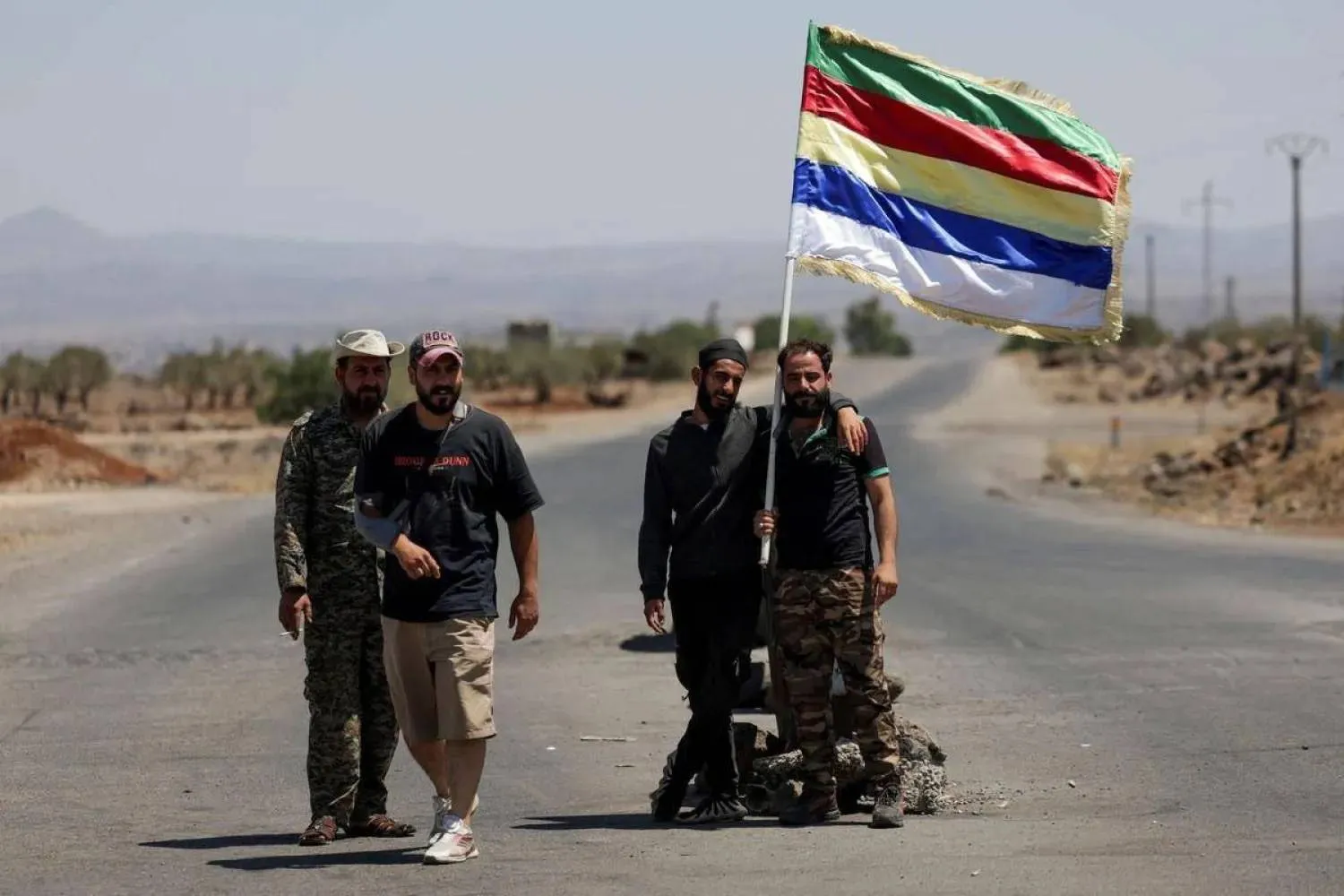
Members of the National Guard affiliated with Sheikh Hikmat al-Hijri in Sweida (File photo: Sweida 24). 
TT

Syrian State Media: Armed Groups Ban UN Delegation from Entering Sweida

Members of the National Guard affiliated with Sheikh Hikmat al-Hijri in Sweida (File photo: Sweida 24). 

Groups described by Syrian state media as operating outside the law prevented a joint UN humanitarian delegation from entering the southern Syrian city of Sweida on Sunday, citing a lack of coordination with them, according to Syria’s Al-Ikhbariya television channel.

The delegation included representatives of the UN Office for the Coordination of Humanitarian Affairs (OCHA) and international organizations. Its visit had been coordinated with the Sweida branch of the Syrian Arab Red Crescent, whose team was expected to accompany the delegation on field visits to Sweida city, Shahba and the village of Ara.

Al-Ikhbariya reported that the groups stopped the delegation at the Umm al-Zeitoun checkpoint for two to three hours before informing its members that entry was prohibited.

The delegation had earlier passed through the Al-Matouna checkpoint, operated by the Sweida Security Directorate.

The broadcaster also recalled that groups affiliated with Druze spiritual leader Sheikh Hikmat al-Hijri had blocked commercial trucks carrying essential goods and fuel from entering Sweida province on September 10.

According to Al-Ikhbariya’s correspondent at the time, the restrictions on commercial convoys coincided with the groups preventing approximately 12,000 students from reaching examination centers to sit special make-up exams for students in Sweida.