US Stresses Need to Transfer Power in Sudan to Civilians https://english.aawsat.com/home/article/4261016/us-stresses-need-transfer-power-sudan-civilians
US Stresses Need to Transfer Power in Sudan to Civilians
Sudanese protesters take part in a demonstration in southern Khartoum on April 6, 2023. (AFP)
The US on Friday reiterated its support for the ongoing political process in Sudan and expressed its readiness to support consultations with all Sudanese parties to overcome the challenges facing the final political agreement, accelerate its signing, and establish a credible transitional civilian government.
Washington made the announcement following a second delay in signing a political agreement between civilians and the military following a dispute between the military and Rapid Support Forces (RSF).
On Thursday, US Assistant Secretary of State for African Affairs Molly Phee held telephone calls with each of Khalid Omer Youssif, the spokesperson for the political process, and Mohamed Hamdan Daglo, also known as Hemedti, the deputy head of the Sovereign Council and commander of the Rapid Support Forces (RSF).
In a tweet, Phee said she underscored to Hemedti “US support for the aspirations of the Sudanese people to move now to transfer power to a civilian-led government.”
In a Facebook post, Hemedti said he assured Phee that the political process was a rare opportunity to restore the course of the revolution and a necessary step to move forward towards a true democratic transition.
In a separate tweet, Phee said she spoke to Youssif to “offer strong US support and advocacy for swift Sudanese action to complete the long journey of restoring the democratic transition.”
Youssif said the US official affirmed her country’s support for the political process, based on the framework agreement signed between the civil forces and the military on December 5.
He added that Phee underlined her administration's readiness to engage positively with all civil and military parties to overcome the remaining challenges to reach a final political agreement as soon as possible.
On March 30, Phee spoke with General Abdul Fattah al-Burhan, the head of the Sovereign Council, to express support for the “Sudanese people’s pressing demand to transfer power to a civilian-led government.”
Joint US-Saudi efforts, which Phee has been a part of since June 2022, succeeded in bringing civilians and military officials together in direct talks, after they came to a halt following an October 2021 military coup.
The US-Saudi efforts led to the formation of the Quartet Mechanism that also includes Britain and the United Arab Emirates.
The signing of the final political agreement between civilians and the military was scheduled for early April. It was the second time in less than a week that the parties failed to meet a deadline to sign it.
The deal aims to restore Sudan’s short-lived transition to democracy, which was halted by the October coup that removed a Western-supported, power-sharing administration.
Four Syrians, One Lebanese Involved in Capture of ‘Baniyas Butcher’ in Lebanonhttps://english.aawsat.com/arab-world/5330446-four-syrians-one-lebanese-involved-capture-%E2%80%98baniyas-butcher%E2%80%99-lebanon
Four Syrians, One Lebanese Involved in Capture of ‘Baniyas Butcher’ in Lebanon
Ali Kayali (Mihrac Ural) in an undated file photo circulated on Syrian social media
Lebanese judicial and security authorities are investigating the abduction of former Syrian regime officer Ali Kayali, also known as Mihrac Ural, from Mount Lebanon and his transfer to Syria in a covert operation that Lebanese officials say was carried out without their prior knowledge.
Accounts differed over how the operation was carried out and the route taken by those who seized him from the Metn area of Mount Lebanon into Syrian territory.
A day after the Syrian side announced the operation without any prior coordination with the Lebanese state, Public Prosecutor at the Court of Cassation Judge Ahmad Rami al-Haj issued judicial instructions to Lebanese Army Intelligence, the Internal Security Forces’ Information Branch and General Security, tasking them with investigating the circumstances of the operation and identifying those who carried it out.
Four Syrians and one Lebanese
A judicial source said preliminary information indicated that the operation was “carried out by four Syrians and one Lebanese.”
The source told Asharq Al-Awsat that tracking the phones used by those involved in the operation, as well as lines active around Kayali’s home, showed that they seized him inside his residence in Mansourieh before taking the coastal road through Jounieh and Tripoli to the Abboudieh border crossing in Akkar.
The source denied reports that Kayali had been taken to the Syrian Embassy compound in Yarzeh, saying footage from the embassy and surrounding surveillance cameras had been secured and showed that “he was never taken to the embassy.”
Syrian authorities accuse Kayali of responsibility for the 2013 massacres in al-Bayda and Baniyas on Syria’s coast, when he was leading an armed group fighting alongside forces loyal to Bashar al-Assad.
Human Rights Watch documented the execution of at least 248 people in the two areas, including women and children, and described the killings in al-Bayda as among the “deadliest instances of mass summary executions” in the Syrian conflict.
Conflicting accounts
Syrian and Lebanese accounts of the abduction differed.
Agence France-Presse quoted a Syrian security source as saying the operation “took place in coordination with the Lebanese side.”
The Lebanese judicial source, however, denied that Lebanese authorities had prior knowledge of it, saying Lebanese security agencies “were unaware that Kayali was in Lebanon or that he had been abducted until the Syrian side announced it.”
The source said security investigations conducted in recent hours showed that Kayali had entered Lebanon clandestinely with his wife in 2025 and had remained in hiding, moving with extreme caution until he was abducted.
According to information reported by Türkiye’s Anadolu news agency, Kayali was born in 1956 in Hatay province in southern Türkiye, near the Syrian border.
Ankara also accuses him of having led an armed group known as the “Syrian Resistance” and the “Popular Front for the Liberation of the Sanjak of Iskenderun,” and of involvement with Syrian intelligence under Bashar al-Assad in the Reyhanli bombings that killed 53 people.
Officers taking refuge in Lebanon
The incident has again brought attention to the flight of dozens of officers from the former Syrian regime to Lebanon following Bashar al-Assad’s departure and the fall of his government in late 2024.
The Lebanese judicial source said the case could not be separated from the arrest several weeks ago of Suleiman Hilal al-Assad, or the earlier detention of Major General Adel Issa inside the Syrian Embassy in Beirut. Lebanese judicial authorities later decided to hand Issa over to Damascus.
The source said the succession of such cases “indicates the presence in Lebanon of officers and figures from the former regime,” adding that some may be “receiving security protection from parties allied with the Assad regime, such as Hezbollah and others, while some are residing illegally or using forged documents to avoid having their identities discovered.”
The judicial source stressed that Lebanon “is cooperating with the Syrian authorities on correspondence concerning wanted figures from the former regime, and is also cooperating with international bodies on arrest requests and Interpol notices involving Syrian security officials accused of serious violations.”
Among the most prominent are former National Security Bureau chief Major General Ali Mamlouk, former Air Force Intelligence chief Major General Jamil Hassan, and Brigadier General Abdul Salam Mahmoud, former head of the Air Force Intelligence investigation branch.
The source said, however, that “no information has emerged indicating that they are present on Lebanese territory.”
Is Israel Signaling a Wider Occupation of Southern Lebanon?https://english.aawsat.com/arab-world/5330380-israel-signaling-wider-occupation-southern-lebanon
Is Israel Signaling a Wider Occupation of Southern Lebanon?
Israeli soldiers near the Litani River in southern Lebanon (File photo - Israeli military)
Israel has escalated threats to expand its occupation of southern Lebanon, with Defense Minister Israel Katz warning that the Nabatieh and Litani areas could be added to what he called a permanent security zone if Hezbollah joins a possible confrontation between Israel and Iran.
The warnings have raised questions over which areas Israeli forces may seek to seize and whether they are preparing for a broader ground operation, as military activity continues and Israel moves closer to Knesset elections.
Katz had threatened to evacuate residents from broad areas of southern Lebanon as far as the Zahrani and Awali rivers, as well as Beirut’s southern suburbs. He said more than one million people could be displaced and that the Israeli military was ready to carry out a ground maneuver.
The threats come after Israeli forces expanded their deployment toward strategic high ground, including Beaufort Castle and Ali al-Taher near Nabatieh. Israeli strikes have also hit the Rihan, Sajd and Jabal al-Rafi heights, raising questions over whether Israel could seek wider control of elevated terrain and geographic corridors.
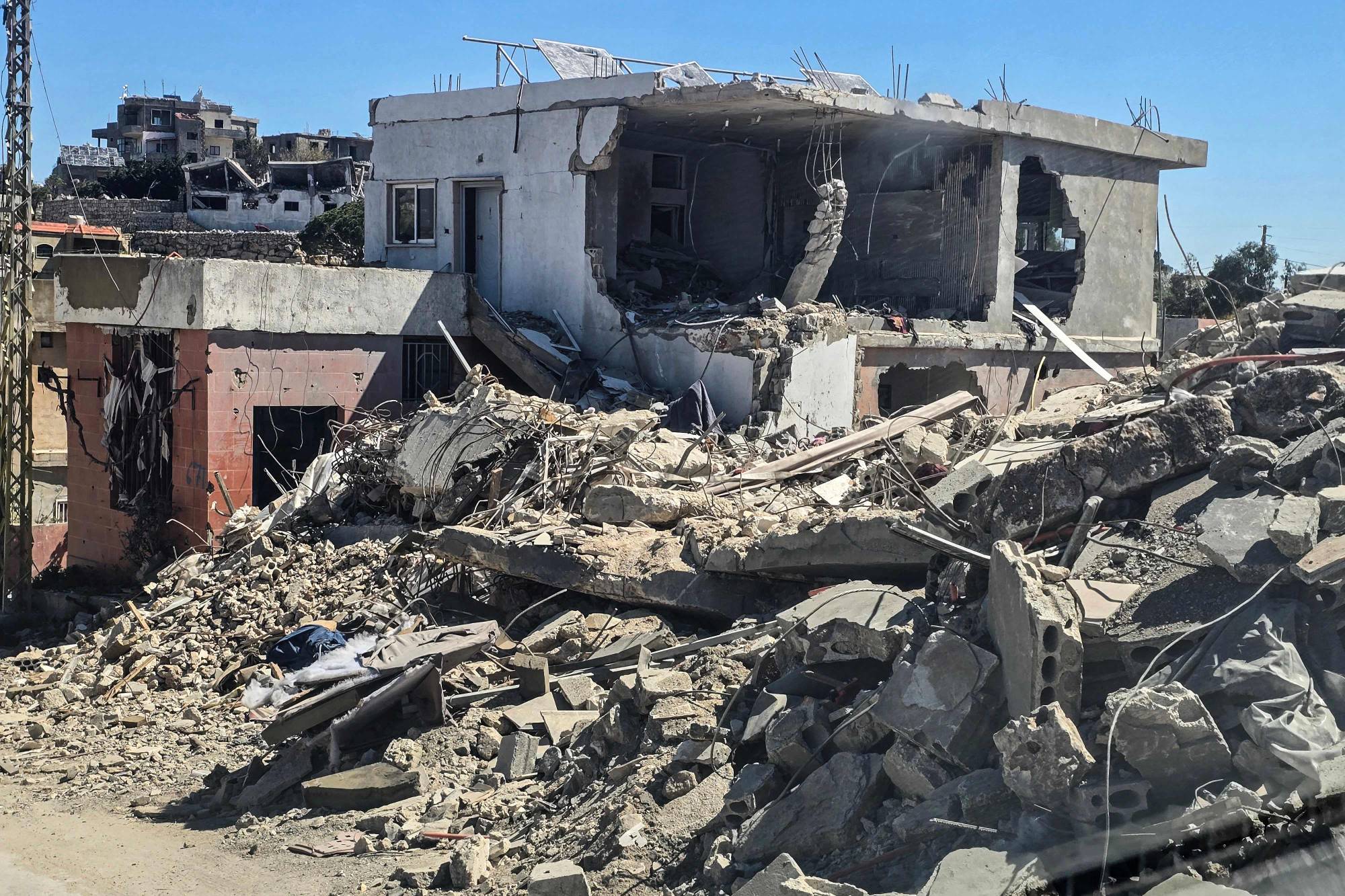
The remains of a home destroyed by the Israeli army in the southern Lebanese village of Beit Lif, in the Bint Jbeil district on April 22, 2026. (Photo by Kawnat HAJU / AFP)
Israel seeks natural geographic barriers
Retired Brigadier General Fadi Daoud said Israel’s threats went beyond targeting Hezbollah and dismantling its military infrastructure, pointing to broader political and geographic aims.
“Military positions and ground operations, regardless of their size or depth, must serve the concept of a military maneuver on the ground, and that maneuver in turn serves a major political objective,” Daoud told Asharq Al-Awsat.
“The Israeli objective is not limited to striking Hezbollah positions and dismantling its military infrastructure. It goes beyond that to objectives linked to geography and control of territory.”
Daoud said Israeli movements in southern Lebanon should be viewed alongside developments in southern Syria, particularly in the Quneitra countryside and the Mount Hermon area, where he said the two tracks appeared interconnected within an Israeli approach centered on using geography to create security zones.
He said Israeli intentions should be read from developments on the ground rather than statements alone, adding that Israel had not yet reached the phase line it was seeking and that any military advance would unfold in stages, regardless of the distance involved.
“Any military action, even if the required advance is no more than 100 meters, is divided into stages, beginning with preparatory fire and securing the flanks, followed by launching the attack and consolidating positions,” he said.
Military phase lines, he added, are typically based on natural geographic barriers that allow attacking forces to consolidate their deployment and organize their defenses.
“What matters is not what Israel says, but what it does on the ground and the positions it is seeking to reach,” Daoud said.
“Israeli forces are seeking to stop at a clear geographic line. They cannot stop in the middle of an area without relying on a geographic barrier that allows them to consolidate their presence.”
Daoud said Israeli military ambitions could extend to the Awali River, north of Sidon. Reaching and controlling that line, he said, would push the security belt deep into Lebanese territory and affect all areas to its south, including Iqlim al-Tuffah and surrounding villages.
Escalation linked to Iran
Retired Brigadier General Naji Malaeb linked the Israeli threats to military preparations and the prospect of a confrontation with Iran as Israeli elections approach.
“Israeli Defense Minister Israel Katz’s talk of possibly reaching the Awali River means the threats are no longer confined to Nabatieh district or the Litani area, but now cover a broader geographical area extending to Sidon and its surroundings,” Malaeb told Asharq Al-Awsat.
He said the threats also extended beyond southern Lebanon to Beirut’s southern suburbs, reflecting a sharp escalation in Israeli rhetoric ahead of the elections.
Malaeb pointed to what he described as significant Israeli military activity on the ground. The Israeli military’s 282nd Artillery Brigade, he said, had completed extensive drills on countering drones used by Hezbollah and on evacuation operations during combat.
The brigade then moved directly to southern Lebanon, he said, giving Israel additional artillery forces alongside those already deployed and ready to act if orders are issued.
Malaeb said any expansion of Israeli military operations would depend less on specific locations than on Israel’s political and military decision-making and on the extent of Hezbollah’s involvement in any renewed confrontation between Israel and Iran.
He said several scenarios were possible, including Iran seeking to use the Israeli election period to launch attacks or influence the electoral process, or Israel moving to expand the war against Iran before or during the elections.
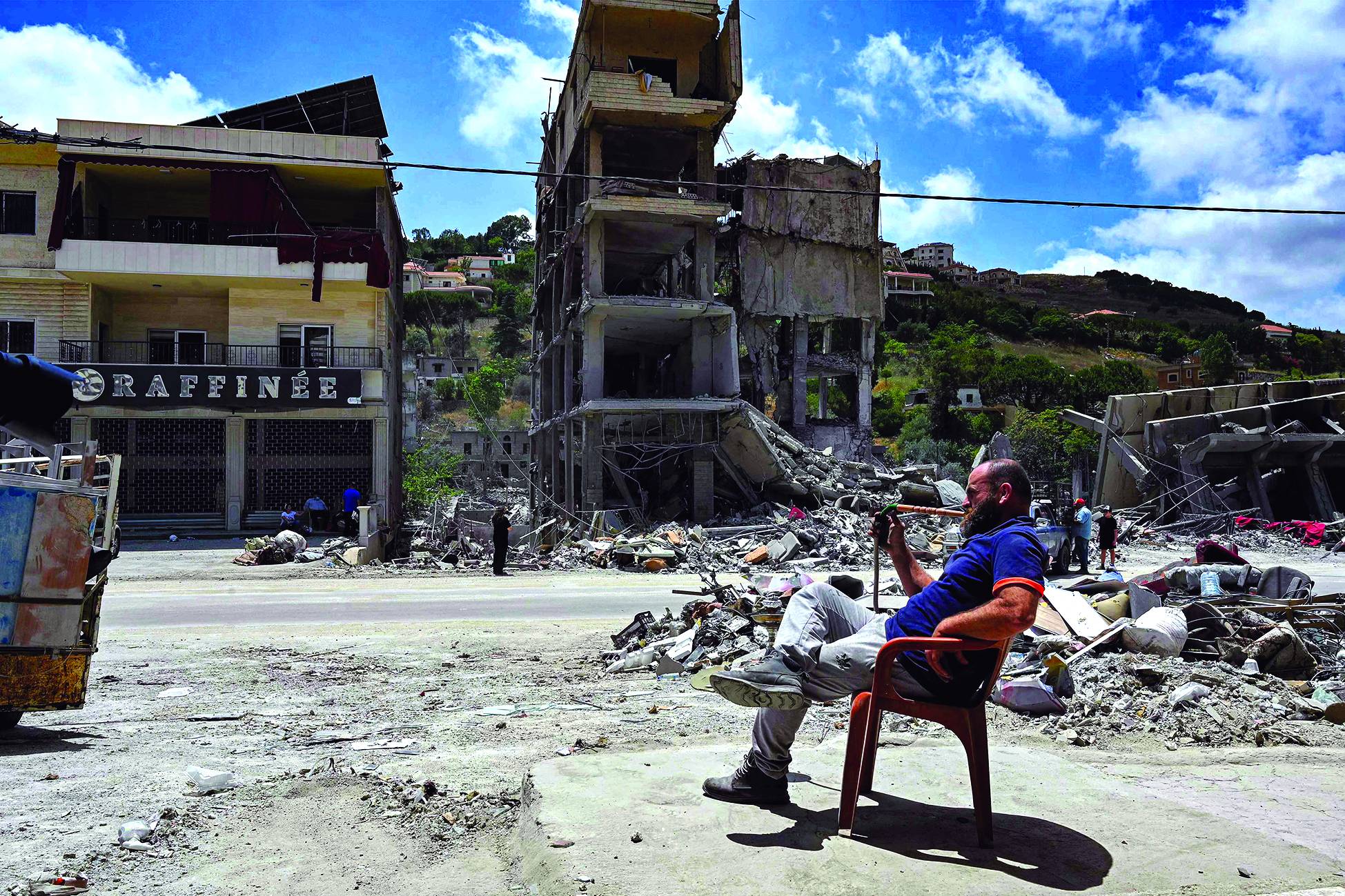
A man smokes a waterpipe as he sits by the rubble in the town of Nabatieh al-Fawqa in southern Lebanon on June 23, 2026. (Photo by Fadel ITANI / AFP)
Malaeb said the prospect of a broader confrontation with Iran had been discussed between the United States and Israel, amid reservations expressed by Israeli Chief of Staff Eyal Zamir over the consequences of entering a conflict that could have difficult repercussions for Israel, particularly if it was not militarily prepared and with elections approaching.
On Hezbollah’s preparations, Malaeb said the seizure by Lebanese security forces of one truck loaded with explosives and linked to the group did not necessarily mean it was the only one to have crossed, as others could have passed without being intercepted.
That, he said, raised the possibility that Hezbollah was preparing for military action if a new regional confrontation erupted.
“The main question today is not which positions Israel may seek to control, but whether the political and military decision to expand the operations will be taken,” he said.
Developments on the ground
Israeli warplanes on Friday carried out a heavy strike on Kfar Tibnit in Nabatieh district, as air and artillery attacks intensified in the districts of Tyre and Bint Jbeil.
The attacks included three strikes on Mansouri and a fourth on Wadi Zibqin. Artillery fire hit Baraachit and Haddatha, the outskirts of Haris, areas around Zibqin and Shaqra, and later Mansouri and Majdal Zoun before dawn.
Warplanes also carried out simulated air raids over Tyre and nearby villages and dropped illumination flares over Mansouri and Bayt al-Sayyad.
Lebanon’s Health Ministry said two people, including a four-year-old child, were wounded in a strike on Haddatha.
In Kfar Shouba, an Israeli force prevented Lebanese farmers from entering the areas of Azrael and Bastara to harvest olives, as residents of border villages continued to face difficulties reaching their farmland.
Sanaa Tribes Hamper Houthi Push to Expand Recruitmenthttps://english.aawsat.com/arab-world/5330371-sanaa-tribes-hamper-houthi-push-expand-recruitment
Sanaa Tribes Hamper Houthi Push to Expand Recruitment
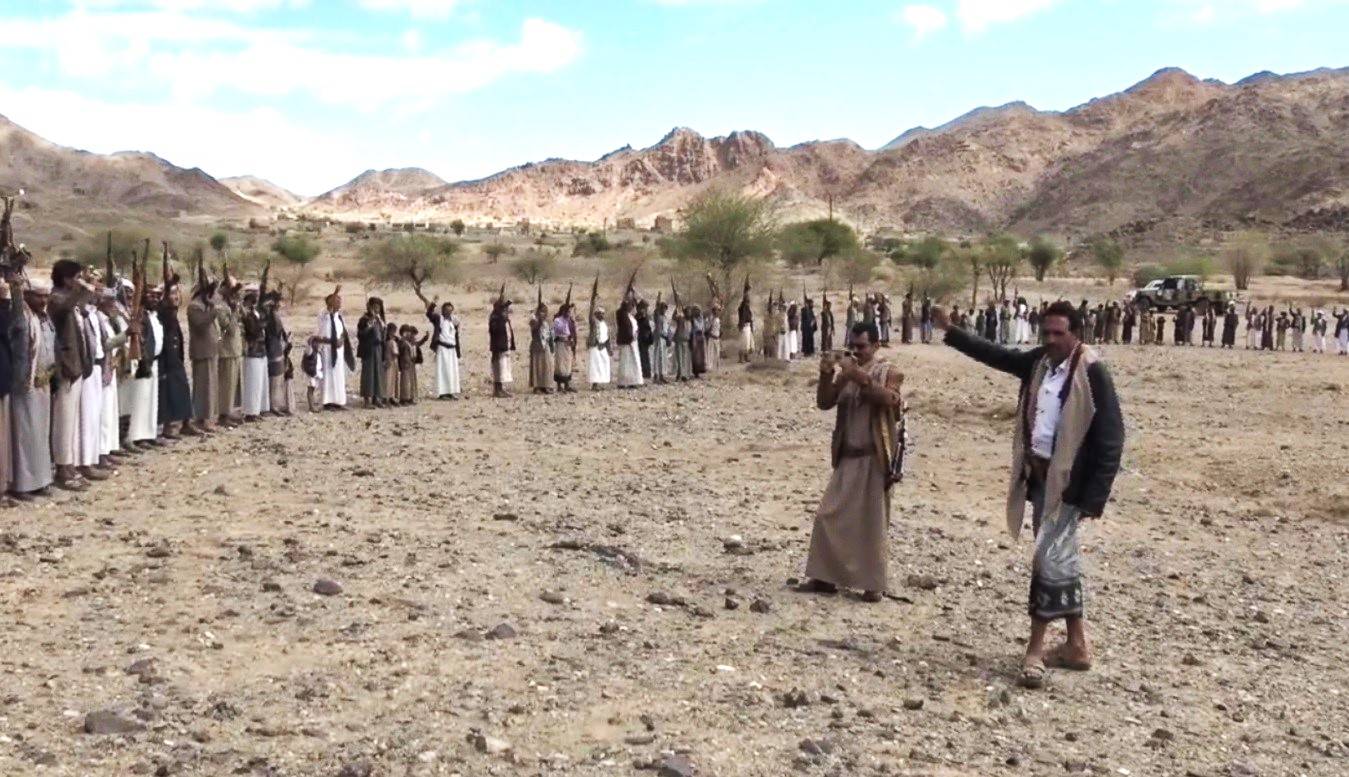
A gathering called for by the Houthi group in the southern suburbs of Sanaa (Houthi media)
Houthi efforts to expand mobilization and recruitment around Yemen’s Houthi-held capital Sanaa are facing growing tribal resistance after the group failed to rally residents in several districts for armed gatherings backing its military escalation, as it steps up pressure on tribal sheikhs to send more young men to the front lines and offset mounting losses.
Local and tribal sources told Asharq Al-Awsat that Houthi leaders have intensified contacts in rural Sanaa since the start of this month, pressing tribal sheikhs to raise readiness for what the group calls “tribal mobilization,” stage armed gatherings and provide new batches of fighters to reinforce the fronts.
The campaign has targeted Bani Matar, Sanhan and Bani Bahloul, Bilad al-Rus, Khawlan, Jihana, Hamdan, Arhab, Nihm, Saafan and Manakha.
But the push has met reluctance from a number of sheikhs and local dignitaries, the sources said, amid growing resentment over the continued depletion of tribal communities in battles whose human and economic costs are borne by families and local communities.
Some tribal leaders have told the Houthis they are unable to provide new fighters, the sources added, as recruitment calls draw fewer responses and fears grow over sending more young men to fronts where the group is suffering repeated losses.
Houthis use killing, displacement, and abduction to subjugate tribes (Facebook)
Threats and incentives
The Houthis have gone beyond outreach and mobilization calls, the sources said, putting pressure on tribal sheikhs to comply with their demands.
The measures have included threats to withdraw privileges and impose financial penalties on those who fail to comply, while offering cash and material incentives to those who agree to supply fighters to the fronts.
Through these tactics, the group is seeking to shift responsibility for providing fighters onto tribal sheikhs and use their social influence to recruit men from their communities, as casualties mount on fronts in Taiz, the western coast, Marib, al-Jawf, Lahj and al-Dhalea.
In a sign of the difficulties facing the recruitment drive, areas in Bani Matar, Sanhan and Nihm in Sanaa province recently held separate tribal gatherings called by the Houthis, but turnout was limited, local sources said.
The group used its media outlets to portray the gatherings as expressions of tribal support, seeking to bolster its image and justify continued military activity while pushing to recruit more fighters.
The limited turnout, according to the sources, underscores the difficulty of turning Houthi appeals into broad tribal mobilization, particularly as objections grow to the depletion of young men and the use of tribal ties to serve the group’s military objectives.
The recruitment drive coincides with continued restrictions and pressure on residents of rural Sanaa, amid accusations that the Houthis are tightening their grip on opponents and continuing to seize privately owned land and property, further fueling public resentment.
As living conditions and public services deteriorate, families are facing heavier economic burdens while the group continues to focus its efforts on mobilization campaigns and military activity rather than residents’ basic needs.
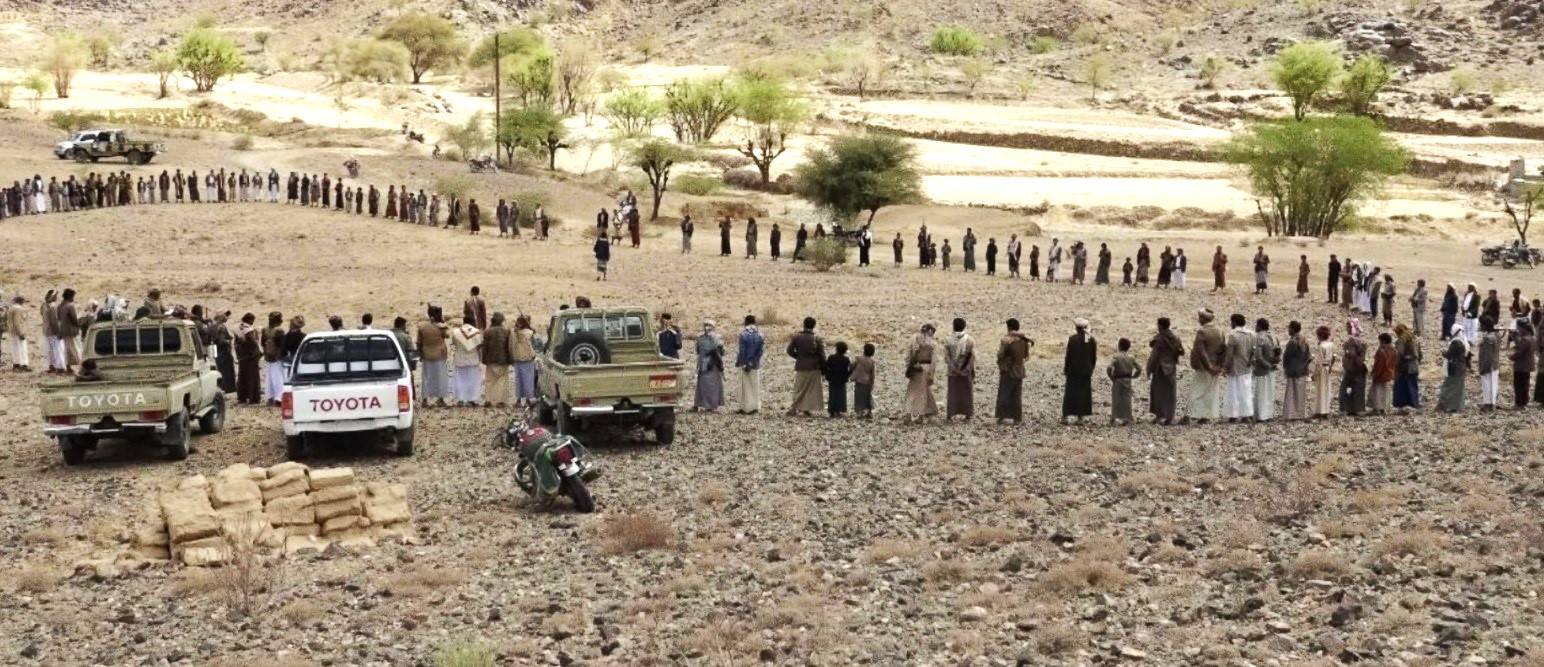
Sanaa rural tribesmen forced to chant Houthi slogans (Facebook)
Families fear for their sons
The campaign comes as the Houthis continue efforts to reinforce the fronts with fighters, while families grow increasingly fearful that their sons could be killed or return with permanent injuries, at a time of worsening economic hardship and declining basic services in Houthi-controlled areas.
Residents of the targeted districts in rural Sanaa are calling for an end to recruitment and mobilization campaigns and for efforts to be redirected toward easing economic hardship and improving services, rather than sending their sons to the front lines.
The Yemeni government has called on tribal sheikhs, fathers and mothers in those areas to prevent their children from joining Houthi ranks, warning against sending them into battles that, in its view, serve Iran’s project and regional agenda at the expense of Yemeni lives and the country’s future.
The government accuses the group of exploiting social influence and economic hardship, alongside intimidation and inducements, to draw young people into mobilization camps and onto the front lines instead of providing conditions that would allow them to work and live away from war.
لم تشترك بعد
انشئ حساباً خاصاً بك لتحصل على أخبار مخصصة لك ولتتمتع بخاصية حفظ المقالات وتتلقى نشراتنا البريدية المتنوعة