Biden Kicks off Easter Egg Roll with Talk of Reelection Bid

US President Joe Biden, alongside First Lady Jill Biden waves after speaking at the annual Easter Egg Roll on the South Lawn of the White House in Washington, DC, on April 10, 2023. (AFP)
TT

Biden Kicks off Easter Egg Roll with Talk of Reelection Bid

US President Joe Biden, alongside First Lady Jill Biden waves after speaking at the annual Easter Egg Roll on the South Lawn of the White House in Washington, DC, on April 10, 2023. (AFP)

Not even the annual White House Easter Egg Roll is safe from presidential politics.

President Joe Biden, the host of Monday's festivities on the South Lawn, said he plans to participate in “at least three or four more Easter egg rolls, maybe five.”

Biden was alluding to his expected reelection bid but when pressed for news by Al Roker of NBC's “Today” show, the president gave no ground. He repeated what he's been saying for months.

“I'm planning on running, Al, but we're not prepared to announce it yet,” Biden told Roker.

After making an early appearance on the lawn to speak with Roker after the gates opened at 7 am, Biden and first lady Jill Biden will also address the crowd from the White House balcony before joining the “egg-citement.” Some 30,000 people, mostly children, were expected, in nine waves of participants, ending at 7 pm.

“Anything’s possible in America,” Biden said in brief remarks welcoming guests to the South Lawn, “if we remember who we are and we do it together.”

The first lady's theme is “EGGucation.” Jill Biden is a teacher and she has incorporated numerous learning opportunities into the event.

“Learning doesn't only happen in a classroom, there are so many fun opportunities to learn around us every day,” she said, explaining that's why they turned the South Lawn into a “school community.”

The White House Easter Egg Roll dates to 1878, when President Rutherford B. Hayes opened the White House lawn to children after they were kicked off the grounds of the US Capitol.


Bones from Iraqi Cave Hint at Violence and Compassion in Neanderthals

The entrance to Shanidar Cave in Iraq's Kurdistan region, a site of important Neanderthal remains, is seen in an undated photograph released on October 15, 2026. Prof Graeme Barker/Handout via REUTERS
TT

Bones from Iraqi Cave Hint at Violence and Compassion in Neanderthals

The entrance to Shanidar Cave in Iraq's Kurdistan region, a site of important Neanderthal remains, is seen in an undated photograph released on October 15, 2026. Prof Graeme Barker/Handout via REUTERS

The bones of a Neanderthal from a cave in Iraq's Kurdistan region are offering evidence of both violence and compassion in the closest evolutionary cousins of our species, exhibiting a wound apparently from a fatal spear attack as well as signs of an earlier nonfatal injury that may have elicited kindly care.

Researchers have discovered at Shanidar Cave in the Zagros Mountains of northern Iraq a partial skeleton of a Neanderthal, aged in the mid-40s, that included a left shoulder blade, or scapula, with a circular hole six-tenths of an inch (15 mm) wide indicative of a deeply penetrating stab.

The bones of this individual, who they call Shanidar A, were unearthed from under about 25 feet (7.5 meters) of rocks and sediment inside the cave and date to about 75,000 years ago.

The researchers were unable to determine Shanidar A's sex.

According to Reuters, the researchers said the injury's shape suggests it was caused by a forceful thrust using a sharpened wooden spear, a type of weapon Neanderthals are known to have used, rather than a spear with a stone tip. It was a weapon employed in hunting large mammals that were an important food source.

"The ⁠spear would have ⁠gone through the skin and major muscles, especially the pectoralis, as well as the ribcage and muscles between the ribs, and the lung," said biological anthropologist Emma Pomeroy of the University of Cambridge in England, lead author of the study published on Thursday in the journal Scientific Reports.

"The location could be like the kind of 'heart shot' hunters use to kill animals quickly by puncturing the heart, but that is a bit speculative. We do see heart shots as a hunting strategy both today and in the archaeological record. Neanderthals would have known this would lead to a quick death," Pomeroy said.

University of Cambridge archaeologist and study co-author Graeme Barker, who has led Shanidar Cave excavations since 2015, said the likeliest scenario ⁠is interpersonal violence.

The researchers said the violence probably occurred either between members of a particular Neanderthal group or between members of rival Neanderthal groups, calling a Homo sapiens attack or an accidental injury less likely.

The researchers found shards of bone displaced by the weapon. The injury indicated that the spear entered from above with a downward trajectory, penetrating the left chest cavity from the front and traveling through the body before punching the hole in the scapula, causing quick death.

In addition to the scapula, the researchers found some ribs, a nearly complete right hand and seven teeth, mostly from the front of the lower jaw, belonging to Shanidar A. The teeth bore evidence that this Neanderthal had survived brutal injury at least a year before death — a blow to the face resulting in front teeth being smashed and lost. One tooth was split, with half remaining rotated in the mouth and others pushed out of position.

"The pain would have been extreme, and basic needs like eating and drinking would have been difficult, perhaps meaning Shanidar A needed food mashing and being able ⁠to rest. It's likely that Shanidar ⁠A did need some care from members of the group for some basic needs during recovery," Pomeroy said.

Shanidar A was one of five Neanderthals, four adults and one infant, whose bodies were carefully tucked behind a rock pillar in the cave in a burial cluster within a generation or so of each other. The cave was occupied by Neanderthals for tens of thousands of years as a seasonal campsite, and later by Homo sapiens.

Neanderthals were more robustly built than Homo sapiens, with larger brows. They lived as hunter-gatherers and inhabited Eurasia from the Atlantic coast to the Ural Mountains from about 400,000 years ago until a bit after 40,000 years ago, disappearing after Homo sapiens became established in the region.

The two species interbred, with modern non-African human populations bearing residual Neanderthal DNA.

The cave, overlooking the Great Zab river valley, has been a source of information about Neanderthals since the 1950s, with Shanidar A now offering new insight into their behavior.

"We see evidence of two contrasting facets of human nature – care and violence – juxtaposed in the same individual," Pomeroy said.

"We see evidence all around us today that violence and care are both aspects of how we humans behave, and we see this here in Shanidar A, too. Neanderthals were like us in many respects, both the good and the bad, and this find really highlights that, going against stereotypes of Neanderthals as unintelligent, uncaring cavemen and cavewomen," Pomeroy said.



Separation Surgery for Fijian Conjoined Twins Begins in Riyadh Under Royal Directives

The medical and surgical team of the Saudi Conjoined Twins Program began Thursday the separation surgery for 13-month-old Fijian conjoined twins Jasbili and Desisia at King Abdullah Specialist Children’s Hospital in Riyadh. (SPA)
TT

Separation Surgery for Fijian Conjoined Twins Begins in Riyadh Under Royal Directives

The medical and surgical team of the Saudi Conjoined Twins Program began Thursday the separation surgery for 13-month-old Fijian conjoined twins Jasbili and Desisia at King Abdullah Specialist Children’s Hospital in Riyadh. (SPA)

Acting on the directives of the Custodian of the Two Holy Mosques, King Salman bin Abdulaziz Al Saud, and Prince Mohammed bin Salman bin Abdulaziz Al Saud, Crown Prince and Prime Minister, the medical and surgical team of the Saudi Conjoined Twins Program began Thursday the separation surgery for 13-month-old Fijian conjoined twins Jasbili and Desisia at King Abdullah Specialist Children’s Hospital in Riyadh.

Supervisor General of the King Salman Humanitarian Aid and Relief Center and head of the program’s surgical team Dr. Abdullah Al Rabeeah said in a statement that the twins arrived in the Kingdom on July 21, 2026. The medical team conducted a thorough assessment, including comprehensive medical examinations and several consultations. It concluded that the twins were conjoined at the abdomen and pelvis and shared the liver, intestines, colon, anus, urinary system, reproductive system, and pelvic bone.

He explained that the medical and surgical team has planned the procedure to be carried out in nine stages, with an estimated duration of approximately 15 hours. A total of 34 individuals, including consultants, specialists, and technical and nursing staff, are participating in the operation.

Al Rabeeah stated that, based on medical assessment, this is a complex procedure with a success rate of 70%.

He noted that this marks the first separation of conjoined twins from the Republic of Fiji and is the 74th case handled by the Saudi Conjoined Twins Program. Since 1990, the program has provided care for 159 sets of conjoined twins from 28 countries across five continents.


Still Smiling at 117, Albanian May be World's Oldest Woman

The 117-year-old Qamile Marra holds a black and white photograph from her youth during an interview with AFP in the garden of her home in the village of Ferras, near Kucove, some 80 kilometres from the capital Tirana on October 3, 2026. (Photo by Adnan Beci / AFP)
TT

Still Smiling at 117, Albanian May be World's Oldest Woman

The 117-year-old Qamile Marra holds a black and white photograph from her youth during an interview with AFP in the garden of her home in the village of Ferras, near Kucove, some 80 kilometres from the capital Tirana on October 3, 2026. (Photo by Adnan Beci / AFP)

At 117, Qamile Marra is not particularly concerned with proving she may be the world's oldest woman -- or even persuading Albanian pension officials that she is not dead.

For a woman born under Ottoman rule, who turned 36 a fortnight before the end of World War II and outlived Albania's communist dictatorship, her focus remains firmly on enjoying life.

"Life is beautiful, like Mount Tomorr in bloom," she told AFP with a smile, referring to one of Albania's loftiest peaks as she sat outside her home in Ferras, about 100 kilometers (60 miles) south of the capital.

Surrounded by fruit trees, Marra has spent almost her entire life in the village, growing her own food and tending livestock.

"You live as long as God has decreed," she said, her deeply wrinkled face framed by a traditional white headscarf.

According to her birthdate as listed on several official documents -- August 19, 1909 -- Marra would be two days older than Britain's Ethel Caterham, recognized by Guinness World Records as the world's oldest living woman.

Definitively proving the age of "supercentenarians" can be difficult.

Many of the people famous for living the longest are from places where shoddy recordkeeping and suspected pension fraud are rampant, according to a study that won the 2024 Ig Nobel prize, which awards offbeat scientific research.

But Marra has extensive records that appear to confirm her age.

Her relatives have contacted Guinness and hold a birth certificate issued in 1945, a passport issued in 1978 and a recent identity card, all showing the same date of birth.

Her age even surprised local authorities, who stopped her pension when she turned 100, according to her 80-year-old son Hysen.

"They didn't believe my mother was still alive," he said, recalling how he had to show proof, including witness statements, to resume the meagre payments.

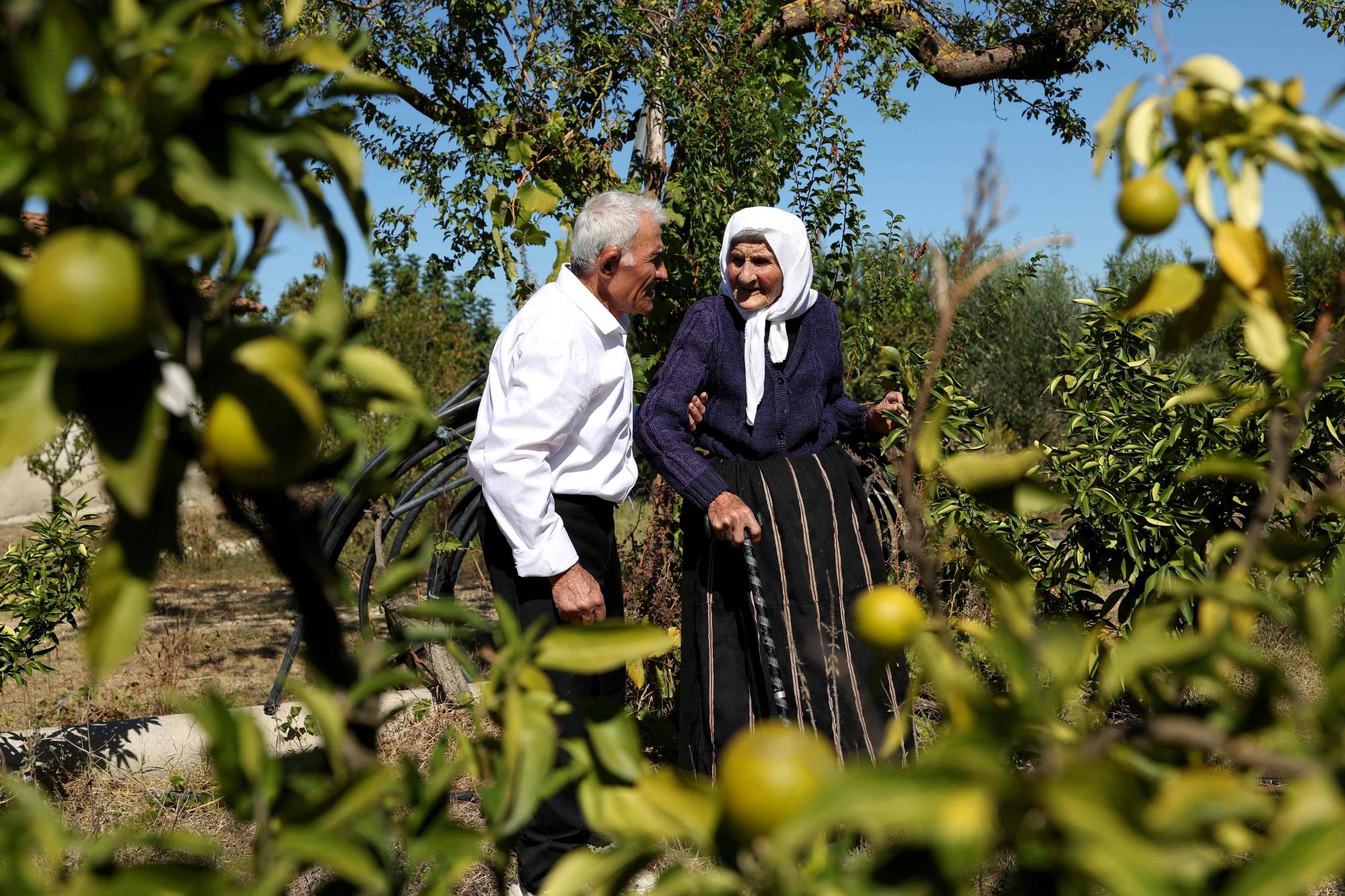
The 117-year-old Qamile Marra speaks with her son Hysen Marra, 80, in the garden of her home in the village of Ferras, near Kucove, some 80 kilometres from the Albanian capital Tirana on October 3, 2026. (Photo by Adnan Beci / AFP)

Earlier this month, the government issued her a special state pension to mark her age.

Perhaps the answer lies in Marra's habits and lifestyle.

She rises early to sweep the yard, water her flowers and feed the chickens before settling down with her favorite coffee.

She still enjoys regular walks through her carefully tended orchard with her son, who lives with her, stopping to pick ripe pomegranates along the way.

She also slips basil leaves in her pockets to "enjoy the aroma.”

Whatever the secret, her son says she has never even visited a doctor.

"She is in good health and has never taken any medication."

Marra's husband died 36 years ago, but she still smiles when talking about their decades together -- an arranged marriage, but a loving one.

"Otherwise, how could I have had seven children with him?" she said.

She has now seen five generations of her family grow up around her.

Tears welled up as she remembered the family and friends she had lost. But her face brightened when a niece called to chat.

"I've watched them get engaged, marry and build their own homes and lives," she said.

"When I see people coming and going in the house, I am so happy."

From her own youth, she has kept a single photograph: a near-century-old picture of a young woman wearing a white scarf just like the one she had on.

"I was 18!" she said.