


Netanyahu Vows to Restore Security in Israel after Surging Violence

Demonstrators walk with Israeli flags past a banner depicting Prime Minister Benjamin Netanyahu during a protest against his government's plans to reform the judicial system in Tel Aviv, on March 25, 2023. Oded Balilty, AP
TT

Netanyahu Vows to Restore Security in Israel after Surging Violence

Demonstrators walk with Israeli flags past a banner depicting Prime Minister Benjamin Netanyahu during a protest against his government's plans to reform the judicial system in Tel Aviv, on March 25, 2023. Oded Balilty, AP

Israeli Prime Minister Benjamin Netanyahu vowed to restore security "on all fronts" after surging violence that included rocket fire from Lebanon and Syria and two more deaths on Monday.

Netanyahu also reinstated the defense minister whose firing he announced last month, AFP said.

Heavy clashes, shootings, rocket strikes and a car-ramming attack have marred a period when the Muslim holy month of Ramadan coincides with the Jewish Passover and Christian Easter.

The latest casualties were a Palestinian teenager and a British-Israeli mother who succumbed on Monday to injuries from a West Bank gun attack that earlier killed her two daughters.

The day after Israeli police on Wednesday stormed the prayer hall of Jerusalem's Al-Aqsa mosque -- Islam's third-holiest site -- more than 30 rockets were fired from Lebanese soil into Israel.

The Israeli army said the attack was most likely carried out by the Palestinian armed movement Hamas.

Israel then bombarded the Gaza Strip and southern Lebanon, targeting "terror infrastructures" it said belonged to Hamas.

"We will not allow the terrorist Hamas to establish itself in Lebanon", by acting on "all fronts", Netanyahu said at a news conference Monday.

Israeli-Palestinian violence had already intensified since Netanyahu's new government took power in December, a coalition with extreme-right and ultra-Orthodox Jewish parties.

The latest surge came late last month after he announced a "pause" for dialogue on judicial reform legislation, which split the nation and caused divisions in his government.

Among the political casualties was Yoav Gallant, whom the prime minister dismissed on March 26 after he called for a halt to the legislative process, citing national security concerns and threats by reserve military personnel not to report for duty.

Netanyahu is currently battling very low levels of domestic popularity. A recent survey showed him likely to lose if an election were held now.

At his news conference, Netanyahu said he and Gallant had "difficult disputes" but he had decided to put them in the past.

"Gallant remains in his post and we will continue to work together for the safety of the citizens of Israel," he added.

In Tel Aviv, several hundred protesters took to the streets to denounce the government and condemn the prime minister's speech, according to images broadcast by Israeli television.

West Bank march
Earlier Monday several government ministers joined a protest march by Jewish settlers, held under tight security in the north of the occupied West Bank.

In the latest shooting in the territory, Israeli forces killed a Palestinian teenager, Mohammed Fayez Balhan, 15, and wounded two other people, the Palestinian health ministry said, during what the army described as a raid to arrest a "terror suspect".

The Israeli army confirmed its forces were operating in the Aqabat Jaber camp, the site of previous deadly Israeli raids this year, near Jericho, where soldiers were seeking "to apprehend a terror suspect".

The army said troops responded with live fire after "suspects opened fire toward (soldiers), hurled explosive devices and Molotov cocktails".

A suspect was taken in by security forces, they added.

Clashes erupted when the army entered the camp and surrounded several houses, according to Palestinian news agency Wafa. A Palestinian security official told AFP that five individuals had been arrested during the raid.

Hamas said it mourned the "young martyr" and praised those "standing up to this arrogant enemy".

British-Israeli mother dies

The operation came as a Jerusalem hospital confirmed that a British-Israeli woman, Lucy (Leah) Dee, had died after being seriously injured in a shooting attack Friday in the West Bank that killed her two daughters, aged 16 and 20.

Their car came under fire in the Jordan Valley, where Jericho is also located. The families were residents of Efrat, a Jewish settlement in the West Bank.

British Foreign Secretary James Cleverly tweeted that there could be "no justification" for the "senseless violence".

Israel has occupied the West Bank since the 1967 Six-Day War and hundreds of thousands of Jewish settlers live in Israeli-approved settlements there which are considered illegal under international law.

Hundreds of Israelis marched Monday in the north of the West Bank, pushing for state approval of an Israeli settler outpost.

Several government ministers -- including Israel's far-right National Security Minister Itamar Ben-Gvir -- appeared at the march to Eviatar, whose residents agreed to leave in 2021 while officials examined their case.

Addressing the crowd, Ben-Gvir said "the response to terror is to build" settlements.

Violence has flared anew since Israeli police stormed the prayer hall of Al-Aqsa mosque in a pre-dawn operation aimed at dislodging "law-breaking youths and masked agitators" they said had barricaded themselves inside.

Late Friday, an Italian tourist was killed and seven others wounded in a car-ramming attack in Tel Aviv.

The Israeli army also said it had launched strikes on targets in Syria Sunday after rockets fired from there landed in the Israeli-occupied Golan Heights.

The conflict has this year claimed the lives of at least 94 Palestinians, 19 Israelis, one Ukrainian and one Italian, according to an AFP count based on Israeli and Palestinian official sources.

These figures include, on the Palestinian side, combatants and civilians, including minors, and on the Israeli side, mostly civilians, including minors, and three members of the Arab minority.



US, Israel Differ Over Timing of Strike on Iran

 Iranians drive past an anti-US billboard in Vanak Square in Tehran, Iran, 14 October 2026- EPA/ABEDIN
Iranians drive past an anti-US billboard in Vanak Square in Tehran, Iran, 14 October 2026- EPA/ABEDIN
TT

US, Israel Differ Over Timing of Strike on Iran

 Iranians drive past an anti-US billboard in Vanak Square in Tehran, Iran, 14 October 2026- EPA/ABEDIN
Iranians drive past an anti-US billboard in Vanak Square in Tehran, Iran, 14 October 2026- EPA/ABEDIN

A group of senior US military officials, including Secretary of War Pete Hegseth, is pushing to resume the war against Iran, while advisers to US President Donald Trump favor continuing to "strangle Iran" through economic sanctions.

In Israel, Prime Minister Benjamin Netanyahu claimed Wednesday that he opposed launching a preemptive strike on Tehran ahead of the Israeli elections, but insisted that he would "bring Iran down" within the next two years.

The US-Israeli differences over the timing of renewed military action coincided with reports that Iran had adopted "new tactics" to target ships transiting the Strait of Hormuz. A container ship was also reported to have caught fire and sunk after striking a mine.

Meanwhile, Iran's Revolutionary Guard Corps (IRGC) spokesperson Brig. Gen. Hossein Mohibbi said Iran had acquired far more advanced weapons following the 40-day war.

On the ground, three people were injured when an unidentified drone struck a fishing boat off Sirik in Hormozgan province, southern Iran.


US Considers Hitting Iran with 'Mother of All Bombs'

An undated handout photo of the “Mother of All Bombs” at Eglin Air Force Base in Florida, US (Reuters)
TT

US Considers Hitting Iran with 'Mother of All Bombs'

An undated handout photo of the “Mother of All Bombs” at Eglin Air Force Base in Florida, US (Reuters)

The United States is considering using its biggest non-nuclear bomb against Iran if President Donald Trump should decide to renew combat in the war that has hit a deadlock, CNN reported Thursday.

The military is planning for the potential use of the GBU-43/B Massive Ordnance Air Blast (MOAB) bomb -- better known by its nickname, the "Mother Of All Bombs" -- to target Iranian energy infrastructure and nuclear sites, according to the news outlet, which quoted officials familiar with the matter.

Trump is trying to boost his low approval ratings ahead of November's midterm elections, with polls showing the unpopular war in Iran and fuel and other price rises it has caused are hurting his Republican Party.

Diplomatic efforts to end the conflict, which erupted with US-Israeli strikes on Iran in February, have been at an impasse since the summer.

But officials have raised doubts over the efficacy of the bomb if it were deployed, particularly its ability to destroy suspected underground nuclear sites in Iran.

"The MOAB is a massive information operation type weapon that is great for huge area clearance but not much else," a source familiar with the plans told CNN.

"It is definitely not designed as a deep penetration warhead."

The United States and Israel have said the war was necessary to prevent Iran from acquiring nuclear weapons -- a goal Tehran has long denied pursuing.

There are also concerns over the possibility of civilian casualties from such a huge weapon, according to AFP.

Washington has in recent weeks dialled back military operations in favour of economic pressure.

In 2017, the US military in Afghanistan dropped the "MOAB" to target ISIS group hideouts in a complex of tunnels and bunkers, killing more than 90 militants.


Pezeshkian: Iran is Facing its Most Intense Blockade since 1979

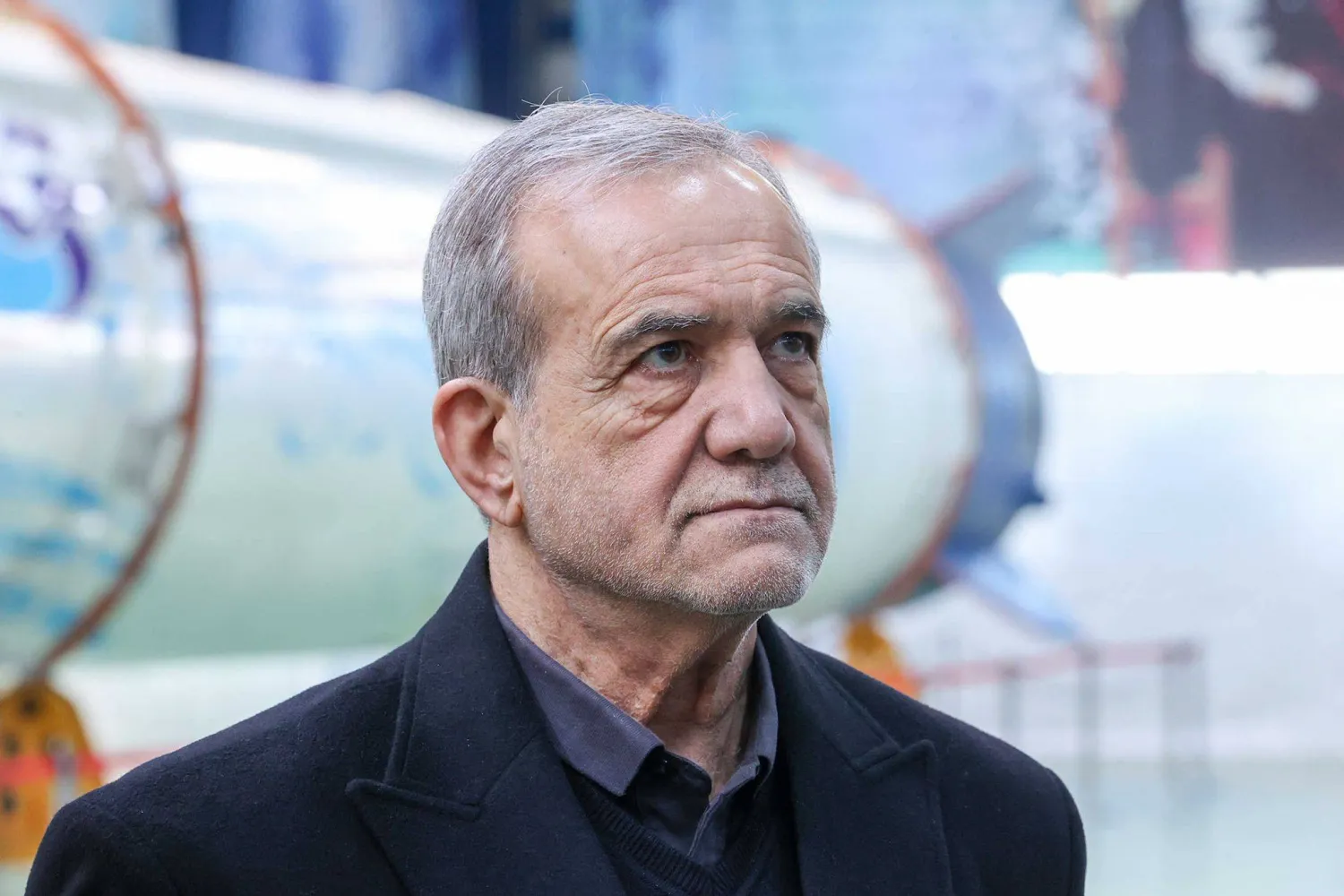
Iranian President Masoud Pezeshkian visits an exhibition that showcases the defense ministry's latest advancements in defense and space in Tehran. Photo: -/Iranian Presidency/dpa
TT

Pezeshkian: Iran is Facing its Most Intense Blockade since 1979

Iranian President Masoud Pezeshkian visits an exhibition that showcases the defense ministry's latest advancements in defense and space in Tehran. Photo: -/Iranian Presidency/dpa

Iranian President Masoud Pezeshkian said Tuesday that the country was facing its most intense blockade since the 1979 Islamic Revolution, accusing the United States of seeking to provoke public protests.

Iran and the United States have been at war since February 28, when US and Israeli strikes killed Iran's supreme leader, Ayatollah Ali Khamenei.

"Over the 48 years since the Revolution, we have never faced such intense blockade, war and difficulties as we are facing now," Pezeshkian said in a speech broadcast by state television.

He accused Washington of seeking to make life difficult for Iranians in order to fuel public anger and trigger unrest.

Pezeshkian said the US was focusing its efforts on making "the people become upset and face difficulties, and then for social protests to emerge so that they can achieve their sinister objectives".

The US imposed a blockade on Iranian ports in response to Tehran's closure of the strategic Strait of Hormuz, diverting or stopping vessels travelling to and from Iranian ports.

Iran has repeatedly accused the US and Israel of fomenting unrest inside the country, and in recent months has executed several Iranians accused of collaborating with its foes.

In late December last year, protests over the cost of living erupted in Iran, spreading nationwide and evolving into a wider anti-government movement.

Iran's rulers blamed the US and Israel for the unrest.