


Incitement Against Palestinians in Israeli Media Increases by 75%

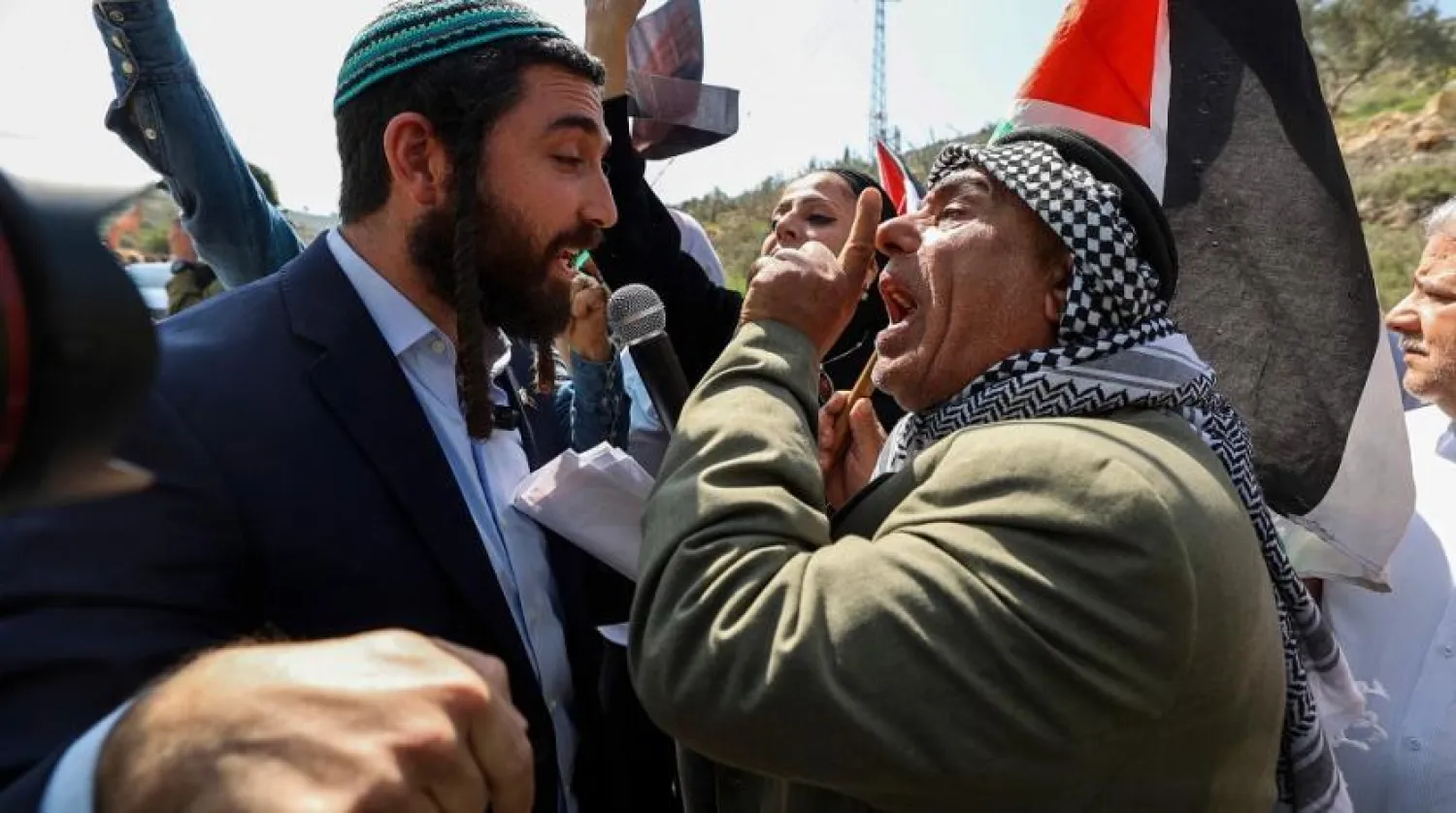
Parliament member for Israel's Religious Zionism party Tzvi Sukkot (L) is confronted as he tries to interrupt a rally by Palestinian and Israeli peace activists protesting at the entrance of Huwara in the occupied West Bank, on March 3, 2023, following deadly violence by Israeli settlers. (AFP)
TT

Incitement Against Palestinians in Israeli Media Increases by 75%

Parliament member for Israel's Religious Zionism party Tzvi Sukkot (L) is confronted as he tries to interrupt a rally by Palestinian and Israeli peace activists protesting at the entrance of Huwara in the occupied West Bank, on March 3, 2023, following deadly violence by Israeli settlers. (AFP)

The Index of Incitement against Palestinians in the Israeli media and social networks increased by 75 percent in the first quarter of 2023 compared to the same period last year and by 67 percent compared to 2021, the Nazareth-based press freedom NGO I'lam Media Center revealed on Thursday.

I’lam said that the increase in incitement is unprecedented and unusual. “It is due to the significant growth of racism following the formation of Benjamin Netanyahu’s government. This is clearly reflected in the Israeli media,” it wrote.

As part of its monitoring project, the media center said it monitored 222 incitement and racism articles and news written in the Israeli media in 2021, compared to 210 articles and news in 2022.

In the same time period this year, the center said it monitored 367 articles and news of incitement and racism against the Palestinian society in general and against the '48 Palestinians' in particular.

The results of the quantitative analysis also revealed that from January 1, 2023 to March 31, 2023, the highest incitement posted were on Twitter (41%), a normal rate as Israeli politicians and journalists use mostly this application.

Also, the data showed that Israel Hayom Newspaper included 12% of incitement articles and news. The pro-Benjamin Netanyahu daily was established by American billionaire Sheldon Adelson and is distributed free of charge and in mass circulation, making it the most widely read newspaper in Israel over the years.

I’lam said in its report that the Makor Rishon newspaper published 11% of the incitement articles and news, the Maariv newspaper 8%, the “Shehret” website 8%, the Channel 7 published 4% while both Hampshire newspaper and Yediot Aharonot newspaper published each 3% of the incitement articles against Palestinians.

The results then showed that the most targeted party in the Israeli media was West Bank Palestinians (24%,) followed by the Jerusalemites (17 %), then Palestinian prisoners (15%) and then West Bank leaders (12%).

Incitement in the Israeli media against international organizations was at 4%, against Israeli left activists 3% and finally incitement against President of the Palestinian Authority, Mahmoud Abbas, was 2%.

The research also analyzed the different types of incitement expressed in the various articles and news reports. Some of them legalize the collective punishment and the use of force against the Palestinians. Others demonize the Palestinians in general, articles delegitimize Palestinians and their authorities using racist discourse, as well as emphasizing Jewish superiority and their role as a victim.

The results show that the method of incitement and racism most frequently used in the Israeli media is demonization of Palestinians (23%), the use of force against the Palestinians (22%), the legalization of collective punishment (20%), the delegitimization of the Palestinians (15%), the Jewish superiority (11%), the victimization of Jews (6%) and finally generalization (4%).



EU Condemns Israel's West Bank Control Measures

The Israeli settlement of Har Homa, seen from the West Bank city of Bethlehem, Tuesday, Dec. 17, 2024. (AP)
TT

EU Condemns Israel's West Bank Control Measures

The Israeli settlement of Har Homa, seen from the West Bank city of Bethlehem, Tuesday, Dec. 17, 2024. (AP)

The European Union on Monday condemned new Israeli measures to tighten control of the West Bank and pave the way for more settlements in the occupied Palestinian territory, AFP reported.

"The European Union condemns recent decisions by Israel's security cabinet to expand Israeli control in the West Bank. This move is another step in the wrong direction," EU spokesman Anouar El Anouni told journalists.


Atrocities in Sudan's El-Fasher Were 'Preventable Human Rights Catastrophe'

Sudanese displaced people who left El Fasher after its fall, sit in the shade in Tawila at the Rwanda camp reception point on December 17, 2025. (Photo by AFP)
TT

Atrocities in Sudan's El-Fasher Were 'Preventable Human Rights Catastrophe'

Sudanese displaced people who left El Fasher after its fall, sit in the shade in Tawila at the Rwanda camp reception point on December 17, 2025. (Photo by AFP)

The atrocities unleashed on El-Fasher in Sudan's Darfur region last October were a "preventable human rights catastrophe", the United Nations said Monday, warning they now risked being repeated in the neighbouring Kordofan region.


"My office sounded the alarm about the risk of mass atrocities in the besieged city of El-Fasher for more than a year ... but our warnings were ignored," UN rights chief Volker Turk told the Human Rights Council in Geneva.


He added that he was now "extremely concerned that these violations and abuses may be repeated in the Kordofan region".


Arab League Condemns Israel's Decisions to Alter Legal, Administrative Status of West Bank

A general view shows the opening session of the meeting of Arab foreign ministers at the Arab League Headquarters (Reuters)
TT

Arab League Condemns Israel's Decisions to Alter Legal, Administrative Status of West Bank

A general view shows the opening session of the meeting of Arab foreign ministers at the Arab League Headquarters (Reuters)

The General Secretariat of the Arab League strongly condemned decisions by Israeli occupation authorities to impose fundamental changes on the legal and administrative status of the occupied Palestinian territories, particularly in the West Bank, describing them as a dangerous escalation and a flagrant violation of international law, international legitimacy resolutions, and signed agreements, SPA reported.

In a statement, the Arab League said the measures include facilitating the confiscation of private Palestinian property and transferring planning and licensing authorities in the city of Hebron and the area surrounding the Ibrahimi Mosque to occupation authorities.

It warned of the serious repercussions of these actions on the rights of the Palestinian people and on Islamic and Christian holy sites.

The statement reaffirmed the Arab League’s firm support for the legitimate rights of the Palestinian people, foremost among them the establishment of their independent state on the June 4, 1967 borders, with East Jerusalem as its capital.