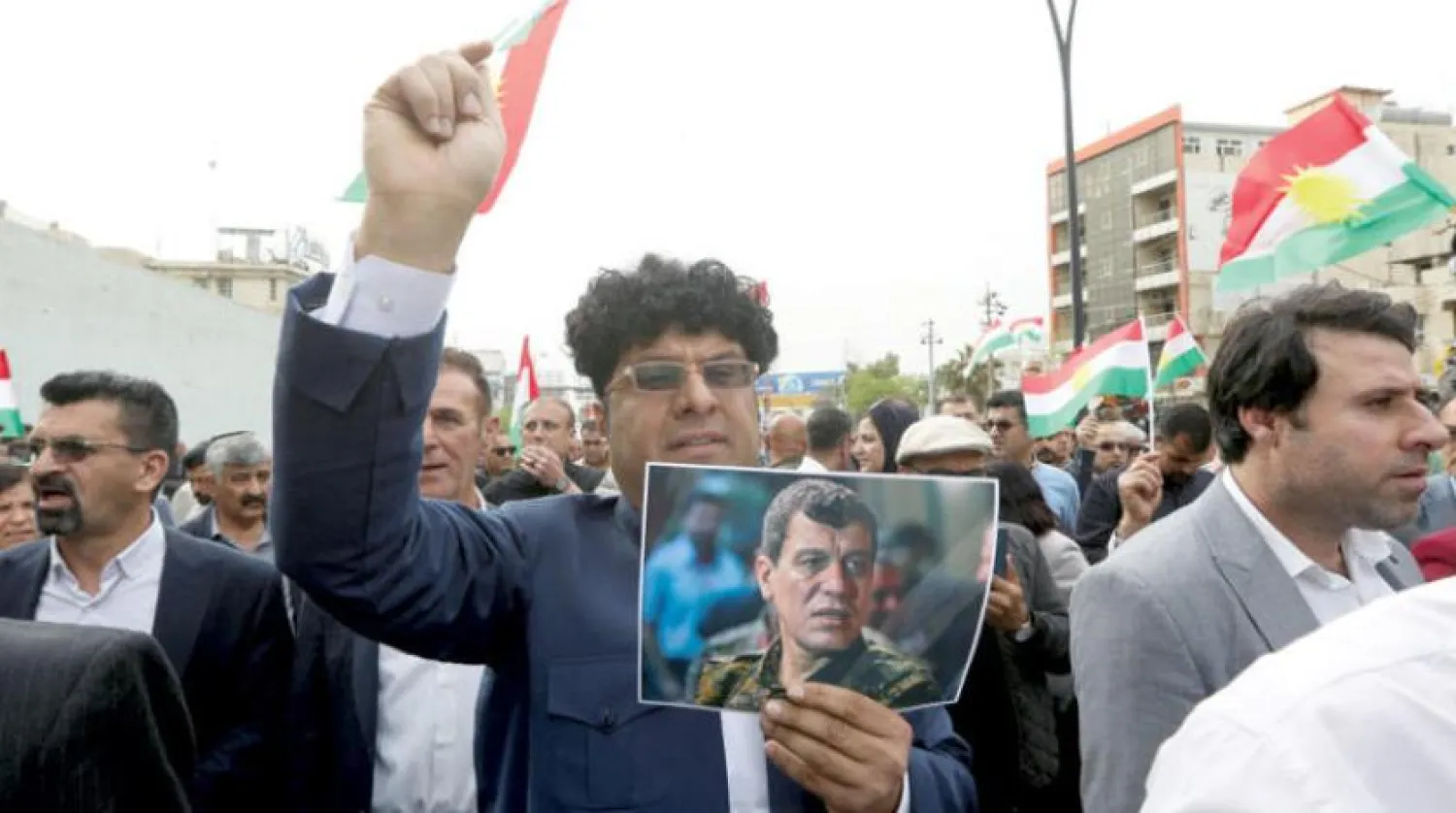
SDF Commander Killed in Turkish Drone Attack

A Kurdish citizen holds a picture of Abdi during a protest after the assassination attempt in Sulaymaniyah on Apr. 9 (Reuters)
TT

SDF Commander Killed in Turkish Drone Attack

A Kurdish citizen holds a picture of Abdi during a protest after the assassination attempt in Sulaymaniyah on Apr. 9 (Reuters)

The Syrian Observatory for Human Rights reported that a commander of the Syrian Democratic Forces (SDF) was killed, and his escort was injured in an attack by a Turkish drone near Nusaybeen crossing on the border with Türkiye in al-Qamishli.

The Observatory pointed out that the attack came a week after SDF Chief Mazloum Abdi survived an assassination attempt by a Turkish drone in the perimeter of al-Suleimaniyah airport in the Kurdistan Region of Iraq.

It noted that this is the first attack since Feb. 22, when a Turkish drone targeted a civil car on the road between al-Qamishli and al-Qahtaniyah.

The attack left a civilian dead, and an Internal Security Forces (Asayish) commander injured.

The Observatory reported 11 drone attacks in the areas controlled by the Autonomous Administration of North and East Syria since the beginning of this year.

The strikes killed five civilians, including a child and a woman, six military personnel, and a car driver, and injured more than five people. The targets focused on al-Hasakah, al-Raqqa, and the countryside of Aleppo.

The US-backed SDF indicated that Abdi and a US forces delegation were at Sulaymaniyah airport in Iraqi Kurdistan after it was targeted last Friday in an attack attributed to Türkiye.

SDF spokesman Farhad Shami told AFP that Abdi was in Sulaymaniyah in the framework of joint work with the counter-terrorism service in Iraqi Kurdistan, to coordinate the ongoing efforts against ISIS.

He confirmed the presence of US forces at the airport during the attack without providing any information about the reason for the visit or whether Abdi accompanied them.

The bombing took place at the airport, according to Shami, while Abdi was leaving Sulaymaniyah after holding several meetings.

Earlier, Abdi condemned the attack, saying the support of the Patriotic Union of Kurdistan (PUK) to "its brothers in Syria annoys Türkiye."

The SDF has a good relationship with the PUK led by Jalal Talabani, who visited Abdi in northeastern Syria at the end of last year.

Ankara classifies the Kurdish People's Defense Units (YPG), the main component of the SDF, as a terrorist organization, saying it is an extension of the Kurdistan Workers' Party (PKK).

For decades, the conflict between Türkiye and the PKK has extended into northern Iraq, where both sides have military outposts or bases.

Ankara carries out air strikes against PKK positions in the Kurdistan region in northern Iraq.

In the past years, the Turkish army has also launched three military operations against Kurdish fighters in Syria, and its drones targeted their areas of control.


After Terrorist Attack, What Do We Know About Hamoud Church and Karak's Christian Community?

St. George Greek Orthodox Church (Official Directory of the Patriarchate’s Churches in Jordan)
TT

After Terrorist Attack, What Do We Know About Hamoud Church and Karak's Christian Community?

St. George Greek Orthodox Church (Official Directory of the Patriarchate’s Churches in Jordan)

A terrorist attack targeting mourners attending a funeral at St. George Greek Orthodox Church in Hamoud village, in southern Jordan's Karak Governorate, has drawn attention to one of the Kingdom's historic Christian communities and renewed interest in the church and its location.

Initial reports indicated that two gunmen got out of a vehicle and opened fire during the funeral, while Jordan's Public Security Directorate announced that it was pursuing the suspects.

Al-Mamlaka television reported Saturday that the death toll from the Karak church attack had risen to eight, while Jordan's Public Security Director said 40 people had been wounded.

The church is commonly referred to in media reports as Hamoud Church, after the village where it is located. Its official name honors St. Georgios, also known as St. George, and it is among the churches affiliated with the Greek Orthodox Patriarchate of Jerusalem in Jordan.

Karak Governorate holds an important place in Jordan's history and is home to Christian communities that have lived alongside the Muslim majority for generations. Churches belonging to different Christian denominations are found throughout the governorate.

The following is an overview of the church, its history and the Christian presence in Karak and Jordan.

Where Is Hamoud Church, and What Is Its Religious Significance?

St. George Greek Orthodox Church is located in Hamoud village in Karak Governorate, approximately 118 kilometers south of the capital, Amman.

According to the official directory of churches affiliated with the Greek Orthodox Patriarchate of Jerusalem, it is one of the patriarchate's churches in Jordan.

The church is named after St. Georgios, also known as St. George, who holds a prominent place in Eastern Christian tradition.

The church forms part of the Orthodox Christian presence in Karak Governorate, which is also home to churches belonging to other Christian denominations.

The Latin Patriarchate of Jerusalem notes that the governorate has Latin Catholic, Greek Catholic and Greek Orthodox communities, reflecting a Christian presence with deep historical roots.

Karak: A Long History of Christianity and Religious Coexistence

Karak Governorate is one of Jordan's regions with a historic Christian presence, dating back to the Byzantine era, when the area served as an episcopal center with several churches, according to a historical report published by the Latin Patriarchate of Jerusalem.

This Christian presence is not limited to Karak city, the governorate's administrative and historical center, but extends to several villages and towns, including Hamoud, Smakieh, Adir, Rabba and Qasr.

The governorate is home to Greek Orthodox, Latin Catholic and Greek Catholic churches, alongside mosques and other Islamic places of worship.

Over the years, the role of churches in Karak has extended beyond religious services to helping establish schools and health centers serving both Christians and Muslims, making them an integral part of the region's social and educational life.

What Is Karak's Population, and Where Are Its Christian Communities Concentrated?

Karak Governorate has a population of approximately 375,000, while estimates by Jordan's Department of Statistics put the figure at 395,400 at the end of 2025.

Historically, Karak has been home to several Christian families and clans, including the Hijazeen, Halasa and Akasheh, according to the Latin Patriarchate of Jerusalem's historical report.

The report notes that these families have formed part of the city's social fabric alongside Muslim clans.

Some Christian families are concentrated in particular neighborhoods, including the area known as the Christian Quarter in central Karak, where Christian and Muslim families have lived alongside one another for generations.

The governorate is characterized by a strong tribal identity and religious diversity.

Its social and religious diversity is reflected in the presence of Christian institutions and churches alongside mosques and other Islamic places of worship.

The World Council of Churches highlights the historical ties between Christians and Muslims in Jordan, emphasizing the importance of preserving places of worship and protecting freedom of religious practice.

Christians in Jordan: What Percentage of the Population Do They Represent, and Which Denominations Do They Belong To?

Christians constitute a religious minority in Jordan, accounting for an estimated 2 to 3 percent of the population, according to Jordan's Ministry of Tourism and Antiquities.

The Kingdom's Christians belong to several denominations, including Greek Orthodox, Catholic, Armenian Orthodox and Protestant communities, with churches located in different parts of the country.

Has Karak Experienced Similar Attacks Before?

Karak Governorate experienced a deadly terrorist attack in December 2016, claimed by ISIS, that targeted civilians and security forces.

The attack killed 10 people, including seven security personnel and a Canadian tourist, and wounded 34 others.

Four ISIS militants were also killed after barricading themselves inside the historic Karak Castle.

Reuters described the latest attack as a rare assault targeting Jordan's Christian minority.


US Embassy Says Security Ramped up in Jordan after Deadly Church Attack

Security personnel stand outside Saint George’s Greek Orthodox Church, where gunmen opened fire during a funeral the previous day, in the village of Hamoud, Karak, Jordan, October 24, 2026. REUTERS/Alaa Al Sukhni
TT

US Embassy Says Security Ramped up in Jordan after Deadly Church Attack

Security personnel stand outside Saint George’s Greek Orthodox Church, where gunmen opened fire during a funeral the previous day, in the village of Hamoud, Karak, Jordan, October 24, 2026. REUTERS/Alaa Al Sukhni

The US embassy in Amman said security had been stepped up at malls, foreign embassies and other locations across Jordan after Friday's attack on a church in Jordan that authorities described as a terrorist act by extremists.

Seven people were killed and dozens were injured when gunmen opened fire during a funeral at a Greek Orthodox church in Karak governorate, the head of Jordan's Public Security Directorate said.

There was no immediate claim of responsibility.

Such attacks are extremely rare in Jordan, though authorities in the US ally say that in recent years they have repeatedly foiled attempted attacks by extremist militants.

Authorities said they are still searching for the attackers, adding it was too early to determine whether they had links to known groups inside or outside Jordan.

"This is a result of a terrorist ideology and blind extremism and we will not allow society to go down this path," Prime Minister Jafar Hassan said in a post on X hours after the violence.

Jordan's King Abdullah visited Karak hours after the attack and said the perpetrators would be punished "with an iron fist".

Christians make up a minority of Jordan's population. The country is home to several biblical sites that attract Christian pilgrims from around the world.


Netanyahu Says Palestinian Authority in for 'Big Surprise'

Israeli troops patrol in the West Bank city of Nablus, 24 October 2026. EPA/ALAA BADARNEH
TT

Netanyahu Says Palestinian Authority in for 'Big Surprise'

Israeli troops patrol in the West Bank city of Nablus, 24 October 2026. EPA/ALAA BADARNEH

Israeli Prime Minister Benjamin Netanyahu said that the Palestinian Authority (PA) was in for a "big surprise" after he ordered a major military operation in response to an attack on soldiers in the West Bank.

Netanyahu, days ahead of elections, declined to answer directly when he was asked if he would dismantle the Palestinian Authority but said he favored "ruse and surprise.”

"We transformed the Middle East. I said that we would change things and we have," Netanyahu told i24News in an interview conducted late Friday.

"There is a very big surprise for the Palestinian Authority as well."

Netanyahu on Friday promised a massive military response after Palestinian militants killed two Israeli soldiers near Hebron in the occupied West Bank.

One of his far-right allies called after the attack for Israel to bring down the Palestinian Authority, the semi-autonomous body that governs parts of the West Bank in cooperation with Israel as part of peace accords in the 1990s.

No evidence suggests that the PA was connected to Friday's attack.