

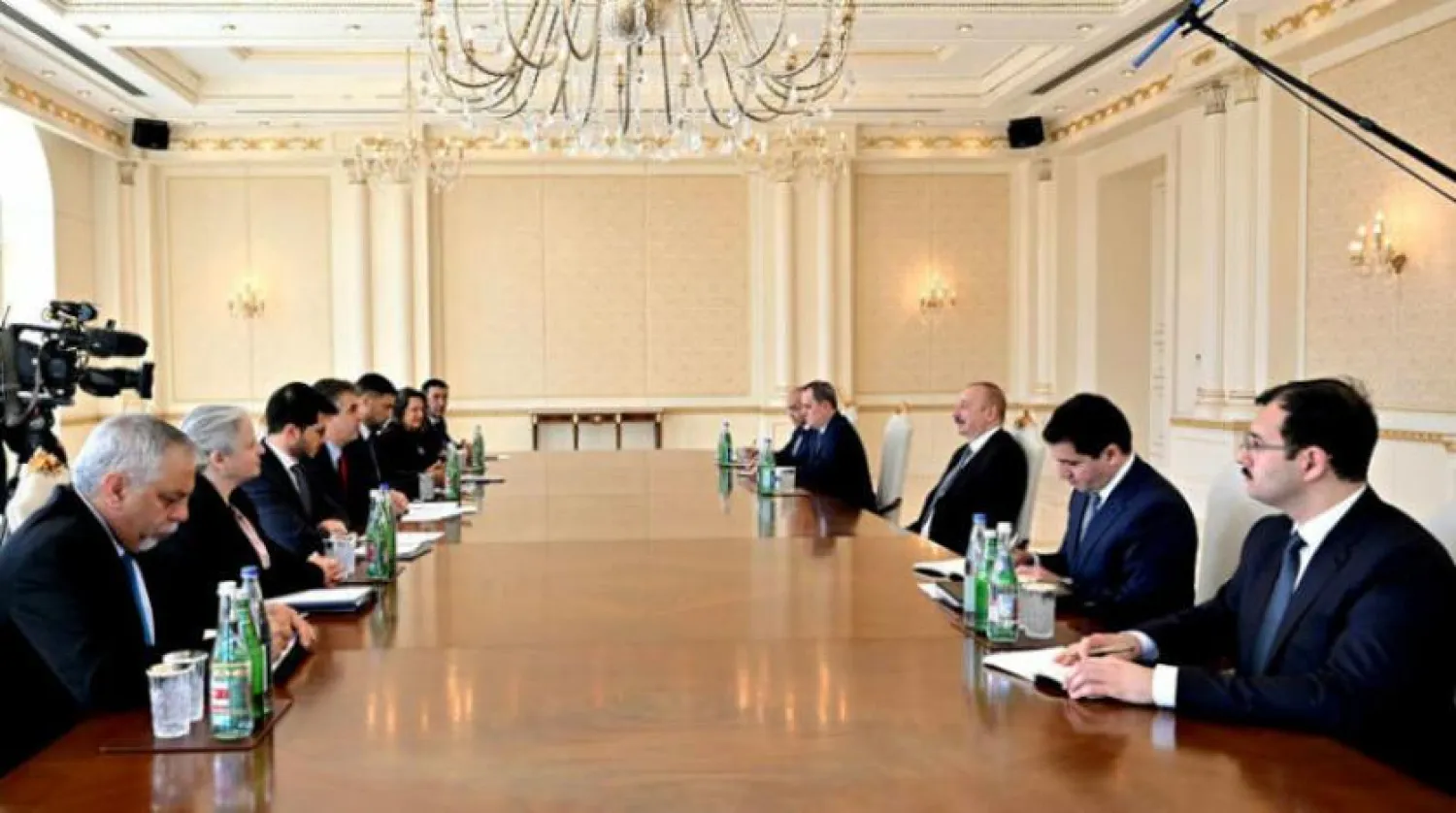

Cohen Meets Aliyev in Baku amid Tension with Tehran

 Photo released by the Azerbaijani presidency of the meeting between Aliyev and Cohen in Baku on Wednesday.
Photo released by the Azerbaijani presidency of the meeting between Aliyev and Cohen in Baku on Wednesday.
TT

Cohen Meets Aliyev in Baku amid Tension with Tehran

 Photo released by the Azerbaijani presidency of the meeting between Aliyev and Cohen in Baku on Wednesday.
Photo released by the Azerbaijani presidency of the meeting between Aliyev and Cohen in Baku on Wednesday.

Israeli Foreign Minister Eli Cohen held consultations in Baku with senior Azerbaijani officials, before heading to Ashgabat, the capital of Turkmenistan, to inaugurate his country’s embassy there, in a move that would anger Tehran.

Cohen met on Wednesday with Azerbaijani President Ilham Aliyev at the presidential palace, a month after the opening of the country’s embassy in Tel Aviv.

Aliyev expressed his satisfaction with the course of relations between the two countries, and said: “The opening of the Azerbaijani embassy in Israel is an indication of the high level of our relations.”

“The ties between our two countries are based on friendship, mutual trust, respect and support,” the Azeri Trend News Agency reported.

Israeli iNews 24 stated that Aliyev and Cohen discussed common strategic challenges and the means to combat hostile operations and expand bilateral cooperation.

“Israel and Azerbaijan are strengthening their political and security alliance,” Cohen said, adding: “We talked about our common strategic regional challenges, on top of which are regional security and the fight against terrorism.”

The Israeli foreign minister is accompanied by a delegation of 30 officials in the fields of economy, homeland security, cyber security and water. On Wednesday, he headed to the Turkmen capital to open his country’s embassy - the closest Israeli diplomatic headquarters to the borders of Iran.

Ashgabat is 25 km from the Turkmen-Iranian borders, which stretch along one thousand kilometers. Cohen is the first Israeli minister to visit Ashgabat over the past 30 years.

Relations between Baku and Tehran deteriorated last month, after the opening of the Azeri embassy in Israel. Baku expelled four Iranian diplomats in March for “provocative actions”. For its part, Tehran severely criticized Baku for its rapprochement with Israel, and said that it sees this relationship as “anti-Iranian”.

Last week, the Iranian foreign minister made two contacts with his Azeri counterpart, Jeyhun Bayramov, in an attempt to defuse the crisis between the two countries.

“In these frank and transparent talks… current problems, misunderstandings and their solutions were discussed,” the Iranian Foreign Ministry said in a statement.

It added that the two parties “stressed the importance of good neighborliness and mutual respect for each other’s sovereignty and territorial integrity.”



China Sanctions Officials in Paraguay and Belize over Their Countries' Ties with Taiwan

A Taiwanese flag is seen in Keelung on October 12, 2026. (Photo by I-Hwa Cheng / AFP)
TT

China Sanctions Officials in Paraguay and Belize over Their Countries' Ties with Taiwan

A Taiwanese flag is seen in Keelung on October 12, 2026. (Photo by I-Hwa Cheng / AFP)

China sanctioned Paraguay’s communications minister and Belize’s foreign minister on Monday over ties with Taiwan, the island democracy Beijing claims as its own.

The sanctions against Gustavo Villate of Paraguay and Francis Fonseca of Belize serve to safeguard China’s “national sovereignty, security, and development interests, and to oppose separatist acts seeking ‘Taiwan independence,’” the Chinese Foreign Ministry said on its website.

“Certain politicians in Paraguay and Belize have willingly served as pawns of the Taiwan authorities in their attempts to seek Taiwan independence by soliciting external forces,” said Foreign Ministry spokesperson Mao Ning.

She added that the foreign officials had visited Taiwan and received visits by “Taiwan independence separatists,” as well as “spread disinformation about Chinese cyberattacks to smear and attack China, creating a seriously negative international impact.”

Paraguay and Belize are among the last 12 remaining diplomatic allies of Taiwan, an island democracy China sees as its own territory, to be annexed by force if necessary.

In recent years, Beijing has increased its military pressure on the island, sending warplanes and military ships near it almost daily. It has also ramped up a campaign of winning over its diplomatic partners. Countries including Nauru, Honduras and Nicaragua have switched allegiances from Taiwan to Beijing in recent years.

Taipei’s remaining diplomatic allies are mostly smaller countries in Central America, the Caribbean and South Pacific, along with Eswatini in southern Africa and Vatican City.

The sanctions against Villate and Fonseca are mostly symbolic, as officials from countries that have ties with Taiwan do not generally travel to China. The curbs include freezing any assets the officials might have in China; denial of visas and entry into China; prohibiting any Chinese individuals and organizations from cooperating with them.

The governments of Belize and Paraguay did not immediately react to the sanctions.

In July, Paraguay and the US Embassy in its capital, Asunción, said cybersecurity attacks linked to the Chinese government had compromised Paraguay's state systems. China vehemently denied the accusations.

The US State Department condemned China's sanctions on Tuesday.

“The Trump Administration opposes coercion and aggression by China against countries in our hemisphere for exercising their sovereign rights,” department spokesperson Tommy Pigott said.

Taiwanese Premier Cho Jung-tai on Tuesday told reporters that the island democracy is a sovereign country and that China has no right to interfere in its internal affairs or influence its foreign relations.

He said Taiwan would continue working with its allies and other democracies to uphold freedom and democracy, maintain regional peace and security, and resist “any expansion of hegemonic or authoritarian forces.”

China and Taiwan have been governed separately since 1949, when a civil war brought the Communist Party to power in Beijing. Defeated Nationalist Party forces fled to Taiwan. The island has operated with its own government since then.

Taiwan’s Deputy Foreign Minister Chen Ming-chi also criticized China’s moves, noting that Taiwan’s international visibility is growing.

“Are they going to sanction the entire world?” he said.


France Braces for Fresh Nationwide Student Demonstrations

TOPSHOT - Protesters hold placards as they march during a demonstration of high-school students in Montpellier, southern France, on October 8, 2026, as part of a nationwide protest movement over learning conditions.  (Photo by Gabriel BOUYS / AFP)
TOPSHOT - Protesters hold placards as they march during a demonstration of high-school students in Montpellier, southern France, on October 8, 2026, as part of a nationwide protest movement over learning conditions. (Photo by Gabriel BOUYS / AFP)
TT

France Braces for Fresh Nationwide Student Demonstrations

TOPSHOT - Protesters hold placards as they march during a demonstration of high-school students in Montpellier, southern France, on October 8, 2026, as part of a nationwide protest movement over learning conditions.  (Photo by Gabriel BOUYS / AFP)
TOPSHOT - Protesters hold placards as they march during a demonstration of high-school students in Montpellier, southern France, on October 8, 2026, as part of a nationwide protest movement over learning conditions. (Photo by Gabriel BOUYS / AFP)

France readied on Tuesday for fresh nationwide demonstrations supporting students who have been protesting poor classroom conditions for weeks, with authorities and participants wary of further violence.

The mobilization, backed by unions and the far-left opposition France Unbowed party, was to include a march through Paris starting at 1200 GMT, along with marches in other cities, said AFP.

It follows demonstrations on Thursday that saw more than 70,000 people take to the streets across France, with about 500 people arrested.

French authorities had been hoping that the student protest movement that started in late September was starting to ease, ahead of half-term holidays. The protests have seen students pile up dumpsters and other obstacles to block access to high schools, with clashes occasionally breaking out with police.

On Monday, only 130 of France's 3,700 lycees were closed, according to the education ministry, though it stated that, while "the number of school closures is falling... the violence is intensifying".

In an incident seemingly unrelated to the protests, police arrested a 14-year-old on Monday near Marseille after a middle school headmaster and a teacher were shot with a hunting rifle, wounding both.

The education ministry said eight members of teaching staff were injured on Monday, mostly in the Paris region and cities of Bordeaux and Lyon, in relation to the protests. Its tally did not include the shooting, which police were treating as a separate case.

- 'Aren't being heard' -

While most of the protests have been peaceful, students say they are determined to press the government to address the problems of too many absent teachers, dilapidated buildings, overcrowded class schedules and other grievances.

"Students aren't being heard enough... not their proposals to authorities and elected officials," a 19-year-old graphic design student in Paris, Leo, said.

He added that the protesters -- many of whom were minors -- were "disturbed by the level of repression never before seen for a student movement".

One young protester lost a hand from a police stun grenade earlier in the protests, another lost many of his teeth from a tear-gas canister fired in his face at close range, and another lost an eye.

Rights groups and students have accused the police of a disproportionate use of force.

Several police officers and teachers have also been hurt, and on Monday authorities said fireworks fired through a tube injured two school workers in Reims, one school worker in a Paris suburb and a police officer outside a school in Marseille.

Tuesday's demonstrations supporting the students were to be followed on Saturday by wider public rallies against the rising cost of living.

Naila, a 17-year-old student in the city of Rennes who said she would participate in Tuesday's demonstration, hoped it would "converge" with the wider one on Saturday.

President Emmanuel Macron, speaking to reporters on Monday, said the pupils' grievances would take time to address and urged restraint from protesters.

"These are issues that deserve time, consultations, discussion and respect," Macron said.

- Worries about lost lessons -

More than 6,800 people -- largely minors -- have been taken into police custody over the course of the protests, according to the justice ministry.

Police have opened internal investigations into 24 allegations of brutality against demonstrators.

After last week's nationwide demonstrations, the government promised some 3,000 substitute teachers would be deployed in the coming days to replace absent staff at the 114 worst-affected high schools.

A government spokeswoman on Monday said they had started to be assigned.

But the national students' union has dismissed the government's move as "crumbs" and was demanding a 10 billion-euro ($11 billion) boost for lycees.

Some parents and students, however, voiced concerns about all the classes being missed because of the protests. A few worried that the children were being used as pawns by opposition political parties.

Some parents pleaded for the teens to lift their blockades at Paris schools.

"The blockades are by their very nature undemocratic," complained one mother, who went by the pseudonym Gladys.

"It's shameful to block students who really want to study, by a movement they aren't part of," said Clara Juillet, a university student in the city of Tours who has been unable to attend lessons for a week because of the protests.


Report: AI and Nuclear War Threaten Human Extinction by 2100

FILE PHOTO: "AI Artificial Intelligence" words, a keyboard and a robotics hand in this illustration taken, September 23, 2026. REUTERS/Dado Ruvic/Illustration/File Photo
TT

Report: AI and Nuclear War Threaten Human Extinction by 2100

FILE PHOTO: "AI Artificial Intelligence" words, a keyboard and a robotics hand in this illustration taken, September 23, 2026. REUTERS/Dado Ruvic/Illustration/File Photo

Malicious use of AI and nuclear conflict pose the biggest threat to human extinction by the year 2100, global experts have warned.

Co-chaired by Dr Christopher JL Murray, director of the Institute for Health Metrics and Evaluation (IHME) at the University of Washington, and Dr. Natalia Kanem, former executive director of the United Nations Population Fund, the risk assessment was compiled drawing on the expertise of 35 leaders spanning health, economics, security, governance and technology, according to Sky News.

Authors of The Lancet Commission on 21st Century Global Threats to Health examined hundreds of possible dangers, drawing on historical evidence and new risk analysis covering 204 countries and territories from the IHME to draw the list of worst-case scenarios.

In addition to the two extinction-potential threats - 15 catastrophic dangers to human health are also identified, including air pollution, climate change, high alcohol use, naturally occurring pandemics, obesity, smoking and poor mental health.

Researchers warned world leaders the greatest threats to human survival and health required co-ordinated, targeted action - and must be addressed together.

Decisions across health, finance, climate, defense and security sectors will determine how many years of good health future generations gain - or lose - to preventable illness and early death, they said, adding there was “a realistic route to act.”

Commission co-chair Professor Murray said: “The striking finding is not only the scale of these threats, but that humanity still has the agency to act.”

“Across all 17 catastrophic threats, the decisions made by leaders today will shape the health and wellbeing of the next generation. But delaying action will only serve to shift and increase the costs into the future.”

For her part, Kanem said: “Recent global events show us just how quickly stability can give way to crisis, and how costly it is to respond only after disaster strikes. And the global threats to health risk amplifying existing inequalities, with the greatest burden falling on the most vulnerable communities.”

“the future is not inevitable. The commission makes a compelling case for reshaping the future by embedding foresight into decision-making. Governments and communities must act decisively starting today, to protect health and build a fairer, more peaceful and more secure future for the coming generations,” Kanem added.