


Special Forces Rescue US Embassy Staffers in Warring Sudan

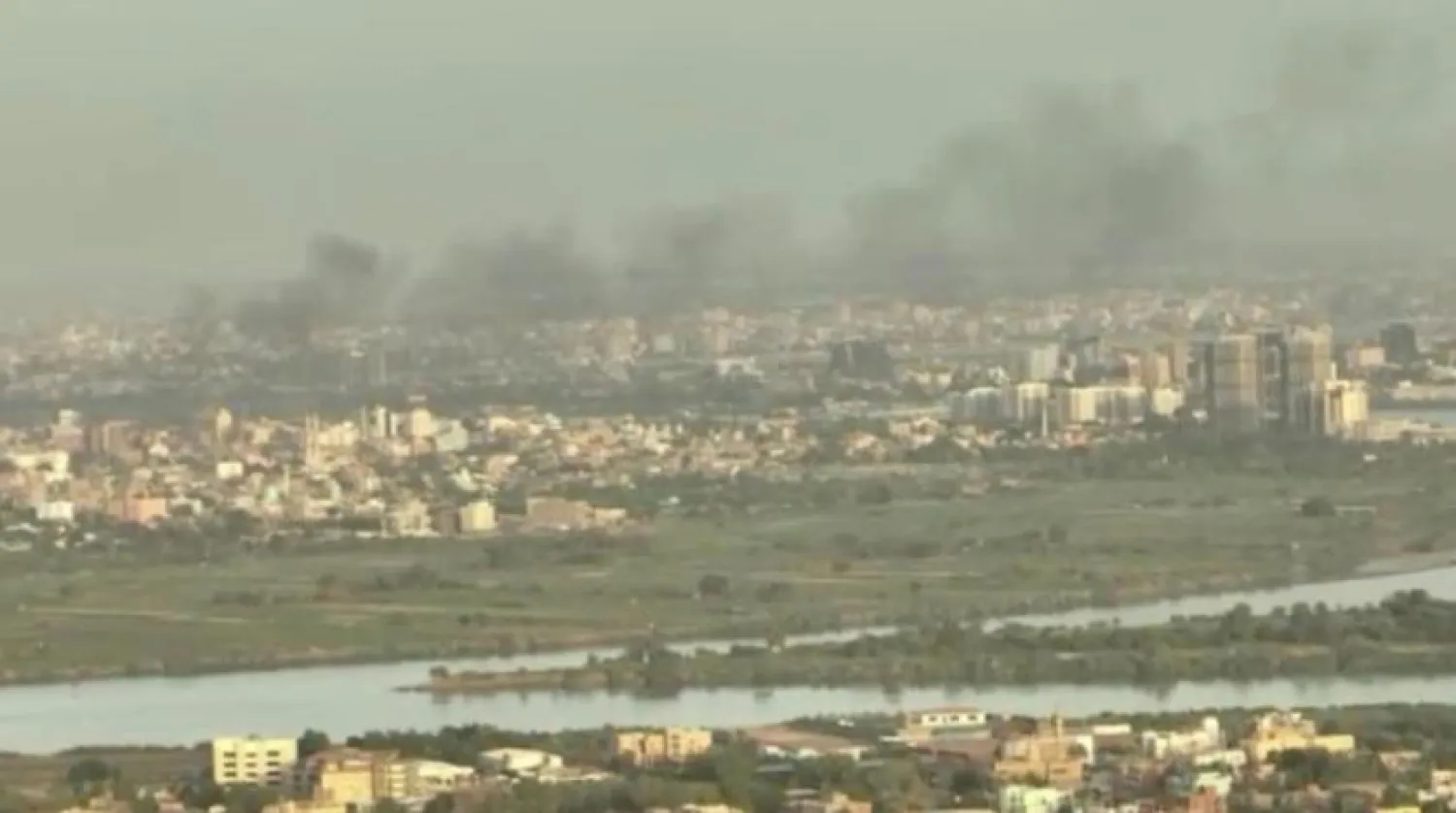
A drone view shows smoke rising over buildings a week after fighting began in North Khartoum, as seen from Omdurman, Sudan, April 22, 2023, in this still image taken from video obtained by Reuters. Reuters TV via REUTERS
TT

Special Forces Rescue US Embassy Staffers in Warring Sudan

A drone view shows smoke rising over buildings a week after fighting began in North Khartoum, as seen from Omdurman, Sudan, April 22, 2023, in this still image taken from video obtained by Reuters. Reuters TV via REUTERS

US special operations forces carried out a precarious evacuation of the American embassy violence-torn Sudan, US officials said late Saturday, sweeping in and out of the capital, Khartoum, with helicopters on the ground for less than an hour. No shots were fired and no major casualties were reported.

With the last US employee of the embassy out, Washington shuttered the US mission in Khartoum indefinitely. Left behind are thousands of Americans remaining in Sudan, with officials saying it would be too dangerous to carry out a broader evacuation mission, The Associated Press said.

In a statement thanking the troops, President Joe Biden said he was receiving regular reports from his team on efforts to assist those remaining Americans in Sudan “to the extent possible.”

He also called for the end to “unconscionable” violence there as two rival commanders battled for power in the African country.

About 100 US troops in three MH-47 helicopters carried out the operation as fighting between two armed Sudanese commanders —which has killed more than 400, put the nation at risk of collapse and could have consequences far beyond its borders—moved into a second week.

Biden said he was receiving regular reports from his team on efforts to assist those remaining Americans in Sudan “to the extent possible.”

The roughly 70 American staffers were airlifted from a landing zone at the embassy to an undisclosed location in Ethiopia, according to two US officials familiar with the mission.

“I am proud of the extraordinary commitment of our Embassy staff, who performed their duties with courage and professionalism and embodied America’s friendship and connection with the people of Sudan,” Biden said in a statement. “I am grateful for the unmatched skill of our service members who successfully brought them to safety.”

Biden also thanked Djibouti, Ethiopia, and Saudi Arabia for their help with the mission.
Biden ordered American troops to evacuate embassy personnel after receiving a recommendation earlier Saturday from his national security team with no end in sight to the fighting.

“This tragic violence in Sudan has already cost the lives of hundreds of innocent civilians. It’s unconscionable and it must stop,” Biden said. “The belligerent parties must implement an immediate and unconditional ceasefire, allow unhindered humanitarian access, and respect the will of the people of Sudan.”

The State Department has suspended operations at the embassy due to the dire security situation. It was not clear when the embassy might resume functioning.

The fighting erupted April 15 between two factions whose leaders are vying for control over the country. The violence has included an unprovoked attack on an American diplomatic convoy and numerous incidents in which foreign diplomats and aid workers were killed, injured or assaulted.

An estimated 16,000 private US citizens are registered with the embassy as being in Sudan. The figure is rough because not all Americans register with the embassy or say when they depart.

Biden said he was receiving regular reports from his team on efforts to assist those remaining Americans in Sudan “to the extent possible.”

The embassy issued an alert earlier Saturday cautioning that “due to the uncertain security situation in Khartoum and closure of the airport, it is not currently safe to undertake a US government-coordinated evacuation of private US citizens.”

Fighting in Sudan between forces loyal to two top generals has put that nation at risk of collapse and could have consequences far beyond its borders.

The fighting, which began as Sudan attempted to transition to democracy, already has left millions trapped in urban areas, sheltering from gunfire, explosions and looters.

Army chief Gen. Abdel Fattah Burhan said Saturday he would facilitate the evacuation of American, British, Chinese and French citizens and diplomats from Sudan after speaking with the leaders of several countries that had requested help. The rival Rapid Support Forces, or RSF, in a Twitter posting said it cooperated with US forces.

The US evacuation planning got underway in earnest on Monday after the embassy convoy was attacked in Khartoum. The Pentagon confirmed on Friday that US troops were being moved to Camp Lemonnier in Djibouti ahead of a possible evacuation.

Saudi Arabia announced the successful repatriation of some of its citizens on Saturday, sharing footage of Saudi nationals and other foreigners welcomed with chocolate and flowers as they stepped off an apparent evacuation ship at the Saudi port of Jeddah.

Embassy evacuations conducted by the US military are relatively rare and usually take place only under extreme conditions.

When it orders an embassy to draw down staff or suspend operations, the State Department prefers to have its personnel leave on commercial transportation if that is an option. When the embassy in Kyiv temporarily closed just before Russia’s invasion of Ukraine in February, 2022, staffers used commercial transport to leave.

However, in several other recent cases, notably in Afghanistan in 2021, conditions made commercial departures impossible or extremely hazardous. US troops accompanied personnel from the US Embassy in Tripoli, Libya, in an overland convoy to Tunisia when they evacuated in 2014.




Yemen's PLC Imposes No Fly-Zone, Sea and Ground Blockade on All Ports and Crossings

Chairman of Yemen's Presidential Leadership Council Dr. Rashad al-Alimi. (Saba)
TT

Yemen's PLC Imposes No Fly-Zone, Sea and Ground Blockade on All Ports and Crossings

Chairman of Yemen's Presidential Leadership Council Dr. Rashad al-Alimi. (Saba)

Chairman of Yemen's Presidential Leadership Council Dr. Rashad al-Alimi declared on Tuesday a state of emergency throughout the country in wake of the "internal strife caused by the military rebellion in eastern provinces aimed at dividing the republic."

He called for all military formations and forces in the Hadhramaut and Al-Mahra governorates to coordinate completely with the Coalition to Restore Legitimacy in Yemen, represented by Saudi Arabia, and to immediately return to their original positions without a fight. They should cede their positions in the two governorates to the National Shield forces.

Al-Alimi said the state of emergency will last 90 days, which can be extended. He also imposed a no fly-zone, sea and ground blockade on all ports and crossings for 72 hours.

The move also stems from "the commitment to the unity of Yemen, its sovereignty, independence, and territorial integrity and the need to confront the Houthi coup that has been ongoing since 2014," he stressed.

Moreover, al-Alimi called on "all United Arab Emirates forces to leave the country within 24 hours."

"We will firmly deal with any rebellion against state institutions," he warned.

He called on the Southern Transitional Council to "return to reason and quickly and unconditionally withdraw its forces from Hadhramaut and Al-Mahra."

Al-Alimi announced the state of emergency shortly after the Saudi-led Arab coalition carried out a "limited" airstrike targeting a military shipment that had arrived in Yemen's Al-Mukalla port.

In a statement, coalition spokesman Major General Turki al-Malki said the forces detected on Saturday and Sunday the arrival of two vessels from the Port of Fujairah to Mukalla without obtaining any permits from the Joint Forces Command.

Saudi Arabia expressed on Tuesday its disappointment in the United Arab Emirates for pressuring the STC to carry out military operations on the Kingdom's southern borders in Hadhramaut and Al-Mahra.

A Saudi Foreign Ministry statement said: "The steps taken by the UAE are considered highly dangerous, inconsistent with the principles upon which the Coalition to Restore Legitimacy in Yemen was established, and do not serve the coalition's purpose of achieving security and stability for Yemen."

"The Kingdom stresses that any threat to its national security is a red line, and the Kingdom will not hesitate to take all necessary steps and measures to confront and neutralize any such threat," it declared.


STC Accused of Committing Hundreds of Violations in Yemen's Hadhramaut 

A person waves a South Yemen flag during a rally in the southern port city of Aden, Yemen, 25 December 2025. (EPA)
TT

STC Accused of Committing Hundreds of Violations in Yemen's Hadhramaut 

A person waves a South Yemen flag during a rally in the southern port city of Aden, Yemen, 25 December 2025. (EPA)

Yemeni Defense Minister Mohsen Mohammed al-Daeri welcomed on Monday Saudi Defense Minister Prince Khalid bin Salman's message to the Yemeni people in which he called on the Southern Transitional Council (STC) to withdraw its forced from the Hadhramaut and al-Mahra governorates.

He said the message underscores "Saudi Arabia's firm support to Yemen and its legitimate authorities and its constant keenness on backing its unity."

The Kingdom has backed Yemen's efforts to restore state institutions, liberate all of its territories and achieve the goals of the Arab coalition and therefore bolster security and stability in Yemen and the region, he added in a post on Facebook.

He expressed his "absolute trust in the Saudi leadership and its ability to overcome and resolve any differences to help guide both northern and southern Yemen to safety."

He hailed the "Saudi sacrifices and its continuous generous support" to Yemen in all fields, voicing his pride "in this strategic partnership that will remain a cornerstone to completing the liberation and building a secure and prosperous future."

Hundreds of violations

Separately, as the STC continues its unilateral military escalation, reports have emerged of hundreds of violations it has committed in Hadhramaut.

The Yemeni Network for Rights and Freedoms (YNRF) documented 614 violations in the governorate between December 2 and 25. It spoke of a "systematic" targeting of civilians and social infrastructure that has displaced some 5,000 families.

In a report on Monday, it said that the "extent of the violations reflects a systematic pattern of practices that cannot be described as incidental. Rather, they are part of a methodical policy that threatens social peace and undermines the rule of law in one of Yemen's most relatively stable governorates."

The violations include murder, extrajudicial killings, arbitrary arrests, forced disappearances and displacement, and looting of private and public property. It documented the killing of 35 members of the army and 12 civilians, and the injury of 56 others, in Hadhramaut.

It documented seven cases of extrajudicial killings of prisoners and 316 cases of arbitrary arrest against civilians. It reported 216 cases of forced disappearances in Hadhramaut, Raymah, Hajjah, Taiz, Dhumar, Abyan, Ibb and other provinces.

The network noted the looting of 112 homes and 56 commercial establishments.

It said that it has received dozens of notices about the detention and forced disappearance of civilians. It revealed that hundreds of military personnel have been reported missing in grave violation of national law and international standards.

The network said the STC violations are a flagrant violation of international humanitarian law and commitments that have been made in Yemen. Some of the violations can also amount to war crimes and crimes against humanity.

It warned of the "catastrophic" humanitarian consequences of the violations, such as the breakup of the social fabric, greater internal displacement, and collapse of the local economy.

It demanded clear international condemnation of the violations in Hadhramaut, urging an immediate and unconditional end to them. It called for the immediate release of all arbitrarily held detainees and that looted property be returned to their owners. It also demanded that those responsible be held to account.

The developments in Hadhramaut "were not an isolated incident, but part of a systematic pattern that undermines the opportunities for stability and peace in Yemen," it warned.


Syria Reveals New Post-Assad Banknotes

Syria's President Ahmed al-Sharaa (L) and Syria's Central bank chief Abdul Qadir al-Hasriya (R) hold one of the country's new revamped currency notes at the Conference Palace in the Syrian capital Damascus on December 29, 2025. (AFP)
TT

Syria Reveals New Post-Assad Banknotes

Syria's President Ahmed al-Sharaa (L) and Syria's Central bank chief Abdul Qadir al-Hasriya (R) hold one of the country's new revamped currency notes at the Conference Palace in the Syrian capital Damascus on December 29, 2025. (AFP)

Syrian leader Ahmed al-Sharaa unveiled on Monday new banknotes replacing those showing ousted ruler Bashar al-Assad and his family, hoping the Syrian pound can regain some of the value lost to over a decade of war.

Improving the standing of the Syrian pound is among the greatest challenges for Syria's new authorities, who will remove two zeros, in a process known as redenomination.

The new bills, which range from 10 to 500 Syrian pounds, will enter circulation on January 1. They show images of roses, wheat, olives, oranges and other agricultural symbols for which Syria is famous.

After unveiling the banknotes, Sharaa said the new currency marks "the end of a previous, unlamented phase and the beginning of a new phase that the Syrian people... aspire to".

"The new currency design is an expression of the new national identity and a move away from the veneration of individuals."

Since the start of Syria's civil war in 2011, the pound has plunged from 50 to around 11,000 against the greenback, and Syrians are forced to carry huge wads of banknotes even for basic needs like grocery shopping.

The removal of the zeros, which does not impact the currency's value, was done to make transactions easier and restore trust in the Syrian pound.

"If someone wants to buy something simple, they need to carry bags in order to trade, so people go for dollars," Sharaa said, adding that the currency revamp will boost "the national currency within the country and strengthen trust".

"Syria deserves a strong economy and a stable currency."

Syria's old banknotes were printed in Russia, Assad's former backer.

When asked by journalists, Syrian central bank chief Abdul Qadir al-Hasriya did not specify where the new currency will be printed.