Foreign Tourism to Portugal Has Best First Quarter Ever

A man walks in Tamariz beach as temperatures rise in Estoril, Portugal, April 27, 2023. (Reuters)
TT

Foreign Tourism to Portugal Has Best First Quarter Ever

A man walks in Tamariz beach as temperatures rise in Estoril, Portugal, April 27, 2023. (Reuters)

The number of foreign tourists visiting Portugal surpassed 2.8 million from January through March, making it the best first quarter on record despite high global inflation and interest rates, data from the National Statistics Institute (INE) showed on Friday.

Measuring only foreigners staying in Portuguese hotels, the number by far topped 1.8 million people a year ago, and was above the 2.5 million reported in the first three months of 2019, which was a record year for tourism, before the COVID-19 pandemic crippled global travel in 2020.

Tourism, a key driver of Portugal's economy, accounted for almost 15% of gross domestic product before the pandemic.

The INE earlier on Friday said Portugal's economic growth accelerated sharply to 1.6% in the first quarter from the previous three-month period, stoked by net exports that include revenue from tourism.

In March alone, more than 1.2 million guests entered the country, with visitors from Britain accounting for the largest share of arrivals, followed by neighboring Spain and the United States, which has recently grown as a source of tourism to Portugal.

It may also have received an additional inflow of visitors after February's devastating earthquake in Türkiye - a major tourism destination - and thanks to the general perception of Portugal as a safe place, far from the war ravaging Ukraine.


World Bank in Talks with Dozens of Countries about Crisis Aid, Banga Says

FILE PHOTO: Ajay Banga, President of the World Bank Group, reacts during the Clinton Global Initiative 2026 Annual Meeting in New York City, US, September 23, 2026. REUTERS/Jeenah Moon/File Photo/File Photo
TT

World Bank in Talks with Dozens of Countries about Crisis Aid, Banga Says

FILE PHOTO: Ajay Banga, President of the World Bank Group, reacts during the Clinton Global Initiative 2026 Annual Meeting in New York City, US, September 23, 2026. REUTERS/Jeenah Moon/File Photo/File Photo

The World Bank is in discussions with 30 to 40 countries about potential crisis aid to help them manage energy shocks and price increases triggered by the war in the Middle East, its president, Ajay Banga, told Reuters in an interview.

Banga said the global economy had proven fairly resilient, in part due to big AI investments and adjustments in supply and demand for oil, which meant that few countries had sought the initial $25 billion in crisis funds that the World Bank had made available when the war began in late February.

However, a sharp spike in diesel and fertilizer prices and other factors, including the looming super El Niño weather effect, were adding to challenges facing developing countries, Banga said in an interview ahead of this week's annual meetings of the International Monetary Fund and World Bank.

"There is pressure, and so I think maybe over the coming months, more countries will come for some slice of that first $50 to $60 billion," Banga said, referring to the initial $25 billion plus ‌another $35 billion that countries ‌could tap by diverting resources from already approved World Bank projects.

"We'll see, but we're ready. ‌We're ⁠engaged. We're having conversations ⁠with a number of them, you know, 30 to 40 countries are in dialogue with us," he said.

Many developing countries have been hit hard by the spike in energy prices and high interest rates that have increased borrowing costs at a time when their fiscal coffers are still depleted by measures taken during the COVID-19 pandemic and the spike in inflation following Russia's invasion of Ukraine.

World Bank estimates show that developing countries owe external creditors about $400 billion in 2026, with interest payments alone comprising one-third of the total.

Banga said more countries had shown interest in retooling existing projects than in tapping the immediate crisis window to address their liquidity needs. If the situation worsened, the Bank could ⁠make available as much as $100 billion in funds, he said, exceeding the $70 billion disbursed during ‌the pandemic.

The World Bank last month announced that it attracted a record $112 billion in ‌private capital in the year ended June versus $69 billion a year earlier, and more than triple the 2022 total before Banga, a former Mastercard ‌CEO, became president.

That was on top of the $123 billion invested from the bank's own resources for that year, for a ‌combined $235 billion, Banga said, underscoring the importance of tapping all available resources, especially at a time when Western countries have sharply cut official bilateral development aid.

"There is no one answer that fits when the world has these kinds of issues. What you need to do is figure out how to cut your coat to suit your cloth," Banga said.

Banga said he expected further gains in private capital flows in coming years, aided by expanded ‌political risk guarantees from the bank's Multilateral Investment Guarantee Agency, growth in local currency financing, and continued work on regulatory reforms that made it easier for foreign investors.

The private capital jump ⁠was biggest in projects in upper-middle-income ⁠countries like Argentina or India, which accounted for $50 billion of the private capital, and lower-middle-income countries including Bangladesh and Angola, which accounted for $37 billion. But more work was needed to boost the roughly $3 billion in private capital flowing to low-income countries.

"In the smaller countries, it hasn't multiplied enough, and there are challenges," he said, noting the bank would announce some new initiatives this week aimed at ensuring micro-, small- and medium-sized businesses also had access to private capital.

Banga said private capital growth was also regionally spread, with the largest increase seen in Latin America and the Caribbean, which accounted for $36.3 billion of last year's total, followed by Europe and Central Asia with $21.3 billion, South Asia with $19.2 billion and Africa with $22 billion.

The top 10 recipient countries were Brazil, India, Türkiye, Romania, Nigeria, Argentina, South Africa, Bangladesh, Mexico and Chile, the Bank said.

Banga said the World Bank and IMF were working together to address the high debt levels plaguing many developing countries through a series of initiatives, including efforts to boost countries' domestic revenue collections.

The Bank had already set up some debt-for-development swaps for Angola and Ivory Coast, and a portfolio-based guarantee for Argentina, and was working on over a dozen more projects.

"We've got 14 or 15 in the pipeline, helping them rotate out higher-priced old debt for newer-priced debt with our guarantees," with the difference then targeted at education, healthcare, water, or nature programs, he said.



Saudi Industrial Production Falls 23.5% in August

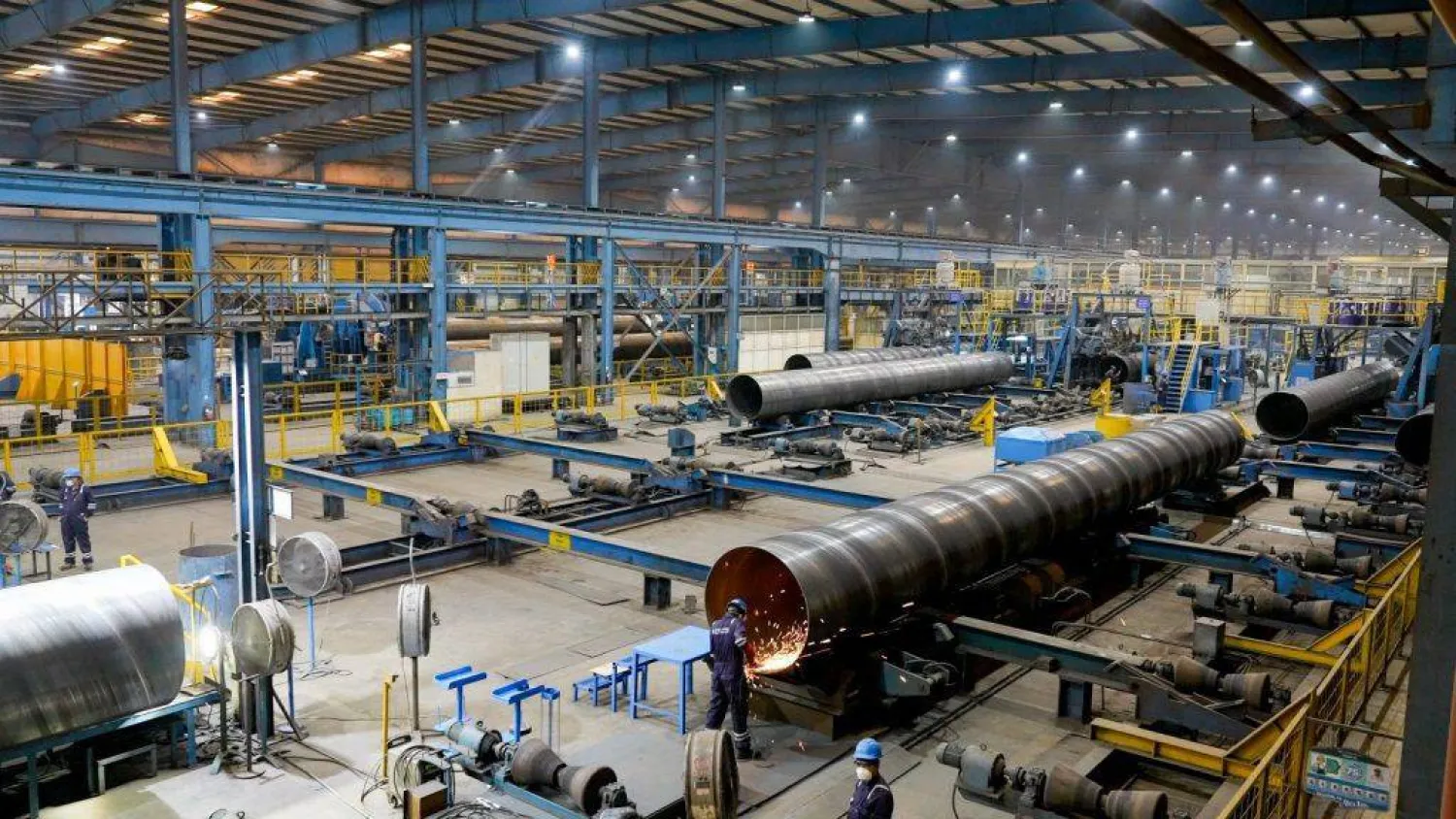
A factory operated by Saudi Arabia’s East Pipes Integrated Company for Industry. (Company photo)
TT

Saudi Industrial Production Falls 23.5% in August

A factory operated by Saudi Arabia’s East Pipes Integrated Company for Industry. (Company photo)

Saudi Arabia’s industrial production index fell 23.5% in August 2026 from a year earlier, weighed down by declines in mining and quarrying and manufacturing activity, data from the General Authority for Statistics showed on Sunday.

On a monthly basis, the index dropped 14% from July, amid declines in both main activities.

The data showed that the oil activities index fell 33.6% year on year, while the non-oil activities index rose 1.2%, reflecting divergent performances between the two sectors during the month.

By economic activity, the mining and quarrying index declined 35.8% year on year and 24% from July. The manufacturing index fell 8.8% annually and 3.2% month on month.

The decline in manufacturing was driven by a 24.1% year-on-year drop in the manufacture of coke and refined petroleum products, and a 3.3% decrease in the manufacture of chemicals and chemical products.

Some industrial activities, however, recorded annual growth. The index for electricity, gas, steam and air conditioning supply rose 9.4%, while the index for water supply, sewerage, waste management and remediation activities increased 7.4%.

On a monthly basis, the non-oil activities index rose 1.4%, while the oil activities index fell 21.5%, according to the authority’s preliminary data.


Iraqi Central Bank Says Traders Will Not Bear the Difference Under New Dollar Exchange Rate

Employees walk outside the Central Bank of Iraq headquarters in Baghdad (Reuters)
TT

Iraqi Central Bank Says Traders Will Not Bear the Difference Under New Dollar Exchange Rate

Employees walk outside the Central Bank of Iraq headquarters in Baghdad (Reuters)

The Central Bank of Iraq announced on Saturday that traders will not be charged the difference under the new dollar exchange rate for transfers whose purchases and funding were confirmed at the previous rate before the seventh of this month.

Iraqi markets have experienced disruption following the central bank’s unexpected decision to raise the dollar exchange rate in the draft federal budget for fiscal year 2027 from 1,320 dinars to 1,520 dinars per dollar.

In a statement issued on Saturday regarding traders’ transfers awaiting execution, the Central Bank of Iraq said it was monitoring banking transactions carried out before and after the exchange rate adjustment and verifying that banks comply with the applicable instructions and regulations, in order to protect the rights of traders and customers.

The central bank urged companies and traders whose transfers to finance imports were due for execution before the seventh of this month to contact their banks and confirm that the transfers had been processed. It noted that it had previously strengthened banks’ accounts to cover these transfers, monitor any delays, and ensure that traders were not charged exchange rate differences on transfers confirmed as purchased and funded at the previous rate.

The bank stressed that “if execution is delayed or additional amounts are demanded, a complaint can be submitted through the Central Bank of Iraq’s complaints platform for follow-up with the bank concerned.” It added that it was coordinating with banks and electronic payment companies to introduce special foreign trade cards for small-scale traders to facilitate import financing, in accordance with the mechanisms and regulations set by the central bank.

The exchange rate adjustment has pushed the dollar’s price in Iraq’s parallel market to 1,665 dinars and led to a sharp increase in the prices of essential goods and electrical appliances.