‘French Spiderman’ Crawls up Barcelona Skyscraper in Climate Actionhttps://english.aawsat.com/varieties/4312436-%E2%80%98french-spiderman%E2%80%99-crawls-barcelona-skyscraper-climate-action
‘French Spiderman’ Crawls up Barcelona Skyscraper in Climate Action
French "Spiderman" Alain Robert climbs a building to raise awareness about drought and climate change, in Barcelona, Spain, May 5, 2023. (Reuters)
TT
TT
‘French Spiderman’ Crawls up Barcelona Skyscraper in Climate Action
French "Spiderman" Alain Robert climbs a building to raise awareness about drought and climate change, in Barcelona, Spain, May 5, 2023. (Reuters)
An urban stunt climber known as the "French Spiderman" for his daring ascents conquered another landmark by scaling a 166-metre (381-foot) Barcelona skyscraper on Friday in a bid to raise awareness about climate change and drought.
Sixty-year-old Alain Robert crawled up the exterior of the glass and steel-covered Melia Barcelona Sky Hotel, the Spanish city's fourth-tallest building, with just a bag of powdered chalk and climbing shoes to aid his ascent.
"I would like to pass on a message on climate change and the problem of soil dehydration in Spain (for it) to be resolved quickly" by the government, he said after reaching the rooftop. The climb was not authorized and police detained him at the top.
Spain is facing a persistent drought and parts of southern Europe are in the grips of unseasonably warm temperatures that scientists say have been exacerbated by global warming.
Before the climb, Robert told Reuters the structure was "quite aggressive", and half-joked that he would be feeling the effects of climate change and drought himself due to the heat.
He draped his fingers with climbing tape to prevent burns from the sizzling surface - heated by strong sunshine even through the maximum temperature in Barcelona on Friday was a relatively balmy 23 Celsius (73.4 Fahrenheit).
Dozens of onlookers gathered outside, craning their necks to catch a glimpse of Robert, sporting a bright-red suit and a cap, as he made his way upward in about half an hour.
Robert began climbing in 1975 on the cliffs near his hometown of Valence. Two years later, he took up the high-risk "free solo" feats, climbing alone and unaided by ropes or harnesses.
Since then, he has climbed more than 150 structures including the world's tallest building, Dubai's Burj Khalifa, Paris' Eiffel Tower and San Francisco's Golden Gate Bridge.
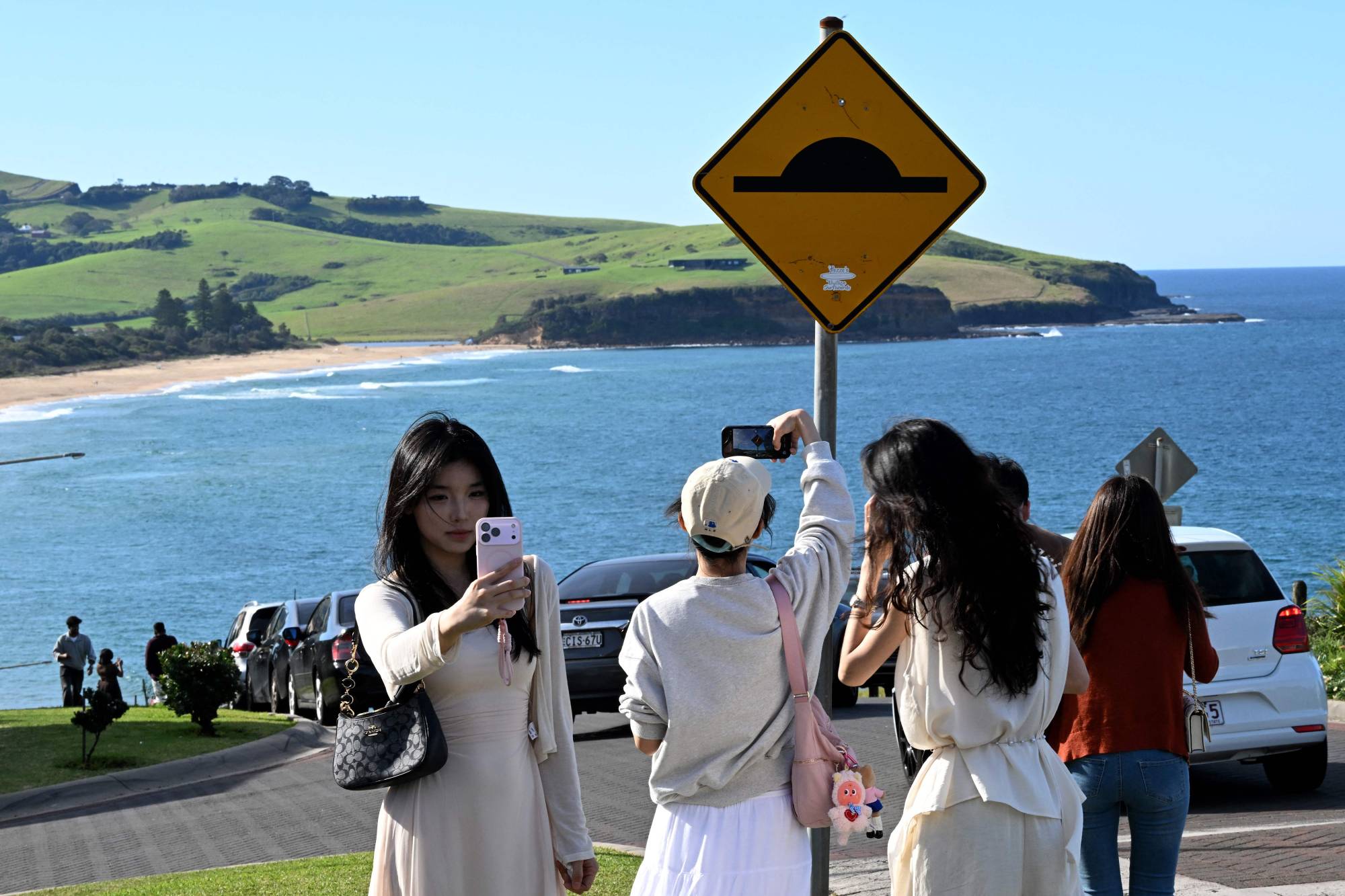
This picture taken on April 27, 2026 shows tourists visiting a street in Gerringong, about a two-hour drive south of Sydney. (Photo by Saeed KHAN / AFP)
Australia's 'Most Beautiful' Street Fed Up with Viral Fame
This picture taken on April 27, 2026 shows tourists visiting a street in Gerringong, about a two-hour drive south of Sydney. (Photo by Saeed KHAN / AFP)
Viral posts of an Australian street dubbed the country's "most beautiful" have enticed coachloads of visitors to a picturesque seaside town -- and locals have had enough of it.
Just a two-hour drive south of Sydney, Gerringong is much like many other photogenic hamlets along Australia's east coast, with multi-million-dollar properties set against stunning views of the azure blue sea.
But recent posts on Instagram, TikTok and as far afield as China's RedNote showing the town's Tasman Drive have left residents fuming that their little slice of paradise has turned into an internet sensation.
"It's getting beyond a joke for a small country town," Peter Hainsworth, 81, told AFP as tourists frolicked on the rolling hills nearby.
"You've got people who are trying to do three-point turns, they're standing in the middle of the road taking photographs, they're leaving their rubbish.
"Everyone's fed up."
Nearby, tourists posed in the middle of the road for selfies to the fury of a sweary local resident on a bicycle who declined to speak to AFP.
Overtourism concerns have sparked backlash in many hotspots worldwide, from European cities Barcelona and Venice to Japan -- where officials erected a barrier to block a popular view of Mount Fuji in 2024 because of the disruptive behavior of unruly tourists.
Some Gerringong residents have resorted to extreme measures, turning on garden sprinklers to prevent tourists from taking pictures on their lawns.
Others are setting up a committee to demand the road be declared a one-way street -- a bid to halt the seemingly endless stream of cars slowing to a halt as they film the viral view.
One neighbor reportedly sold their house to escape the furor.
"It's nice to see people enjoying it, but really, it's just getting a bit too much," resident Linda Bruce, 76, told AFP on a hill next to the viral view.
"It's just so weird to see so many people coming all this way for the view."
Thanks to the massive reach of the posts, which have racked up millions of views, tourists have come from across Asia -- an "unusual" sight in Gerringong, Bruce said.
"I mean, it's an amazing country, and it's there to share... it's just a bit much for the locals."
Some of the tourists have had less far to travel.
Sagar Munjal, a 28-year-old taxi driver living in Parramatta, near Sydney, drove down with friends to see the view after spotting it on Instagram.
"My eyes were totally stunned," he said.
"You can enjoy the coastal drive with the beach plus beautiful mountains."
"I was amazed to see that."
Andy Liao, a property developer originally from Chengdu, China who now lives in Sydney, told AFP he and his family had driven down after seeing the street on RedNote.
"The landscape is so beautiful," he said. "That's why I drove two hours."
But Andy said he understood why locals might be annoyed with the attention.
"If I'm living here, I don't want too many people coming to my backyard."
This picture taken on April 27, 2026 shows tourists taking photos on a street in Gerringong, about a two-hour drive south of Sydney. (Photo by Saeed KHAN / AFP)
Others were less sympathetic to the residents' plight.
Kevin Medina, a 22-year-old cook from Colombia, provoked a string of expletives from one local when he took selfies on the roadside.
"They should be really happy, because are they getting more people to know this beautiful place."
Chief among the locals' complaints is that the tourists are not spending money in the area -- they simply show up, snap their selfies and leave.
Deputy mayor and local business owner Melissa Matters told AFP the financial impact was mixed.
"Some businesses are experiencing not a lot of uptake," but others "are doing quite well out of it", she said.
And while many residents had moved down from the big city seeking a quiet life, Matters said Gerringong was hardly a stranger to outsiders.
"We've always been about tourism here."
Back on Tasman Drive, tourists excitedly posed for pictures next to a speed bump sign as a grumbling resident glared at them.
"You sort of wonder, why are they doing this?" Bruce said.
"Is it because they really, really love the area and think it's so wonderful to see the view, or are they just ticking off another box on their to-do list?"
Aerial photo taken on April 29, 2026 shows the rescued humpback whale in a special barge along the Danish coastline enroute back to the North Sea after it beached on a sandbank near the city of Luebeck, in late March. (Photo by Philip Dulian / dpa / AFP)
Aerial photo taken on April 29, 2026 shows the rescued humpback whale in a special barge along the Danish coastline enroute back to the North Sea after it beached on a sandbank near the city of Luebeck, in late March. (Photo by Philip Dulian / dpa / AFP)
A special barge carrying a humpback whale that was stranded in Germany had entered Danish waters by Wednesday afternoon and is expected to reach the North Sea in two days, local officials said.
The whale, dubbed "Timmy" by German media, was coaxed into the vessel in a last-ditch rescue attempt on Tuesday after a weeks-long struggle for survival on the Baltic Sea coast.
The ship Fortuna B, which is towing the barge, was located between the islands of Langeland and Lolland in southeastern Denmark at around 1400 GMT, according to the VesselFinder website.
"If everything goes well, he'll be in the North Sea in two days. The very worst is already behind him now," Till Backhaus, environment minister for the state of Mecklenburg-Western Pomerania, told the Bild daily.
Speaking to reporters on the island of Poel, where the whale was most recently stranded, Backhaus said the animal was "doing well" and had made sounds during the night, AFP reported.
Backhaus thanked rescuers for their "wonderful" effort in "an exceptional situation that is hardly comparable anywhere in the world in this form".
The whale had been struggling for more than a month around the German coast, getting stuck on sandbanks and then managing to free itself again several times.
At the start of April, officials gave up on trying to rescue the animal, saying they believed it could not be saved.
But this triggered an outcry and authorities were persuaded to approve a privately financed rescue plan proposed by two wealthy entrepreneurs.
The barge idea was hatched after their initial attempt to save the whale with inflatable cushions and pontoons was unsuccessful.
The rescue effort was seen as a long shot and criticized by experts who said it would only cause the animal more distress.
The whale's ordeal has sparked a media frenzy -- with non-stop coverage from TV channels, online outlets and social media influencers -- but has also led to angry spats and conspiracy theories.
Dragon Diplomacy: Indonesia Lends Komodo Lizard Pair to Japan Zoohttps://english.aawsat.com/varieties/5267884-dragon-diplomacy-indonesia-lends-komodo-lizard-pair-japan-zoo
Dragon Diplomacy: Indonesia Lends Komodo Lizard Pair to Japan Zoo
A delegation from Japan's iZoo inspects the Komodo dragon enclosure at Surabaya Zoo in Surabaya on April 29, 2026. (Photo by JUNI KRISWANTO / AFP)
Indonesia will lend a breeding pair of endangered Komodo dragons to Japan under an agreement signed Wednesday between zoos from the two countries that emphasized the project's conservation merits.
The five-year renewable deal, criticized by animal rights group PETA, will in turn see Indonesia's Surabaya Zoo receive a pair of red pandas, a pair of giraffes, four Aldabra giant tortoises and two female Japanese macaques from iZoo in Kawazu in Japan's Shizuoka prefecture, officials said.
"This is not just animal exchange. This is a bridge between our two countries, Japan and Indonesia," iZoo director Tsuyoshi Shirawa said at the signing ceremony.
Indonesia's environment ministry said in a statement this month the program's main objective was "long-term conservation".
PETA Asia has expressed concern that any dragon offspring born in Japan will be "condemned to a lifetime of confinement".
"True conservation protects Komodo dragons where they belong -- in their natural habitats -- not by exporting them for political optics or public relations gains," PETA Asia president Jason Baker said in a statement.
The ministry said conservation of the dragons in their natural habitat remained "the main priority".
"Through this cooperation, it is hoped there will be more Japanese people and tourists coming to Indonesia, particularly to the Komodo National Park... to witness Komodos in their natural habitat," Indonesian forestry official Ahmad Munawir said at Wednesday's event, according to AFP.
Under the rules of the CITES pact that governs international trade in endangered species, transfers like this one are allowed for non-commercial breeding programs.
The zoo in Surabaya, Indonesia's second-largest city over 700 kilometers (434 miles) from the dragon's natural habitat, has bred dozens of the dragons in recent years in conditions that mimic their natural home.
In the wild, the world's largest living lizards are found only in the World Heritage-listed Komodo National Park and on neighboring Flores island.
According to the International Union for Protection of Nature, the global population was about 3,458 adult and juvenile Komodo dragons at the last count in 2019.
The fearsome reptiles, which can grow to three meters (10 feet) in length and weigh up to 90 kilograms (200 pounds), are threatened by human activity and climate change destroying their habitat.
In some places, they are losing natural prey to human hunters, and they sometimes die in conflict with humans over livestock.
Some are captured and illicitly traded to zoos or as pets.
There have been legal transfers of Komodos to other zoos in the past, including London and Singapore.
The Indonesian and Japanese governments signed a Memorandum of Understanding last month to make the exchange with Japan possible.
لم تشترك بعد
انشئ حساباً خاصاً بك لتحصل على أخبار مخصصة لك ولتتمتع بخاصية حفظ المقالات وتتلقى نشراتنا البريدية المتنوعة