


WHO Downgrades COVID Pandemic, Says It’s No Longer Emergency

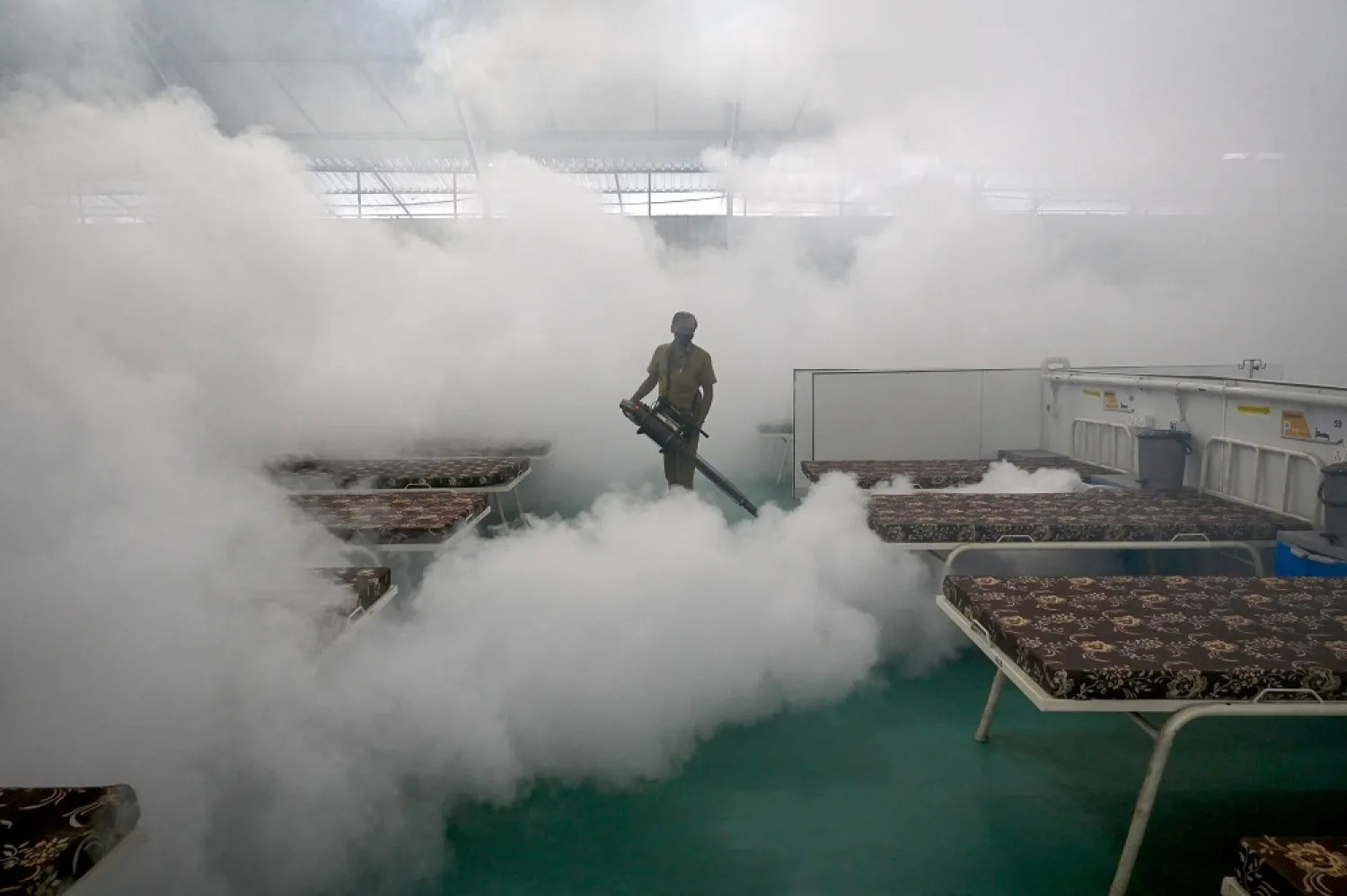
In this file photograph taken on June 9, 2022, a civic authority worker fumigates inside a soon to be Covid-19 hospital, as a preventive measure against mosquito-borne diseases in Mumbai. (AFP)
TT

WHO Downgrades COVID Pandemic, Says It’s No Longer Emergency

In this file photograph taken on June 9, 2022, a civic authority worker fumigates inside a soon to be Covid-19 hospital, as a preventive measure against mosquito-borne diseases in Mumbai. (AFP)

The World Health Organization said Friday that COVID-19 no longer qualifies as a global emergency, marking a symbolic end to the devastating coronavirus pandemic that triggered once-unthinkable lockdowns, upended economies and killed at least 7 million people worldwide.

WHO first declared COVID-19 to be an emergency more than three years ago. The UN health agency's officials said that even though the emergency phase was over, the pandemic hasn't come to an end, noting recent spikes in cases in Southeast Asia and the Middle East.

WHO says that thousands of people are dying from the virus every week, and millions of others report that they are still suffering from debilitating, long-term effects from the disease.

“It’s with great hope that I declare COVID-19 over as a global health emergency,” WHO Director-General Tedros Adhanom Ghebreyesus said.

“That does not mean COVID-19 is over as a global health threat,” he said, adding he wouldn't hesitate to reconvene experts to reassess the situation should COVID-19 “put our world in peril.”

Tedros said the pandemic had been on a downward trend for more than a year, acknowledging that most countries have already returned to life before COVID-19.

He bemoaned the damage that COVID-19 had done to the global community, saying the pandemic had shattered businesses, exacerbated political divisions, led to the spread of misinformation and plunged millions into poverty. Tedros also noted that there were likely at least 20 million COVID-19 deaths, far more than the officially reported 7 million.

“COVID has changed our world and it has changed us,” he said, warning that the risk of new variants still remained.

Dr. Michael Ryan, WHO's emergencies chief, said it was incumbent on heads of states and other leaders to decide on how future health threats should be faced, given the numerous problems that crippled the world's response to COVID-19. Countries are negotiating a pandemic treaty that some hope may spell out how future disease threats will be faced — but it's unlikely any such treaty would be legally binding.

When the UN health agency first declared the coronavirus to be an international crisis on Jan. 30, 2020, it hadn't yet been named COVID-19 and there were no major outbreaks beyond China.

More than three years later, the virus has caused an estimated 764 million cases globally and about 5 billion people have received at least one dose of vaccine.

In the US, the public health emergency declaration made regarding COVID-19 is set to expire on May 11, when wide-ranging measures to support the pandemic response, including vaccine mandates, will end. Many other countries, including Germany, France and Britain, dropped many of their provisions against the pandemic last year.

When Tedros declared COVID-19 to be an emergency in 2020, he said his greatest fear was the virus’ potential to spread in countries with weak health systems.

In fact, some of the countries that suffered the worst COVID-19 death tolls were previously judged to be the best-prepared for a pandemic, including the US and Britain. According to WHO data, the number of deaths reported in Africa account for just 3% of the global total.

WHO doesn't “declare” pandemics, but first used the term to describe the outbreak in March 2020, when the virus had spread to every continent except Antarctica, long after many other scientists had said a pandemic was already underway.

WHO is the only agency mandated to coordinate the world’s response to acute health threats, but the organization faltered repeatedly as the coronavirus unfolded.

In January 2020, WHO publicly applauded China for its supposed speedy and transparent response, even though recordings of private meetings obtained by The Associated Press showed top officials were frustrated at the country’s lack of cooperation.

WHO also recommended against mask-wearing for the public for months, a mistake many health officials say cost lives.

Numerous scientists also slammed WHO’s reluctance to acknowledge that COVID-19 was frequently spread in the air and by people without symptoms, criticizing the agency’s lack of strong guidance to prevent such exposure.

Tedros was a vociferous critic of rich countries who hoarded the limited supplies of COVID-19 vaccines, warning that the world was on the brink of a “catastrophic moral failure” by failing to share shots with poor countries.

Most recently, WHO has been struggling to investigate the origins of the coronavirus, a challenging scientific endeavor that has also become politically fraught.

After a weeks-long visit to China, WHO released a report in 2021 concluding that COVID-19 most likely jumped into humans from animals, dismissing the possibility that it originated in a lab as “extremely unlikely.”

But the UN agency backtracked the following year, saying “key pieces of data” were still missing and that it was premature to rule out that COVID-19 might have ties to a lab.

Tedros lamented that the catastrophic toll of COVID-19 could have been avoided.

"We have the tools and the technologies to prepare for pandemics better, to detect them earlier, to respond to them faster,” Tedros said, without citing missteps by WHO specifically.

“A lack of (global) solidarity meant that those tools were not used as effectively as they could have been,” he said. “Lives were lost that should not have been. We must promise ourselves and our children and grandchildren that we will never make those mistakes again.”



Nigeria's President to Make a Sate Visit to the UK in March

Nigeria’s President Bola Tinubu gives a joint statement with Brazil’s President Luiz Inacio Lula da Silva, at the Planalto presidential palace, in Brasilia, Brazil, Aug. 25, 2025. (AP Photo/Eraldo Peres, File)
TT

Nigeria's President to Make a Sate Visit to the UK in March

Nigeria’s President Bola Tinubu gives a joint statement with Brazil’s President Luiz Inacio Lula da Silva, at the Planalto presidential palace, in Brasilia, Brazil, Aug. 25, 2025. (AP Photo/Eraldo Peres, File)

Nigeria’s president is set to make a state visit to the UK in March, the first such trip by a Nigerian leader in almost four decades, Britain’s Buckingham Palace said Sunday.

Officials said President Bola Tinubu and first lady Oluremi Tinubu will travel to the UK on March 18 and 19, The AP news reported.

King Charles III and Queen Camilla will host them at Windsor Castle. Full details of the visit are expected at a later date.

Charles visited Nigeria, a Commonwealth country, four times from 1990 to 2018 before he became king. He previously received Tinubu at Buckingham Palace in September 2024.m

Previous state visits by a Nigerian leader took place in 1973, 1981 and 1989.

A state visit usually starts with an official reception hosted by the king and includes a carriage procession and a state banquet.

Last year Charles hosted state visits for world leaders including US President Donald Trump, French President Emmanuel Macron and German President Frank-Walter Steinmeier.


Iran Strikes Hard Line on US Talks, Saying Tehran's Power Comes From Saying 'No'

Traffic moves through a street in Tehran on February 7, 2026. (Photo by ATTA KENARE / AFP)
TT

Iran Strikes Hard Line on US Talks, Saying Tehran's Power Comes From Saying 'No'

Traffic moves through a street in Tehran on February 7, 2026. (Photo by ATTA KENARE / AFP)

Iran's top diplomat insisted Sunday that Tehran's strength came from its ability to “say no to the great powers," striking a maximalist position just after negotiations with the United States over its nuclear program and in the wake of nationwide protests.

Foreign Minister Abbas Araghchi, speaking to diplomats at a summit in Tehran, signaled that Iran would stick to its position that it must be able to enrich uranium — a major point of contention with President Donald Trump, who bombed Iranian atomic sites in June during the 12-day Iran-Israel war.

Iran will never surrender the right to enrich uranium, even if war "is imposed on us,” he noted.

"Iran has paid a very heavy price for its peaceful nuclear program and for uranium enrichment." 

Israeli Prime Minister Benjamin Netanyahu is expected to travel to Washington this week, with Iran expected to be the major subject of discussion, his office said.

While Iranian President Masoud Pezeshkian praised the talks Friday in Oman with the Americans as “a step forward,” Araghchi's remarks show the challenge ahead. Already, the US moved the aircraft carrier USS Abraham Lincoln, ships and warplanes to the Middle East to pressure Iran into an agreement and have the firepower necessary to strike the Islamic Republic should Trump choose to do so, according to The AP news.

“I believe the secret of the Islamic Republic of Iran’s power lies in its ability to stand against bullying, domination and pressures from others," Araghchi said.

"They fear our atomic bomb, while we are not pursuing an atomic bomb. Our atomic bomb is the power to say no to the great powers. The secret of the Islamic Republic’s power is in the power to say no to the powers.”

‘Atomic bomb’ as rhetorical device Araghchi's choice to explicitly use an “atomic bomb” as a rhetorical device likely wasn't accidental. While Iran has long maintained its nuclear program is peaceful, the West and the International Atomic Energy Agency say Tehran had an organized military program to seek the bomb up until 2003.

Iran had been enriching uranium up to 60% purity, a short, technical step to weapons-grade levels of 90%, the only non-weapons state to do so. Iranian officials in recent years had also been increasingly threatening that Tehran could seek the bomb, even while its diplomats have pointed to Iranian Supreme Leader Ali Khamenei’s preachings as a binding fatwa, or religious edict, that Iran wouldn’t build one.

Pezeshkian, who ordered Araghchi to pursue talks with the Americans after likely getting Khamenei's blessing, also wrote on X on Sunday about the talks.

“The Iran-US talks, held through the follow-up efforts of friendly governments in the region, were a step forward,” the president wrote. “Dialogue has always been our strategy for peaceful resolution. ... The Iranian nation has always responded to respect with respect, but it does not tolerate the language of force.”

It remains unclear when and where, or if, there will be a second round of talks. Trump, after the talks Friday, offered few details but said: “Iran looks like they want to make a deal very badly — as they should.”

Aircraft carrier in the Arabian Sea During Friday's talks, US Navy Adm. Brad Cooper, the head of the American military's Central Command, was in Oman. Cooper's presence was apparently an intentional reminder to Iran about US military power in the region. Cooper later accompanied US special envoy Steve Witkoff and Jared Kushner, Trump's son-in-law, to the Lincoln out in the Arabian Sea after the indirect negotiations.

Araghchi appeared to be taking the threat of an American military strike seriously, as many worried Iranians have in recent weeks. He noted that after multiple rounds of talks last year, the US “attacked us in the midst of negotiations."

“If you take a step back (in negotiations), it is not clear up to where it will go,” Araghchi said.


Russia: Man Suspected of Shooting Top General Detained in Dubai

An investigator works outside a residential building where the assassination attempt on Russian Lieutenant General Vladimir Alexeyev took place in Moscow, Russia February 6, 2026. REUTERS/Anastasia Barashkova
TT

Russia: Man Suspected of Shooting Top General Detained in Dubai

An investigator works outside a residential building where the assassination attempt on Russian Lieutenant General Vladimir Alexeyev took place in Moscow, Russia February 6, 2026. REUTERS/Anastasia Barashkova

Russia's Federal Security Service (FSB) said on Sunday that the man suspected of shooting top Russian military intelligence officer Vladimir Alexeyev in Moscow has been detained in Dubai and handed over to Russia.

Lieutenant General Vladimir Alexeyev, deputy head of the GRU, ⁠Russia's military intelligence arm, was shot several times in an apartment block in Moscow on Friday, investigators said. He underwent surgery after the shooting, Russian media ⁠said.

The FSB said a Russian citizen named Lyubomir Korba was detained in Dubai on suspicion of carrying out the shooting.

Russian Foreign Minister Sergei Lavrov accused Ukraine of being behind the assassination attempt, which he said was designed to sabotage peace talks. ⁠Ukraine said it had nothing to do with the shooting.

Alexeyev's boss, Admiral Igor Kostyukov, the head of the GRU, has been leading Russia's delegation in negotiations with Ukraine in Abu Dhabi on security-related aspects of a potential peace deal.