Biden Calls for ‘Fair Deal’ for Striking Hollywood Writers 

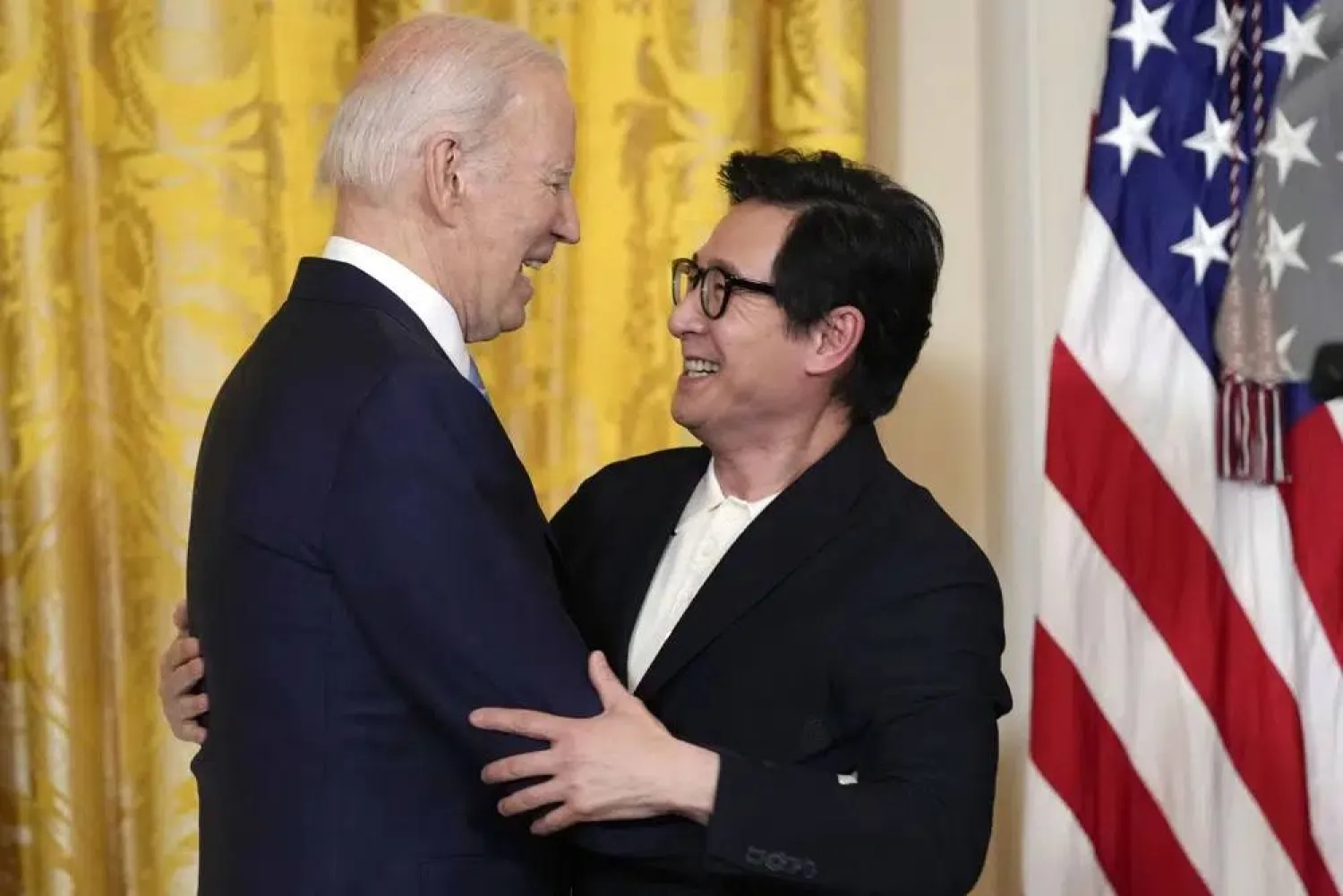
Actor Ke Huy Quan hugs President Joe Biden after he introduced Biden to speak before a screening of the series "American Born Chinese" in the East Room of the White House in Washington. (AP)
TT

Biden Calls for ‘Fair Deal’ for Striking Hollywood Writers 

Actor Ke Huy Quan hugs President Joe Biden after he introduced Biden to speak before a screening of the series "American Born Chinese" in the East Room of the White House in Washington. (AP)

President Joe Biden called for a “fair deal” for Hollywood’s striking writers on Monday as he hosted a White House screening of the upcoming streaming series “American Born Chinese” to mark Asian American, Native Hawaiian, and Pacific Islander Heritage Month.

Biden made his first public comments on the strike, which hits the one-week mark Tuesday, in remarks ahead of the pilot’s screening. He was joined by an overflow crowd of hundreds of community leaders, elected officials and cast members and producers from the show in the East Room and the State Dining Room.

“Nights like these are a reminder of stories and the importance of treating storytellers with the dignity, respect and the value they deserve,” Biden said. “I sincerely hope the writers strike in Hollywood gets resolved and the writers are given a fair deal they deserve as soon as possible.”

He added: “This is an iconic, meaningful American industry. And we need the writers and all the workers and everyone involved to tell the stories of our nation and the stories of all of us.”

“American Born Chinese” is an adaptation of a graphic novel of the same name by Gene Luen Yang, and stars Oscar winners Michelle Yeoh and Ke Huy Quan. It will premiere on Disney+ May 24.

Biden used his brief remarks onstage to outline his administration’s efforts to highlight the accomplishments of the Asian American, Native Hawaiian, and Pacific Islander communities and to speak out against prejudice and violence targeting them.

“Hate can have no safe harbor in America,” Biden said. “Silence is complicity and we will not remain silent”

Quan, who introduced Biden, reflected on his journey from arriving in the US as an 8-year-old refugee from Vietnam to making his first visit to the White House months after winning an Oscar.

“I do not take this moment lightly, because I know this building is a monument to a country that opened its arms to me,” he said.


Director Nick Paley Channels Childhood Fears in New Thriller 'Phony'

US director Nick Paley attends the premiere of Hulu's TV series "Phony" at the Pacific Design Center in West Hollywood, California, on Ocotber 13, 2026. (Photo by Unique Nicole / AFP)
TT

Director Nick Paley Channels Childhood Fears in New Thriller 'Phony'

US director Nick Paley attends the premiere of Hulu's TV series "Phony" at the Pacific Design Center in West Hollywood, California, on Ocotber 13, 2026. (Photo by Unique Nicole / AFP)

A teenager wakes up after a traffic crash convinced his mother has been replaced by an imposter -- but almost no one believes him.

The plot of "Phony," the show that debuted this week on Hulu, stems from a childhood fear long held by creator and writer Nick Paley.

"I had this core fear when I was a kid of losing my mom," he told AFP. "I just was obsessed with things, bad things happening to her, and just getting separated from her."

"That was sort of an emotional thing that I wanted to explore."

"Phony" stars Sam Nivola as Sonny, a teenager with a close bond to his single mother, Ellen (Connie Britton).

When he regains consciousness following the accident, Sonny doesn't recognize the woman claiming to be Ellen -- in terms of looks, but also because she no longer has a grasp on the insider codes of their relationship.

And Paley -- who co-wrote the Oscar-nominated "Marcel the Shell with Shoes On" -- lets "Phony" bleed across genre.

"It's like a thriller that feels real to life, and to me, like real to life is things are funny, things are scary, things are dramatic, and they kind of all work together," he said.

Paley noted that Britton was instrumental in heightening the suspense and horror elements, portraying the alleged imposter with a warmth that confuses both Sonny and the audience.

He said he spoke frequently about "how to play both sides of this."

"How can it seem like she's a possibly, a worried mom who's helping her son who's losing his mind, or an imposter who is something really dark and is doing something that's like, you know, scary," he continued.

"Like, she's not a person to be trusted."

For Paley, Britton -- who starred in series including "Friday Night Lights" and "The White Lotus" -- was an obvious casting choice.

"She's like, very much an America's mom in a certain way," he said.

The series is set in a small, fictional community in Oregon, in the Pacific Northwest of the United States.

The area is characterized by its dramatic mountains and forested landscapes, which, for Paley, complemented the storytelling: "There's such drama to the mountains and the fog, and it just gives you this feeling that magic and strangeness is afoot."

The show touches, if tangentially, on conspiracy theories and alternative versions of the truth that can spring up on social media.

"We're living in a world that looks a lot like the world we know, but it's actually quite different," Paley said.

"And often, like based on our algorithms -- our individual information feeds -- we are seeing things slightly different than other people, and it's difficult to identify the mechanisms that are separating us," the show's creator continued.

"So there is a really good, you know, allegory in the main character's experience."


Saudi Film Commission to Host Fourth International Film Criticism Conference in November 2026

Saudi Film Commission to Host Fourth International Film Criticism Conference in November 2026
TT

Saudi Film Commission to Host Fourth International Film Criticism Conference in November 2026

Saudi Film Commission to Host Fourth International Film Criticism Conference in November 2026

Saudi Arabia's Film Commission will host the fourth International Film Criticism Conference on November 5-6, reported the Saudi Press Agency on Tuesday.

The conference will bring together leading critics, researchers, filmmakers and cinema enthusiasts to discuss the role of criticism in reading films, explore its artistic and cultural dimensions, and examine its evolving relationship with audiences amid the changes taking place across the film sector.

Reading a film goes beyond following its events or assessing its technical elements. It involves understanding its visual language, analyzing its narratives and symbols, and exploring the meanings carried by its scenes.

In this spirit, the conference raises questions about the plurality of critical readings, the different perspectives from which a film can be approached, and the critic’s role in enriching the viewing experience and broadening the conversation around films.

The program will feature panel discussions, practical workshops, and two film screenings examining contemporary approaches to film criticism.

The conference will also shed light on the changes in critical practice brought about by the spread of digital platforms and advances in artificial intelligence, and the questions they raise about analytical tools, forms of critical expression and ways of reaching audiences. These discussions are especially relevant as the Saudi and Arab film landscape evolves, bringing greater diversity in experiences, works and themes.

The conference offers a space for critics, researchers, filmmakers and cinema enthusiasts to meet and exchange views on the relationship between filmmaking and critical reading, and on developing practices that deepen the understanding of films and engagement with their content, strengthening the place of criticism in the cultural conversation around cinema.

Between 2023 and 2025, previous editions of the conference and its forums attracted more than 29,000 visitors from over 20 countries, with more than 180 participants, over 25 workshops and 30 side events, and 28 sponsors and partners.

The 2026 conference will convene diverse voices to examine the future of film criticism and reinforce its role in shaping informed, engaged cultural dialogue around cinema.


Can DC Blend Horror with a Superhero Movie? ‘Clayface’ Wants to Blur Genres

 This image released by Warner Bros. Pictures shows Tom Rhys Harries in a scene from "Clayface." (Warner Bros. Pictures via AP)
This image released by Warner Bros. Pictures shows Tom Rhys Harries in a scene from "Clayface." (Warner Bros. Pictures via AP)
TT

Can DC Blend Horror with a Superhero Movie? ‘Clayface’ Wants to Blur Genres

 This image released by Warner Bros. Pictures shows Tom Rhys Harries in a scene from "Clayface." (Warner Bros. Pictures via AP)
This image released by Warner Bros. Pictures shows Tom Rhys Harries in a scene from "Clayface." (Warner Bros. Pictures via AP)

The dominant movie genres of the past decade, superhero films and horror, have usually stayed, like bashful teenagers on the dance floor, on separate sides of the multiplex.

But when James Gunn and Peter Safran were plotting the projects with which they wanted to launch their era of DC Studios, writer-director Mike Flanagan came in with a pitch that would fuse both genres.

Neither Safran nor Gunn were looking for a standalone movie about Clayface, a lesser-known villain from the Batman comics. But they were won over by Flanagan’s vision, which eventually became a script by Flanagan and Hossein Amini.

“It fit within the broader framework of how James and I saw the broad spectrum of film and television shows we want to make,” says Safran. “But it really was Mike Flanagan’s passion and pitch. You always look for volunteers and not recruits.”

Not many studios would push “Clayface” to the front of the pack, but Gunn, who started in horror, and Safran, who helped launch “The Conjuring” franchise, made “Clayface” — with James Watkins eventually coming on to direct — part of their first wave of DCU films, following “Superman” and “Supergirl.”

“Clayface” is a darker detour for DC. And, if it proves successful, it just might open up a darker frontier for comic book movies.

“From the get-go, this was not designed to be a traditional superhero movie,” Safran says. “It was always supposed to be a character-driven story that uses the DC mythology. If you took the DC elements out of it, it would just be a great horror movie.”

That makes “Clayface” something unusual in the normally calculated realm of superhero movies. It’s R-rated. It’s modestly budgeted at $40 million. And it stars the relatively unknown Tom Rhys Harries as a little-known DC villain.

“A lot of people wouldn’t necessarily know who Clayface is, but they wouldn’t need to,” says Watkins, the Welsh filmmaker of “Speak No Evil” and “The Woman in Black.” “It’s its own movie.”

‘Supergirl’ disappointment puts pressure on ‘Clayface’

That, Safran says, is by design. He and Gunn have emphasized filmmaker-first projects at DC, carving a more idiosyncratic, multi-genre path that has won them fans but also added some degree of risk.

“Clayface,” which opens in theaters Oct. 22, will debut shortly after Skydance and David Ellison’s takeover of Warner Bros. Ellison is keeping Gunn and Safran to lead DC, even though they’re coming off a misfire in the box-office disappointment of “Supergirl.” That puts more pressure on “Clayface” to perform.

“If you look at the cumulative choices that we’ve made, I think it’s pretty clear we’re trying to do things differently,” says Safran. “Not everything is going to work. The pressure we feel for ‘Clayface’ is honestly the pressure we feel for everything we put into the world.”

There have been a few movies to meld horror and superheroes together, including Wes Craven’s “Swamp Thing” (1982), Sam Raimi’s “Darkman” (1990) and “Brightburn” (2019), a sinister twist on the “Superman” origin story that Gunn produced.

But Clayface, a Batman villain created in 1940 by Bill Finger and Bob Kane, is still an unlikely character to put center stage. In the comics, he began as Basil Karlo, a B-list actor who, furious that he wasn’t cast in a horror remake he had previously starred in, wears the movie’s Clayface costume to kill the film's actors.

Winning over skeptical DC fans

Some fan skepticism has followed “Clayface.” Last week, Gunn defended the choice on the social media platform Threads after a user asked, “Who the (expletive) asked for a ‘Clayface’ movie?”

Gunn replied: “Although it may seem like it, Hollywood isn’t a place where the only way to make a movie is the public voting on what IP they want to see that they’ve seen countless times before.”

Watkins’ film, taking inspiration from the two-part episode “Feat of Clay” from “Batman: The Animated Series,” twists the original Clayface story slightly. Rising movie star Matt Hagen (Harries) is disfigured by a mob boss (Eddie Marsan) and rapidly falls out of Hollywood. After numerous unsuccessful surgeries, he resorts to an experimental process created by the scientist Dr. Caitlyn Corr (Naomi Ackie) that uses an untested, claylike living organism to rehabilitate his face.

“Part of the joy was being surprised at what’s looking back at me in the mirror every day,” says Harries, smiling.

To a large degree, “Clayface” progresses as a character study, one of an actor whose livelihood falls away from him and whose attempts to get back on the red carpet turn increasingly dark. His journey, though, hinges less on vanity than on his relationship with Caitlyn.

“I was approaching it the whole time like: Matt thinks he’s in a romantic comedy,” says Harries. “The fulcrum of the whole thing is his relationship with Caitlyn Corr. Without that, you don’t get the propulsion for Matt to be doing what he decides he needs to.”

Shape-shifting in genre and body

As “Clayface” devolves, Matt’s face and body increasingly shape-shift in chilling body horror transformations. That can include his own body changing or Matt taking the form of other characters around him. While CGI and visual effects were used, Watkins leaned into practical effects.

“I like horror when it’s most relatable, when it actually gets under the skin,” Watkins says.

In the third act of “Clayface,” that’s taken to body-changing extremes as Matt dons the appearance of those around him. Often, actors were swapping into scenes moment to moment with Harries.

“We’d often play a scene with Tom and then someone else would play the same scene,” says Watkins. “Sometimes Tom would copy them, sometimes they would copy Tom.”

If the superhero movie has sometimes been too rigidly formulaic, “Clayface” proves the genre has more elasticity than it's been shown to have. In “Clayface,” even the lead role was an ensemble piece.

“I won’t mention any actor’s name because it’s a bit of a spoiler,” Watkins says. “But one of the cast members was saying to me his son asked, ‘So who are you in the movie?’ And he said, ‘I’m Clayface.’”