
Global companies are choosing Saudi Arabia’s capital, Riyadh, as a hub to launch their operations and expand their businesses towards the three continents of Asia, Africa, and Europe.
The US health and care products company iHerb and Korea's world leader in logistics solutions CJ Logistics have chosen Riyadh as their operational hub in the region to meet the growing demand of consumers, along with the attractiveness of the business environment in the Kingdom.
Both companies are scheduled to begin operations in the integrated private logistics zone in Riyadh, which Saudi Arabia launched last November at King Khalid International Airport.
The zone's objective is to serve over 650 million customers from Asia, Africa, and Europe.
When the zone was announced, Saleh Al-Jasser, Saudi Minister of Transport and Logistics Services, revealed that Apple was the first investor recruited, which prompted several global companies, including iHerb and CJ Logistics, to declare their interest in entering and investing in the region.
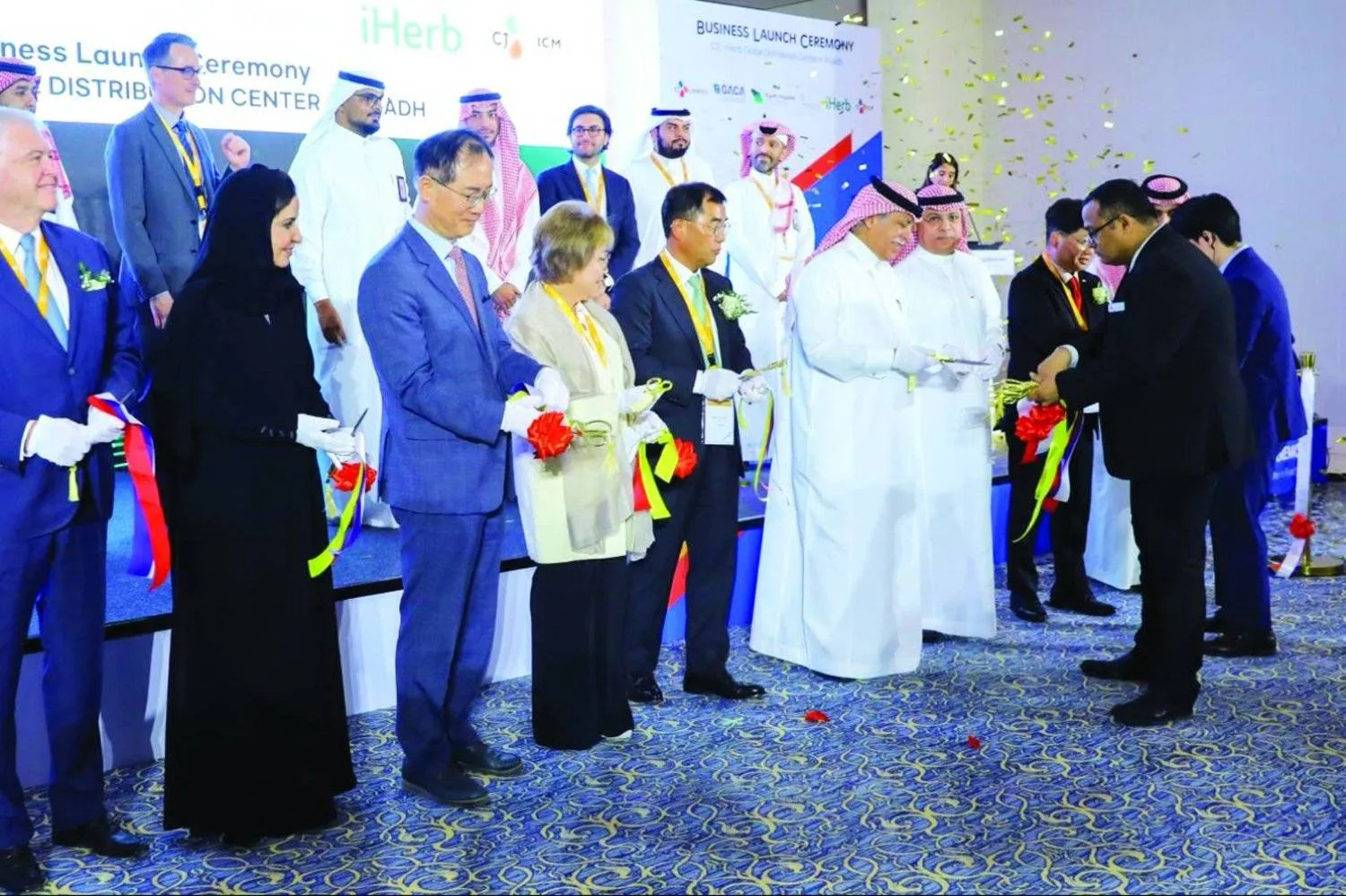
The companies signed an eight-year agreement whereby CJ Logistics will provide consumers in the Middle East and Africa with iHerb products through its global distribution center (GDC) that specializes in e-commerce located in Riyadh's Integrated Logistics Bonded Zone. The zone will be established with the latest technology on an area of 18,000 square meters, and will have a daily production capacity of 15,000 shipments to link the Middle East, Africa and Europe.
President of the General Authority of Civil Aviation Abdulaziz Al-Duailej granted CJ Logistics a license to practice its commercial activities in the Kingdom.
The handing-over ceremony was attended by Saudi Minister of Commerce and President of E-Commerce Council Majid bin Abdullah Al-Qasabi, South Korean Ambassador to the Kingdom Park Joon-yong, Chief Executive Officer of CJ Logistics Kang Sin-Ho and Chief Operating Officer of iHerb Miriee Chang.
Al-Qasabi stressed that the access of international companies to do business in the Kingdom is part of the growing interest in the promising opportunities available under the Saudi Vision 2030, which is committed to the development of the e-commerce business system and its important role in the Saudi economy, especially as the Kingdom is one of the top ten developed countries in this field.
According to Al-Qasabi, the coronavirus pandemic has aided in accelerating e-commerce in Saudi Arabia, with the sector reaching approximately SAR 184 billion ($49 billion) last year.
“It is anticipated to increase to approximately SAR 260 billion ($69.3 billion) by the end of 2025,” he added.
The minister confirmed that the unprecedented digital shift in the country is affecting e-commerce, revealing that there are over 147 financial technology firms, more than 152 logistics service providers, and 39 specialized applications operating in the sector.
For his part, Al-Duailej told Asharq Al-Awsat that the integrated logistics zone has become a magnet for large global companies, which are continuously converging to invest in it. This helps achieve the zone’s objective of reaching the world’s top 100 companies.
Al-Duailej noted that the zone is a testament to the achievements of the national aviation sector strategy within the framework of Vision 2030, which aims to boost the Kingdom’s position as a global logistics hub connecting three continents and attracting the largest companies in the world and the region, at a time when logistics services are undergoing a radical transformation.
He highlighted that the integrated logistics zone stands out for its regulatory measures that aid in attracting investments by granting foreign investors the ability to establish and fully own companies. Moreover, the zone eases the requirements and procedures for investment registration.