


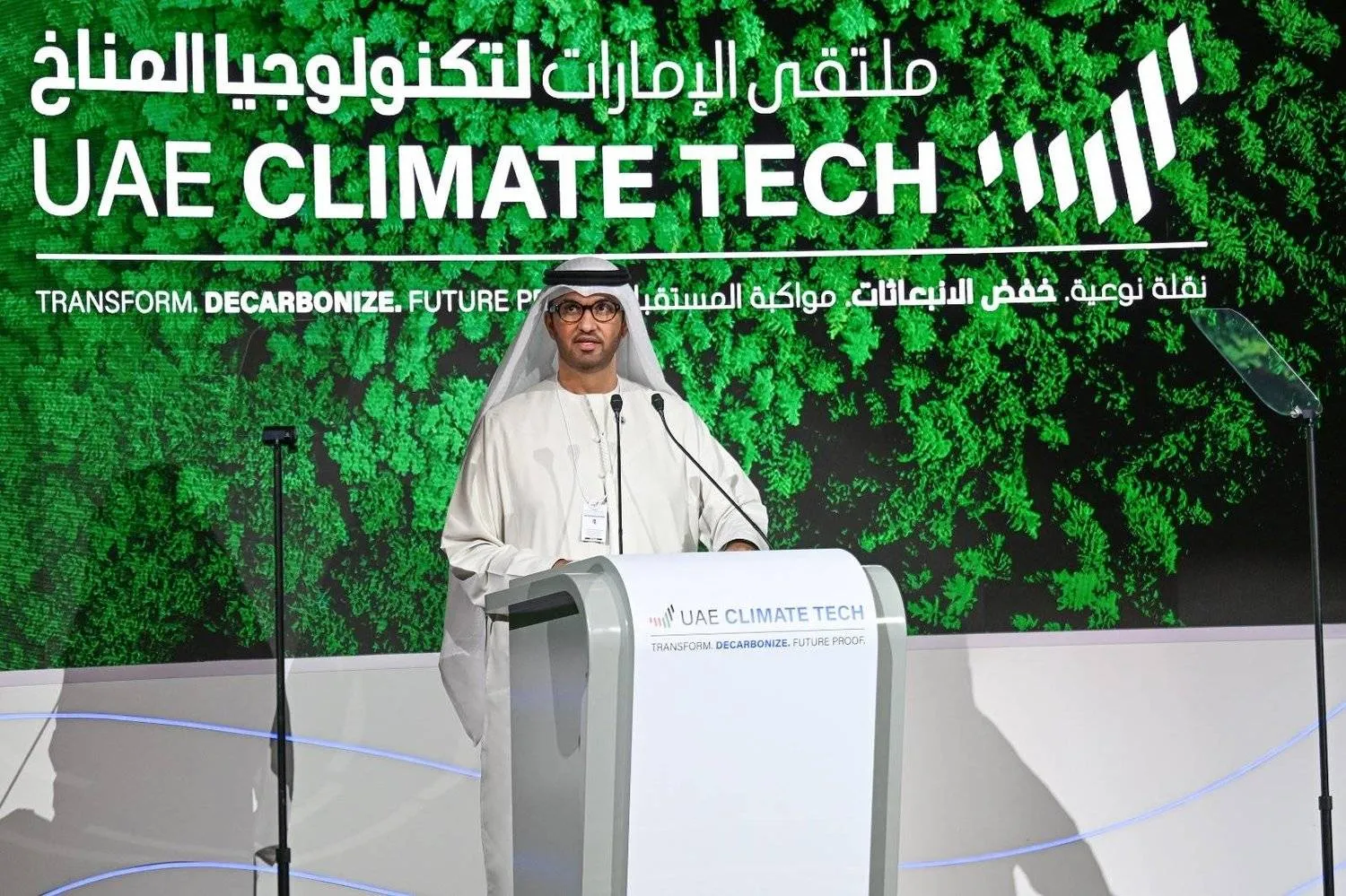

UAE Minister of Industry and Advanced Technology and COP28 President-Designate Dr. Sultan al-Jaber renewed on Wednesday his call for the oil and gas industry to zero out methane emissions by 2030 and align around comprehensive net zero plans by or before 2050.
"While the world still uses hydrocarbons, we must do everything in our power to reduce and eventually eliminate the carbon intensity of that energy. That's why I have called on the oil and gas industry to zero out methane emissions by 2030 and align around comprehensive net zero plans by or before 2050," said al-Jaber at the UAE CLIMATE TECH conference in Abu Dhabi.
"The goal for this industry and all industries is clear. We need to phase out emissions from all sectors, including transportation, agriculture, heavy industry, and fossil fuel emissions, while investing in technologies to phase up all viable zero-carbon alternatives."
He recalled a need to reimagine the relationship between producers and consumers, from one based purely on supply and demand to one focused on co-creating the future.
"We must create an active partnership between the largest producers of energy, the biggest industrial consumers, technology companies, the finance community, government, and civil society," he said.
"It is an all-of-the-above effort: working together, the goal would be an accelerated, pragmatic, practical and just energy transition that leaves no one behind," he added.
Al-Jaber noted that maximizing technology adoption in the Global South requires the public, multilateral, and private sectors to supercharge climate finance by enhancing the availability, accessibility, and affordability of capital in countries that need it most.
He explained that while it was critical to adopt new technologies, the Global South must be included.
Last year, developing economies received only 20 percent of cleantech investments, representing 70 percent of the world's population.
"Technology is essential to helping the most vulnerable communities build capacities and leapfrog into a low carbon economic development model," he stressed.
The minister asserted that despite the growth of renewable energy, most emissions could not be solved by renewables alone, particularly in heavy-emitting industries.
More than 5,000 cement, steel, and aluminum plants in the world together make up almost 30 percent of global emissions, and none of them can run on wind or solar alone, he noted.
Moreover, al-Jaber underscored the importance of investing in nuclear energy, and pushing for breakthroughs in battery storage, before moving on to the need for cooperation between agriculture and technology to drive down global emissions.


