

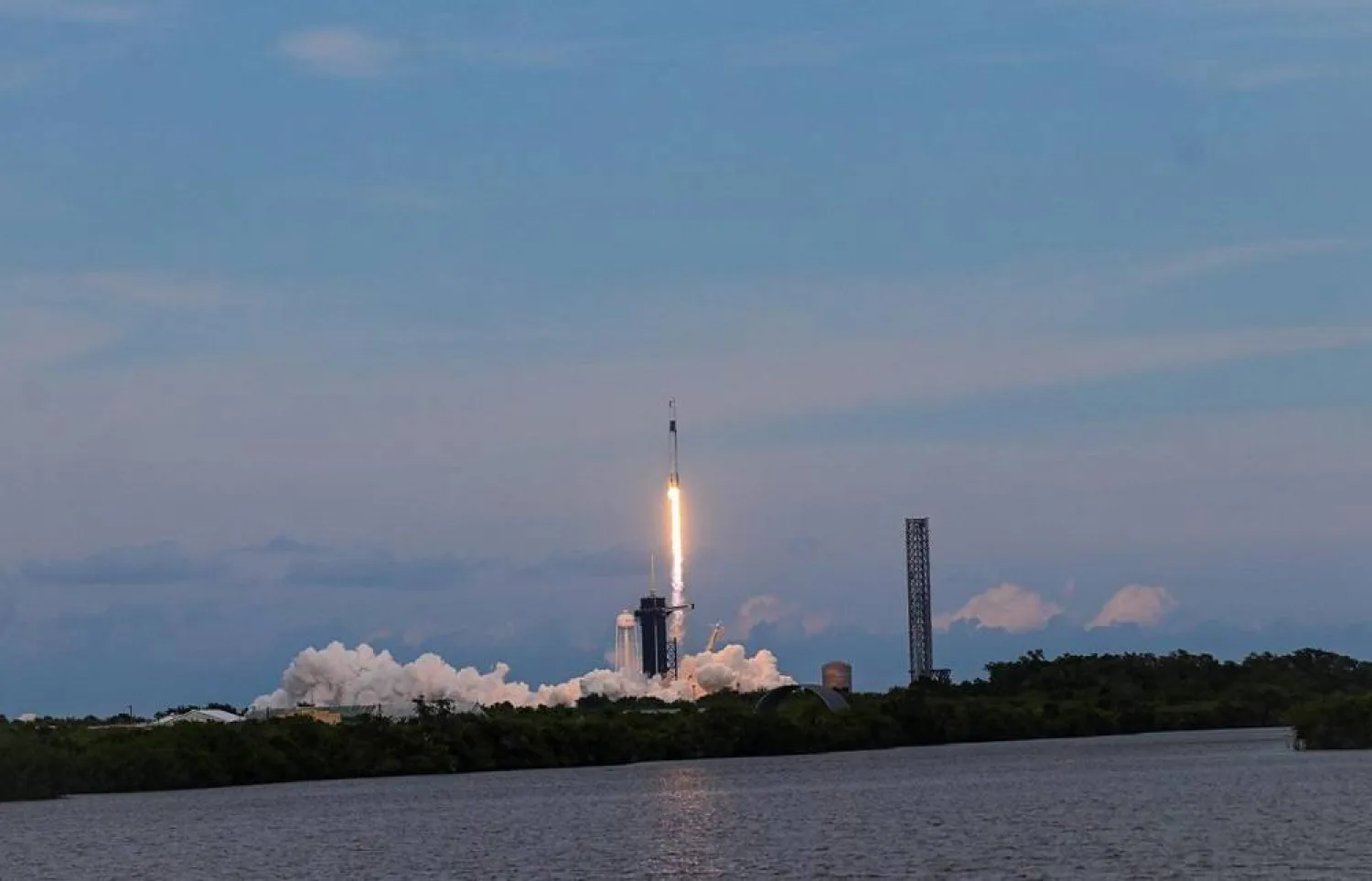

Saudi Arabia’s Bernawi, Al-Qarni Rocket towards ISS

Saudi Arabia’s first astronauts in decades, Rayana Bernawi, and Ali Al-Qarni, rocketed toward the International Space Station on Sunday. (SPA)
TT

Saudi Arabia’s Bernawi, Al-Qarni Rocket towards ISS

Saudi Arabia’s first astronauts in decades, Rayana Bernawi, and Ali Al-Qarni, rocketed toward the International Space Station on Sunday. (SPA)

Saudi Arabia’s first astronauts in decades, Rayana Bernawi, and Ali Al-Qarni, rocketed toward the International Space Station on Sunday.

SpaceX launched the crew, led by a retired NASA astronaut now working for the company that arranged the trip from Kennedy Space Center. Also on board: a US businessman who now owns a sports car racing team.

They should reach the space station in their capsule Monday morning; they’ll spend just over a week there before returning home with a splashdown off the Florida coast.

Bernawi, a stem cell researcher, became the first woman from the Kingdom to go to space. Al-Qarni is a fighter pilot with the Royal Saudi Air Force.

They’re the first from their country to ride a rocket since a Saudi prince launched aboard shuttle Discovery in 1985. In a quirk of timing, they’ll be greeted at the station by an astronaut from the United Arab Emirates.

“Hello from outer space! It feels amazing to be viewing Earth from this capsule,” Bernawi said after settling into orbit.

Added al-Qarni: “As I look outside into space, I can't help but think this is just the beginning of a great journey for all of us.”

Rounding out the visiting crew: Knoxville, Tennessee’s John Shoffner, former driver and owner of a sports car racing team that competes in Europe, and chaperone Peggy Whitson, the station’s first female commander who holds the US record for most accumulated time in space: 665 days and counting.

The mission aims to conduct scientific and research experiments that can help strengthen the Kingdom's global position in the field of space exploration, serve humanity and highlight the role of Saudi research centers.

During their trip, the two Saudi astronauts will carry out 14 research and scientific experiments in a microgravity environment, including three educational awareness experiments on the ISS. The experiments will focus on human research, cell sciences, and artificial cloud seeding.

King Faisal Specialist Hospital and Research Center (KFSH&RC), headed by Dr. Khalid Abu Khabar, Dr. Wejdan Al-Ahmadi and Dr. Edward Hitti and the Saudi Space Commission (SSC) will supervise the cell sciences experiment. They will monitor how the inflammatory response changes in space and the resulting changes in the lifespan of the messenger ribonucleic acid (mRNA) between space and Earth.

The King Fahd University of Petroleum and Minerals, headed by Dr. Ashraf Farahat, and in cooperation with the SSC, will supervise the cloud seeding experiment, which aims at simulating the process used in the Kingdom and many countries to increase rates of precipitation.

The experiment will help scientists and researchers come up with new methods to provide suitable conditions for humans to live in space colonies on the surface of the Moon and Mars. The experiment will help improve researchers' understanding of cloud seeding technology that helps increase rainfall in several countries.

Saudi Arabia’s Nebula Research and Development, led by Dr. Bader Shirah, in cooperation with the SSC, will conduct six experiments in the field of human research to learn about human adaptation to spaceflight, its safety on the brain and to understand the effects that occur on human health while in space.

During these experiments, the functions of human organs and vital systems will be tested in microgravity, such as measuring blood flow to the brain, assessing intracranial pressure and electrical activity of the brain, and monitoring changes in the optic nerve.

Moreover, experiments will include taking blood and biological samples to examine the vital signs associated with spaceflights, and mapping changes in the length, structure, and epigenetics of genes.

The Kingdom's male and female students will participate in scientific experiments aboard the ISS, to enhance cognitive awareness of space science and its contribution to improving the quality of life on Earth.

Students will be able to communicate with the Saudi astronauts directly by conducting their experiments together. The process will be held in cooperation with the Ministry of Education, King Abdulaziz and his Companions Foundation for Giftedness and Creativity "Mawhiba", Riyadh schools, and Misk schools.

The mission is part of the Kingdom's astronauts’ program, which is one of the programs that aims, in its first phase, to send two Saudi astronauts, a male and female, on a manned spaceflight to the ISS.

The program is expected to consolidate the Kingdom's position and place it among leading countries, inspiring future generations in space technologies, promoting scientific research in various fields of space, and strengthening national partnerships and cooperation with relevant authorities.

The program bears special significance in achieving the Kingdom's aspirations and goals of its Vision 2030.

The program aims to activate scientific innovations in space sciences. This will reflect positively on the future of the industry and the country. It focuses on the importance of developing skills, such as increasing national interest in science, technology, engineering, and mathematics (STEM) graduates and scaling-up investment in their potentials and developing human capital in accordance with the objectives of Vision 2030 by attracting talents and developing the necessary skills.

The launch of this program will pave the way for the Kingdom's ambitions in the field of space exploration, especially since it is able to conduct its own research independently.

This ambition is reinforced by the Kingdom’s previous achievements in space flight. Through the program, it aspires to enable more distinguished and talented citizens to unleash their capabilities and compete on the local and global levels.




Thieves Drill into a German Bank Vault and Steal Tens of Millions of Euros Worth of Property

 Police officers stand in front of the savings bank branch in the Buer district in Gelsenkirchen, Germany, Tuesday, Dec. 30, 2025 following a break-in into the bank's vault. (Christoph Reichwein/dpa via AP)
Police officers stand in front of the savings bank branch in the Buer district in Gelsenkirchen, Germany, Tuesday, Dec. 30, 2025 following a break-in into the bank's vault. (Christoph Reichwein/dpa via AP)
TT

Thieves Drill into a German Bank Vault and Steal Tens of Millions of Euros Worth of Property

 Police officers stand in front of the savings bank branch in the Buer district in Gelsenkirchen, Germany, Tuesday, Dec. 30, 2025 following a break-in into the bank's vault. (Christoph Reichwein/dpa via AP)
Police officers stand in front of the savings bank branch in the Buer district in Gelsenkirchen, Germany, Tuesday, Dec. 30, 2025 following a break-in into the bank's vault. (Christoph Reichwein/dpa via AP)

Thieves stole tens of millions of euros worth of property from safety deposit boxes inside a German bank vault that they drilled into Monday during the holiday lull, police said.

Some 2,700 bank customers were affected by the theft in Gelsenkirchen, police and the Sparkasse bank said.

Thomas Nowaczyk, a police spokesperson, said investigators believe the theft was worth between 10 and 90 million euros ($11.7 to 105.7 million).

German news agency dpa reported that the theft could be one of Germany's largest heists.

The bank remained closed Tuesday, when some 200 people showed up demanding to get inside, dpa reported.

A fire alarm summoned police officers and firefighters to the bank branch shortly before 4 a.m. Monday. They found a hole in the wall and the vault ransacked. Police believe a large drill was used to break through the vault's basement wall.

Witnesses told investigators they saw several men carrying large bags in a nearby parking garage over the weekend. Video footage from the garage shows masked people inside a stolen vehicle early Monday, police said.

Gelsenkirchen is about 192 kilometers (119 miles) northwest of Frankfurt.


The Year's First Meteor Shower and Supermoon Clash in January Skies

People look up to the sky from an observatory near the village of Avren, Bulgaria, Aug. 12, 2009. (AP Photo/Petar Petrov, File)
TT

The Year's First Meteor Shower and Supermoon Clash in January Skies

People look up to the sky from an observatory near the village of Avren, Bulgaria, Aug. 12, 2009. (AP Photo/Petar Petrov, File)

The year's first supermoon and meteor shower will sync up in January skies, but the light from one may dim the other.

The Quadrantid meteor shower peaks Friday night into Saturday morning, according to the American Meteor Society. In dark skies during the peak, skygazers typically see around 25 meteors per hour, but this time they'll likely glimpse less than 10 per hour due to light from Saturday's supermoon, The AP news reported.

“The biggest enemy of enjoying a meteor shower is the full moon,” said Mike Shanahan, planetarium director at Liberty Science Center in New Jersey.

Meteor showers happen when speedy space rocks collide with Earth’s atmosphere, burning up and leaving fiery tails in their wake — the end of a “shooting star.” A handful of meteors are visible on any given night, but predictable showers appear annually when Earth passes through dense streams of cosmic debris.

Supermoons occur when a full moon is closer to Earth in its orbit. That makes it appear up to 14% bigger and 30% brighter than the faintest moon of the year, according to NASA. That difference can be tough to notice with the naked eye.

Supermoons, like all full moons, are visible in clear skies everywhere that it's night. The Quadrantids, on the other hand, can be seen mainly from the Northern Hemisphere. Both can be glimpsed without any special equipment.

To spot the Quadrantids, venture out in the early evening away from city lights and watch for fireballs before the moon crashes the party, said Jacque Benitez with the Morrison Planetarium at the California Academy of Sciences. Skygazers can also try looking during early dawn hours on Sunday.

Wait for your eyes to get used to the darkness, and don’t look at your phone. The space rocks will look like fast-moving white dots and appear over the whole sky.

Meteor showers are named for the constellation where the fireballs appear to come from. The Quadrantids — space debris from the asteroid 2003 EH1 — are named for a constellation that's no longer recognized.

The next major meteor shower, called the Lyrids, is slotted for April.

Supermoons happen a few times a year and come in groups, taking advantage of the sweet spot in the moon’s elliptical orbit. Saturday night’s event ends a four-month streak that started in October. There won't be another supermoon until the end of 2026.


New Maritime Theater in Jazan to Host the City's Festival Opening

The site also includes various amenities, such as shopping zones, kiosks for dining, an art gallery - SPA
TT

New Maritime Theater in Jazan to Host the City's Festival Opening

The site also includes various amenities, such as shopping zones, kiosks for dining, an art gallery - SPA

The Jazan city theater on the southern corniche will host the opening ceremony of the Jazan Festival 2026 on Friday. This event will take place at a 35-square-kilometer site that features the Kingdom's largest maritime theater, SPA reported.

The theater accommodates more than 10,000 spectators and features five VIP areas. To ensure a smooth experience, the venue offers parking for over 9,000 vehicles, providing easy access during peak times.

Built specifically for the festival, the stage meets stringent safety and technical standards, providing a high-quality audiovisual experience against the stunning backdrop of the Red Sea.

The site also includes various amenities, such as shopping zones, kiosks for dining, an art gallery, a play area for children, a bird garden, and a regional museum, showcasing the region's history and culture.

This temporary maritime theater aims to provide a cohesive experience, integrating entertainment, culture, shopping, and services in one location, further establishing Jazan as a year-round destination for tourism and entertainment.