
Brazil Faces Dilemma: Endangered Macaw vs. Wind Farm

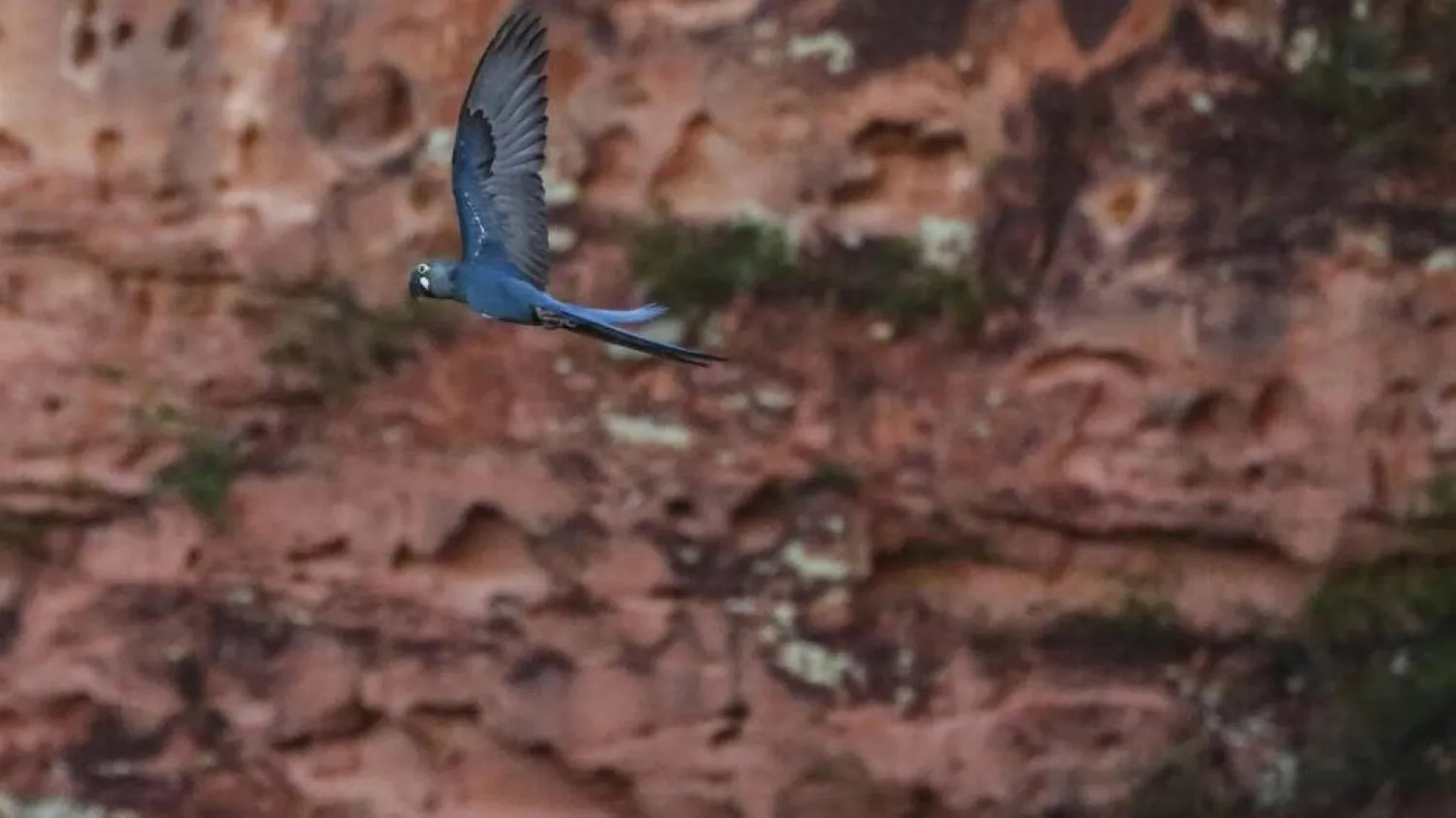
An endangered Lear's macaw (Anodorhynchus leari) flies over a reserve near the Canudos Biological Station, close to the Canudos Wind Energy Complex in Canudos, Bahia state, Brazil, on May 5, 2023. Rafael Martins / AFP
TT

Brazil Faces Dilemma: Endangered Macaw vs. Wind Farm

An endangered Lear's macaw (Anodorhynchus leari) flies over a reserve near the Canudos Biological Station, close to the Canudos Wind Energy Complex in Canudos, Bahia state, Brazil, on May 5, 2023. Rafael Martins / AFP

A wind farm in northeastern Brazil sounds like a welcome climate-friendly energy solution, but it is causing controversy over another kind of environmental worry: the impact on the endangered Lear's macaw.

Home to more than 90 percent of Brazil's booming wind-power industry, the northeast is known for strong, steady winds that President Luiz Inacio Lula da Silva wants to harness to power a green-energy revolution, said AFP.

The region has drawn the interest of French renewable energy company Voltalia, which broke ground last year on a 28-turbine, 100-megawatt wind farm in semi-arid Canudos county, in the state of Bahia.

But the project soon came under attack when it emerged that the enormous turbines, with their 120-meter (nearly 400-foot) diameter blades -- a known threat to birds in flight -- were being built in a nesting region for the Lear's macaw, a bright blue parrot also known as the indigo macaw, or by its scientific name Anodorhynchus leari.

Named for 19th-century English poet Edward Lear, the birds have dwindled to an estimated population of no more than 2,000 in the wild, as farming and logging have vastly reduced their habitat.

The wind farm is "very risky," said Marlene Reis, of the Lear's Macaw Gardens Project, an organization trying to save the species.

"It could considerably increase the risk of extinction," she told AFP.

And the damage "could be irreversible, especially for these iconic macaws, who only live and reproduce in this region."

A federal court halted the final stage of construction on the turbines in April, revoking Voltalia's permits.

"It cannot be considered a low environmental impact" project, given the proximity to an endangered bird species, the court ruled, ordering further impact studies and consultations with local communities.

Voltalia has appealed the decision.

"The potential environmental and social impacts have already been dealt with exhaustively," Voltalia's country manager for Brazil, Nicolas Thouverez, told AFP.

The impact studies required by state authorities have shown the turbines "in no way endanger the conservation" of the Lear's macaw, he said.

"They demonstrated the environmental viability of the project."

The company has proposed reducing risks by painting the turbines to make them more visible to birds, as well as fitting the macaws with GPS trackers and installing technology that immediately stops the blades turning when they fly over.

'The name of progress'

Brazil is a world leader on green energy.

It has the largest percentage of clean electricity in the G20 group of nations, at 89 percent.

Lula, who took office in January, has vowed to expand that further still.

Mines and Energy Minister Alexandre Silveira said recently that Lula wants to turn Brazil's impoverished northeast into the "biggest renewable energy breadbasket in the world."

Silveira has announced plans to install up to 30 gigawatts of clean energy production capacity in the northeast, mainly wind and solar.

The total investment could reach 120 billion reais ($24 billion).

But Voltalia offers a case study of the kind of opposition projects can run into on the ground.

In addition to the outcry over the Lear's macaw, the company faces resistance from small-scale communal farmers and cattle ranchers, around 7,500 of whom live in the area around the wind farm.

"The impact will be felt across the board," said Adelson Matos, 65, a white-bearded farmer who tends to goats, sheep, cows, chickens and fruit in the nearby village of Alto Redondo.

The wind farm is noisy, draws vehicle traffic at all hours, and has altered rain and wind patterns with its enormous structures, Matos complained.

"It breaks all harmony with the natural habitat," he told AFP.

"All in the name of progress," he said bitterly.


SpaceX Loses Contact with Starlink Satellite after Mishap

FILE PHOTO: SpaceX logo and Elon Musk silhouette are seen in this illustration taken, December 19, 2022. REUTERS/Dado Ruvic/Illustration/File Photo
TT

SpaceX Loses Contact with Starlink Satellite after Mishap

FILE PHOTO: SpaceX logo and Elon Musk silhouette are seen in this illustration taken, December 19, 2022. REUTERS/Dado Ruvic/Illustration/File Photo

SpaceX's Starlink said one of its satellites experienced an anomaly in space on Wednesday that created a "small number" of debris and cut off communications with the spacecraft at 418 km (259.73 miles) in altitude, a rare kinetic accident in orbit for the satellite internet giant.

"The satellite is largely intact, tumbling, and will reenter the Earth's atmosphere and fully demise within weeks," Starlink said in a post on X.

The company said it was working with the US Space Force and NASA to monitor the debris pieces, the number of which SpaceX did not say.

Space Force's space-tracking unit did not immediately return a Reuters request for comment on the number of trackable debris, which could pose risks for other active satellites in orbit.

With the Starlink satellite still somewhat intact, the event seemed smaller in scale than other orbital mishaps such as the breakup of an Intelsat satellite that created more than 700 pieces, or the breakup of a Chinese rocket body last year.


Lion, Bear Kept as Pets in Albania Find New Homes in German Wildlife Sanctuaries

In this photo, released on Tuesday, Dec. 16, 2025 by Four Paws, veterinarians prepare Erion, a three-year-old lion for its transportation from Tirana to Germany after its illegal keeping in Albania. (Four Paws via AP)
TT

Lion, Bear Kept as Pets in Albania Find New Homes in German Wildlife Sanctuaries

In this photo, released on Tuesday, Dec. 16, 2025 by Four Paws, veterinarians prepare Erion, a three-year-old lion for its transportation from Tirana to Germany after its illegal keeping in Albania. (Four Paws via AP)

A lion and bear rescued from captivity in northern Albania arrived in animal sanctuaries in Germany in early December after authorities in Tirana discovered they were being illegally kept as pets on a private estate.

Erion, a 3-year-old lion, and Flora, a 2-year-old bear, are now both starting a new life.

“We are very happy that the authorities confiscated the animals and that we now have the chance to bring them to Germany, where they can start over and live in species-appropriate conditions,” said Magdalena Scherk-Trettin, a senior project manager responsible for rescues at the international animal welfare organization FOUR PAWS.

A team from FOUR PAWS carried out the rescue after Albania’s National Forestry Agency located the lion based on videos posted on TikTok by its owner.

Neither authorities nor the organization have named the person who was keeping them as pets.

Veterinarians administered anesthesia before the animals were loaded into crates for their long trip to new homes. On Dec. 13, they ended a 70-hour journey through several European countries, with Erion now housed in a wild animal sanctuary in southeast Germany and Flora in a bear sanctuary in the north of the country, FOUR PAWS said.

The organization said both animals had been in poor condition.

“An initial visual check determined that Flora is malnourished and has dental issues, so her recovery plan is already underway,” the organization said.

And when Erion was rescued, his mane had fallen out, for reasons that the veterinarians have not yet been able to determine, it said.

Despite the challenging journey, the rescue was worth it, said Scherk-Trettin. “We are delighted to see these animals begin their new lives.”

Illegal wildlife trade remains a systemic problem in Albania and across the region, where bears in particular, as well as exotic animals, are kept in cages at restaurants or on private properties with little or no expert care.

Erion's and Flora's origins remain unclear. FOUR PAWS said it believes the lion is a victim of illegal wildlife trafficking, while the bear was likely poached from the wild.

“The rescue highlights Albania’s urgent need to tackle illegal wildlife trade and private keeping,” The Associated Press quoted the organization as saying in a statement.

Weak legislation, legal loopholes and poor enforcement have contributed to the widespread private captivity and trade of wild animals in Albania, according to FOUR PAWS, which estimates that more than 60 big cats are still being kept in poor conditions in Albania.

Albanian law allows for individuals or organizations to keep specimens of wild animals if they were born in captivity – for example in a zoo or a specialized facility. Non-native species born outside of Albania can also be kept if documents can be provided proving they were acquired from specialized breeding and trade centers.

Sajmir Shehu, a project manager at Four Paws, said the law lacks a stringent framework based on which organizations like his could prevent wild animals being kept in captivity.

The law also allows for animals to be confiscated if welfare or veterinary standards are not met, but imposes no sanctions on the owners of exotic pets.


Saturn's Moon Titan May Not Have a Buried Ocean as Long Suspected, New Study Suggests

This image made by the Cassini spacecraft and provided by NASA on March 12, 2006, shows two of Saturn's moons, the small Epimetheus and smog-enshrouded Titan, with Saturn's A and F rings stretching across the frame. (NASA via AP)
TT

Saturn's Moon Titan May Not Have a Buried Ocean as Long Suspected, New Study Suggests

This image made by the Cassini spacecraft and provided by NASA on March 12, 2006, shows two of Saturn's moons, the small Epimetheus and smog-enshrouded Titan, with Saturn's A and F rings stretching across the frame. (NASA via AP)

Saturn's giant moon Titan may not have a vast underground ocean after all.

Titan instead may hold deep layers of ice and slush more akin to Earth’s polar seas, with pockets of melted water where life could possibly survive and even thrive, scientists reported Wednesday.

The team led by researchers at NASA's Jet Propulsion Laboratory challenged the decade-long assumption of a buried global ocean at Titan after taking a fresh look at observations made years ago by NASA’s Cassini spacecraft around Saturn.

They stress that no one has found any signs of life at Titan, the solar system’s second largest moon spanning 3,200 miles (5,150 kilometers) and brimming with lakes of liquid methane on its frosty surface, The AP news reported.

But with the latest findings suggesting a slushy, near-melting environment, “there is strong justification for continued optimism regarding the potential for extraterrestrial life,” said the University of Washington’s Baptiste Journaux, who took part in the study published in the journal Nature.

As to what form of life that might be, possibly strictly microscopic, “nature has repeatedly demonstrated far greater creativity than the most imaginative scientists," he said in an email.

JPL’s Flavio Petricca, the lead author, said Titan’s ocean may have frozen in the past and is currently melting, or its hydrosphere might be evolving toward complete freezing.

Computer models suggest these layers of ice, slush and water extend to a depth of more than 340 miles (550 kilometers). The outer ice shell is thought to be about 100 miles (170 kilometers) deep, covering layers of slush and pools of water that could go down another 250 miles (400 kilometers). This water could be as warm as 68 degrees Fahrenheit (20 degrees Celsius).

Because Titan is tidally locked, the same side of the moon faces Saturn all the time, just like our own moon and Earth. Saturn’s gravitational pull is so intense that it deforms the moon’s surface, creating bulges as high as 30 feet (10 meters) when the two bodies are closest.

Through improved data processing, Petricca and his team managed to measure the timing between the peak gravitational tug and the rising of Titan’s surface. If the moon held a wet ocean, the effect would be immediate, Petricca said, but a 15-hour gap was detected, indicating an interior of slushy ice with pockets of liquid water. Computer modeling of Titan’s orientation in space supported their theory.

Sapienza University of Rome’s Luciano Iess, whose previous studies using Cassini data indicated a hidden ocean at Titan, is not convinced by the latest findings.

While “certainly intriguing and will stimulate renewed discussion ... at present, the available evidence looks certainly not sufficient to exclude Titan from the family of ocean worlds," Iess said in an email.

NASA’s planned Dragonfly mission — featuring a helicopter-type craft due to launch to Titan later this decade — is expected to provide more clarity on the moon’s innards. Journaux is part of that team.

Saturn leads the solar system’s moon inventory with 274. Jupiter’s moon Ganymede is just a little larger than Titan, with a possible underground ocean. Other suspected water worlds include Saturn’s Enceladus and Jupiter’s Europa, both of which are believed to have geysers of water erupting from their frozen crusts.

Launched in 1997, Cassini reached Saturn in 2004, orbiting the ringed planet and flying past its moons until deliberately plunging through Saturn’s atmosphere in 2017.