


Rich Countries Should Play Bigger Role in Combating Pandemics, Says WHO Draft

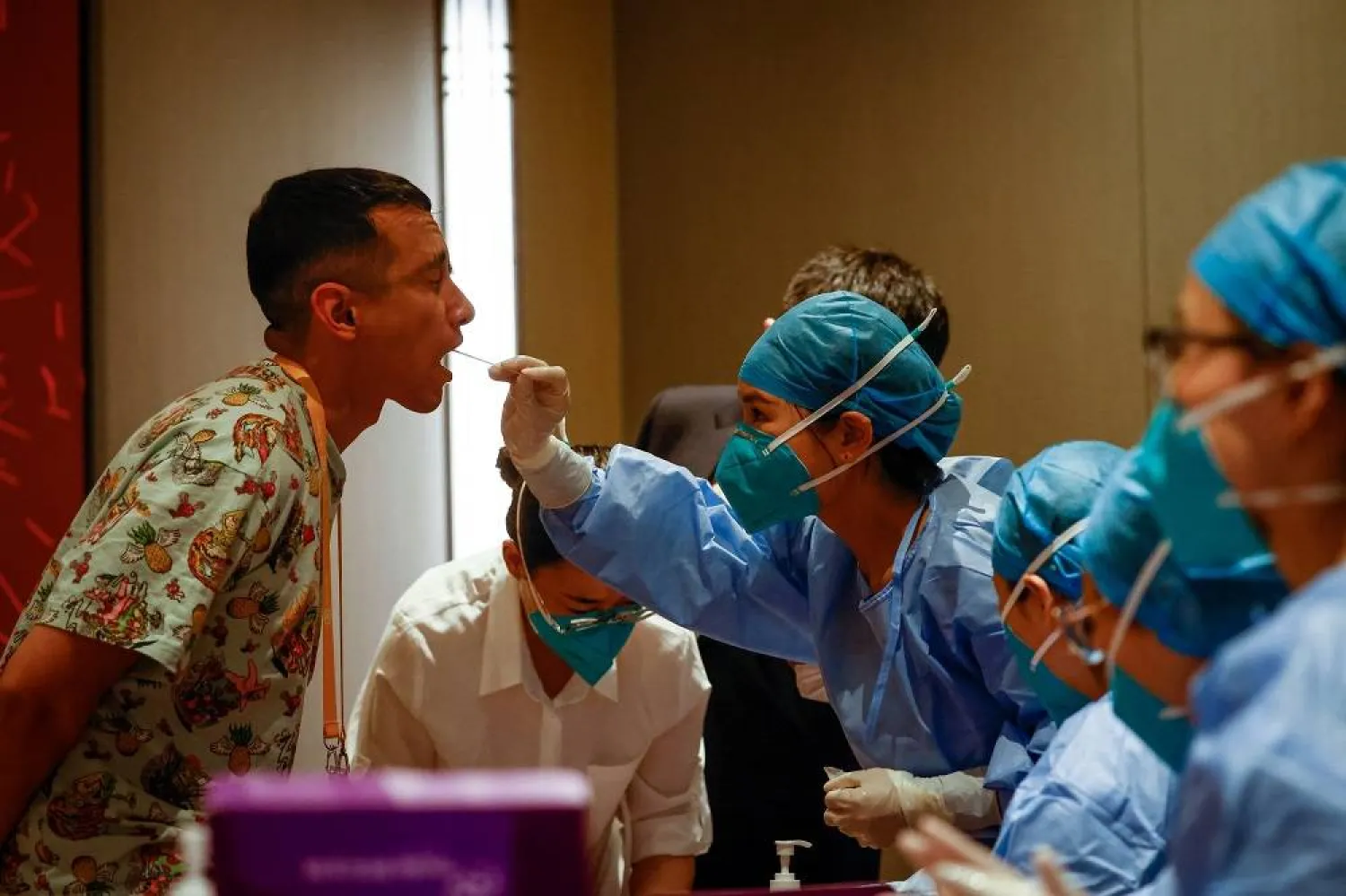
A journalist undergoes a Covid-19 PCR test ahead of the China-Central Asia Summit welcome ceremony at a hotel in Xi'an, Shaanxi province, China, 18 May 2023. (EPA)
TT

Rich Countries Should Play Bigger Role in Combating Pandemics, Says WHO Draft

A journalist undergoes a Covid-19 PCR test ahead of the China-Central Asia Summit welcome ceremony at a hotel in Xi'an, Shaanxi province, China, 18 May 2023. (EPA)

Richer countries should be asked to better pull their weight in helping the world cope with pandemics, according to a new draft of a treaty being negotiated at the World Health Organization.

Countries with more "capacities and resources" should bear a "commensurate degree" of responsibility for preparing for and responding to global health threats, the draft, seen by Reuters on Tuesday, suggests.

The treaty, a legally binding agreement being negotiated by WHO member states, aims to address what it calls the "catastrophic failure" of the international community to fight COVID-19 fairly around the world.

COVID has killed around 7 million people since it emerged in China at the end of 2019, disrupting the global economy and ravaging communities. More than 750 million infections have been reported.

The 42-page document aims to help the world do better next time. Member states have the option to remove numerous paragraphs from it in future negotiations, including the one about responsibilities.

Sections that have proved controversial in earlier drafts, including around intellectual property and reserving 20% of tests, treatments and vaccines for the WHO to distribute in poorer countries during emergencies, remain in the new draft but could still be removed. No such provision on pandemic countermeasures existed during COVID.

A clause in an earlier draft obliging pharmaceutical companies to make details of their deals with governments public appears to have been dropped.

The document also defines "pandemic" - one of several sticking points that have already taken up negotiating time - as "the global spread of a pathogen or variant" that spreads easily, is dangerous, overwhelms health systems, and requires international coordination.

The treaty is due to be finalized by 2024.


NCW Releases over 10,000 Animals under Reintroduction Programs

The releases carried out by the center over the past years included more than 80 priority wildlife species - SPA
TT

NCW Releases over 10,000 Animals under Reintroduction Programs

The releases carried out by the center over the past years included more than 80 priority wildlife species - SPA

The National Center for Wildlife (NCW) announced that the total number of wildlife animals released under its breeding and reintroduction programs for locally threatened species has exceeded 10,000 animals, an achievement reflecting the scale of the center’s sustained efforts to develop wildlife, restore ecosystems, and enhance biodiversity across various regions of the Kingdom.

The releases carried out by the center over the past years included more than 80 priority wildlife species, including reem gazelles (sand gazelles), Arabian oryx, Idmi gazelles, mountain ibex, houbara bustards, ostriches, and sandgrouse, as part of efforts aimed at supporting the recovery of natural populations of these species and enhancing their sustainability within their environmental and historical ranges, SPA reported.

CEO of NCW Dr. Mohammad Qurban noted that release operations are among the key tools for restoring ecosystems and reducing ecological imbalance, as the return of wildlife to their natural habitats contributes to protecting biodiversity and improving environmental quality, which in turn supports habitat integrity, the continuity of plant and animal components, and the enhancement of ecosystem functions over the long term.

NCW continues to implement its strategic plans to develop wildlife, protect endangered species, and enhance the efficiency of natural habitat management through expanding breeding programs, enhancing applied scientific research, building national capacities, and applying the best international practices in biodiversity management, in addition to raising environmental awareness, engaging local communities, and supporting eco-tourism, thereby contributing to achieving the objectives of the Saudi Green Initiative and Saudi Vision 2030, and the National Environment Strategy, toward thriving and sustainable wildlife, biodiversity, and ecosystems.


Somalia Welcomes Its First Bowling Alley as the Middle Class and Diaspora Returnees Grow

 People bowl at the Feynuus Bowling Center in Mogadishu, Somalia, on Jan. 15, 2026. (AP)
People bowl at the Feynuus Bowling Center in Mogadishu, Somalia, on Jan. 15, 2026. (AP)
TT

Somalia Welcomes Its First Bowling Alley as the Middle Class and Diaspora Returnees Grow

 People bowl at the Feynuus Bowling Center in Mogadishu, Somalia, on Jan. 15, 2026. (AP)
People bowl at the Feynuus Bowling Center in Mogadishu, Somalia, on Jan. 15, 2026. (AP)

In a city long defined by conflict, Somalia ’s capital of Mogadishu now echoes with the crash of pins at the country's first modern bowling alley.

It's the latest sign of revival in the once-thriving Indian Ocean port shaped by 35 years of civil war and militant bombings. Millions of people were forced to flee what became one of the world’s most dangerous cities. Those who remained avoided public spaces as the al-Qaeda-linked group al-Shabab waged an insurgency against the Somali state.

In recent years, improved security measures against al-Shabab, an expanded government presence and growing private investment have allowed daily life to re-emerge. Cafes line newly reopened streets, beaches draw evening crowds and traffic congestion, once unimaginable, now clogs key intersections.

The Feynuus Bowling Center opened last year and draws many locals and Somalis returning from the diaspora, who bring investment and business ideas after years of sending billions of dollars in remittances from abroad.

On a recent evening, young Somalis gathered in groups, laughing and filming each other on their phones while music played. Many from the diaspora are visiting Mogadishu for the first time in years, or the first time ever.

“I couldn’t believe Mogadishu has this place,” said Hudoon Abdi, a Somali-Canadian on holiday, as she prepared to take her turn to bowl.

“I’m enjoying it. Mogadishu is actually safe,” she said, urging others to visit.

Mogadishu remains vulnerable to militant attacks, however, with security measures like checkpoints and heavily guarded zones part of daily life. Non-Somalis remain largely confined to a compound at the international airport.

But residents say the ability to gather for recreation signals an important psychological shift. Such venues provide a welcoming environment for a younger generation eager for safe spaces to socialize.

Abukar Hajji returned from the United Kingdom on holiday after many years away and found the difference between what he imagined and what he experienced eye-opening.

“When I was flying from the UK, I believed it was a scary place, like a war-torn country,” he said. “Everyone told me, ‘Good luck,’ but when I came and saw it with my own eyes, I didn’t want to leave.”

Sadaq Abdurahman, the manager of the bowling center, said the idea for the business emerged from a growing demand among young people for recreational facilities.

“It has created employment opportunities for at least 40 youths,” he said.

According to the Somali National Bureau of Statistics, Somalia’s unemployment rate stands at 21.4%.

The bowling alley has private security guards, bag checks and surveillance cameras, reflecting the precautions common at public venues in Mogadishu.

Urban planners and economists say businesses like the bowling alley signal a broader shift in Mogadishu’s recovery, as private sector growth increasingly complements international aid and government-led rebuilding efforts.

Ahmed Khadar Abdi Jama, a lecturer in economics at the University of Somalia, said innovative businesses are responding to the needs of diaspora returnees and the growing middle class, “which in turn adds to the expected increase in Somalia’s GDP.”

Outside the bowling alley, traffic hummed and neon signs flickered, other reminders of Mogadishu’s fragile transformation.


Benefit of Taking Magnesium Does Not Get Enough Attention

Nutrition experts recommended trying to get more of magnesium in our diet from food first (Harvard University)
TT

Benefit of Taking Magnesium Does Not Get Enough Attention

Nutrition experts recommended trying to get more of magnesium in our diet from food first (Harvard University)

Nutrition experts revealed that magnesium is often not given the same attention as other vitamins and minerals, although it plays a pivotal role in supporting the overall health of our body, especially improving blood sugar management and supporting neuro-psychological balance.

According to the US National Institutes of Health (NIH), magnesium is an abundant mineral in our body and it’s naturally present in many foods.

The mineral is required in more than 300 different reactions in our body, including those that regulate muscle and nerve function, blood sugar levels, and blood pressure.

“Magnesium plays a role in how our body handles sugar,” Scott Keatley, RD, co-owner of Keatley Medical Nutrition Therapy told Prevention magazine.

“It helps with the action of insulin, the hormone that controls blood sugar levels.” When you have enough magnesium in your body, insulin can work better and your body can manage blood sugar more effectively, Keatley said.

Also, stress can cause our body to use more magnesium than usual, which can limit our body’s ability to do other tasks with the nutrient, Keatley said.

“In addition, magnesium can help reduce the release of stress hormones like cortisol,” he said. “It’s like a natural chill pill that can help keep our body’s stress response in check.”

Magnesium helps regulate brain function and mood. It plays a role in releasing and using neurotransmitters, which are chemicals in our brain that affect our mood and emotions.

The mineral may help improve bone density and decrease fracture risk.
“Magnesium is stored in bones and is an important part of bone health,” said Deborah Cohen, DCN, an associate professor in the department of clinical and preventive nutrition sciences at Rutgers University School of Health Professions.

At baseline, magnesium can help to relax and widen your blood vessels, Keatley said. “This makes it easier for blood to flow and can help lower blood pressure,” he added. “It’s like making the highways wider so that traffic can move more smoothly.”

A 2025 review in hypertension found that magnesium seems to be beneficial for lowering blood pressure in people with high blood pressure and magnesium deficiency, but larger studies are needed.

There are a lot of foods that are high in magnesium. Nutrition experts recommended trying to get more of the nutrient in our diet from food first.

These are the most magnesium-rich foods, according to the NIH are: Pumpkin seeds, Chia seeds, almonds, spinach, cashews, peanuts, shredded wheat, soymilk, black beans, edamame, peanut butter, potato with skin, brown rice and plain yogurt.
