


German Prosecutor Says Clues to McCann Child Disappearance Possible at Portuguese Dam Site 

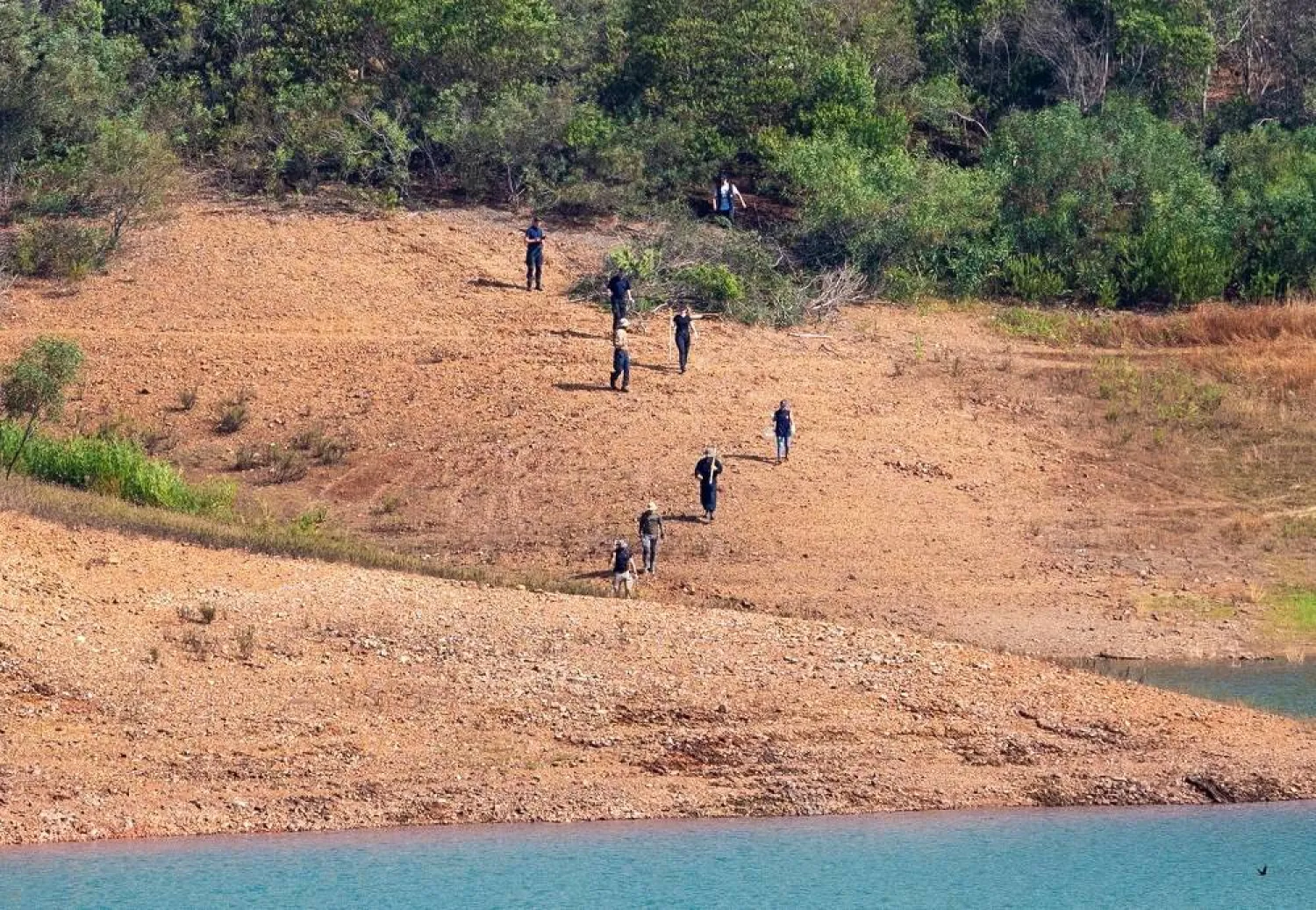
Portuguese and German police search a reservoir near the area where British girl Madeleine McCann went missing in the Portuguese Algarve in May 2007, in Silves, Portugal, May 24, 2023. (Reuters)
TT

German Prosecutor Says Clues to McCann Child Disappearance Possible at Portuguese Dam Site 

Portuguese and German police search a reservoir near the area where British girl Madeleine McCann went missing in the Portuguese Algarve in May 2007, in Silves, Portugal, May 24, 2023. (Reuters)

Police searching for clues regarding the disappearance of Madeleine McCann, the British child who went missing in 2007 in Portugal, were concentrating operations Wednesday in several areas around a dam, including one where media reports say a lead suspect in the case often stayed.

The latest search for clues regarding the disappearance started Tuesday following a request by German authorities. Some 30 Portuguese, German and British police are taking part in the operation at the Arade dam, which is located about 50 kilometers (30 miles) from the resort of Praia da Luz, where the 3-year-old girl was last seen 16 years ago.

In Germany, Braunschweig prosecutor Christian Wolters told German public broadcaster NDR, “We have indications that we could find evidence there. I don’t want to say what that is exactly, and I also don’t want to say where these indications come from.

“The only thing that I would clarify is that it doesn’t come from the suspect — so we don’t have a confession or anything similar now, or an indication from the suspect of where it would make sense to search,” Wolters said, adding that “it was other indications that prompted us to conduct this search.”

But Wolters appeared to calm expectations of what might be found, saying, "We never said that the girl disappeared where we are now searching.”

Police on Tuesday were studying an area where Portuguese and Spanish media say the suspect stayed around the time that Madeleine went missing.

Officers could be heard using a motor saw to clear trees and bushes in the zone, which is located on the far side of the reservoir from the base camp that police set up Monday.

Police have given no details on the progress of the searches so far, but leading Portuguese daily Expresso said Wednesday that the first day ended with no significant results, adding that police had collected some objects including fabrics and garments. It said that in places where the sniffer dogs signaled, the soil was dug up, possibly indicating that biological traces were also being sought.

The search is expected to end Wednesday or Thursday.

Detectives from the three countries are still trying to figure out what happened on the night when the toddler disappeared from her bed in the southern Portuguese resort on May 3, 2007. She was in the same room as her twin brother and sister, who were 2 at the time, while her parents had dinner with friends at a nearby restaurant.

Portuguese media say this is the fourth search for McCann, following the initial one in 2007 in the Algarve area and further efforts in 2013 and 2014. Another search was held in Germany in 2020.

In mid-2020, German officials said that a 45-year-old German citizen, identified by media as Christian Brueckner, who was in the Algarve in 2007, was a suspect in the case. Brueckner has denied any involvement.

Brueckner is currently serving a seven-year prison sentence in Germany for raping a 72-year-old woman in Portugal in 2005.

He is under investigation in the McCann case, but hasn’t been charged. He spent many years in Portugal, including in Praia da Luz, around the time of Madeleine’s disappearance.

The reservoir is currently less than half full owing to a drought affecting Portugal and neighboring Spain. Much of the area being searched would be below water level in years of normal rainfall.

Madeleine’s parents aren't commenting because of the active investigation, according to an email response from the website set up for the search for the child, findmadeleine.com.



Row Deepens Over Vanished River Wave in Munich

(FILES) Surfers ride the Eisbach (ice creek) wave during freezing conditions on the Isar River in the English Garden in Munich, southern Germany on January 4, 2017. (Photo by Mark RALSTON / AFP)
TT

Row Deepens Over Vanished River Wave in Munich

(FILES) Surfers ride the Eisbach (ice creek) wave during freezing conditions on the Isar River in the English Garden in Munich, southern Germany on January 4, 2017. (Photo by Mark RALSTON / AFP)

A row over the disappearance of a famous river surfing wave in Munich escalated on Sunday as authorities removed a beam inserted over Christmas to recreate the attraction.

The Eisbach wave on a side branch of the Isar River had been a landmark in the Bavarian city since the 1980s but it vanished in October after annual cleanup work along the riverbed.

Activists had placed a beam in the water early on December 25 to partially recreate the wave, according to German media reports, and hung a banner above the water that read "Merry Christmas".

But a spokesman for the Munich fire service told AFP the "installation was removed" on Sunday at the request of city authorities.

Activists have made several attempts to reinstate the wave in the city's Englischer Garten park since October -- only to see them reversed.

The local surfers' association IGSM on Thursday posted a statement on its website saying it had abandoned its campaign to save the wave, accusing city authorities of dragging their feet.

The Eisbach wave was considered the largest and most consistent river wave in the heart of a major city and had become a tourist attraction in Bavaria's state capital.

Franz Fasel, head of the IGSM, told AFP in July that 3,000 to 5,000 local surfers were using it.

Access to the wave was cut off for several months earlier this year after the death of a 33-year-old Munich woman who became trapped under the surface while surfing at night.


New York Subway Ends its MetroCard Era and Switches Fully to Tap-and-go Fares

Lev Radin, a MetroCard collector, shows his collection of Inaugural Limited Edition MetroCards, Dec. 10, 2025, in New York. (AP Photo/Yuki Iwamura)
TT

New York Subway Ends its MetroCard Era and Switches Fully to Tap-and-go Fares

Lev Radin, a MetroCard collector, shows his collection of Inaugural Limited Edition MetroCards, Dec. 10, 2025, in New York. (AP Photo/Yuki Iwamura)

When the MetroCard replaced the New York City subway token in 1994, the swipeable plastic card infused much-needed modernity into one of the world’s oldest and largest transit systems.

Now, more than three decades later, the gold-hued fare card and its notoriously finicky magnetic strip are following the token into retirement, The Associated Press reported.

The last day to buy or refill a MetroCard is Dec. 31, 2025, as the transit system fully transitions to OMNY, a contactless payment system that allows riders to tap their credit card, phone or other smart device to pay fares, much like they do for other everyday purchases.

Transit officials say more than 90% of subway and bus trips are now paid using the tap-and-go system, introduced in 2019.

Major cities around the world, including London and Singapore, have long used similar contactless systems. In the US, San Francisco launched a pay-go system earlier this year, joining Chicago and others.

MetroCards upended how New Yorkers commute The humble MetroCard may have outlasted its useful life, but in its day it was revolutionary, says Jodi Shapiro, curator at the New York Transit Museum in Brooklyn, which opened an exhibit earlier this month reflecting on the MetroCard’s legacy.

Before MetroCards, bus and subway riders relied on tokens, the brass-colored coins introduced in 1953 that were purchased from station booths. When the subway opened in 1904, paper tickets cost just a nickel, or about $1.82 in today’s dollars.

“There was a resistance to change from tokens to something else because tokens work,” Shapiro said on a recent visit to the museum, housed underground in a decommissioned subway station. “MetroCards introduced a whole other level of thinking for New Yorkers.”

The Metropolitan Transportation Authority launched public campaigns to teach commuters how to swipe the originally blue-colored cards correctly, hoping to avoid the dreaded error message or lost fares. Officials even briefly toyed with the idea of a quirky mascot, the Cardvaark, before coming to their senses.

The cards quickly became collectors items as the transit system rolled out special commemorative editions marking major events, such as the “Subway Series” between baseball’s New York Mets and the New York Yankees in the 2000 World Series. At the time, a fare cost $1.50.

Artists from David Bowie and Olivia Rodrigo to seminal New York hip hop acts, such as the Wu-Tang Clan, the Notorious B.I.G. and LL Cool J, have also graced the plastic card over the years, as have iconic New York shows like Seinfeld and Law & Order.

“For me, the most special cards are cards which present New York City to the world,” said Lev Radin, a collector in the Bronx. “Not only photos of landmarks, skylines, but also about people who live and make New York special.”

Perfecting the correct angle and velocity of the MetroCard swipe also became something of a point of pride separating real New Yorkers from those just visiting.

During her failed 2016 presidential campaign, Hillary Clinton, a former US Senator from New York, took an excruciating five swipes at a Bronx turnstile. In fairness, her chief Democratic opponent at the time, US Sen. Bernie Sanders of Vermont, a native Brooklynite, didn't even appear to realize tokens had been discontinued.

Cost savings and lingering concerns Unlike the MetroCard rollout, OMNY has required little adjustment.

Riders reluctant to use a credit card or smart device can purchase an OMNY card they can reload, similar to a MetroCard. Existing MetroCards will also continue to work into 2026, allowing riders to use remaining balances.

MTA spokespersons declined to comment, pointing instead to their many public statements as the deadline approaches.

The agency has said the changeover saves at least $20 million annually in MetroCard-related costs.

The new system also allows unlimited free rides within a seven-day period because the fare is capped after 12 rides. It'll max out at $35 a week once the fare rises to $3 in January.

Still, new changes come with tradeoffs, with some critics raising concerns about data collection and surveillance.

Near Times Square on a recent morning, Ronald Minor was among the dwindling group of "straphangers" still swiping MetroCards.

The 70-year-old Manhattan resident said he's sad to see them go. He has an OMNY card but found the vending machines to reload it more cumbersome.

“It’s hard for the elders,” Minor said as he caught a train to Brooklyn. “Don’t push us aside and make it like we don’t count. You push these machines away, you push us away.”

John Sacchetti, another MetroCard user at the Port Authority stop, said he likes being able to see his balance as he swipes through a turnstile so he knows how much he’s been spending on rides.

“It’s just like everything else, just something to get used to," he said as he headed uptown. "Once I get used to it, I think it’ll be okay.”


French Legend Brigitte Bardot Dead at 91

FILED - 01 April 1956, France, Cannes: Then French actress and singer Brigitte Bardot is photographed with a parrot in her hand on the beach during the Cannes Film Festival. Photo: -/AFP Intercontinentale/dpa
TT

French Legend Brigitte Bardot Dead at 91

FILED - 01 April 1956, France, Cannes: Then French actress and singer Brigitte Bardot is photographed with a parrot in her hand on the beach during the Cannes Film Festival. Photo: -/AFP Intercontinentale/dpa

French film legend Brigitte Bardot, a cinema icon of the 1950s and sixties who walked away from global stardom to become an animal rights protector, has died aged 91, her foundation said Sunday.

Bardot had rarely been seen in public in recent months but was hospitalized in October and in November released a statement denying rumors that she had died. The foundation did not say when or where she died.

"The Brigitte Bardot Foundation announces with immense sadness the death of its founder and president, Madame Brigitte Bardot, a world-renowned actress and singer, who chose to abandon her prestigious career to dedicate her life and energy to animal welfare and her foundation," it said in a statement sent to AFP.

Bardot became a global star after appearing in "And God created Woman" in 1956, and went on to appear in about 50 more movies before giving up acting.

She retired from film to settle permanently near the Riviera resort of Saint-Tropez where she devoted herself to fighting for animals.

Her calling apparently came when she encountered a goat on the set of her final film, "The Edifying and Joyous Story of Colinot.”

To save it from being killed, she bought the animal and kept it in her hotel room.