


Turkish Voters Weigh Final Decision on Next President, Visions for Future

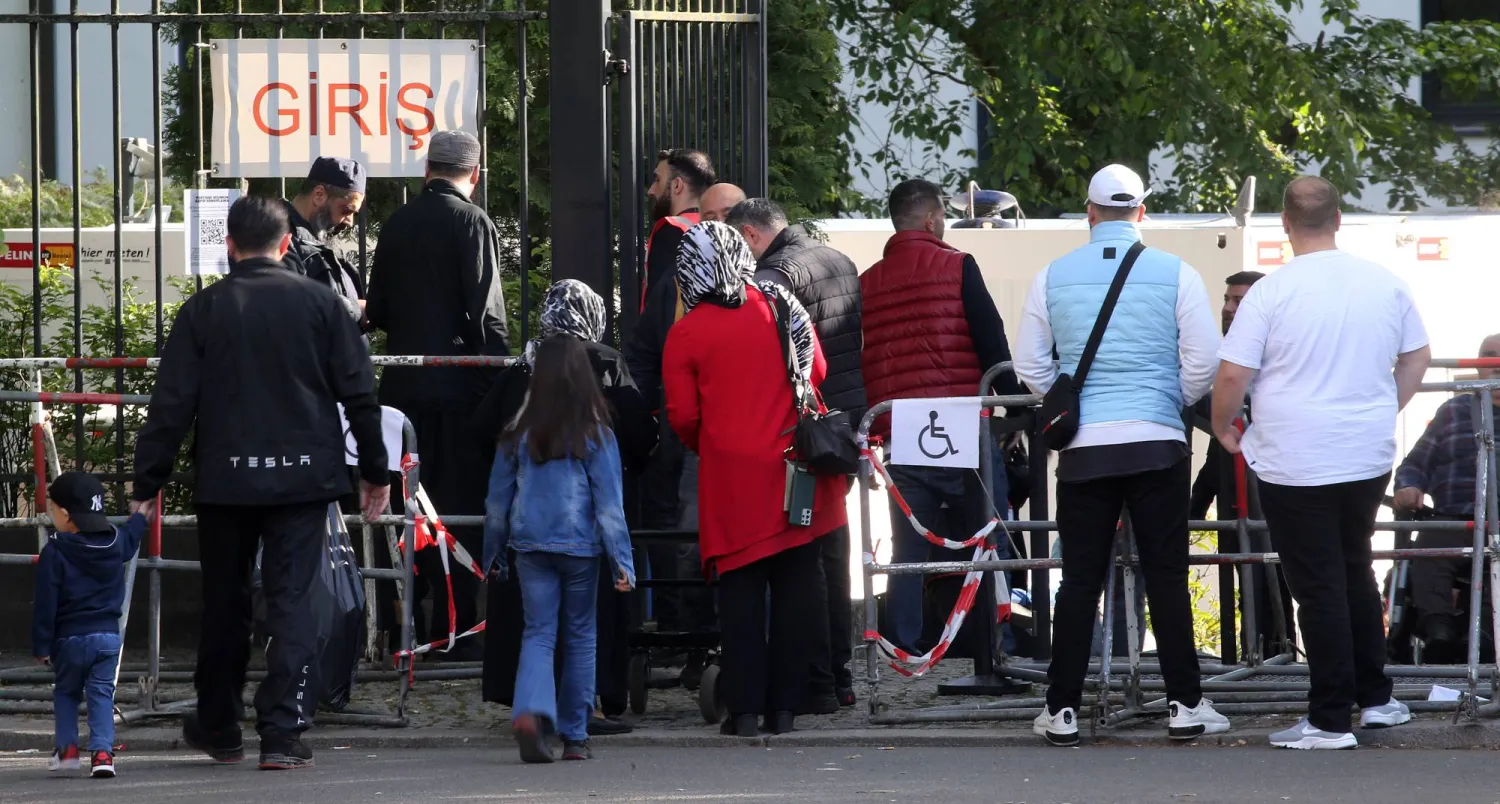
24 May 2023, Berlin: People line up in front of the Turkish Consulate General's property to cast their votes in containers set up for the runoff election in Türkiye. Photo: Wolfgang Kumm/dpa
TT

Turkish Voters Weigh Final Decision on Next President, Visions for Future

24 May 2023, Berlin: People line up in front of the Turkish Consulate General's property to cast their votes in containers set up for the runoff election in Türkiye. Photo: Wolfgang Kumm/dpa

Two opposing visions for Türkiye’s future are on the ballot when voters return to the polls Sunday for a runoff presidential election that will decide between an increasingly authoritarian incumbent and a challenger who has pledged to restore democracy.

President Recep Tayyip Erdogan, a populist and polarizing leader who has ruled Türkiye for 20 years, is well positioned to win after falling just short of victory in the first round of balloting on May 14. He was the top finisher even as the country reels from sky-high inflation and the effects of a devastating earthquake in February, The Associated Press said.

Kemal Kilicdaroglu, the leader of Türkiye’s pro-secular main opposition party and a six-party alliance, has campaigned on a promise to undo Erdogan's authoritarian tilt. The 74-year-old former bureaucrat has described the runoff as a referendum on the direction of the strategically located NATO country, which is at the crossroads of Europe and Asia and has a key say over the alliance's expansion.

“This is an existential struggle. Türkiye will either be dragged into darkness or light,” Kilicdaroglu said. “This is more than an election. It has turned into a referendum.”

In a bid to sway nationalist voters ahead of Sunday's runoff, the normally soft-mannered Kilicdaroglu (pronounced KEH-lich-DAHR-OH-loo) shifted gear and hardened his stance, vowing to send back millions of refugees if he is elected and rejecting any possibility of peace negotiations with Kurdish fighters.

The social democrat had previously said he planned to repatriate Syrians within two years, after establishing economic and safety conditions conducive to their return.

He has also repeatedly called on 8 million people who stayed away from the polls in the first round to cast votes in the make-or-break runoff.

Erdogan scored 49.5% of the vote in the first round. Kilicdaroglu received 44.9%.

At 69, Erdogan is already Türkiye’s longest-serving leader, having ruled over the country as prime minister since 2003 and as president since 2014. He could remain in power until 2028 if reelected.

Under Erdogan, Türkiye has proven to be an indispensable and sometimes troublesome NATO ally.

It vetoed Sweden’s bid to join the alliance and purchased Russian missile-defense systems, which prompted the United States to oust Türkiye from a US-led fighter-jet project. Yet together with the UN Türkiye also brokered a vital deal that allowed Ukraine to ship grain through the Black Sea to parts of the world struggling with hunger.

This week, Erdogan received the endorsement of the nationalist third-place candidate, Sinan Ogan, who garnered 5.2% of the vote. The move was seen as a boost for Erdogan even though Ogan’s supporters are not a monolithic bloc and not all of his votes are expected to go to Erdogan.

Erdogan’s nationalist-Islamist alliance also retained its hold on parliament in legislative elections two weeks ago, further increasing his chances for reelection as many voters are likely to want to avoid a split government.

On Wednesday, the leader of a hardline anti-migrant party that had backed Ogan threw its weight behind Kilicdaroglu after the two signed a protocol pledging to send back millions of migrants and refugees within the year.

Kilicdaroglu’s chances of turning the vote around in his favor appear to be slim but could hinge on the opposition’s ability to mobilize voters who did not cast ballots in the first round.

“It’s not possible to say that the odds are favoring him, but nevertheless, technically, he stands a chance,” said professor Serhat Guvenc of Istanbul’s Kadir Has University.

If the opposition can reach the voters who previously stayed home, "it may be a different story.”

In Istanbul, 45-year-old Serra Ural accused Erdogan of mishandling the economy and said she would vote for Kilicdaroglu.

She also expressed concerns over the rights of women after Erdogan extended his alliance to include Huda-Par, a hardline Kurdish Islamist political party with alleged links to a group that was responsible for a series of gruesome killings in the 1990s. The party wants to abolish mixed-gender education, advocates for the criminalization of adultery and says women should prioritize their homes over work.

“We don’t know what will happen to women tomorrow or the next day, what condition they’ll be in,” she said. “To be honest Huda-Par scares us, especially women.”

Mehmet Nergis, 29, said he would vote for Erdogan for stability.

Erdogan "is the guarantee for a more stable future,” Nergis said. “Everyone around the world has already seen how far he has brought Türkiye.”

He dismissed the country’s economic woes and expressed confidence that Erdogan would make improvements.

Erdogan’s campaign has focused on rebuilding areas that were devastated by the earthquake, which leveled cities and left more 50,000 dead in Türkiye. He has promised to build 319,000 homes within the year.

In the parliamentary election, Erdogan’s alliance won 10 out 11 provinces in the region affected by the quake despite criticism that his government’s initial disaster response was slow.

“Yes, there was a delay, but the roads were blocked,” said Yasar Sunulu, an Erdogan supporter in Kahramanmaras, the quake’s epicenter. “We cannot complain about the state ... It gave us food, bread and whatever else needed."

He and his family members are staying in a tent after their house was destroyed.

Nursel Karci, a mother of four living in the same camp, said she too would vote for Erdogan.

Erdogan "did all that I couldn’t,” she said. “He clothed my children where I couldn’t clothe them. He fed them where I couldn’t ... Not a penny left my pocket.”

Erdogan has repeatedly portrayed Kilicdaroglu as colluding with the outlawed Kurdistan Workers’ Party, or PKK, after the opposition party leader received the backing of the country’s pro-Kurdish party.

During a rally in Istanbul, Erdogan broadcast a faked video purporting to show a PKK commander singing the opposition’s campaign song to hundreds of thousands of his supporters. On Monday, Erdogan doubled down on the narrative, insisting that the PKK has thrown its support to Kilicdaroglu whether the video is “faked or not.”

“Most analysts failed to gauge the impact of Erdogan’s campaign against Kilicdaroglu,” Guvenc said. “This obviously did strike a chord with the average nationalist-religious electorate in Türkiye.”

“Politics today is about building and sustaining a narrative which shadows the reality," he added. "Erdogan and his people are very successful in building narratives that eclipse realities.”



Trump Hints at Land Strike as Venezuela Pressure Mounts

A US Air Force C-130J Super Hercules aircraft approaches for landing at Rafael Hernandez Airport, amid tensions between US President Donald Trump's administration and the government of Venezuelan President Nicolas Maduro, in Aguadilla, Puerto Rico, December 28, 2025. (Reuters)
TT

Trump Hints at Land Strike as Venezuela Pressure Mounts

A US Air Force C-130J Super Hercules aircraft approaches for landing at Rafael Hernandez Airport, amid tensions between US President Donald Trump's administration and the government of Venezuelan President Nicolas Maduro, in Aguadilla, Puerto Rico, December 28, 2025. (Reuters)

A throwaway remark last week by President Donald Trump has raised questions about whether US forces may have carried their first land strike against drug cartels in Venezuela.

Trump said the US knocked out a "big facility" for producing trafficking boats, as he was discussing his pressure campaign against Venezuelan President Nicolas Maduro in an interview broadcast Friday.

"They have a big plant or a big facility where they send, you know, where the ships come from," Trump said in an interview with billionaire supporter John Catsimatidis on the WABC radio station in New York.

"Two nights ago we knocked that out. So we hit them very hard."

Trump did not say where the facility was located or give any other details. US forces have carried out numerous strikes in both the Caribbean Sea and eastern Pacific Ocean since September, killing more than 100 people.

The Pentagon referred questions about Trump's remarks to the White House. The White House did not respond to requests for comment from AFP.

There has been no official comment from the Venezuelan government.

Trump has been saying for weeks that the United States will "soon" start carrying out land strikes targeting drug cartels in Latin America, but there have been no confirmed attacks to date.

The Trump administration has been ramping up pressure on Maduro, accusing the Venezuelan leader of running a drug cartel himself and imposing an oil tanker blockade.

Maduro has accused Washington of attempting regime change.


UN Chief Says ‘Get Serious’ in Grim New Year Message

 UN Secretary-General Antonio Guterres. (AFP)
UN Secretary-General Antonio Guterres. (AFP)
TT

UN Chief Says ‘Get Serious’ in Grim New Year Message

 UN Secretary-General Antonio Guterres. (AFP)
UN Secretary-General Antonio Guterres. (AFP)

The United Nations urged global leaders Monday to focus on people and the planet in a New Year's message depicting the world in chaos.

"As we enter the new year, the world stands at a crossroads. Chaos and uncertainty surround us. Division. Violence. Climate breakdown. And systemic violations of international law," UN Secretary-General Antonio Guterres said in a video message.

In 2026, as war rages in Ukraine and elsewhere, world leaders must work to ease human suffering and fight climate change, he added.

"I call on leaders everywhere: Get serious. Choose people and planet over pain," said Guterres, criticizing the global imbalance between military spending and financing for the poorest countries.

Military spending is up nearly 10 percent this year to $2.7 trillion, which is 13 times total world spending on development aid and equivalent to the entire gross domestic product of Africa, he said.

Wars are raging at levels unseen since World War II, he added.

"In this New Year, let's resolve to get our priorities straight. A safer world begins by investing more in fighting poverty and less in fighting wars. Peace must prevail," said Guterres, who will be serving his last year as secretary general.


Türkiye and Armenia Agree to Simplify Visa Procedures to Normalize Ties

Türkiye’s President Recep Tayyip Erdogan, right, and Armenia's Prime Minister Nikol Pashinyan shake hands before a meeting at Prague Castle in Prague, Czech Republic, Thursday, Oct. 6, 2022. (Turkish Presidency via AP, File)
TT

Türkiye and Armenia Agree to Simplify Visa Procedures to Normalize Ties

Türkiye’s President Recep Tayyip Erdogan, right, and Armenia's Prime Minister Nikol Pashinyan shake hands before a meeting at Prague Castle in Prague, Czech Republic, Thursday, Oct. 6, 2022. (Turkish Presidency via AP, File)

Türkiye and Armenia have agreed to simplify visa procedures as part of efforts to normalize ties, Türkiye’s Foreign Ministry announced Monday, making it easier for their citizens to travel between the two countries.

Relations between Türkiye and Armenia have long been strained by historic grievances and Türkiye’s alliance with Azerbaijan. The two neighboring countries have no formal diplomatic ties and their joint border has remained closed since the 1990s.

The two countries, however, agreed to work toward normalization in 2021, appointing special envoys to explore steps toward reconciliation and reopening the frontier. Those talks have progressed in parallel with efforts to ease tensions between Armenia and Azerbaijan.

Türkiye supported Azerbaijan during its 2020 conflict with Armenia for control of the Karabakh region, known internationally as Nagorno-Karabakh, a territorial dispute that had lasted nearly four decades.

The Turkish Foreign Ministry said in a statement posted on social platform X that Ankara and Yerevan agreed that holders of diplomatic, special and service passports from both countries would be able to obtain electronic visas free of charge as of Jan. 1.

“On this occasion, Türkiye and Armenia reaffirm once again their commitment to continue the normalization process between the two countries with the goal of achieving full normalization without any preconditions,” the ministry said.

Türkiye and Armenia also have a more than century-old dispute over the deaths of an estimated 1.5 million Armenians in massacres, deportations and forced marches that began in 1915 in Ottoman Türkiye. Historians widely view the event as genocide.

Türkiye denies the deaths constituted genocide, saying the toll has been inflated and those killed were victims of civil war and unrest. It has lobbied to prevent countries from officially recognizing the massacres as genocide.