


Saudi Economic Developments Challenge Business Councils’ Capacity to Keep Pace

Saudi flags along a commercial street in the capital Riyadh, Saudi Arabia (Asharq Al-Awsat)
TT

Saudi Economic Developments Challenge Business Councils’ Capacity to Keep Pace

Saudi flags along a commercial street in the capital Riyadh, Saudi Arabia (Asharq Al-Awsat)

Amidst Saudi Arabia’s push for economic diversification, the localization of emerging industries, the adoption of green energy technologies like ammonia and hydrogen, climate-conscious initiatives, and the integration of artificial intelligence, experts stress the vital importance of business councils affiliated with the Federation of Saudi Chambers to assume a proactive role.

Their task involves not only keeping pace with the ever-evolving modern economic and industrial landscape but also spearheading the necessary adaptations to effectively respond to transformative developments.

Experts stressed the importance of business councils adopting a strategic plan to attract top investments, form successful partnerships, produce high-quality products that can compete globally, and draw on innovative experiences from various fields, especially in aerospace and technology.

“Business councils play a crucial and primary role in fostering economic and trade relations, facilitating investment flows between Saudi Arabia and other countries,” affirmed Shura Council member Fadl al-Buainain.

“Additionally, they enhance mutual cooperation and contribute to translating commercial and investment opportunities into tangible and high-quality partnerships,” he told Asharq Al-Awsat.

“The more business councils receive the support and guidance of leadership, the more effective their role becomes in overall development,” explained Buainain.

“Saudi Arabia is keen on enhancing the role of the private sector through joint business councils, with increasing support in line with the government’s vision to strengthen strategic partnerships with friendly countries.”

“These councils are envisioned as a bridge for development and investment flows, aligning with a comprehensive vision.”

Buainain further highlighted that within the private sector, there are large companies in which the government holds the majority of ownership. As a result, economic decisions intertwine with sovereign developmental decisions, ultimately serving the public interest.

Regarding the new trends that business councils are expected to focus on, Buainain emphasized the importance of exploring opportunities for green economic development.

He highlighted that this is one of the Kingdom’s main objectives, noting that there is a package of initiatives, including financial investments exceeding SAR 700 billion ($186.6 billion).

According to Buainain, this means expanding investments in two main areas: first, enhancing energy sources to ensure supply sustainability and market stability, and second, promoting green economic development that safeguards the environment and human health.

These efforts are directed towards achieving long-term carbon neutrality.

Buainain also highlighted that the completion of the green hydrogen plant project, which is the world’s largest green hydrogen project with a cost of $5 billion, will enable the Kingdom to export clean fuel in the coming years.

He emphasized that diversifying economic sources is the primary goal of Crown Prince Mohammed bin Salman, stating that hydrogen production is a significant part of his strategy.



Saudi EXIM Bank Signs Trilateral MoU with Poland’s BGK and KUKE

The MoU enhances collaboration among the three parties in export support, financing, and insurance - SPA
TT

Saudi EXIM Bank Signs Trilateral MoU with Poland’s BGK and KUKE

The MoU enhances collaboration among the three parties in export support, financing, and insurance - SPA

Saudi Export-Import Bank (Saudi EXIM Bank) has signed a memorandum of understanding with two Polish financial institutions, Bank Gospodarstwa Krajowego (BGK) and Polish export credit agency (KUKE), strengthening cooperation in export support, financing, and insurance, and expanding trade and investment between Saudi Arabia and the Republic of Poland.

According to a press release issued by the Saudi EXIM Bank today, the agreement was signed by Saudi EXIM Bank Deputy CEO Dr. Naif bin Abdulrahman Al-Shammari, Member of the Board of BGK Mateusz Szczurek and CEO and President of the Board of KUKE Janusz Władyczak during the Saudi-Polish Investment Forum, SPA reported.

The MoU enhances collaboration among the three parties in export support, financing, and insurance, including export-related co-financing, guarantees, insurance, and reinsurance. It also promotes the exchange of information and expertise relating to export credit policies and practices, in addition to organizing meetings, workshops, training programs, and capacity-building initiatives.

The release added that the agreement enables Saudi and Polish companies to explore joint business and project opportunities of mutual interest, while facilitating access to non-oil export markets for both countries through cooperation among export finance and guarantee institutions.

On this occasion, Al-Shammari stated: “This memorandum comes as an extension of Saudi EXIM’s efforts to build high-quality partnerships with global export finance and credit insurance institutions, and to establish a cooperation framework that enables exporters and buyers in Saudi Arabia and Poland to access new markets. Through this cooperation, we look forward to enhancing the flow of mutual trade and investment and opening broader horizons for companies to benefit from the opportunities available in both countries.”

The signing of this MoU aligns with Saudi EXIM Bank's strategy to build effective partnerships with export finance and credit guarantee institutions worldwide, supporting the growth and competitiveness of Saudi non-oil exports in regional and global markets, in line with the objectives of Vision 2030.


Oil Gains as Traders Weigh Supply Risks Linked to US–Iran Tensions

A pumpjack, used to help lift oil from a well, in the Permian basin near Midland, Texas, US, October 8, 2025. REUTERS/Arathy Somasekhar/File Photo
TT

Oil Gains as Traders Weigh Supply Risks Linked to US–Iran Tensions

A pumpjack, used to help lift oil from a well, in the Permian basin near Midland, Texas, US, October 8, 2025. REUTERS/Arathy Somasekhar/File Photo

Oil prices edged up on Tuesday as traders gauged the potential for supply disruptions after US guidance for vessels transiting the Strait of Hormuz kept attention squarely on tensions between Washington and Tehran.

Brent crude oil futures were up 37 cents, or 0.5%, at $69.41 a barrel by 1136 GMT. US West Texas Intermediate crude rose 25 cents, or 0.4%, to $64.61.

"The market is still focused on the tensions between Iran and the US," said Tamas Varga, an oil analyst at brokerage PVM.

"But unless there are concrete signs of supply disruptions, prices will likely start going lower," he said. "The market is range-bound, it's an oversupplied market against geopolitics."

Prices rose more than 1% on Monday, when the US Department of Transportation's Maritime Administration advised US-flagged commercial vessels to stay as far from Iran’s territorial waters as possible and to verbally decline Iranian forces' permission to board if asked.

About a fifth of the oil consumed globally passes through the Strait of Hormuz between Oman and Iran, making any escalation in the area a major risk to global oil supplies.

Iran and fellow OPEC members Saudi Arabia, the United Arab Emirates, Kuwait and Iraq export most of their crude via the strait, mainly to Asia.

The guidance was issued despite Iran's top diplomat saying last week that Oman-mediated nuclear talks with the US were off to a "good start" and set to continue.

Goldman Sachs analysts wrote in a note on Tuesday that prices were supported by geopolitics, with a pickup in oil on vessels as buyers seek to secure more oil amid heightened uncertainty.

"While talks in Oman produced a cautiously positive tone, lingering uncertainty over potential escalation, sanctions tightening, or supply disruptions in the Strait of Hormuz has kept a modest risk premium intact," said Tony Sycamore, an analyst at IG.

Meanwhile, the European Union has proposed extending its sanctions against Russia to include ports in Georgia and Indonesia that handle Russian oil, the first time the bloc would target ports in third countries, according to a proposal document seen by Reuters.

The move is part of efforts to tighten sanctions on Russian oil, a key source of revenue for Moscow, over the war in Ukraine.

Indian Oil Corp bought six million barrels of crude from West Africa and the Middle East, traders said, as India steered clear of Russian oil in New Delhi's push for a trade deal with Washington, which the countries hope to conclude in March.


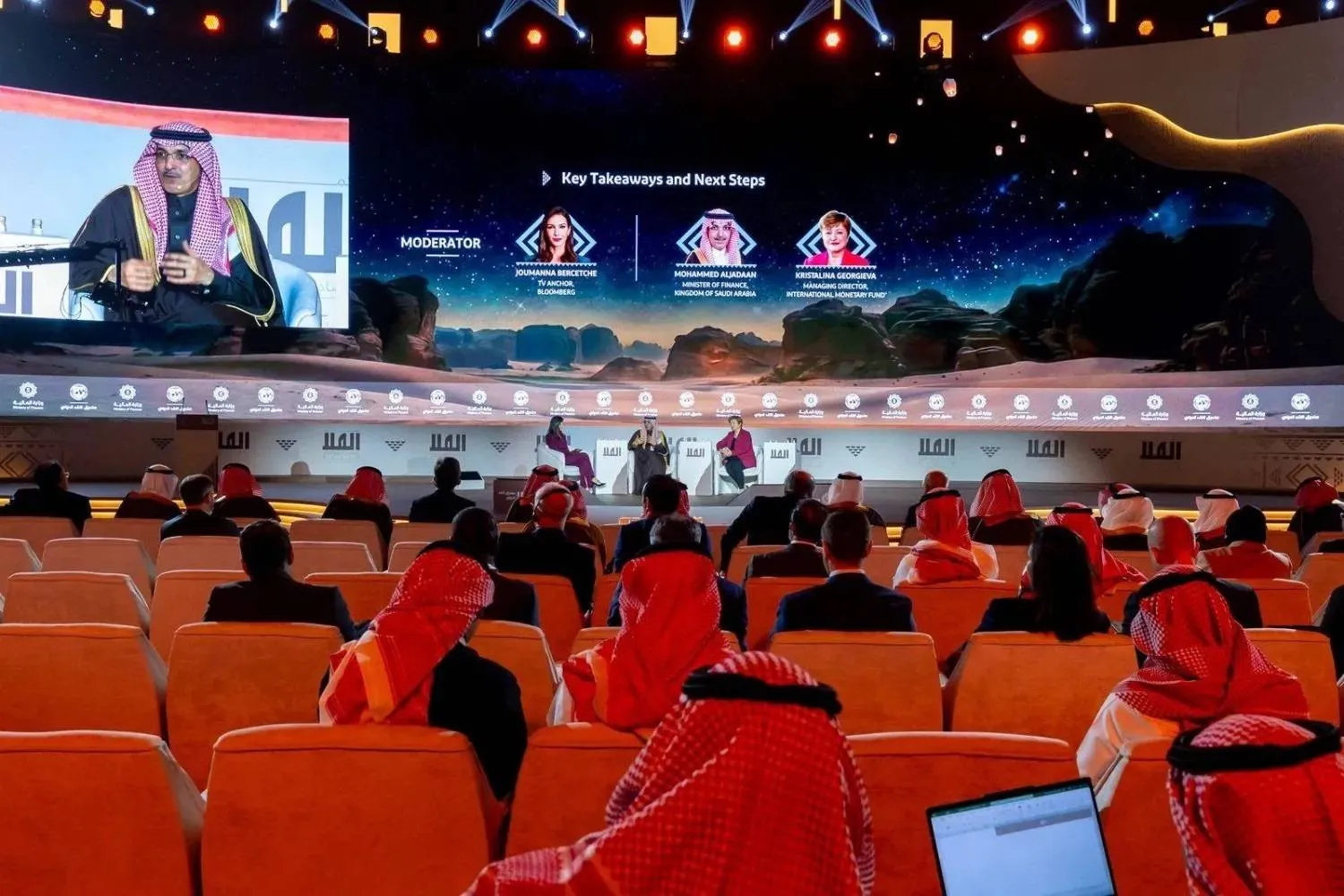
AlUla Conference Urges Emerging Economies to Act Decisively, Define Their Own Growth Models

Saudi Arabia’s Minister of Finance addresses attendees at the AlUla Conference for Emerging Market Economies (Asharq Al-Awsat). 
TT

AlUla Conference Urges Emerging Economies to Act Decisively, Define Their Own Growth Models

Saudi Arabia’s Minister of Finance addresses attendees at the AlUla Conference for Emerging Market Economies (Asharq Al-Awsat). 

The AlUla Conference for Emerging Market Economies concluded with a clear call for emerging nations to move beyond imitation and take ownership of their economic futures, as global uncertainty reshapes trade, finance and development models.

Speakers stressed that emerging markets now possess the confidence and capacity to set their own standards and compete globally on their own terms.

Conference discussions reflected a growing shift in mindset among emerging economies, which are increasingly positioning themselves as influential players in the global economy rather than peripheral participants.

A central theme was the expanding role of the private sector, which participants described not only as a partner in development but as a primary engine of sustainable growth.

Saudi Finance Minister Mohammed Al-Jadaan emphasized the need for decisive reform, regardless of political or economic difficulty. He rejected the notion of a “perfect time” for change, urging emerging economies to diagnose their own challenges and take responsibility for addressing them without waiting for external direction.

Speaking during the conference’s closing session on Monday, Al-Jadaan said postponing necessary reforms only increases their cost. He noted that successful structural transformation depends on bold leadership and an acceptance that meaningful economic reform inevitably requires difficult decisions.

Transparency, he said, remains central to Saudi Arabia’s Vision 2030, particularly in building trust with citizens, investors and international partners. Al-Jadaan revealed that more than 87 per cent of Vision 2030 initiatives have been completed or are on track, while 93 per cent of key performance indicators have been achieved or are progressing as planned.

He cited artificial intelligence as an example of adaptive policymaking, noting that while the technology was not initially a dominant focus, changing global conditions required adjustments to ensure Saudi Arabia captures its economic value.

In the same closing dialogue, International Monetary Fund Managing Director Kristalina Georgieva called on governments to shift from directly managing economies to enabling them. She said reducing state control over companies is essential to unlocking innovation and allowing the private sector to flourish.

Georgieva highlighted the mounting challenges facing emerging economies, including geopolitical tensions, demographic change and climate pressures, all of which have increased global uncertainty and made international cooperation indispensable.

Despite differing national circumstances, she said emerging economies share a common goal of building strong institutions and pursuing sound fiscal and monetary policies to enhance resilience.

She also underscored the role of international financial institutions in sharing best practices and supporting a more integrated global economy, concluding with a symbolic message: “One hand does not clap,” to emphasize the importance of partnership in achieving shared prosperity.

The second edition of the AlUla Conference for Emerging Market Economies was hosted in AlUla in partnership between Saudi Arabia’s Ministry of Finance and the International Monetary Fund, bringing together finance ministers, central bank governors, international financial leaders and experts from around the world at a time of heightened global economic uncertainty.