


Villagers Flee Floods as Huge Kakhovka Dam Destroyed in Ukraine War Zone

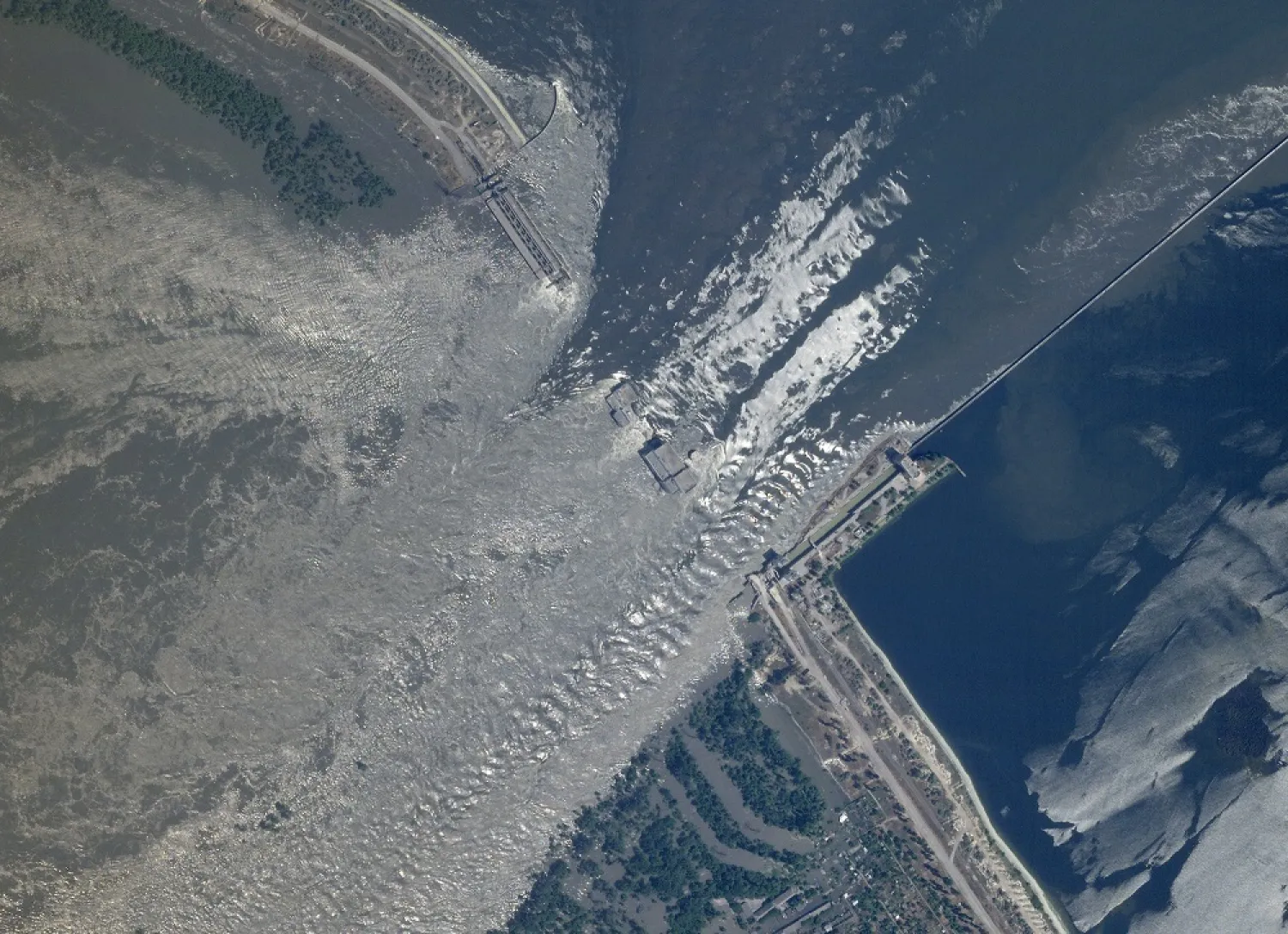
This satellite image provided by Planet Labs PBC shows an overview of the damage on the Kakhovka dam in southern Ukraine on Tuesday, June 6, 2023. (Planet Labs PBC via AP)
TT

Villagers Flee Floods as Huge Kakhovka Dam Destroyed in Ukraine War Zone

This satellite image provided by Planet Labs PBC shows an overview of the damage on the Kakhovka dam in southern Ukraine on Tuesday, June 6, 2023. (Planet Labs PBC via AP)

A torrent of water burst through a massive dam on the Dnipro River that separates Russian and Ukrainian forces in southern Ukraine on Tuesday, flooding a swathe of the war zone and forcing villagers to flee.

Ukraine accused Russia of blowing up the Nova Kakhovka dam in a deliberate war crime. The Kremlin said it was Ukraine that had sabotaged the dam, to distract attention from the launch of a major counteroffensive Moscow says is faltering. Some Russian-installed officials said the dam had burst on its own.

Neither side offered immediate public evidence of who was to blame. The Geneva Conventions explicitly ban targeting dams in war, because of the danger to civilians.

By mid-morning in the city of Kherson in Ukrainian government-controlled territory downstream from the dam, a pier on a tributary of the Dnipro had already been submerged.

Lidia Zubova, 67, waiting for a train out of the city after abandoning her inundated village of Antonivka, told Reuters: "Our local school and stadium downtown were flooded... The road was completely flooded, our bus got stuck."

Ukrainian police released video of an officer carrying an elderly woman to safety and others rescuing dogs in villages being evacuated as the waters rose. Interior Minister Ihor Klymenko accused Russia of shelling areas from where people were being evacuated and said two police officers were wounded.

On the Russian-controlled bank of the Dnipro, the Moscow-installed mayor of Nova Kakhovka said water levels had risen to 11 meters (36 feet). Residents reached by telephone there told Reuters that some had decided to stay despite being ordered out by occupying Russians.

"They say they are ready to shoot without warning," said one local man, Hlib, describing encounters with Russian troops. "If you come a meter closer than allowed, they immediately start yelling obscenities. We're still allowed to go to the store, but we don't know what orders will be given next."

Yevheniya, a female resident, said the water was up to the knees of the Russian soldiers walking the main street in high rubber boots. "If you try to go somewhere they don't allow, they immediately point their machine guns at you," she said. "More and more water is coming every hour. It's very dirty."

The Kazkova Dibrova zoo on the Russian-held riverbank was completely flooded and all 300 animals were dead, a representative said via the zoo's Facebook account.

The dam supplies water to a wide area of southern Ukrainian farmland, including the Russian-occupied Crimean peninsula, as well as cooling the Russian-held Zaporizhzhia nuclear plant.

The vast reservoir behind the dam is one of the main geographic features of southern Ukraine, 240 km (150 miles) long and up to 23 km (14 miles) wide.

An expanse of countryside lies in the flood plain below, with low-lying villages on the Russian-held southern bank particularly vulnerable.

'Terrorists'

The dam's destruction raised fears of a new humanitarian disaster in the center of the war zone and transformed front lines just as Ukraine prepared to launch a long-awaited counteroffensive to drive Russian troops from its territory.

Russia has controlled the dam since early in its 15-month-old invasion, although Ukrainian forces recaptured the Dnipro's northern bank last year. Both sides had long accused the other of plotting to destroy the dam.

"Russian terrorists. The destruction of the Kakhovka hydroelectric power plant dam only confirms for the whole world that they must be expelled from every corner of Ukrainian land," President Volodymyr Zelenskiy wrote on the Telegram messaging app.

Russians had "carried out an internal detonation of the structures" of the dam, Zelenskiy said. "About 80 settlements are in the zone of flooding."

NATO Secretary-General Jens Stoltenberg called it "an outrageous act, which demonstrates once again the brutality of Russia's war in Ukraine".

Kremlin spokesman Dmitry Peskov blamed "deliberate sabotage by the Ukrainian side".

"Apparently, this sabotage is also connected with the fact that having started large-scale offensive actions two days ago, now the Ukrainian armed forces are not achieving their goals."

Earlier, Russian-installed officials had given conflicting accounts, some saying the dam had been hit by Ukrainian missiles overnight, others saying it had burst on its own due to earlier damage.

Zaporizhzhia nuclear plant

The UN nuclear watchdog said the Zaporizhzhia power plant, upriver on the reservoir's Russian-held bank, should have enough water to cool its reactors for "some months" from a separate pond, even as the huge reservoir drains out.

Video showed water surging through the remains of the dam - which is 30 meters (yards) tall and 3.2 km (2 miles) long.

Some 22,000 people living across 14 settlements in the Kherson region are at risk of flooding, Russia's RIA news agency quoted the Moscow-installed head of the region as saying.

The Russian-installed governor of Crimea, Sergei Aksyonov, said there was a risk that water levels in the canal that carries fresh water to the Black Sea peninsula could fall. Crimea, which Russia has held since 2014, had sufficient water reserves for now and the risk would become clear in coming days.

Zelenskiy said in an interview published on Saturday that Ukraine was poised to unleash its much-heralded major counteroffensive, using newly supplied Western battle tanks and armored vehicles.

Moscow has said the Ukrainian offensive began on Sunday and claimed to have repulsed a third day of Ukrainian advances.

Kyiv has maintained deliberate ambiguity about it though Zelenskiy hinted at successes. In an evening address before the dam broke, he hailed "the news we have been waiting for" claiming forward moves around Bakhmut, a ruined city Russia captured earlier this month.

Russia also carried out a fresh wave of overnight air strikes on Kyiv. Ukraine said its air defense systems had downed more than 20 cruise missiles on their approach to the capital.

The Shebekino district of Russia's Belgorod region near the Ukrainian border came under renewed shelling, local authorities said. Anti-government Russian fighters based in Ukraine claim to have captured villages there.



Iran Strikes Hard Line on US Talks, Saying Tehran's Power Comes From Saying 'No'

Traffic moves through a street in Tehran on February 7, 2026. (Photo by ATTA KENARE / AFP)
TT

Iran Strikes Hard Line on US Talks, Saying Tehran's Power Comes From Saying 'No'

Traffic moves through a street in Tehran on February 7, 2026. (Photo by ATTA KENARE / AFP)

Iran's top diplomat insisted Sunday that Tehran's strength came from its ability to “say no to the great powers," striking a maximalist position just after negotiations with the United States over its nuclear program and in the wake of nationwide protests.

Foreign Minister Abbas Araghchi, speaking to diplomats at a summit in Tehran, signaled that Iran would stick to its position that it must be able to enrich uranium — a major point of contention with President Donald Trump, who bombed Iranian atomic sites in June during the 12-day Iran-Israel war.

Iran will never surrender the right to enrich uranium, even if war "is imposed on us,” he noted.

"Iran has paid a very heavy price for its peaceful nuclear program and for uranium enrichment." 

Israeli Prime Minister Benjamin Netanyahu is expected to travel to Washington this week, with Iran expected to be the major subject of discussion, his office said.

While Iranian President Masoud Pezeshkian praised the talks Friday in Oman with the Americans as “a step forward,” Araghchi's remarks show the challenge ahead. Already, the US moved the aircraft carrier USS Abraham Lincoln, ships and warplanes to the Middle East to pressure Iran into an agreement and have the firepower necessary to strike the Islamic Republic should Trump choose to do so, according to The AP news.

“I believe the secret of the Islamic Republic of Iran’s power lies in its ability to stand against bullying, domination and pressures from others," Araghchi said.

"They fear our atomic bomb, while we are not pursuing an atomic bomb. Our atomic bomb is the power to say no to the great powers. The secret of the Islamic Republic’s power is in the power to say no to the powers.”

‘Atomic bomb’ as rhetorical device Araghchi's choice to explicitly use an “atomic bomb” as a rhetorical device likely wasn't accidental. While Iran has long maintained its nuclear program is peaceful, the West and the International Atomic Energy Agency say Tehran had an organized military program to seek the bomb up until 2003.

Iran had been enriching uranium up to 60% purity, a short, technical step to weapons-grade levels of 90%, the only non-weapons state to do so. Iranian officials in recent years had also been increasingly threatening that Tehran could seek the bomb, even while its diplomats have pointed to Iranian Supreme Leader Ali Khamenei’s preachings as a binding fatwa, or religious edict, that Iran wouldn’t build one.

Pezeshkian, who ordered Araghchi to pursue talks with the Americans after likely getting Khamenei's blessing, also wrote on X on Sunday about the talks.

“The Iran-US talks, held through the follow-up efforts of friendly governments in the region, were a step forward,” the president wrote. “Dialogue has always been our strategy for peaceful resolution. ... The Iranian nation has always responded to respect with respect, but it does not tolerate the language of force.”

It remains unclear when and where, or if, there will be a second round of talks. Trump, after the talks Friday, offered few details but said: “Iran looks like they want to make a deal very badly — as they should.”

Aircraft carrier in the Arabian Sea During Friday's talks, US Navy Adm. Brad Cooper, the head of the American military's Central Command, was in Oman. Cooper's presence was apparently an intentional reminder to Iran about US military power in the region. Cooper later accompanied US special envoy Steve Witkoff and Jared Kushner, Trump's son-in-law, to the Lincoln out in the Arabian Sea after the indirect negotiations.

Araghchi appeared to be taking the threat of an American military strike seriously, as many worried Iranians have in recent weeks. He noted that after multiple rounds of talks last year, the US “attacked us in the midst of negotiations."

“If you take a step back (in negotiations), it is not clear up to where it will go,” Araghchi said.


Russia: Man Suspected of Shooting Top General Detained in Dubai

An investigator works outside a residential building where the assassination attempt on Russian Lieutenant General Vladimir Alexeyev took place in Moscow, Russia February 6, 2026. REUTERS/Anastasia Barashkova
TT

Russia: Man Suspected of Shooting Top General Detained in Dubai

An investigator works outside a residential building where the assassination attempt on Russian Lieutenant General Vladimir Alexeyev took place in Moscow, Russia February 6, 2026. REUTERS/Anastasia Barashkova

Russia's Federal Security Service (FSB) said on Sunday that the man suspected of shooting top Russian military intelligence officer Vladimir Alexeyev in Moscow has been detained in Dubai and handed over to Russia.

Lieutenant General Vladimir Alexeyev, deputy head of the GRU, ⁠Russia's military intelligence arm, was shot several times in an apartment block in Moscow on Friday, investigators said. He underwent surgery after the shooting, Russian media ⁠said.

The FSB said a Russian citizen named Lyubomir Korba was detained in Dubai on suspicion of carrying out the shooting.

Russian Foreign Minister Sergei Lavrov accused Ukraine of being behind the assassination attempt, which he said was designed to sabotage peace talks. ⁠Ukraine said it had nothing to do with the shooting.

Alexeyev's boss, Admiral Igor Kostyukov, the head of the GRU, has been leading Russia's delegation in negotiations with Ukraine in Abu Dhabi on security-related aspects of a potential peace deal.


Factory Explosion Kills 8 in Northern China

Employees work on an electric vehicle (EV) production line at the Volkswagen Anhui factory in Hefei, Anhui province, China, February 4, 2026. REUTERS/Florence Lo
TT

Factory Explosion Kills 8 in Northern China

Employees work on an electric vehicle (EV) production line at the Volkswagen Anhui factory in Hefei, Anhui province, China, February 4, 2026. REUTERS/Florence Lo

An explosion at a biotech factory in northern China has killed eight people, Chinese state media reported Sunday, increasing the total number of fatalities by one.

State news agency Xinhua had previously reported that seven people died and one person was missing after the Saturday morning explosion at the Jiapeng biotech company in Shanxi province, citing local authorities.

Later, Xinhua said eight were dead, adding that the firm's legal representative had been taken into custody.

The company is located in Shanyin County, about 400 kilometers west of Beijing, AFP reported.

Xinhua said clean-up operations were ongoing, noting that reporters observed dark yellow smoke emanating from the site of the explosion.

Authorities have established a team to investigate the cause of the blast, the report added.

Industrial accidents are common in China due to lax safety standards.
In late January, an explosion at a steel factory in the neighboring province of Inner Mongolia left at least nine people dead.