
A recent joint Gulf-US statement underscored the global significance of combating terrorism and violent extremism, emphasizing the protection of navigation rights and freedoms and the need to address threats posed to ships.
Notably, the statement welcomed the resumption of diplomatic relations between Saudi Arabia and Iran.
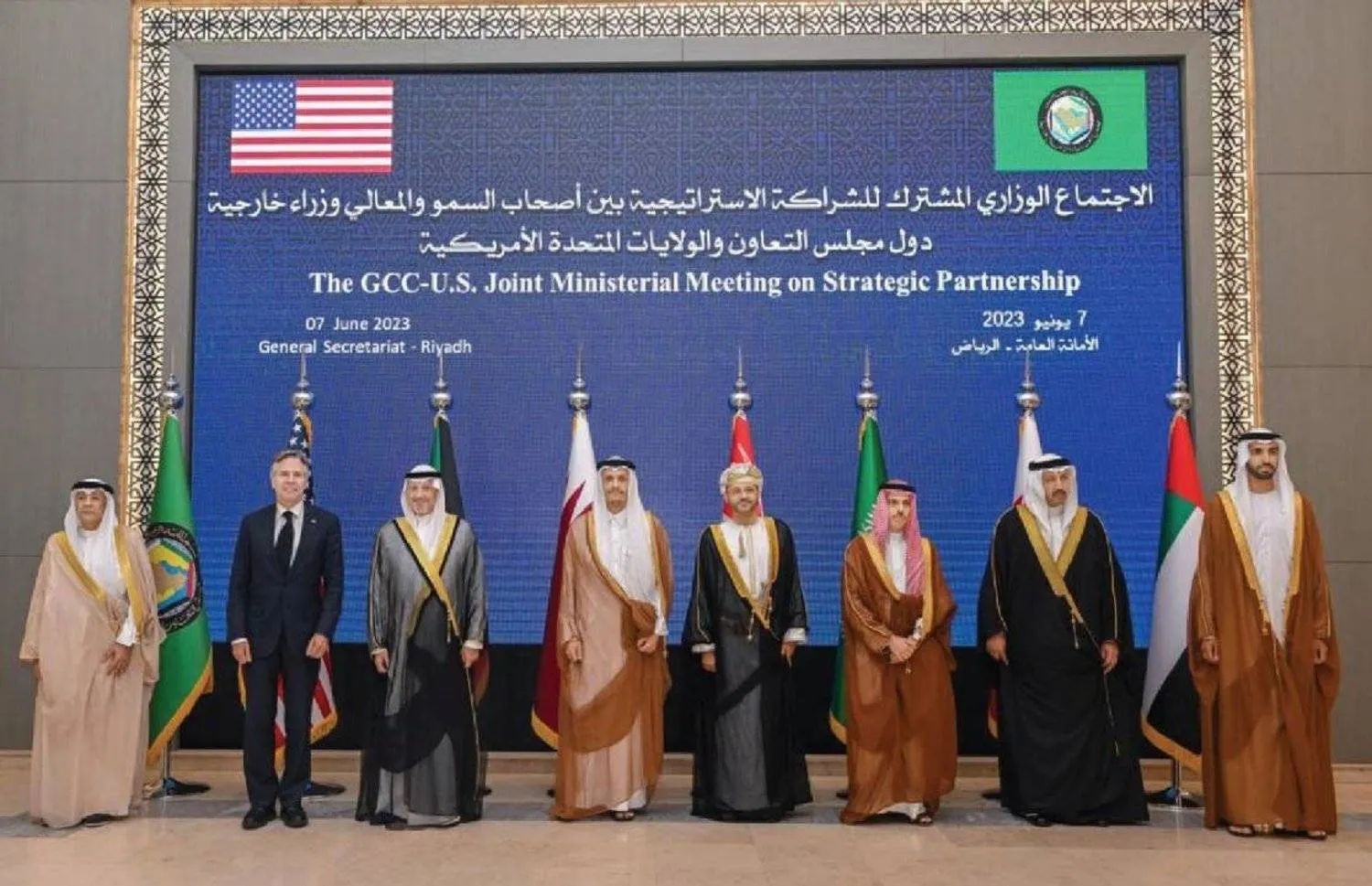
During a meeting at the Gulf Cooperation Council (GCC) headquarters, attended by foreign ministers from GCC member states, US Secretary of State Antony Blinken, and GCC Secretary General Jassim Mohammed Al-Budaiwi, the significance of the longstanding relations between the US and Arab Gulf countries was highlighted.
They reiterated their joint dedication to further advance cooperation, coordination, and consultation, building upon the accomplishments of prior ministerial meetings and the “Jeddah Summit” held on July 16, 2022.
Moreover, the focus was on strengthening ambitious strategic partnerships between the US and GCC member states. The objective is to enhance peace, security, stability, integration, and economic prosperity in the Middle East.
De-Escalation, Support for Diplomacy
The two sides also emphasized the importance of joint efforts to de-escalate tensions in the region, reaffirming their shared commitment to supporting diplomacy in achieving these goals. They further agreed on the significance of infrastructure projects in enhancing integration and connectivity in the region, contributing to regional stability and prosperity.
The importance of supporting navigation rights and freedoms and collective efforts to counter threats targeting the security of ships in the waterways of the region was also stressed.
The officials also emphasized the significance of confronting terrorism and violent extremism worldwide and welcomed the ministerial meeting of the International Coalition to defeat ISIS, which took place in Riyadh on Thursday.
US Commitment to Regional Security
Blinken affirmed the US steadfast commitment to the region’s security, recognizing its vital role in the global economy and international trade.
Iran
GCC countries and the US reaffirmed their commitment to freedom of navigation and maritime security in the region. They expressed their determination to confront any aggressive or unlawful acts at sea or elsewhere that could threaten international trade, maritime passages, and oil facilities in GCC countries.
The two sides also reiterated their support for the Treaty on the Non-Proliferation of Nuclear Weapons and renewed their call for Iran to fully cooperate with the International Atomic Energy Agency.
The officials also welcomed the decision of Saudi Arabia and Iran to resume diplomatic relations, emphasizing the importance of regional states’ commitment to international law, including the UN Charter.
Regarding Yemen, both sides reiterated the significance of the ongoing peace efforts led by the UN following the April 2022 ceasefire and the subsequent calm.
They expressed deep appreciation for the efforts undertaken by Saudi Arabia, Oman, the UN Special Envoy, and the US Special Envoy in this regard.
GCC countries and the US expressed their hope to witness a comprehensive intra-Yemeni political process that leads to a lasting resolution of the conflict, addressing the Yemeni people's calls for justice, accountability, and the prosecution of human rights violations. This process should aim to put the country on the path to recovery.
Yemen’s Sovereignty
Support for Yemen's sovereignty, independence, unity, and territorial integrity was reaffirmed.
The officials also expressed their support for the Presidential Leadership Council (PLC) in Yemen and urged the Houthi group to seize this opportunity and make use of the past 14 months, which have been marked by relative calm and stability, to provide relief to millions of Yemenis.
They emphasized the importance of continuing to meet the humanitarian needs of the people in all regions of Yemen and providing economic and developmental support throughout the country.
Officials also affirmed support for UN-led efforts to address the environmental and economic threat posed by the derelict oil tanker Safer off the coast of Yemen.
Two-State Solution
Both sides reaffirmed their commitment to achieving a just, lasting, and comprehensive peace in the Middle East based on a two-state solution, in accordance with the 1967 borders and any mutually agreed land swaps, in line with internationally recognized criteria and the Arab Peace Initiative.
They also stressed the necessity of refraining from any unilateral measures that undermine the two-state solution, escalate tensions, and maintaining the historical status quo in the holy sites of Jerusalem, emphasizing the special role of the Hashemite Kingdom of Jordan in this regard.
A Political Solution for Syria’s Crisis
As for Syria, both sides reiterated their commitment to reaching a political solution to the Syrian crisis that preserves the country’s unity and sovereignty, meets the aspirations of its people, and complies with international humanitarian law, in accordance with UN Security Council Resolution 2254 (2015).
In this regard, the officials welcomed Arab efforts to resolve the crisis in a step-by-step manner, in line with Security Council Resolution 2254, as agreed upon during the Amman Consultative Meeting of the Arab Ministerial Contact Group on Syria on May 1.
Furthermore, they reiterated support for US and International Coalition forces working to defeat ISIS in Syria, condemning all acts that threaten the safety and security of these forces.
Iraq
Additionally, the officials praised the positive and growing partnership between the GCC and Iraq, welcoming the ongoing progress in the electricity connection project that links Iraq to the GCC’s power grid.
This project represents years of diplomatic efforts aimed at achieving greater regional integration and connectivity, in the best interest of the Iraqi people and the region.
Sudan Crisis
Regarding the war in Sudan, GCC countries and the US expressed grave concern over the recent outbreak of fighting in Sudan.
They reaffirmed the GCC’s support for diplomatic efforts led by Saudi Arabia and the US in Jeddah to reach an agreement between the Sudanese Armed Forces and the Rapid Support Forces for the full implementation of a short-term ceasefire agreement and the unhindered access of humanitarian aid.
Ukraine War
Considering the war in Ukraine, the officials reiterated the importance of respecting the principles of sovereignty and international law, including the UN Charter, and the commitment to refrain from the use or threat of force against the territorial integrity or political independence of any state.
They urged all countries and the international community to intensify their efforts to reach a peaceful solution, end the humanitarian crisis, and support refugees, internally displaced persons, and other affected individuals from the war in Ukraine.
They also emphasized the importance of facilitating the export of grains and other food supplies, as well as supporting food security in the affected countries.
The strategic partnership between the GCC, US
Officials also affirmed their joint determination to contribute to achieving regional security and stability within the framework of the strategic partnership between the GCC and the US.
They commended the outcomes of the joint working group meetings on integrated air and missile defense, maritime security, and Iran, which took place in Riyadh from February 13 to 15.
They also praised the discussions of the fourth trade and investment dialogue meeting held on March 9 in Riyadh.