

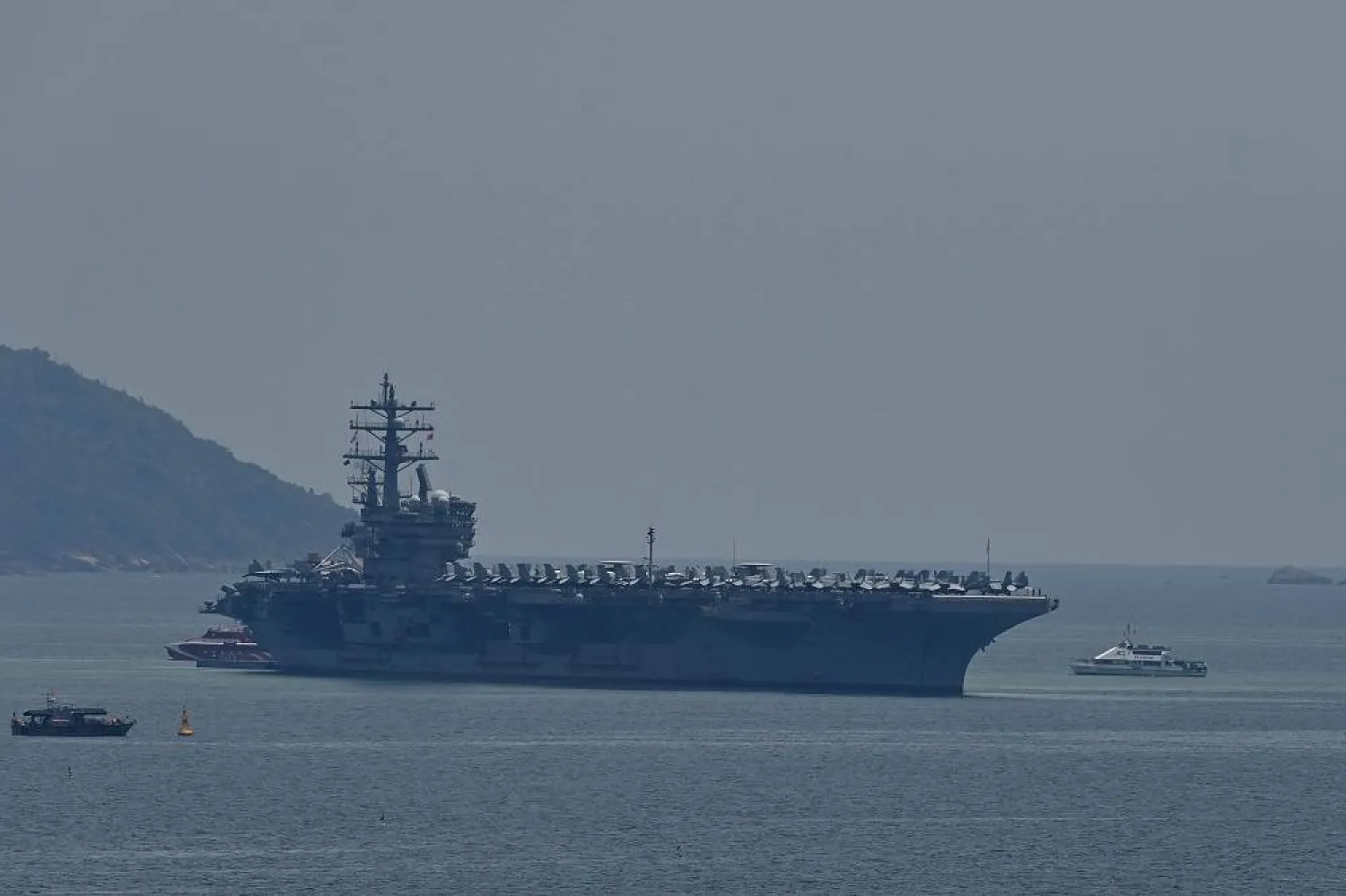

US Aircraft Carrier Arrives in Vietnam

The USS Ronald Reagan, a US Navy Nimitz-class nuclear-powered aircraft carrier, pulls into port in Danang on June 25, 2023. (AFP)
TT

US Aircraft Carrier Arrives in Vietnam

The USS Ronald Reagan, a US Navy Nimitz-class nuclear-powered aircraft carrier, pulls into port in Danang on June 25, 2023. (AFP)

A US aircraft carrier arrived in the central Vietnamese city of Danang on Sunday, weeks after Hanoi protested against Chinese vessels sailing in its waters.

The USS Ronald Reagan's port call in Danang comes as the United States and Vietnam celebrate the 10th anniversary of their "comprehensive partnership".

The aircraft carrier -- part of the US 7th Fleet "supporting a free and open Indo-Pacific region" -- arrived with two escort ships, the guided-missile cruisers USS Antietam and USS Robert Smalls, the American Embassy in Hanoi said.

US Navy officials disembarked and shook hands with their Vietnamese military counterparts in a brief ceremony on Sunday afternoon.

"More than 5,000 sailors aboard USS Ronald Reagan are eager to visit Danang and experience Vietnamese culture," USS Ronald Reagan's commanding officer Captain Daryle Cardone said in a statement.

Vietnam and the US share increasingly close trade links, as well as concerns over China's growing strength in the region.

A Chinese survey vessel, multiple coast guard ships and fishing boats operated for several weeks in Vietnam's exclusive economic zone in the South China Sea, prompting a demand that they leave from Vietnam's foreign ministry.

The boats eventually departed in early June.

China claims most of the resource-rich waterway despite competing claims from other Southeast Asian nations including Vietnam, the Philippines and Malaysia.

"The visit gives that message that Vietnam is continuing to balance against China by improving its security relationship with the US, and with other outside powers," Nguyen The Phuong, a PhD candidate in maritime security at the University of New South Wales Canberra, told AFP.

Bilateral ties

The US aircraft carrier's visit follows the arrival of Indian naval ships in Danang last month, as well as a port call by Japan's largest warship in Cam Ranh, a city on the southeastern coast, earlier this week.

Pham Thu Hang, spokesperson for Vietnam's foreign ministry, said earlier in the week that port calls were an "ordinary friendship exchange for peace, stability, and cooperation and development in the region and the world".

Strong bilateral ties between the US and Vietnam are key for Washington if it wants to remain the dominant power in the region, Phuong said.

"The US hopes that by sending one of their most formidable naval assets, they will have a trusted and reliable partner in Vietnam," he said.

US Secretary of State Antony Blinken made a quick visit to Hanoi in April and made it clear he wanted to upgrade diplomatic ties.

This is the third visit by a US aircraft carrier to Vietnam after a historic port call by the USS Carl Vinson in 2018, the first time such a ship had arrived in the country since the end of the war.

The visit includes several cultural and community events, such as a US Navy band concert, a visit to an orphanage and sports matches.

The USS Ronald Reagan has been based in Japan since 2015.


Iran's Top Negotiator Threatens 'Faster, More Intense' Response to US Attacks

People walk past a large anti-US banner with reference to the dropping of the atomic bomb on the Japanese city of Hiroshima, in Tehran on September 2, 2026. (Photo by Atta KENARE / AFP) /
TT

Iran's Top Negotiator Threatens 'Faster, More Intense' Response to US Attacks

People walk past a large anti-US banner with reference to the dropping of the atomic bomb on the Japanese city of Hiroshima, in Tehran on September 2, 2026. (Photo by Atta KENARE / AFP) /

Iran's top negotiator Mohammad Bagher Ghalibaf threatened on Sunday to launch swifter and more forceful responses to US attacks, after Tehran targeted American warships in retaliation for US attacks on tankers.

"The Americans must have understood that the era of proportionate responses has come to an end," said Ghalibaf in a speech carried by state media, adding that "any aggression against Iran's interests and security will receive a faster, more intense and more painful response.”

Iran said Sunday that it struck an unmanned US military boat in the Strait of Hormuz.

US Central Command, which oversees the US military operations in the Middle East, did not confirm the claim or respond to request for comment. It comes one day after the US said it struck Iranian oil tankers in retaliation for Iran launching ballistic missiles at Navy warships.


A Fuel Tanker Explosion in West Iran Kills 11 and Injures 7

A fuel tanker exploded in western Iran, killing 11 people and injuring seven others, according to the state media.(AP)
TT

A Fuel Tanker Explosion in West Iran Kills 11 and Injures 7

A fuel tanker exploded in western Iran, killing 11 people and injuring seven others, according to the state media.(AP)

A fuel tanker exploded in western Iran, killing 11 people and injuring seven others, state media said.

IRNA reported late Saturday that the tanker hit other cars before bursting into flames near a traffic police station close to the Kurdish city of Sanandaj, some 400 kilometers (248 miles) west of the capital, Tehran. The report cited a faulty brake system, The Associated Press said.

The injured were transferred to hospitals.

In 2018, a similar road accident between a fuel tanker and an intercity passenger bus near Sanandaj killed 15 people and injured four.

Road and traffic accidents annually leave more than 17,000 dead in Iran. Experts blame the high fatality rate on unsafe vehicles, disregard for traffic rules, and inadequate emergency services.


Nepali Rescuers Buoyed by Miracle Finds but Tough Conditions Persist

Nepal Army personnel work to build an iron bridge across Tadi Khola river following the deadly flash floods and mudslide, in Devighat, Nuwakot district, Nepal, September 4, 2026. REUTERS/Adnan Abidi
TT

Nepali Rescuers Buoyed by Miracle Finds but Tough Conditions Persist

Nepal Army personnel work to build an iron bridge across Tadi Khola river following the deadly flash floods and mudslide, in Devighat, Nuwakot district, Nepal, September 4, 2026. REUTERS/Adnan Abidi

Nepali rescuers faced challenging conditions on Sunday as search operations after catastrophic floods entered their 12th day, buoyed by the extraordinary rescues of four survivors.

The glacial and mountain collapse on the China-Nepal border has killed at least 1,372 people and left more than 5,500 missing across the two countries, AFP said.

Rescuers found two more people alive on Saturday, joining two saved the day before in what have been described as miraculous tales of survival.

Three of those have been found in hydropower tunnels where the government initially said it believed more than 100 workers could be alive.

"Search and rescue is going on at the tunnels despite geography, adverse weather and lack of connectivity," Energy Minister Biraj Bhakta Shrestha told AFP.

Rescue workers were experiencing "multiple challenges", he said.

The wall of icy water and debris tore through mountain districts on August 26, destroying roads, bridges and other infrastructure.

On Saturday, rescuers pulled a Chinese man alive from deep inside a hydropower tunnel, and a 64-year-old Nepali woman, Chandrika Shrestha, from her mud-covered home.

Prime Minister Balendra Shah said the latter rescue had "given hope to the entire nation".

A day earlier, two Nepali hydropower workers were rescued at the Trishuli 3A tunnel, where searches continue alongside multiple other sites, with at least 12 hydropower projects affected.

Biraj Bhakta Shrestha said work was continuing to restore electricity in several areas.

"Places that have unreachable, we've tried to restore power with solar," he told AFP.

Foreign Minister Shisir Khanal has called the disaster a "Himalayan tsunami" and has warned reconstruction costs could run into the billions of dollars.

The United Nations has said the magnitude of the destruction makes delivering aid an immense challenge, and has launched a $50 million appeal to help more than 84,000 people.

With mortuaries overflowing, Nepal has buried hundreds of bodies in mass graves, after taking DNA samples for future identification, according to the police.

Only around 100 bodies have been identified and handed over to families.

Nepal will hold a national day of mourning on Monday, the 13th day since the disaster, in line with a traditional period of mourning in Hindu rituals.

While the exact cause of the glacial collapse is unclear, climate change is accelerating glacial melting worldwide, increasing the risk of such disasters.

In Nepal, rescuers have retrieved 1,341 bodies, while around 4,996 people remain missing, according to the disaster agency.

Chinese state media report that 31 people have been killed and 531 are missing in Tibet.

The combined toll is 1,372 dead and more than 5,500 missing, including around 800 foreigners, among them tourists and pilgrims.
