


The Next Big Advance in Cancer Treatment Could Be a Vaccine

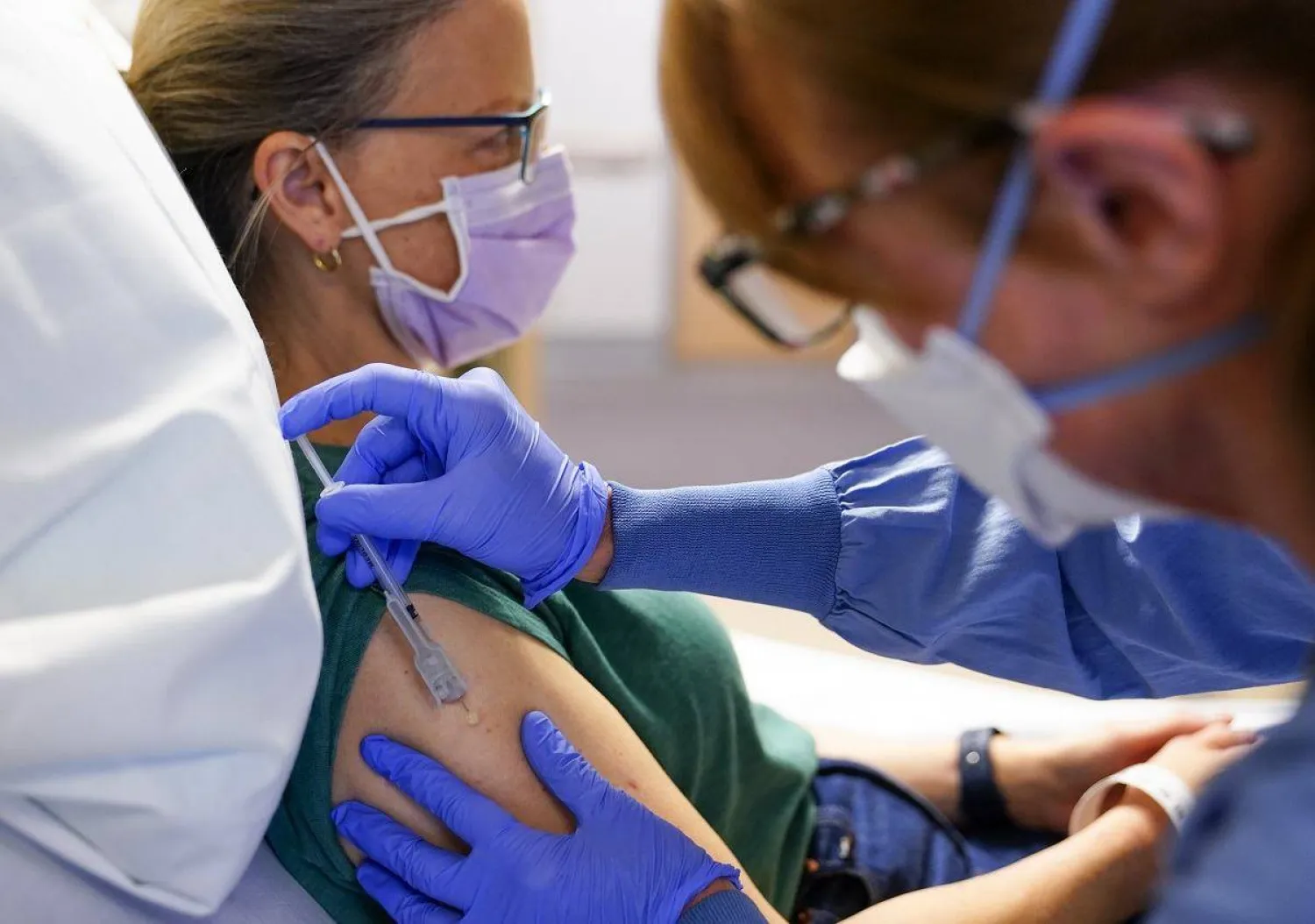
AP Photo/Lindsey Wasson- Registered nurse Erika Obrietan administers the third dose of an experimental breast cancer vaccine to patient Kathleen Jade at University of Washington Medical Center – Montlake, Tuesday, May 30, 2023, in Seattle.
TT

The Next Big Advance in Cancer Treatment Could Be a Vaccine

AP Photo/Lindsey Wasson- Registered nurse Erika Obrietan administers the third dose of an experimental breast cancer vaccine to patient Kathleen Jade at University of Washington Medical Center – Montlake, Tuesday, May 30, 2023, in Seattle.

After decades of limited success, scientists say research has reached a turning point, with many predicting more vaccines will be out in five years.

These aren’t traditional vaccines that prevent disease, but shots to shrink tumors and stop cancer from coming back. Targets for these experimental treatments include breast and lung cancer, with gains reported this year for deadly skin cancer melanoma and pancreatic cancer, AFP said.

“We’re getting something to work. Now we need to get it to work better,” said Dr. James Gulley, who helps lead a center at the National Cancer Institute that develops immune therapies, including cancer treatment vaccines.

More than ever, scientists understand how cancer hides from the body’s immune system. Cancer vaccines, like other immunotherapies, boost the immune system to find and kill cancer cells. And some new ones use mRNA, which was developed for cancer but first used for COVID-19 vaccines.

For a vaccine to work, it needs to teach the immune system’s T cells to recognize cancer as dangerous, said Dr. Nora Disis of UW Medicine’s Cancer Vaccine Institute in Seattle. Once trained, T cells can travel anywhere in the body to hunt down danger.

“If you saw an activated T cell, it almost has feet,” she said. “You can see it crawling through the blood vessel to get out into the tissues.”

Patient volunteers are crucial to the research.

Kathleen Jade, 50, learned she had breast cancer in late February, just weeks before she and her husband were to depart Seattle for an around-the-world adventure. Instead of sailing their 46-foot boat, Shadowfax, through the Great Lakes toward the St. Lawrence Seaway, she was sitting on a hospital bed awaiting her third dose of an experimental vaccine. She’s getting the vaccine to see if it will shrink her tumor before surgery.

“Even if that chance is a little bit, I felt like it’s worth it,” said Jade, who is also getting standard treatment.

Progress on treatment vaccines has been challenging. The first, Provenge, was approved in the US in 2010 to treat prostate cancer that had spread. It requires processing a patient’s own immune cells in a lab and giving them back through IV. There are also treatment vaccines for early bladder cancer and advanced melanoma.

Early cancer vaccine research faltered as cancer outwitted and outlasted patients’ weak immune systems, said Olja Finn, a vaccine researcher at the University of Pittsburgh School of Medicine.

“All of these trials that failed allowed us to learn so much,” Finn said.

As a result, she’s now focused on patients with earlier disease since the experimental vaccines didn’t help with more advanced patients. Her group is planning a vaccine study in women with a low-risk, noninvasive breast cancer called ductal carcinoma in situ.

More vaccines that prevent cancer may be ahead too. Decades-old hepatitis B vaccines prevent liver cancer and HPV vaccines, introduced in 2006, prevent cervical cancer.

In Philadelphia, Dr. Susan Domchek, director of the Basser Center at Penn Medicine, is recruiting 28 healthy people with BRCA mutations for a vaccine test. Those mutations increase the risk of breast and ovarian cancer. The idea is to kill very early abnormal cells, before they cause problems. She likens it to periodically weeding a garden or erasing a whiteboard.

Others are developing vaccines to prevent cancer in people with precancerous lung nodules and other inherited conditions that raise cancer risk.

“Vaccines are probably the next big thing” in the quest to reduce cancer deaths, said Dr. Steve Lipkin, a medical geneticist at New York’s Weill Cornell Medicine, who is leading one effort funded by the National Cancer Institute. “We’re dedicating our lives to that.”

People with the inherited condition Lynch syndrome have a 60% to 80% lifetime risk of developing cancer. Recruiting them for cancer vaccine trials has been remarkably easy, said Dr. Eduardo Vilar-Sanchez of MD Anderson Cancer Center in Houston, who is leading two government-funded studies on vaccines for Lynch-related cancers.

“Patients are jumping on this in a surprising and positive way,” he said.

Drugmakers Moderna and Merck are jointly developing a personalized mRNA vaccine for patients with melanoma, with a large study to begin this year. The vaccines are customized to each patient, based on the numerous mutations in their cancer tissue. A vaccine personalized in this way can train the immune system to hunt for the cancer’s mutation fingerprint and kill those cells.

But such vaccines will be expensive.

“You basically have to make every vaccine from scratch. If this wasn’t personalized, the vaccine could probably be made for pennies, just like the COVID vaccine,” said Dr. Patrick Ott of Dana-Farber Cancer Institute in Boston.

The vaccines under development at UW Medicine are designed to work for many patients, not just a single patient. Tests are underway in early and advanced breast cancer, lung cancer and ovarian cancer. Some results may come as soon as next year.

Todd Pieper, 56, from suburban Seattle, is participating in testing for a vaccine intended to shrink lung cancer tumors. His cancer has spread to his brain, but he’s hoping to live long enough to see his daughter graduate from nursing school next year.

“I have nothing to lose and everything to gain, either for me or for other people down the road,” Pieper said of his decision to volunteer.

One of the first to receive the ovarian cancer vaccine in a safety study 11 years ago was Jamie Crase of nearby Mercer Island. Diagnosed with advanced ovarian cancer when she was 34, Crase thought she would die young and had made a will that bequeathed a favorite necklace to her best friend. Now 50, she has no sign of cancer and she still wears the necklace.

She doesn’t know for sure if the vaccine helped, “But I’m still here.”


Over 60 Endangered Species Released into King Khalid Royal Reserve

These efforts align with the National Environment Strategy and Saudi Vision 2030 - SPA
TT

Over 60 Endangered Species Released into King Khalid Royal Reserve

These efforts align with the National Environment Strategy and Saudi Vision 2030 - SPA

In collaboration with the National Center for Wildlife (NCW), the Imam Abdulaziz bin Mohammed Royal Reserve Development Authority has released over 60 endangered species into the King Khalid Royal Reserve. This initiative supports a national program to reintroduce wildlife into their natural habitats.

CEO of the authority Dr. Talal Al-Harigi stated that the release aims to enhance biodiversity and restore natural habitats. He emphasized that the project fosters a stable environment for wildlife adaptation, SPA reported.

These efforts align with the National Environment Strategy and Saudi Vision 2030, which seek to improve the quality of life and promote sustainability. Dr. Al-Harigi noted that the partnership with NCW exemplifies institutional integration and the use of global best practices for successful reintroduction.

The release included species such as Arabian sand gazelles, Arabian oryx, wild hares, and mountain gazelles, contributing to biodiversity, ecological balance, and eco-tourism in the region.


'The Best Gift Ever': Baby is Born after the Rarest of Pregnancies, Defying All Odds

This photo provided by the family shows Ryu Lopez in California in October 2025. (Lopez family via AP)
TT

'The Best Gift Ever': Baby is Born after the Rarest of Pregnancies, Defying All Odds

This photo provided by the family shows Ryu Lopez in California in October 2025. (Lopez family via AP)

Suze Lopez holds her baby boy on her lap and marvels at the remarkable way he came into the world.

Before little Ryu was born, he developed outside his mom’s womb, hidden by a basketball-sized ovarian cyst — a dangerous situation so rare that his doctors plan to write about the case for a medical journal, The AP news reported.

Just 1 in 30,000 pregnancies occur in the abdomen instead of the uterus, and those that make it to full term “are essentially unheard of — far, far less than 1 in a million,” said Dr. John Ozimek, medical director of labor and delivery at Cedars-Sinai in Los Angeles, where Ryu was born. “I mean, this is really insane.”

Lopez, a 41-year-old nurse who lives in Bakersfield, California, didn’t know she was pregnant with her second child until days before giving birth.

When her belly began to grow earlier this year, she thought it was her ovarian cyst getting bigger. Doctors had been monitoring the mass since her 20s, leaving it in place after removing her right ovary and another cyst.

Lopez experienced none of the usual pregnancy symptoms, such as morning sickness, and never felt kicks. Though she didn’t have a period, her cycle is irregular and she sometimes goes years without one.

For months, she and her husband, Andrew Lopez, went about their lives and traveled abroad.

But gradually, the pain and pressure in her abdomen got worse, and Lopez figured it was finally time to get the 22-pound (10-kilogram) cyst removed. She needed a CT scan, which required a pregnancy test first because of the radiation exposure. To her great surprise, the test came back positive.

Lopez shared the news with her husband at a Dodgers baseball game in August, handing him a package with a note and a onesie.

“I just saw her face,” he recalled, “and she just looked like she wanted to weep and smile and cry at the same time.”

Shortly after the game, Lopez began feeling unwell and sought help at Cedars-Sinai. It turned out she had dangerously high blood pressure, which the medical team stabilized. They also did blood work and gave her an ultrasound and an MRI. The scans found that her uterus was empty, but a nearly full-term fetus in an amniotic sac was hiding in a small space in her abdomen, near her liver.

“It did not look like it was directly invading any organs,” Ozimek said. “It looked like it was mostly implanted on the sidewall of the pelvis, which is also very dangerous but more manageable than being implanted in the liver.”

Dr. Cara Heuser, a maternal-fetal specialist in Utah not involved with the case, said almost all pregnancies that implant outside the uterus — called ectopic pregnancies — go on to rupture and hemorrhage if not removed. Most commonly, they occur in the fallopian tubes.

A 2023 medical journal article by doctors in Ethiopia described another abdominal pregnancy in which the mother and baby survived, pointing out that fetal mortality can be as high as 90% in such cases and birth defects are seen in about 1 in 5 surviving babies.

But Lopez and her son beat all the odds.

On Aug. 18, a medical team delivered the 8-pound (3.6-kilogram) baby while she was under full anesthesia, removing the cyst during the same surgery. She lost nearly all of her blood, Ozimek said, but the team got the bleeding under control and gave her transfusions.

Doctors continually updated her husband about what was happening.

“The whole time, I might have seemed calm on the outside, but I was doing nothing but praying on the inside,” Andrew Lopez said. “It was just something that scared me half to death, knowing that at any point I could lose my wife or my child.”

Instead, they both recovered well.

“It was really, really remarkable,” Ozimek said.

Since then, Ryu — named after a baseball player and a character in the Street Fighter video game series — has been healthy and thriving. His parents love watching him interact with his 18-year-old sister, Kaila, and say he completes their family.

With Ryu’s first Christmas approaching, Lopez describes feeling blessed beyond measure.

“I do believe in miracles,” she said, looking down at her baby. “God gave us this gift — the best gift ever.”


Daughters of King Charles' Brother Andrew Join Royals for Christmas Service

Britain's Princess Beatrice, Princess Eugenie, and Edoardo Mapelli Mozzi leave after attending the Royal Family's Christmas Day service at St. Mary Magdalene's church, as the royals take residence at the Sandringham estate in eastern England, Britain, December 25, 2025. REUTERS/Hannah McKay
TT

Daughters of King Charles' Brother Andrew Join Royals for Christmas Service

Britain's Princess Beatrice, Princess Eugenie, and Edoardo Mapelli Mozzi leave after attending the Royal Family's Christmas Day service at St. Mary Magdalene's church, as the royals take residence at the Sandringham estate in eastern England, Britain, December 25, 2025. REUTERS/Hannah McKay

Britain's Princesses Beatrice and Eugenie attended the royal family's traditional Christmas Day church service on Thursday, while their father Andrew, recently stripped ​of his titles over ties to convicted sex offender Jeffrey Epstein, was absent.

King Charles and Queen Camilla led senior royals to a church in Sandringham in eastern England, about 110 miles (175 km) northeast of London, greeting well-wishers in crisp winter weather, Reuters reported.

Charles and Camilla walked ahead while the Prince and Princess of ‌Wales, William ‌and Kate, and their ‌three ⁠children, followed.

Other ​family members ‌included Princess Anne and her husband Tim Laurence, the Duke and Duchess of Edinburgh with their children, as well as the king's niece Zara and her husband Mike Tindall.

Now known only as Andrew Mountbatten Windsor, the king's younger brother has faced mounting pressure over his ⁠links to Epstein. In October, Charles stripped him of all titles, including ‌Duke of York and prince, and ‍ordered him to vacate ‍his Windsor home and move to private accommodation on ‍the Sandringham estate, which has been the royal family's traditional venue for their Christmas Day service since 1988.

Buckingham Palace had said the steps taken against Andrew were necessary to ​protect the monarchy's reputation, adding that the king's thoughts and sympathies were with victims of ⁠abuse.

The attendance of his daughters Beatrice, 37, and Eugenie, 35, underscores their continuing presence at family events despite the controversy surrounding their father.

The royals ‌are expected to return to Sandringham House for lunch before the king's televised Christmas message later in the day.
