


France Will Deploy 40,000 Police Officers to Quell Violence that Followed Deadly Police Shooting

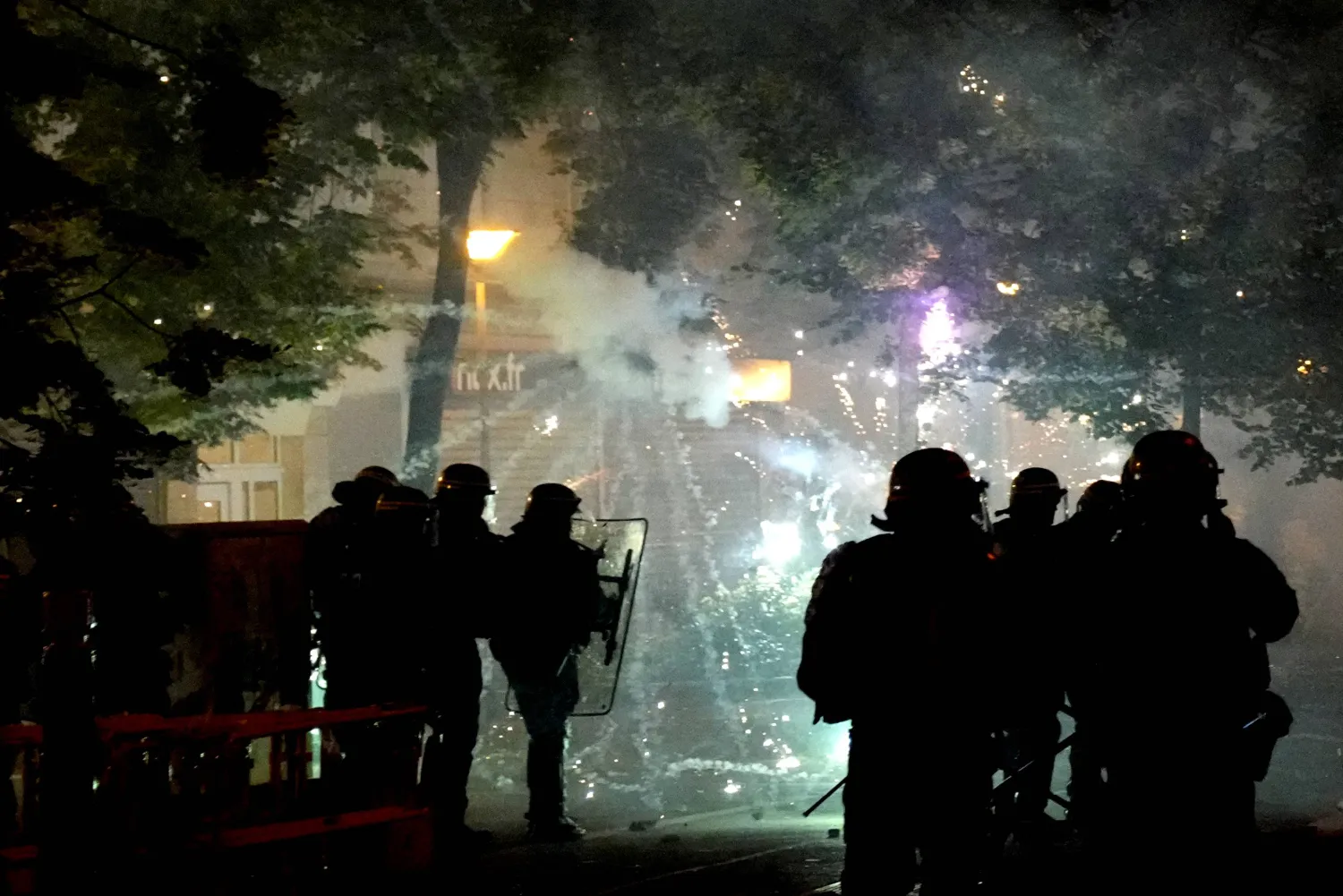
Police forces clash with youths in Nanterre, outside Paris, Thursday, June 29, 2023. (AP Photo/Christophe Ena)
TT

France Will Deploy 40,000 Police Officers to Quell Violence that Followed Deadly Police Shooting

Police forces clash with youths in Nanterre, outside Paris, Thursday, June 29, 2023. (AP Photo/Christophe Ena)


A French police officer who shot and killed a 17-year-old driver will be investigated for voluntary homicide, following two days of fires and violent protests that injured scores of officers, officials said Thursday.

Some 40,000 police officers will be deployed overnight to quell violence that engulfed cities and towns in the wake of the shooting, The Associated Press said.

The killing of 17-year-old Nahel during a traffic check Tuesday, captured on video, shocked the country and stirred up long-simmering tensions between young people and police in housing projects and other disadvantaged neighborhoods around France.

Protesters set cars and public buildings ablaze in Paris suburbs and unrest spread to some other French cities and towns.

“The professionals of disorder must go home,” Interior Minister Gerald Darmanin said. “There will be a lot more police and gendarmes present tonight.”

Darmanin said 170 officers had been injured in the unrest but none of the injuries were life-threatening.

Nanterre prosecutor Pascal Prache said that he had requested that the officer be held in custody. That decision is to be made by another magistrate.

Based on an initial investigation, Prache said, he concluded that "the conditions for the legal use of the weapon were not met.”

Three persons were in the car when police tried to stop it Tuesday, the prosecutor said. Nahel managed to avoid a traffic stop by running a red light. He was later got stuck in a traffic jam.

Both officers involved said they drew their guns to prevent him from starting the car again.

The officer who fired a single shot said he wanted to prevent the car from leaving and because he feared someone may be hit by the car, including himself or his colleague, according to Prache.

Both officers said they felt “threatened” by seeing the car drive off, he added.

Two magistrates have been named to lead the investigation, Prache said. Under the French legal system, which differs from the US and British systems, magistrates are often assigned to lead investigations.

In a separate case, a police officer who fatally shot a 19-year-old Guinean man in western France earlier this month was handed preliminary charges of voluntary homicide, according to a statement by the local prosecutor on Wednesday. The man was fatally shot by an officer as he allegedly tried to escape a traffic stop. The investigation is still ongoing.

Clashes first erupted Tuesday night in and around the Paris suburb of Nanterre, where Nahel was killed, and the government deployed 2,000 police to maintain order Wednesday. But violence resumed after dusk.

Nahel’s surname has not been released by authorities or by his family. In earlier statements, lawyers for the family spelled the name Nael.

Police and firefighters struggled to contain protesters and extinguish numerous blazes through the night that damaged schools, police stations and town halls or other public buildings, according to a spokesperson for the national police. The national police on Thursday reported fires or skirmishes in multiple cities overnight, from Toulouse in the south to Lille in the north, though the nexus of tensions was Nanterre and other Paris suburbs.

Police arrested 150 people around the country, more than half of them in the Paris region, the spokesperson said. She was not authorized to be publicly named according to police rules.

The number of injured was not immediately released.

Scenes of violence in France’s suburban areas echo 2005, when the deaths of 15-year-old Bouna Traoré and 17-year-old Zyed Benna led to three weeks of nationwide riots, exposing anger and resentment in neglected, crime-ridden suburban housing projects.

The two boys entered a power substation to hide from police in the Paris suburb of Clichy-sous-Bois, and were electrocuted.

French President Emmanuel Macron held an emergency security meeting Thursday about the violence.

“These acts are totally unjustifiable,” Macron said at the beginning of the meeting, which aimed at securing hot spots and planning for the coming days “so full peace can return."

Macron also said it was time for “remembrance and respect” as Nahel’s mother called for a silent march Thursday in his honor on the square where he was killed.

Multiple vehicles were set ablaze in Nanterre and protesters shot fireworks and threw stones at police, who fired repeated volleys of tear gas. Flames shot out of three stories of a building, and a blaze was reported at an electrical plant. Fire damaged the town hall of the Paris suburb of L’Ile-Saint-Denis, not far from France’s national stadium and the headquarters of the Paris 2024 Olympics.

The police officer accused of the killing is in custody on suspicion of manslaughter and could face preliminary charges as soon as Thursday, according to the Nanterre prosecutor's office.

French activists renewed calls to tackle what they see as systemic police abuse, particularly in neighborhoods like the one where Nahel lived, where many residents struggle with poverty and racial or class discrimination. Government officials condemned the killing and sought to distance themselves from the police officer’s actions.

Macron called the killing “inexplicable and inexcusable" and called for calm. “Nothing justifies the death of a young person,” he told reporters in Marseille on Wednesday.

Videos of the shooting shared online show two police officers leaning into the driver-side window of a yellow car before the vehicle pulls away as one officer fires into the window. The videos show the car later crashed into a post nearby.

The driver died at the scene, the prosecutor’s office said.

Bouquets of orange and yellow roses now mark the site of the shooting, on Nanterre’s Nelson Mandela Square.

Speaking to Parliament, Prime Minister Elisabeth Borne said, “the shocking images broadcast yesterday show an intervention that appears clearly not to comply with the rules of engagement of our police forces.”

Deadly use of firearms is less common in France than in the United States, though several people have died or sustained injuries at the hands of French police in recent years, prompting demands for more accountability. France also saw protests against racial profiling and other injustice in the wake of George Floyd’s killing by police in Minnesota.

The most recent government statistics available show that 17 people were killed after police and gendarmerie officers shot at them in 2021.

Asked about police abuses, Macron said justice should be allowed to run its course.

A lawyer for Nahel's family, Yassine Bouzrou, told The Associated Press they want the police officer prosecuted for murder instead of manslaughter.

French soccer star Kylian Mbappe, who grew up in the Paris suburb of Bondy, was among many shocked by what happened.

“I hurt for my France,” he tweeted.


Macron Accuses US of 'Turning Away' from Allies

President Emmanuel Macron delivers a speech to French ambassadors at the Elysee Palace © Michel Euler / POOL/AFP
TT

Macron Accuses US of 'Turning Away' from Allies

President Emmanuel Macron delivers a speech to French ambassadors at the Elysee Palace © Michel Euler / POOL/AFP

French President Emmanuel Macron said on Thursday that the United States was "breaking free from international rules" and "gradually turning away" from some of its allies.

Macron delivered his annual speech to French ambassadors at the Elysee Palace as European powers are scrambling to come up with a coordinated response to US assertive foreign policy in the Western hemisphere following Washington's capture of Venezuela's leader Nicolas Maduro and Donald Trump's designs on Greenland, according to AFP.

"The United States is an established power, but one that is gradually turning away from some of its allies and breaking free from international rules that it was still promoting recently," Macron told ambassadors at the Elysee Palace.

"Multilateral institutions are functioning less and less effectively," Macron added.

"We are living in a world of great powers with a real temptation to divide up the world."

Macron spoke after US special forces snatched Maduro and his wife from Venezuela on Saturday in a lightning raid and whisked them to New York, sparking condemnation the United States was undermining international law.

In the wake of his military intervention in Venezuela, President Trump set off alarm bells in Europe by repeating his insistence that he wants to take control of Greenland.

Trump has repeatedly refused to rule out using force to seize the strategic Arctic island, prompting shock and anger from controlling power Denmark and other longstanding European allies.

Copenhagen has warned that any attack would spell the end of the NATO alliance.

- 'Reinvest fully in the UN' -

The French leader said "global governance" was key in a time when "every day people wonder whether Greenland is going to be invaded" as well as whether "Canada will face the threat of becoming the 51st state".

He said it was the right moment to "reinvest fully in the United Nations, as we note its largest shareholder no longer believes in it".

The White House on Wednesday flagged the US exit from 66 global organizations and treaties -- roughly half affiliated with the United Nations -- it identified as "contrary to the interests of the United States."

Macron said Europe must protect its interests and urged the "consolidation" of European regulation of the tech sector.

He stressed the importance of safeguarding academic independence and hailed "the possibility of having a controlled information space where opinions can be exchanged completely freely, but where choices are not made by the algorithms of a few."

Brussels has adopted a powerful legal arsenal aimed at reining in tech giants -- namely through its Digital Markets Act (DMA) which covers competition and the Digital Services Act (DSA) on content moderation.

Washington has denounced the tech rules as an attempt to "coerce" American social media platforms into censoring viewpoints they oppose.

"The DSA and DMA are two regulations that must be defended," Macron said.


Trump Says US Oversight of Venezuela Could Last Years

US President Donald Trump speaks as Secretary of State Marco Rubio and Secretary of Defense Pete Hegseth look on during a press conference following a US strike on Venezuela where President Nicolas Maduro and his wife, Cilia Flores, were captured, from Trump's Mar-a-Lago club in Palm Beach - Reuters
TT

Trump Says US Oversight of Venezuela Could Last Years

US President Donald Trump speaks as Secretary of State Marco Rubio and Secretary of Defense Pete Hegseth look on during a press conference following a US strike on Venezuela where President Nicolas Maduro and his wife, Cilia Flores, were captured, from Trump's Mar-a-Lago club in Palm Beach - Reuters

The United States could oversee Venezuela and control its oil revenue for years, President Donald Trump said in an interview ​published on Thursday.

During what the New York Times described as a wide-ranging, two-hour interview, the paper said Trump also appeared to lift a threat to take military action against Venezuela's neighbor Colombia. Trump invited Colombia's leftist leader, whom he had previously called a "sick man", to visit Washington.

"Only time will tell" how long the United States will oversee Venezuela, Trump said. When asked by the newspaper if it would be three months, six months, a year or longer, Trump said: "I would say much longer."

"We will rebuild it in a very profitable way," Trump said of Venezuela, where he sent troops to seize President Nicolas Maduro in a night raid on January 3.

"We're going to be using oil, and we're going to be taking oil. We're getting oil prices down, and we're going to be giving money to Venezuela, which ‌they desperately need."

Trump ‌added that the US was "getting along very well" with the government of the interim president, ‌Delcy ⁠Rodriguez, ​a longstanding Maduro ‌loyalist who had served as the ousted leader's vice president.

'MARCO SPEAKS TO HER ALL THE TIME'

The Times said Trump declined to answer questions about why he had decided not to give power in Venezuela instead to the opposition, which Washington had previously considered the legitimate winner of an election in 2024.

Trump on Tuesday unveiled a plan to refine and sell up to 50 million barrels of Venezuelan oil that had been stuck in Venezuela under US blockade.

"They're giving us everything that we feel is necessary," Trump said, referring to the Venezuelan government.

He declined to comment when asked if he had personally spoken to Rodriguez.

"But Marco speaks to her all the time," he said, referring to Secretary of State Marco Rubio. "I will tell you ⁠that we are in constant communication with her and the administration."

COLOMBIA THREAT APPEARS TO DISSIPATE

The Times said its reporters were permitted to sit in during a phone call between Trump and ‌Colombia's President Gustavo Petro, provided the contents of the call were off the record.

In ‍a post on social media, Trump said: "It was a great ‍honor to speak with the President of Colombia, Gustavo Petro, who called to explain the situation of drugs and other disagreements that we ‍have had. I appreciated his call and tone, and look forward to meeting him in the near future."

Petro described the call, his first with Trump, as cordial.

On Sunday Trump had threatened to carry out military action against Colombia, calling Petro "a sick man who likes making cocaine and selling it to the United States, and he's not going to be doing it very long".

The Times said Trump's phone call with Petro lasted about an hour and "appeared to dissipate ​any immediate threat of US military action".

Trump's use of force in Venezuela has made some members of his own Republican Party wary, after he long criticised US military ventures abroad. The Senate is due to consider a resolution on ⁠Thursday to block Trump from taking further action without congressional authorization.

Republicans, who control the Senate with 53 seats, have defeated several such measures since Trump began military action around Venezuela late last year, but the last vote in November was a close 49-51 after two Republicans backed it. Senator Rand Paul, a Kentucky Republican co-sponsoring the resolution, said he had spoken to at least two additional Republicans now "thinking about it".

MEETING PLANNED WITH OIL COMPANIES

Trump has said the United States intends to "run" Venezuela. US officials have indicated their plan for now is to exert influence without a military occupation.

Venezuela, with the world's biggest proven oil reserves, has become impoverished in recent decades, with eight million people fleeing abroad in one of the world's biggest migration crises.

Washington and the Venezuelan opposition have long blamed corruption, mismanagement and brutality by the ruling Socialist Party. Maduro blamed the economic damage on US sanctions.

Several senior US officials said on Wednesday that the United States needs to control Venezuela's oil sales and revenues indefinitely in order to restore the country's oil industry and rebuild its economy.

Trump is scheduled to meet with the heads of major oil companies at the White House on Friday ‌to discuss ways of raising Venezuela's oil production. Representatives from the top three US oil companies, Exxon Mobil, ConocoPhillips and Chevron , would be present, according to a source familiar with the planning.

The companies, all of which have experience in Venezuela, have declined to comment.


Iran Ready to Fight Back if US or Israel Attacks again, Says Foreign Minister

The Iranian flag waves in front of the International Atomic Energy Agency (IAEA) headquarters, before the beginning of a board of governors meeting, amid the coronavirus disease (COVID-19) outbreak in Vienna, Austria, March 1, 2021. (Reuters)
TT

Iran Ready to Fight Back if US or Israel Attacks again, Says Foreign Minister

The Iranian flag waves in front of the International Atomic Energy Agency (IAEA) headquarters, before the beginning of a board of governors meeting, amid the coronavirus disease (COVID-19) outbreak in Vienna, Austria, March 1, 2021. (Reuters)

Iran does not want war with Israel or the United States, but is ready to fight back if attacked again, the country’s foreign minister said Thursday.

Speaking upon arrival in Beirut, Abbas Araghchi told reporters that Iran is also ready for negotiations with the US over its nuclear program as long as the talks are based on mutual respect rather than “dictation” by Washington.

Araghchi’s comments came as many fear that close US ally Israel will target Iran again as it did during the 12-day war it launched against Tehran in June. Israel killed a slew of top military officials and nuclear scientists, and the US bombed Iranian nuclear enrichment sites.

“America and Israel have tested their attack on Iran and this attack and strategy faced extreme failure,” the Iranian official said in Beirut at the start of a two-day visit to Lebanon. “If they repeat it, they will face the same results.”

“We are ready for any choice. We don’t desire a war but we are ready for it,” Araghchi said.

In February, US President Donald Trump reimposed a “maximum pressure” campaign on Iran in an effort to block its development of nuclear weapons. The campaign included US led strikes on three critical Iranian enrichment facilities in June.

Araghchi said Tehran is ready for “negotiations but I say that the negotiations should be based on mutual respect and mutual interests.”

“We believe that once the Americans reach the outcome that constructive and positive negotiations rather than ordering dictation are the framework, then at that time the results of the these negotiations become fruitful,” he said.

Iran had been enriching uranium up to 60% purity — a short, technical step from weapons-grade levels — after Trump unilaterally withdrew the United States from Tehran’s 2015 nuclear deal with world powers in 2018. Tehran long has maintained its atomic program is peaceful, though the West and the IAEA, the UN's nuclear watchdog, say Iran had an organized nuclear weapons program until 2003.

In late December, Trump warned Iran that the US could carry out further military strikes if the country attempts to reconstitute its nuclear program as he held talks with Israeli Prime Minister Benjamin Netanyahu in Florida.
