
Israeli Killing of 15-year-old Palestinian Girl in West Bank Casts Light on Civilian Casualties

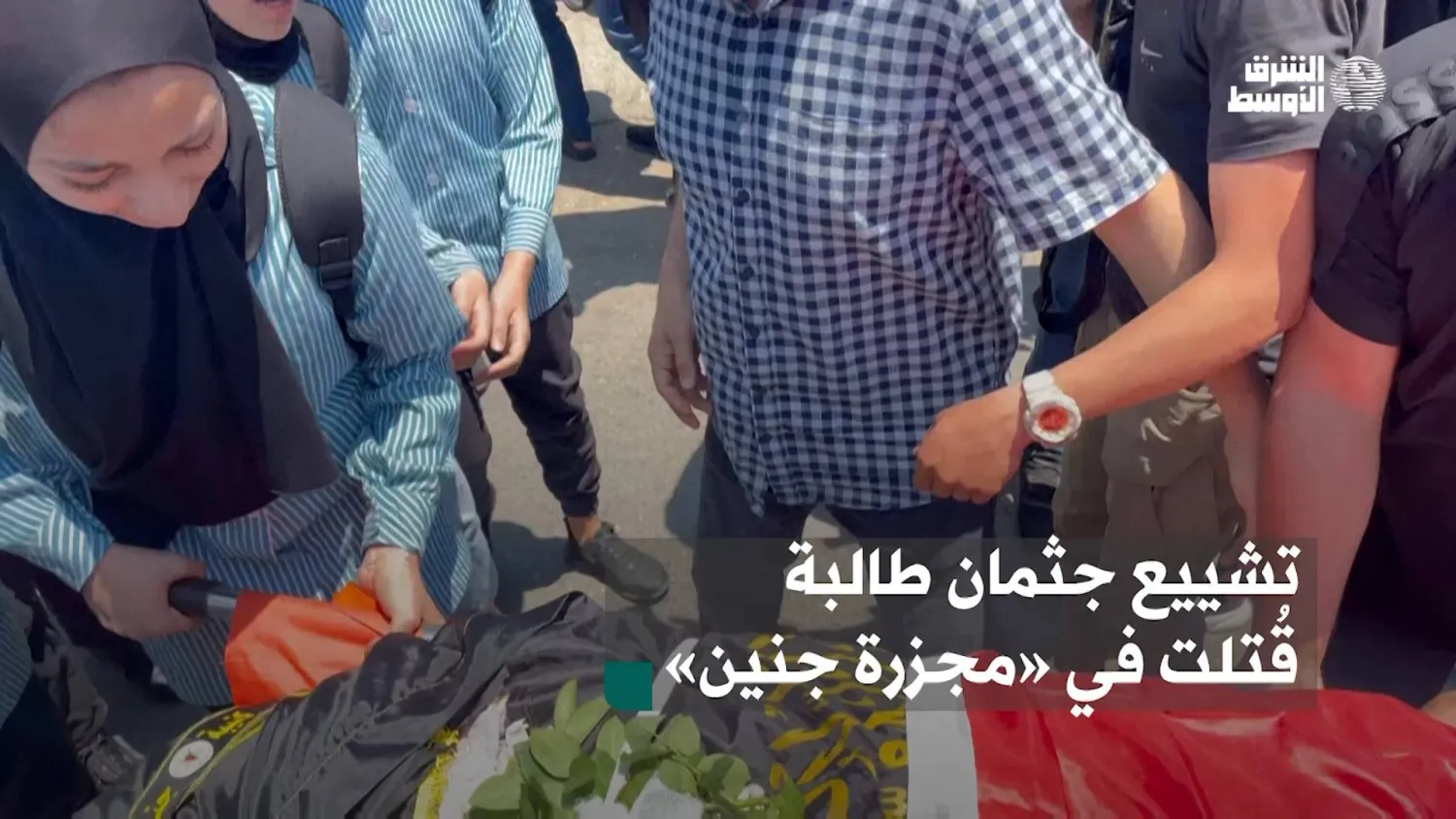
 Funeral of a student who was killed in the Jenin massacre.
Funeral of a student who was killed in the Jenin massacre.
TT

Israeli Killing of 15-year-old Palestinian Girl in West Bank Casts Light on Civilian Casualties

 Funeral of a student who was killed in the Jenin massacre.
Funeral of a student who was killed in the Jenin massacre.

At the funeral for Sadeel Naghniyeh, 15, her closest friends hoisted her dead body over their small shoulders. Wearing their school uniforms — tight black hijabs and oversized striped shirts — they staggered through the Palestinian refugee camp, crying and choking out the Islamic funeral prayers.

Last week's tribute by the schoolgirls was a striking departure from the stream of funerals that have become a grim routine in this flashpoint West Bank town. The death of Sadeel — killed by suspected Israeli fire when a raid into the northern Jenin refugee camp ignited the territory's fiercest Israeli-Palestinian fighting in years — drew attention to the rising number of children killed in the heightened violence and the extraordinary risks they face, The Associated Press said.

Typically in Palestinian funerals, older men — relatives and friends — drape the dead in the flags of armed groups. Sadeel's eighth-grade classmates wrapped her in the uniform she would no longer wear.

“She was only a child. She had ambitions to become a nurse and save lives,” her father, Ghassan Naghniyeh, 46, said from his vine-covered driveway where Sadeel was shot. “They killed my daughter and they killed her dreams.”

Witness accounts and surveillance videos suggest there were no clashes at that time on her street and that the fighting between Palestinians and Israeli forces was unfolding some 650 meters (700 yards) west of her home.

The killing of Sadeel — one of 12 Palestinians under the age of 16 killed by Israeli fire in the West Bank this year, according to a tally by The Associated Press — has sparked condemnation from rights groups and renewed scrutiny of the military’s record of causing civilian casualties. The army launched a widespread campaign into Palestinian towns last year in response to a wave of Palestinian attacks inside Israel.

So far this year, nearly 140 Palestinians have been killed by Israeli fire in the West Bank, according to the AP’s count, almost half of them affiliated with armed groups. The army says that number is much higher. But civilians have also been killed, including a 2-year-old boy earlier this month and a 15-year-old boy in last week's same Jenin camp raid. His death is also under military review.

“We’re not just talking about Sadeel’s death, we’re talking about daily killings and no accountability that could serve as a way to prevent Israel from killing more civilians in the future,” said Shawan Jabarin, director of Al Haq, a Palestinian human rights group.

The Israeli army often accuses Palestinian groups of endangering civilians by using residential areas for cover. It gave no explanation for Sadeel's death, saying the circumstances are “under examination.”

Sadeel’s family believes the bullet that killed her likely came from an Israeli army jeep rumbling down their quiet street that morning, according to surveillance footage. Two motorists, a woman in her 30s and a young man, were wounded when they came under fire from the same jeep, neighbors said.

The last video taken on Sadeel’s phone shows a similar military jeep moving along a dusty road some 200 meters (yards) from where she stood. It remains unclear whether it was the same jeep. Minutes after she posted the clip to Telegram, she was lying in her driveway, brain-dead. Two days later, she died.

The Israeli military declined to answer multiple questions about the military vehicles. Without mentioning Sadeel, the army said its arrest operation had sparked a “massive exchange of fire with terrorists” and that Israeli forces had opened fire on gunmen and those throwing explosive devices.

Israeli military raids have been met regularly with Palestinian gunfire and rippled into bloody battles. Israel contends the intensified military activities are a counterterrorism effort and has focused its operations on the hometowns of assailants — particularly the city of Jenin and its adjacent refugee camp.

The camp has reemerged as a stronghold of Palestinian militancy two decades after Israel invaded the camp with tanks and helicopters, flattening homes. The effects of that 2002 battle, among the biggest of the second Palestinian uprising, linger.

“The martyrs from that battle are still dead. The prisoners are still in prison,” said Mohammed Shehata, the general manager of the Freedom Theater, which was co-founded by a famous militant and offers drama classes for young Palestinians in the camp. "And now, the young people fighting today’s battles will pass their pain onto the next generation.”

Sadeel, who lived just behind the theater, could often be found there, watching auditions, joking with foreign volunteers and playing improv games in its summer camp, Shehata said. He shared a video of a younger Sadeel singing with other kids, making her hands into a heart shape as she pranced.

But the conflict never went away. It sliced through her home. Residents say on the outskirts of the camp, rooftops in Sadeel’s neighborhood afforded Israeli snipers a good vantage point. Multiple bullet holes from past raids pierce her father’s parked white Kia.

Two of her uncles were killed as teenagers in the second uprising. Another two remain in Israeli prison.

Sadeel’s profile picture on Facebook is a black-and-white photo of an unidentified girl wearing an abaya and holding up a rifle. “Oh God, I end my life according to your will,” she wrote several months ago. Transfixed by Israeli and Palestinian attacks, killings and clashes each day, Sadeel could hardly focus in school, her father said.

Israeli officials say incitement on social media drives Palestinian youth toward militancy. But her uncle, Nidal Naghniyeh, described Sadeel's praise for militants as the inevitable outcome of life in Jenin refugee camp.

“Sadeel had nothing else around her but death and destruction,” he said. "So what does she think about? What does she dream of? Death.”

When Israeli military vehicles and drones swarmed the camp last week, armed Palestinians ambushed the forces with gunfire and powerful explosives, prompting the Israeli military to dispatch helicopter gunships to help evacuate its stranded soldiers. Seven Palestinians were killed.

The raid started with a familiar scene. The camp sirens wailed. Militants fired into the air to warn residents about the incursion. Naghniyeh and his wife ushered Sadeel and their four sons toward the back of the house. They shut all the windows.

But Sadeel was restless around 8.a.m. and asked her father if she could spend the day next door with her twin cousins, Sara and Yara.

Naghniyeh agreed, considering it a safe and much-needed distraction. Minutes after she disappeared down the stairs, he heard his 9-year-old son, Hamoudi, shrieking.

In the driveway, Naghniyeh cradled Sadeel's limp body and felt blood at the back of her head. He knew his only daughter was gone.

“Whoever shot her would have seen her,” he said. “Did they not see she was small?”


Israeli Reservist Rams Vehicle into Palestinian Man Praying in West Bank

Israeli security forces secure a street as they leave the Palestinian village of Bizariya, in the occupied West Bank, where Israeli authorities demolished the house of a Palestinian man killed in July after he and another man reportedly killed an Israeli settler on the same day, on December 24, 2025. (AFP)
TT

Israeli Reservist Rams Vehicle into Palestinian Man Praying in West Bank

Israeli security forces secure a street as they leave the Palestinian village of Bizariya, in the occupied West Bank, where Israeli authorities demolished the house of a Palestinian man killed in July after he and another man reportedly killed an Israeli settler on the same day, on December 24, 2025. (AFP)

An Israeli reservist soldier rammed his vehicle into a Palestinian man as he prayed on a roadside in ​the occupied West Bank on Thursday, after earlier firing shots in the area, the Israeli military said.

"Footage was received of an armed individual running over a Palestinian individual," it said in a statement, adding the individual was a reservist ‌and his ‌military service had ‌been terminated.

The ⁠reservist ​acted "in severe ‌violation of his authority" and his weapon had been confiscated, the military said.

Israeli media reported that he was being held under house arrest.

The Israeli police did not immediately respond to a Reuters request for comment.

The ⁠Palestinian man went to hospital for checks after ‌the attack, but was unhurt ‍and is now ‍at home.

Video which aired on Palestinian ‍TV shows a man in civilian clothing with a gun slung over his shoulder driving an off-road vehicle into a man praying on ​the side of the road.

This year ​was one of the most violent on ⁠record for Israeli civilian attacks against Palestinians in the West Bank, according to United Nations data that shows more than 750 injuries.

More than a thousand Palestinians were killed in the West Bank between October 7, 2023 and October 17, 2025, mostly in operations by security forces and some by settler violence, according to the UN In ‌the same period, 57 Israelis were killed in Palestinian attacks.


Deadly Blast Hits Mosque in Syria’s Homs, Saraya Ansar al-Sunna Claims Responsibility

Syrian security forces stand inside a damaged mosque after several people were killed in an explosion at a mosque as the Syrian Arab News Agency (SANA) said, in Homs, Syria December 26, 2025. REUTERS/Ali Ahmed al-Najjar
TT

Deadly Blast Hits Mosque in Syria’s Homs, Saraya Ansar al-Sunna Claims Responsibility

Syrian security forces stand inside a damaged mosque after several people were killed in an explosion at a mosque as the Syrian Arab News Agency (SANA) said, in Homs, Syria December 26, 2025. REUTERS/Ali Ahmed al-Najjar

A bombing at a mosque in Syria during Friday prayers killed at least eight people and wounded 18 others, authorities said.

Images released by Syria’s state-run Arab News Agency showed blood on the mosque’s carpets, holes in the walls, shattered windows and fire damage. The Imam Ali bin Abi Talib Mosque is located in Homs, Syria's third-largest city.

SANA, citing a security source, said that preliminary investigations indicate that explosive devices were planted inside the mosque. Authorities were searching for the perpetrators, who have not yet been identified, and a security cordon was placed around the building, Syria’s Interior Ministry said in a statement.

In a statement on Telegram, the Saraya Ansar al-Sunna said its fighters "detonated a number of explosive devices" in the mosque.

The same group had previously claimed a suicide attack in June in which a gunman opened fire and then detonated an explosive vest inside a Greek Orthodox church in Dweil’a, on the outskirts of Damascus, killing 25 people as worshippers prayed on a Sunday.

Several countries, including Saudi Arabia, Jordan and Lebanon, condemned the attack. 


Fuel Shortage Forces Gaza Hospital to Suspend Most Services

The sun sets behind a makeshift tent camp for displaced Palestinians set up in an area of al-Bureij camp, in the central Gaza Strip, Wednesday, Dec. 24, 2025. (AP)
TT

Fuel Shortage Forces Gaza Hospital to Suspend Most Services

The sun sets behind a makeshift tent camp for displaced Palestinians set up in an area of al-Bureij camp, in the central Gaza Strip, Wednesday, Dec. 24, 2025. (AP)

A major Gaza hospital has suspended several services because of a critical fuel shortage in the devastated Palestinian territory, which continues to face a severe humanitarian crisis, it said.

Devastated by more than two years of war, the Al-Awda Hospital in the central Gaza district of Nuseirat cares for around 60 in-patients and receives nearly 1,000 people seeking medical treatment each day.

"Most services have been temporarily stopped due to a shortage of the fuel needed for the generators," said Ahmed Mehanna, a senior official involved in managing the hospital.

"Only essential departments remain operational: the emergency unit, maternity ward and pediatrics."

To keep these services running, the hospital has been forced to rent a small generator, he added.

Under normal conditions, Al-Awda Hospital consumes between 1,000 and 1,200 liters of diesel per day. At present, however, it has only 800 liters available.

"We stress that this shutdown is temporary and linked to the availability of fuel," Mehanna said, warning that a prolonged fuel shortage "would pose a direct threat to the hospital's ability to deliver basic services".

He urged local and international organizations to intervene swiftly to ensure a steady supply of fuel.

Despite a fragile truce observed since October 10, the Gaza Strip remains engulfed in a severe humanitarian crisis.

While the ceasefire agreement stipulated the entry of 600 aid trucks per day into Gaza, only 100 to 300 carrying humanitarian assistance can currently enter, according to the United Nations and non-governmental organizations.

The remaining convoys largely transport commercial goods that remain inaccessible to most of Gaza's 2.2 million people.

- Health hard hit -

On a daily basis, the vast majority of Gaza's residents rely on aid from UN agencies and international NGOs for survival.

Gaza's health sector has been among the hardest hit by the war.

During the fighting, the Israeli miliary repeatedly struck hospitals and medical centers across Gaza, accusing Hamas of operating command centers there, an allegation the group denied.

International medical charity Doctors Without Borders now manages roughly one-third of Gaza's 2,300 hospital beds, while all five stabilization centers for children suffering from severe malnutrition are supported by international NGOs.

The war in Gaza was sparked on October 7, 2023, following an unprecedented Hamas attack on Israel that resulted in the deaths of 1,221 people, most of them civilians, according to an AFP tally based on official Israeli figures.

In Israel's ensuing military campaign in Gaza, at least 70,942 people - also mostly civilians - have been killed, according to the health ministry in the Hamas-run territory.