
UN Votes to Establish Independent Body to Clarify Fate of over 130,000 Syrians Missing in Conflict

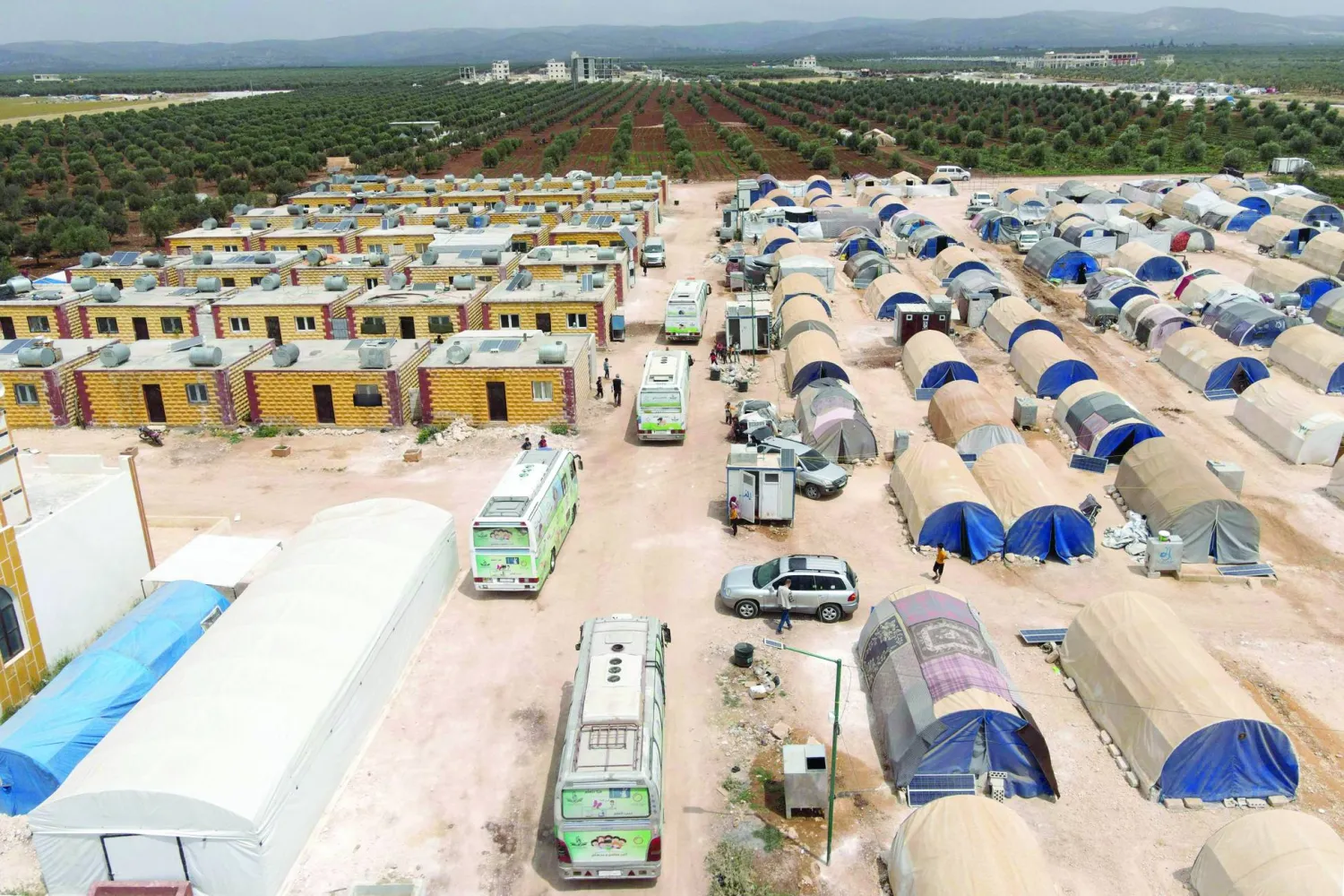
Buses turned into travelling classrooms pull into at a displacement camp in Jindayris in the opposition-held northwestern Syrian province of Aleppo on May 23, 2023, following a devastating earthquake more than three months ago. (Photo by Rami al SAYED / AFP)
TT

UN Votes to Establish Independent Body to Clarify Fate of over 130,000 Syrians Missing in Conflict

Buses turned into travelling classrooms pull into at a displacement camp in Jindayris in the opposition-held northwestern Syrian province of Aleppo on May 23, 2023, following a devastating earthquake more than three months ago. (Photo by Rami al SAYED / AFP)

The UN General Assembly approved a resolution Thursday that will establish an independent body to determine what happened to more than 130,000 people missing as a result of the conflict in Syria.

The resolution, an important response to appeals by their families and loved ones, was adopted by the 193-member world body on a vote of 83-11 with 62 abstentions. Among those opposing the resolution was Syria, which said it will not cooperate with the new institution. Russia, China, North Korea, Venezuela, Cuba and Iran also voted no.

The resolution, spearheaded by Luxembourg, noted that after 12 years of fighting in Syria “little progress has been achieved in alleviating the suffering of families by providing answers as to the fate and whereabouts of all missing persons”, reported The Associated Press.

It authorizes the establishment of an Independent Institution of Missing Persons in the Syrian Arab Republic, under UN auspices, “to clarify the fate and whereabouts of all missing persons ... and to provide adequate support to victims, survivors and the families of those missing.”

It says victims, survivors and the families of the missing should be represented in the new body, which will be guided by principles including “do no harm,” impartiality, transparency and the confidentiality of sources and information.

Under the resolution, UN Secretary-General Antonio Guterres must present terms of reference for the new institution within 80 working days and take steps to speedily establish the body and put it in operation. It requests the UN chief to report on implementation of the resolution within 100 working days.

Luxembourg’s UN ambassador, Olivier Maes, told the General Assembly before the vote that “every day families, especially women, face administrative and legal difficulties, financial uncertainties and deep trauma as they continue to search for their missing loved ones.”

He noted that Guterres recommended in a report last August that UN members consider establishing an independent institution to clarify the fate of the missing. The UN chief cited insufficient coordination among current bodies dealing with Syria’s missing and said families often had to report disappearances to multiple places.

Maes said the new institution will be “a one-stop shop” and serve as a single place to collect and compare data and ensure coordination and communication with all parties.

Syrian Ambassador Bassam Sabbagh called the resolution “politicized,” saying it clearly reflects “flagrant interference in our internal affairs” and provides new evidence of the “hostile approach” of the United States and other Western nations to his country.

Urging a "no" vote, he said Syria has addressed the issue of missing persons, processed all claims of disappearances submitted to law enforcement authorities and carried out “independent investigations in accordance with Syrian law and on the basis of available information and resources.”

US deputy ambassador Jeffrey DeLaurentis said many of the missing were unjustly detained or taken by the parties to the conflict, including individuals believed to be missing at the hands of the ISIS extremist movement and other terrorist groups.

"Nearly every Syrian family is affected by this issue," he said. “Confirming the fate and whereabouts of the missing, securing their release, and returning the remains of those who perished to their families is a moral and humanitarian imperative.”

DeLaurentis said that “even with limited or no initial cooperation from Damascus, we believe this institution will make meaningful progress.”

Syria’s uprising-turned conflict, now in its 13th year, has killed nearly a half million people and displaced half of its prewar population of 23 million. The International Commission on Missing Persons cites UN estimates that in 2021 more than 130,000 Syrians were missing as a result of the conflict.

In the run-up to the vote, over 100 civil society organizations and 23 UN human rights experts had urged the General Assembly to establish an independent institution.

The organizations, including Amnesty International and Human Rights Watch and a dozen Syrian groups, called on UN member nations “to support the families’ right to truth.” They noted that the call was also supported by the International Committee of the Red Cross and others.


Qassem's Threat of Civil War Widely Condemned in Lebanon

Hezbollah's then deputy leader Sheikh Naim Qassem speaks during an interview with The Associated Press in Beirut's southern suburbs, Lebanon, July 2, 2024. (AP)
TT

Qassem's Threat of Civil War Widely Condemned in Lebanon

Hezbollah's then deputy leader Sheikh Naim Qassem speaks during an interview with The Associated Press in Beirut's southern suburbs, Lebanon, July 2, 2024. (AP)

Hezbollah Secretary-General Sheikh Naim Qassem's continued refusal to lay down his party's weapons in defiance of the state have sparked outrage in Lebanon.

In a televised address on Saturday, Qassem declared that Hezbollah "will not surrender", accusing Foreign Minister Youssef Raggi of "undermining civil peace and inciting strife." He also called on the government to replace the minister.

Ministerial sources close to the presidency told Asharq Al-Awsat that some of Qassem's remarks were viewed as a response to President Joseph Aoun's recent statements in which he indirectly called on the Iran-backed party to "return to reason and the state and hand over its weapons that have become a burden on its community and Lebanon."

The sources told Asharq Al-Awsat that official "decisions were taken to be implemented. Nothing will change the president's convictions."

Qassem escalated his rhetoric to save face in front of Hezbollah supporters, they added, ruling out the possibility that the party would take its objections to the streets.

The process of imposing state monopoly over arms is on the right path, they stressed.

Meanwhile, officials expressed their outrage over Qassem's remarks.

In a post on the X platform, Justice Minister Adel Nassar said: "Those threatening civil war to preserve their weapons must cease giving lectures about patriotism to a minister in government."

Lebanese Forces MP Razi al-Hajj slammed Hezbollah as a "calamity" on Lebanon. In a post on X, he said: "Naim Qassem is working outside the state, manipulating civil peace, inciting strife and standing against the presidency, government and will of the Lebanese people."

"He refuses to hand over Hezbollah's weapons and makes threats of civil war. Day and night he attacks the Lebanese state's official positions and works against them. Hezbollah is Lebanon's real calamity," he remarked.

LF MP Ghayath Yazbeck slammed Qassem for "verbally" and "morally" assaulting LF ministers, "in complete disregard of ethical principles".

He warned that Qassem’s remarks may be a prelude to the assassination of the ministers and "the assassination of the Lebanese state."

"Our ministers represent dignity, sovereignty and the state," he stressed. Indirectly addressing Qassem, he said: "Act smart. Your predecessors made these mistakes and ended up in history’s trash bin. Haven’t you learned anything?"

Responding to Qassem, Kataeb MP Nadim Gemayel said: "The foreign minister's stance is based on the humiliating agreement that you signed after the 'support war'. Lebanon officially agreed to the deal that effectively embodies the president's swearing in oath and government's policy statement in terms of imposing state monopoly over arms across the country."

In a post on X, he hoped the president and prime minister would issue a clear stance in support of FM Raggi.

Addressing Qassem, LF MP Elias Hankach said on X: "By continuing to rebel against state decisions and threaten the Lebanese people, you have become an outlaw gang."

"Just as the army imposed state monopoly over arms south of the Litani River, it will soon do so to its north," he said.

MP Waddah Sadek slammed Qassem, saying on X: "He himself does not believe what he is saying... He is living in a parallel world while the state continues to firmly reclaim its institutions regardless of the critics."

"The only thing Qassem got right was that Lebanon has indeed entered a new phase," he noted. Addressing the Hezbollah leader, he added: "Your weapons are a burden and no longer serve a purpose."

"For years, we have listened to your speeches and endured defeats and destruction that you brought onto the country. Yours is just another speech that won't make a difference," he stated.

MP Fuad Makhzoumi expressed his rejection of Qassem's statements, saying he is "detached from reality" and posing a "frank challenge to the state and its institutions."

In a post on X, he wrote: "You are part of the government, so how can you object to decisions you were a partner to? Whoever objects to government decisions must resign, not defy the state from the inside."

He urged Hezbollah to commit to the ceasefire, United Nations Security Council resolution 1701, and hand over its weapons, otherwise face the responsibility of violating state decisions.

"No one is above the law in Lebanon and threats have only led to destruction that the Lebanese people alone have paid the price of," he added.


Palestinian President’s Advisor: Board of Peace, Related Entities Are a ‘Temporary Arrangement’

Palestinian President Mahmoud Abbas’ advisor Dr. Mahmoud Al-Habbash. WAFA
TT

Palestinian President’s Advisor: Board of Peace, Related Entities Are a ‘Temporary Arrangement’

Palestinian President Mahmoud Abbas’ advisor Dr. Mahmoud Al-Habbash. WAFA

Palestinian President Mahmoud Abbas’ advisor Dr. Mahmoud Al-Habbash said that the situation in the Gaza Strip, along with the formation of the Board of Peace and its related entities is not a Palestinian choice.

This is “a temporary arrangement (mandated by the UN Security Council) that the Palestinian leadership rejects under any circumstances... but it is the lesser of two evils,” Al-Habbash told Asharq Al-Awsat.

Speaking from Ramallah, Al-Habbash said that the Palestinian leadership “chose this arrangement to stop the massacre and open a potential window ... leading to a Palestinian state.”

US President Donald Trump announced last week the formation of the Board of Peace, a new body of world leaders meant to oversee next steps in Gaza.

The White House said there would be a main board, chaired by Trump himself, a Palestinian committee of technocrats meant to govern the war-wracked territory, and a second "executive board" that appears designed to have a more advisory role.

“Our clear and firm position is that we did not create this reality,” said Al-Habbash. “Rather, it is a reality imposed on us for two reasons: First, Israel’s aggression ... and second, the reckless adventure carried out by Hamas movement, which whetted Israel’s appetite to liquidate the Palestinian cause.”

According to Al-Habbash, “this transitional arrangement is the least harmful to the Palestinian cause,” because it ensures that Palestinians remain in the Gaza Strip and prevents displacement.


UN Human Rights Commissioner Calls for Accountability for Atrocity Crimes in Sudan

UN Human Rights commissioner Volker Turk 
TT

UN Human Rights Commissioner Calls for Accountability for Atrocity Crimes in Sudan

UN Human Rights commissioner Volker Turk 

UN Human Rights commissioner Volker Turk said on Sunday he is alarmed by the increasing militarization of society by all parties to the conflict in Sudan, also expressing his worries that the atrocity crimes committed during and after the takeover of El Fasher would be repeated in the Kordofan region.

Speaking at a press conference in Port Sudan, where the government had been operating as a temporary capital since the conflict began, the UN envoy said the proliferation of advanced military equipment, in particular drones, across Sudan has enhanced the military capabilities of both the Sudanese army (SAF) and the Rapid Support Forces (RSF), prolonging hostilities and deepening the crisis for civilians.

“I am deeply alarmed by the increasing militarization of society by all parties to the conflict, including through the arming of civilians and recruitment and use of children,” Turk noted.

The envoy said that during his visit to refugee camps in north Sudan, he heard accounts of widespread summary executions by RSF during the offensive on El Fasher, the capital of North Darfur region – for revenge, for suspected affiliation with the Sudanese Army or its allied Joint Forces.

He added, “I am very worried that the atrocity crimes committed during and after the takeover of El Fasher are at grave risk of repeating themselves in the Kordofan region, where the conflict has been rapidly escalating since late October.”

Horror and Hell

Turk also said the Sudanese population had endured “horror and hell,” especially with the expansion of the fighting in Kordofan.

“The Kordofan states are extremely volatile, with relentless military engagements, heavy shelling, drone bombardments and airstrikes causing widespread destruction and collapse of essential services,” he warned.

Since the end of October, and after taking control of El Fasher in Darfur, the RSF attacks have expanded into the neighboring Kordofan region, resulting in a continued displacement of civilians from the besieged city – all in the context of extreme food insecurity, with famine conditions confirmed in Kadugli, and risk of famine in other areas including Dilling, according to Turk.

The latest UN figures show that more than 65,000 people have been displaced since October.

At his press conference at Port Sudan airport, the envoy said that during his four-day visit to Port Sudan, Dongola, Ad Dabba and Merowe, he has met with those who have been hardest hit by brutal violence and injustice in this war.

“The terrifying experiences of these survivors must provoke action to end this conflict, and to make sure they can access what they need: medical care, psychosocial care, justice and support to pursue education and a livelihood”.

End This Madness

Turk and his UN team had visited the Al Afad site for internally displaced people (IDPs) in Ad Dabba, where they met with a large number of displaced people from the regions of Darfur and Kordofan.

“In my meetings with more than 50 local and international organizations in Dongola and Port Sudan, I heard appeals directed to those waging this war and the international community to end this madness,” he said.

“And to allow NGOs, journalists, lawyers and humanitarian actors to do their essential work without undue restrictions and reprisals,” Turk added.

He said the RSF and the Sudanese army must cease intolerable attacks against civilian objects that are indispensable to the civilian population, including markets, health facilities, schools and shelters.

“Attacks on critical civilian infrastructure are serious violations that can amount to war crimes,” Turk affirmed.

The UN envoy said the international community must ensure that the perpetrators of the horrific violations in Sudan face justice, regardless of their affiliation.

My Office, he said, is working to document and report on these violations and abuses to pave the way for accountability.

Turk described as “despicable” the fact that large sums of money are being spent on procuring increasingly advanced weaponry – funds he said that should be used to alleviate the suffering of the population.

Protection of Civilians

The envoy then called on all parties to the conflict to ensure the protection of civilians and civilian infrastructure, to guarantee safe passage for civilians to leave areas of active conflict – including Kadugli and Dilling – and for humanitarian aid to enter where it is needed.

He also repeated his call from three years ago, when he last visited Sudan, urging all those involved to set aside entrenched positions, power games, and personal interests, and to focus on the common interests of the Sudanese people.

The envoy then left Sudan with a plea that human rights be central to building confidence and bringing this war to an end, to resuming the difficult task of building a sustainable peace.

“It is difficult, but certainly not impossible, with the resilience and power of the Sudanese people,” he affirmed.