


Ukraine Aims to Wear Down and Outsmart a Russian Army Distracted by Infighting

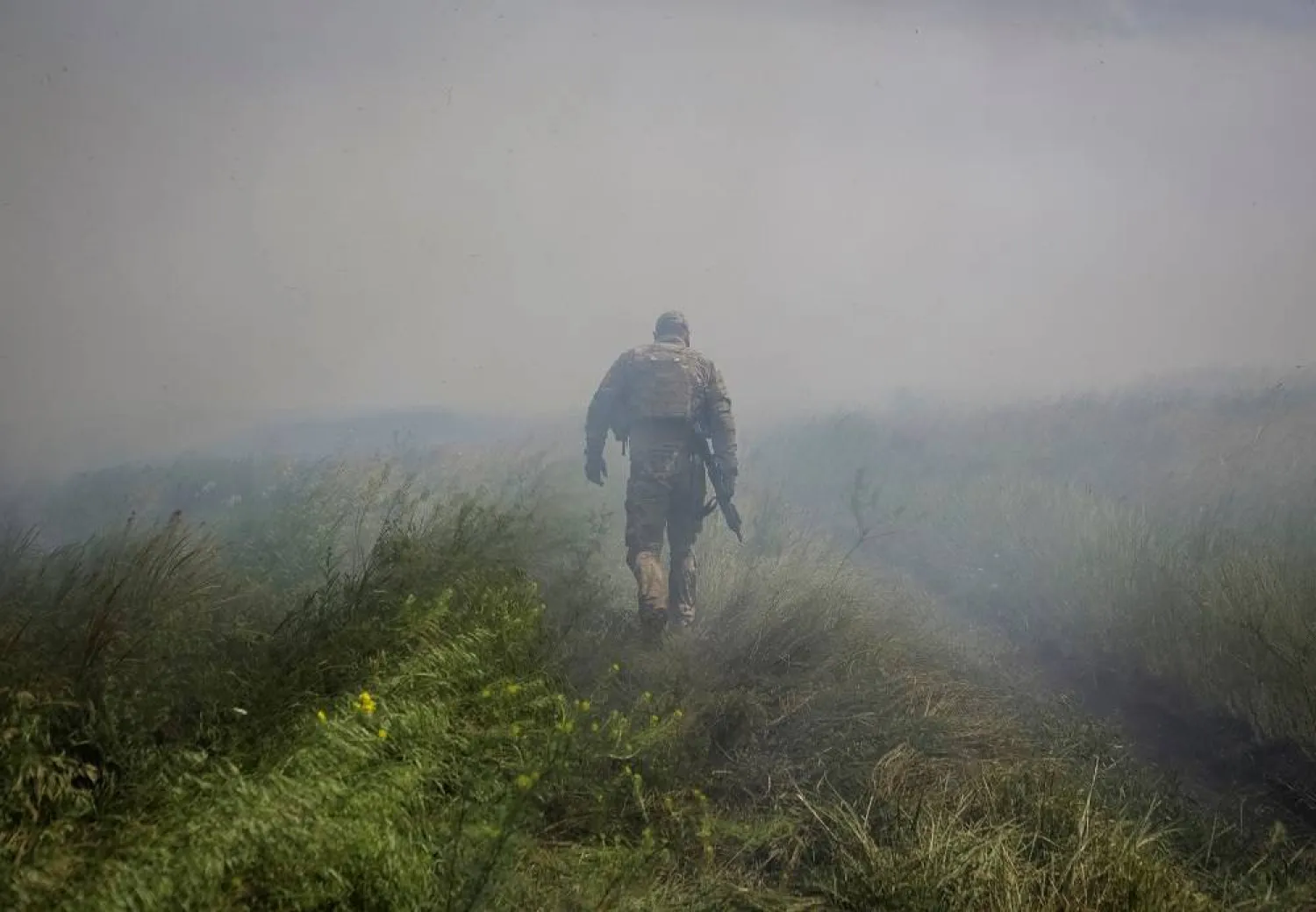
A Ukrainian service member is seen, amid Russia's attack on Ukraine, near the front line near the newly liberated village Neskuchne in Donetsk region, Ukraine June 13, 2023. (Reuters)
TT

Ukraine Aims to Wear Down and Outsmart a Russian Army Distracted by Infighting

A Ukrainian service member is seen, amid Russia's attack on Ukraine, near the front line near the newly liberated village Neskuchne in Donetsk region, Ukraine June 13, 2023. (Reuters)

The ambush had been postponed three times before Ukrainian commanders decided one recent night that conditions were finally right. Cloaked in darkness, a battalion of Kyiv’s 129th brigade pressed ahead, advancing stealthily on unsuspecting Russian soldiers.

By the time the Russians situated along the front line realized they were under attack, it was too late.

Ukraine's recapture of the small village of Neskuchne in the eastern Donetsk region on June 10 encapsulates the opening strategy of a major counteroffensive launched earlier this month. Small platoons bank on the element of surprise and, when successful, make incremental gains in territory and battlefield intelligence.

"We had a few scenarios. In the end, I think we chose the best one. To come quietly, unexpectedly," said Serhii Zherebylo, the 41-year-old deputy commander of the battalion that retook Neskuchne.

Across the 1,500-kilometer (930-mile) front line, Ukrainian forces are attempting to wear down the enemy and reshape battle lines to create more favorable conditions for a decisive, eastward advance. One strategy could be to try to split Russia's forces in two so that the Crimean Peninsula, which Moscow illegally annexed in 2014, is isolated from the rest of the territory it controls.

Ukraine's troops were given a boost of morale last week by an armed rebellion in Russia that posed the most significant threat to President Vladimir Putin's power in more than two decades. Yet how the revolt by Wagner Group mercenaries under the command of Russian warlord Yevgeny Prigozhin affects the trajectory of the war remains to be seen.

The infighting is a major distraction for Russia's military and political leaders, but experts say the impact on the battlefield so far appears minimal.

For the past four days, Ukraine has stepped up operations around the eastern city of Bakhmut, which Wagner forces seized after months of intense fighting and then handed over to Russian soldiers, who continue to lose some ground on their southern flank.

Along the front line, however, the strength of the Russian military remains unchanged since the revolt.

It is not clear where Ukraine will attempt to decisively punch through, but any success will rely on newly formed, Western-equipped brigades that are not yet deployed. For now, Russia's deeply fortified positions and relative air superiority are slowing Ukraine's advance.

Military experts say it is hard to say who has the advantage: Russia is dug-in with manpower and ammunition, while Ukraine is versatile, equipped with modern weaponry and clever on the battlefield.

But with the autumn muddy season only four months away, some Ukrainian commanders say they are racing against time.

"Although Ukrainian forces are making small and steady gains, they do not yet have the operational initiative, meaning they are not dictating the tempo and terms of action," said Dylan Lee Lehrke, an analyst with the British security intelligence firm Janes.

"This has led some observers to claim the counteroffensive is not meeting expectations," Lehrke said. But it was never going to resemble Ukraine’s blitzkrieg liberation of the eastern Kharkiv region last year, he said, because "Russian forces have had too long to prepare fortifications."

Russian authorities say Ukraine has suffered substantial losses since the start of the counteroffensive — 259 tanks and 790 armored vehicles, according to Putin, whose claims could not be independently verified.

Grinding battles are being waged in multiple combat zones.

A catastrophic dam collapse last month in the southern Kherson region has altered the geography along the Dnieper River, giving Ukrainians more freedom of movement there. Russian military bloggers claim a small group of Ukrainian fighters are making gains in the area, although Ukrainian officials have not confirmed these reports.

Across the agricultural plains of the southeastern Zaporizhzhia region, Ukrainian troops backed by tanks, artillery and drones appear to be chipping away more decisively against Russian positions.

Ukrainian troops would deal a severe blow to Russian forces if they managed to regain access to the Sea of Azov from this direction, effectively cutting off Moscow’s land bridge to Crimea. It’s too early to determine whether this is a realistic goal.

They are still a long way off.

In an underground command center on the front, a Ukrainian Special Forces commander with the call sign "Hunter" stares intently at an aerial view of the lush green battlefield.

His servicemen have just stormed an enemy position, but the return fire is constant. Russians blast rockets into the air, while his fighters hide and wait for orders.

Hunter directs the drone operator to shoot.

On the screen, a huge plume of black smoke swells in the air. A hit, he says.

The battle here will only get harder, analysts say.

Ukrainian troops are still several kilometers from Russia’s main defensive lines. As they penetrate deeper into occupied territory, the fighters will have to contend with Russian defenses organized in a diagonal pattern, 10 kilometers deep in some areas, including minefields, anti-tank ditches and pyramid-shaped obstacles known as "dragon's teeth."

And with each advance, they become more vulnerable to Russian air attacks.

At least 130 square kilometers (50 square miles) of land has been regained in the south since the start of the counteroffensive, Deputy Defense Minister Hanna Malyar said this week.

It’s not the pace many hoped for.

A US official familiar with the Biden administration thinking said the counteroffensive is a "long slog" that is testing Ukrainian forces in ways that few other episodes of the 16-month old war have. The official, who was not authorized to comment and spoke on the condition of anonymity, said that there never was expected to be a "D-Day moment," but that the early going suggests the pace of the counteroffensive will be "tough and challenging" for the Ukrainians.

Unlike some of the earlier battles in the war, in which Russian forces showed little resistance or even fled the battlefield, Ukrainian forces are currently facing stiff resistance, the official said.

In the northeast, Russian forces have stepped up offensive operations in the direction of the Kreminna forest near Lyman with the aim of securing a buffer to prevent incursions close to Moscow’s supply lines, said Lehrke. But it may well have a secondary aim — of forcing more Ukrainian deployments, he said.

The dense forested area has proven to be notoriously difficult terrain.

"The Russians have sabotage groups going into the woods and there have been cases where they enter behind the first line of Ukrainian defenses," said Pavlo Yusov, a press officer with the National Guard’s Thunderstorm brigade, currently in Lyman.

Col. Volodymyr Silenko, a commander of the 30th Mechanized Brigade operating near Bakhmut, pays no mind to criticism over the pace of attacks. It’s much more important to focus on how the adversary is thinking and responding, he said.

"A war is not a competition of raw force and strength of weapons and people, it’s more about who’s more cunning," he said.

Silenko knows the Russians watch his men, the same way he watches theirs; Moscow sees their movements, how they change, how they evolve.

"Our job is to outsmart them," he said.

Deception was a key part of Ukraine's most significant battlefield success to date, last fall's "Kherson ruse." By making it appear that the city of Kherson was the main target of that counteroffensive, Ukrainian forces were able to swiftly retake the northern Kharkiv region.

"That was a master class in deception," said Lehrke. "Whether they can do the same this time remains to be seen."



Trump Praises New Honduras President after Talks in US

(COMBO) This combination of pictures created on February 06, 2026 shows Honduras' President Nasry Asfura walking following the inauguration ceremony at the Honduran Congress in Tegucigalpa on January 27, 2026, and US President Donald Trump smiling during an announcement in the Oval Office of the White House in Washington, DC, on October 16, 2025. (Photo by Johny MAGALLANES and ANDREW CABALLERO-REYNOLDS / AFP)
TT

Trump Praises New Honduras President after Talks in US

(COMBO) This combination of pictures created on February 06, 2026 shows Honduras' President Nasry Asfura walking following the inauguration ceremony at the Honduran Congress in Tegucigalpa on January 27, 2026, and US President Donald Trump smiling during an announcement in the Oval Office of the White House in Washington, DC, on October 16, 2025. (Photo by Johny MAGALLANES and ANDREW CABALLERO-REYNOLDS / AFP)

US President Donald Trump on Saturday praised Honduran counterpart Nasry Asfura, whom he endorsed on the campaign trail, following a meeting at his Mar-a-Lago resort.

Asfura, a conservative businessman and former mayor of Honduran capital Tegucigalpa, was sworn in last week after winning November elections with Trump's backing.

Trump had threatened to cut aid to Central America's poorest country if his "friend" was defeated.

"I had a very important meeting with my friend, and the President of Honduras, Nasry 'Tito' Asfura," Trump wrote on his Truth Social platform.

"Once I gave him my strong Endorsement, he won his Election! Tito and I share many of the same America First Values. We have a close partnership on Security."

He said the pair discussed investment and trade between the two nations.

Asfura is set to speak to media about the talks Sunday, AFP reported.

The Honduran presidency released a photo of the two leaders smiling and giving a thumbs up.

Asfura already met with US Secretary of State Marco Rubio on January 12, after which the two countries announced plans for a free trade deal.

His win gave Trump another ally in Latin America after conservatives campaigning heavily on crime and corruption replaced leftists in Chile, Bolivia, Peru and Argentina.

Trump has been pressuring countries in Washington's backyard to choose between close ties with Washington or Beijing.

Asfura, who succeeded left-wing leader Xiomara Castro, has said he is considering switching diplomatic ties from China to the self-ruled island of Taiwan.

On the eve of the Honduran election, Trump in a surprise move pardoned former president Juan Orlando Hernandez, from Asfura's party, who was serving a 45-year prison sentence in the US for drug trafficking.

Hernandez was convicted of helping to smuggle 400 tons of cocaine into the United States.

Trump's decision to pardon him, even as US forces were blowing up alleged drug boats in the Caribbean and tightening the noose on Venezuela's Nicolas Maduro, whom Washington accuses of drug trafficking, drew heavy criticism.


Top Trump Iran Negotiator Says Visits US Aircraft Carrier in Middle East

US Special Envoy Steve Witkoff delivers a press conference upon the signing of the declaration on deploying post-ceasefire force in Ukraine, during the so-called "Coalition of the Willing" summit, at the Elysee Palace in Paris, France, January 6, 2026. (Reuters)
TT

Top Trump Iran Negotiator Says Visits US Aircraft Carrier in Middle East

US Special Envoy Steve Witkoff delivers a press conference upon the signing of the declaration on deploying post-ceasefire force in Ukraine, during the so-called "Coalition of the Willing" summit, at the Elysee Palace in Paris, France, January 6, 2026. (Reuters)

US President Donald Trump's lead Iran negotiator Steve Witkoff on Saturday said he visited the USS Abraham Lincoln aircraft carrier currently in the Arabian Sea, with Washington and Tehran due to hold further talks soon.

"Today, Adm. Brad Cooper, Commander of US Naval Forces Central Command, Jared Kushner, and I met with the brave sailors and Marines aboard the USS Abraham Lincoln, her strike group, and Carrier Air Wing 9 who are keeping us safe and upholding President Trump's message of peace through strength," said Witkoff in a social media post.

Iranian Foreign Minister Abbas Araghchi said on Saturday he hoped talks with the United States would resume soon, while reiterating Tehran's red lines and warning against any American attack.


Israel’s Netanyahu Expected to Meet Trump in US on Wednesday and Discuss Iran

Israeli Prime Minister Benjamin Netanyahu delivers a speech during a special session to mark the 77th anniversary of the Knesset's establishment and the 60th anniversary of the dedication of the current building at the Knesset, the Israeli parliament, in Jerusalem, 02 February 2026. (EPA)
TT

Israel’s Netanyahu Expected to Meet Trump in US on Wednesday and Discuss Iran

Israeli Prime Minister Benjamin Netanyahu delivers a speech during a special session to mark the 77th anniversary of the Knesset's establishment and the 60th anniversary of the dedication of the current building at the Knesset, the Israeli parliament, in Jerusalem, 02 February 2026. (EPA)

Israeli Prime Minister Benjamin Netanyahu is expected to meet US President Donald Trump on Wednesday in Washington, where they will discuss negotiations with Iran, Netanyahu's office said on Saturday.

Iranian and US officials held indirect nuclear ‌talks in the ‌Omani capital ‌Muscat ⁠on Friday. ‌Both sides said more talks were expected to be held again soon.

A regional diplomat briefed by Tehran on the talks told Reuters Iran insisted ⁠on its "right to enrich uranium" ‌during the negotiations with ‍the US, ‍and that Tehran's missile capabilities ‍were not raised in the discussions.

Iranian officials have ruled out putting Iran's missiles - one of the largest such arsenals in the region - up ⁠for discussion, and have said Tehran wants recognition of its right to enrich uranium.

"The Prime Minister believes that any negotiations must include limiting ballistic missiles and halting support for the Iranian axis," Netanyahu's office said in a ‌statement.