


Orchestra-Conducting Robot Wows Audience in S. Korean Capital

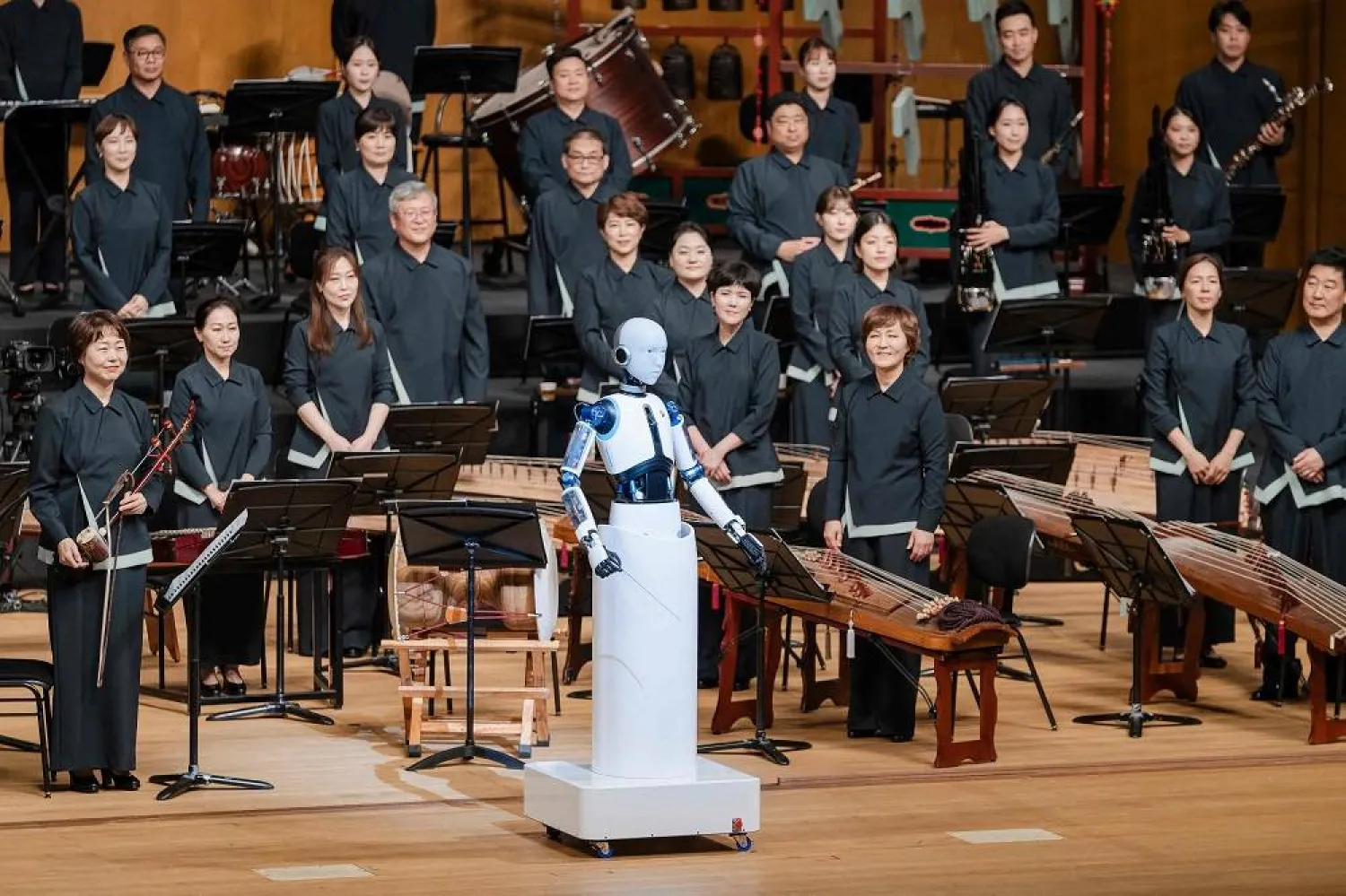
This handout picture taken on June 30, 2023 and provided by the National Theater of Korea shows the South Korean-made robot called "EveR 6" conducting musicians of the National Orchestra of Korea during a concert at the national theater in Seoul. (National Theater of Korea / AFP)
TT

Orchestra-Conducting Robot Wows Audience in S. Korean Capital

This handout picture taken on June 30, 2023 and provided by the National Theater of Korea shows the South Korean-made robot called "EveR 6" conducting musicians of the National Orchestra of Korea during a concert at the national theater in Seoul. (National Theater of Korea / AFP)

A South Korean-made robot made its debut as an orchestra conductor before a sell-out crowd in Seoul on Friday, wowing the audience with a flawless performance in place of a human maestro.

Named "EveR 6", the five-foot-ten-inch-tall (1.8m) robot guided more than 60 musicians of the National Orchestra of Korea who were playing traditional Korean instruments.

The robot successfully guided the compositions, both independently and in collaboration with a human maestro who was standing next to it for about half an hour, entertaining the more than 950 audience members who had packed the National Theater of Korea.

The robot was showered with applause when it first appeared from below the stage on a lift and turned to face the audience, bowing in greeting.

Throughout the performance, the robot's blue eyes stared unblinkingly at the musicians, only nodding its head in time to the music.

The rookie performed well on its stage debut, audience members said.

"I came here worried whether this robot could pull this off without a glitch," Kim Ji-min, a 19-year-old college student majoring in music, told AFP.

"But I found it to be in great harmony with the musicians... It felt like a whole new world for me."

While there have been musical performances led by robotic conductors in the past, including a 2017 concert led by the robot YuMi in Italy, this was the first time South Koreans were able to witness a robotic conductor on stage.

EveR 6, developed by the state-run Korea Institute of Industrial Technology, was programmed to replicate the movements of a human conductor through motion capture technology.

The machine is not capable of listening or improvising in real-time, however.

EveR 6's developers are currently working on enabling the robot to make gestures that are not pre-programmed, said Lee Dong-wook, the robot's engineer.

Improvising and communicating with musicians in real-time is the next big step, said Song Joo-ho, a music columnist who came to see the performance.

"It needs to improvise in real-time when musicians make a mistake or things go wrong."


Neuralink Plans ‘High-Volume’ Brain Implant Production by 2026, Musk Says

Elon Musk steps off Air Force One upon arrival at Morristown Municipal Airport in Morristown, New Jersey, US, March 22, 2025. (AFP)
TT

Neuralink Plans ‘High-Volume’ Brain Implant Production by 2026, Musk Says

Elon Musk steps off Air Force One upon arrival at Morristown Municipal Airport in Morristown, New Jersey, US, March 22, 2025. (AFP)

Elon Musk's brain implant company Neuralink will start "high-volume production" of brain-computer interface devices and move to an entirely automated surgical procedure in 2026, Musk said in a post on the social media platform X on ‌Wednesday.

Neuralink did ‌not immediately respond ‌to ⁠a Reuters ‌request for comment.

The implant is designed to help people with conditions such as a spinal cord injury. The first patient has used it to play video ⁠games, browse the internet, post on ‌social media, and ‍move a cursor ‍on a laptop.

The company began ‍human trials of its brain implant in 2024 after addressing safety concerns raised by the US Food and Drug Administration, which had initially rejected its application in ⁠2022.

Neuralink said in September that 12 people worldwide with severe paralysis have received its brain implants and were using them to control digital and physical tools through thought. It also secured $650 million in a June funding round.


Report: France Aims to Ban Under-15s from Social Media from September 2026

French President Emmanuel Macron holds a press conference during a European Union leaders' summit, in Brussels, Belgium December 19, 2025. (Reuters)
TT

Report: France Aims to Ban Under-15s from Social Media from September 2026

French President Emmanuel Macron holds a press conference during a European Union leaders' summit, in Brussels, Belgium December 19, 2025. (Reuters)

France plans to ban children under 15 from social media sites and to prohibit mobile phones in high schools from September 2026, local media reported on Wednesday, moves that underscore rising public angst over the impact of online harms on minors.

President Emmanuel Macron has often pointed to social media as one of the factors to blame for violence among young people and has signaled he wants France to follow Australia, whose world-first ‌ban for under-16s ‌on social media platforms including Facebook, Snapchat, TikTok ‌and ⁠YouTube came into force ‌in December.

Le Monde newspaper said Macron could announce the measures in his New Year's Eve national address, due to be broadcast at 1900 GMT. His government will submit draft legislation for legal checks in early January, Le Monde and France Info reported.

The Elysee and the prime minister's office did not immediately respond to a request for comment on the reports.

Mobile phones have been banned ⁠in French primary and middle schools since 2018 and the reported new changes would extend that ban ‌to high schools. Pupils aged 11 to ‍15 attend middle schools in the French ‍educational system.

France also passed a law in 2023 requiring social platforms to ‍obtain parental consent for under-15s to create accounts, though technical challenges have impeded its enforcement.

Macron said in June he would push for regulation at the level of the European Union to ban access to social media for all under-15s after a fatal stabbing at a school in eastern France shocked the nation.

The European Parliament in ⁠November urged the EU to set minimum ages for children to access social media to combat a rise in mental health problems among adolescents from excessive exposure, although it is member states which impose age limits. Various other countries have also taken steps to regulate children's access to social media.

Macron heads into the New Year with his domestic legacy in tatters after his gamble on parliamentary elections in 2024 led to a hung parliament, triggering France's worst political crisis in decades that has seen a succession of weak governments.

However, cracking down further on minors' access to social media could prove popular, according to opinion ‌polls. A Harris Interactive survey in 2024 showed 73% of those canvassed supporting a ban on social media access for under-15s.


Poland Urges Brussels to Probe TikTok Over AI-Generated Content

The TikTok logo is pictured outside the company's US head office in Culver City, California, US, September 15, 2020. (Reuters)
TT

Poland Urges Brussels to Probe TikTok Over AI-Generated Content

The TikTok logo is pictured outside the company's US head office in Culver City, California, US, September 15, 2020. (Reuters)

Poland has asked the European Commission to investigate TikTok after the social media platform hosted AI-generated content including calls for Poland to withdraw from the EU, it said on Tuesday, adding that the content was almost certainly Russian disinformation.

"The disclosed content poses a threat to public order, information security, and the integrity of democratic processes in Poland and across the European Union," Deputy Digitalization Minister Dariusz Standerski said in a letter sent to the Commission.

"The nature of ‌the narratives, ‌the manner in which they ‌are distributed, ⁠and the ‌use of synthetic audiovisual materials indicate that the platform is failing to comply with the obligations imposed on it as a Very Large Online Platform (VLOP)," he added.

A Polish government spokesperson said on Tuesday the content was undoubtedly Russian disinformation as the recordings contained Russian syntax.

TikTok, representatives ⁠of the Commission and of the Russian embassy in Warsaw did not ‌immediately respond to Reuters' requests for ‍comment.

EU countries are taking ‍measures to head off any foreign state attempts to ‍influence elections and local politics after warning of Russian-sponsored espionage and sabotage. Russia has repeatedly denied interfering in foreign elections.

Last year, the Commission opened formal proceedings against social media firm TikTok, owned by China's ByteDance, over its suspected failure to limit election interference, notably in ⁠the Romanian presidential vote in November 2024.

Poland called on the Commission to initiate proceedings in connection with suspected breaches of the bloc's sweeping Digital Services Act, which regulates how the world's biggest social media companies operate in Europe.

Under the Act, large internet platforms like X, Facebook, TikTok and others must moderate and remove harmful content like hate speech, racism or xenophobia. If they do not, the Commission can impose fines of up to 6% ‌of their worldwide annual turnover.
