Putin Will Speak with Leaders of China and India in His First Summit since the Wagner Insurrection

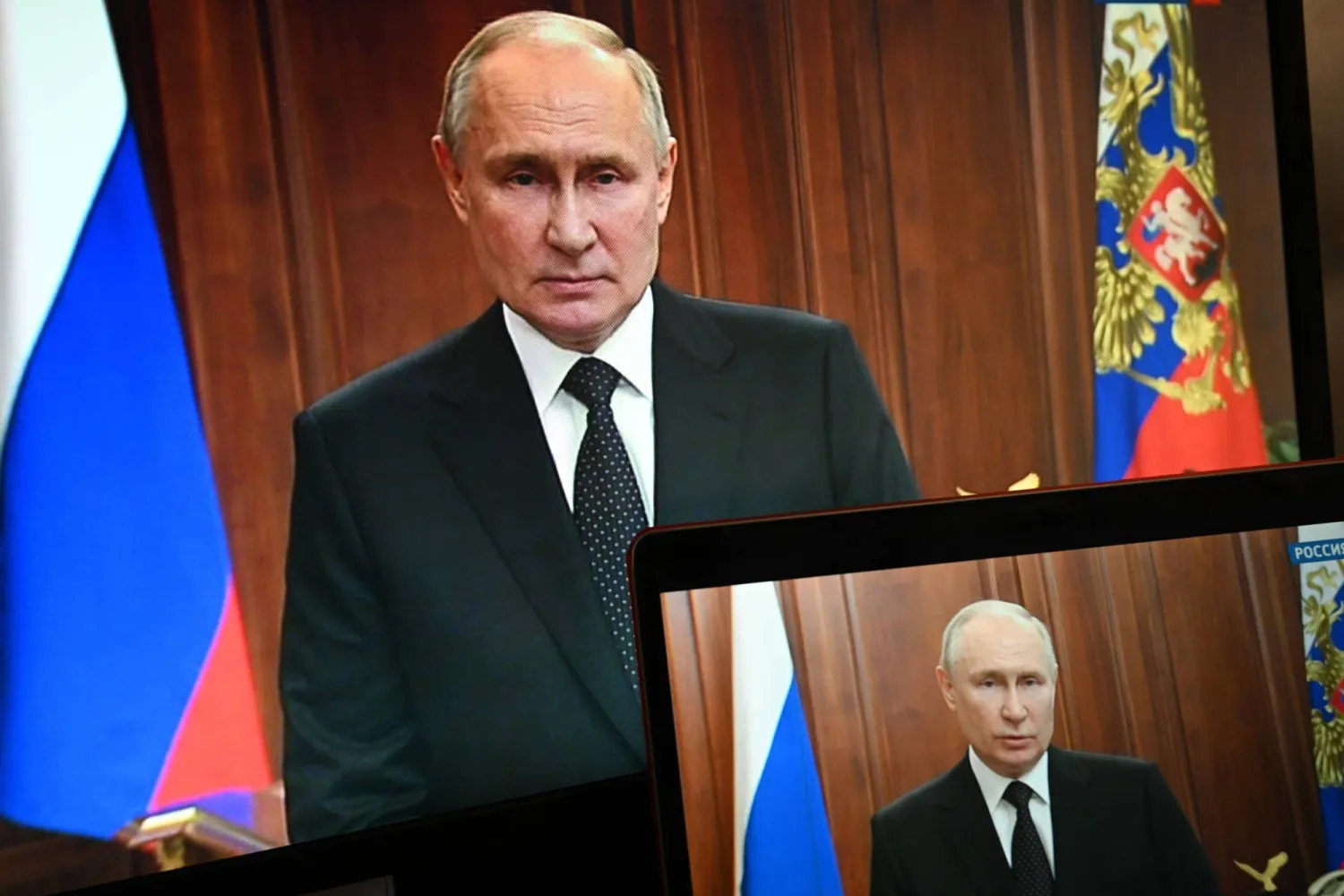
FILE - Russian President Vladimir Putin is seen on monitors as he addresses the nation after Yevgeny Prigozhin, the owner of the Wagner Group military company, called for armed rebellion and reached the southern city of Rostov-on-Don with his troops, in Moscow, Russia, Saturday, June 24, 2023. (Pavel Bednyakov, Sputnik, Kremlin Pool Photo via AP, File)
TT

Putin Will Speak with Leaders of China and India in His First Summit since the Wagner Insurrection

FILE - Russian President Vladimir Putin is seen on monitors as he addresses the nation after Yevgeny Prigozhin, the owner of the Wagner Group military company, called for armed rebellion and reached the southern city of Rostov-on-Don with his troops, in Moscow, Russia, Saturday, June 24, 2023. (Pavel Bednyakov, Sputnik, Kremlin Pool Photo via AP, File)

President Vladimir Putin will participate this week in his first multilateral summit since an armed rebellion rattled Russia, as part of a rare international grouping in which his country still enjoys support.
Leaders will convene virtually on Tuesday for a summit of the Shanghai Cooperation Organization, a security grouping founded by Russia and China to counter Western alliances from East Asia to the Indian Ocean, The Associated Press said.
This year’s event is hosted by India, which became a member in 2017. It's the latest avenue for Prime Minister Narendra Modi to showcase the country’s growing global clout.
The group so far has focused on deepening security and economic cooperation, fighting terrorism and drug trafficking, tackling climate change and the situation in Afghanistan after the Taliban took over in 2021. When the foreign ministers met in India last month, Russia's war on Ukraine barely featured in their public remarks but the fallout for developing countries on food and fuel security remains a concern for the group, analysts say.
The forum is more important than ever for Moscow, which is eager to show that the West has failed to isolate it. The group includes the four Central Asian nations of Kazakhstan, Kyrgyzstan, Tajikistan and Uzbekistan, in a region where Russian influence runs deep. Others include Pakistan, which became a member in 2017, and Iran, which is set to join on Tuesday. Belarus is also in line for membership.
“This SCO meeting is really one of the few opportunities globally that Putin will have to project strength and credibility," said Michael Kugelman, director of the Wilson Center’s South Asia Institute.
None of the member countries has condemned Russia in UN resolutions, choosing instead to abstain. China has sent an envoy to mediate between Russia and Ukraine, and India has repeatedly called for a peaceful resolution of the conflict.
For Putin personally, the summit presents an opportunity to show he is in control after a short-lived insurrection by Wagner mercenary chief Yevgeny Prigozhin.
“Putin will want to reassure his partners that he is very much still in charge, and leave no doubt that the challenges to his government have been crushed,” said Tanvi Madan, a senior fellow at the Brookings Institution.
India announced in May that the summit would be held online instead of in-person like last year in Samarkand, Uzbekistan, where Putin posed for photographs and dined with other leaders.
For New Delhi at least, the optics of hosting Putin and China’s leader Xi Jinping just two weeks after Modi was honored with a pomp-filled state visit by US President Joe Biden would be less than ideal.
After all the fanfare Modi received from American leaders on his recent visit, “it would have been too soon (for India) to be welcoming Chinese and Russian leaders,” Kugelman said.
India’s relationship with Moscow has stayed strong throughout the war; it has scooped up record amounts of Russian crude and relies on Moscow for 60% of its defense hardware. At the same time, the US and its allies have aggressively courted India, which they see as a counterweight to China’s growing ambitions.
A key priority for India in the forum is to balance its ties with the West and the East, with the country also hosting the Group of 20 leading economies' summit in September. It's also a platform for New Delhi to engage more deeply with Central Asia.
“India glorifies in this type of foreign policy where it’s wheeling and dealing with everybody at the same time,” said Derek Grossman, an Indo-Pacific analyst at the RAND Corporation.
New Delhi, observers say, will be looking to secure its own interests at the summit. It will likely emphasize the need to combat what it calls “cross-border terrorism” — a dig at Pakistan, whom India accuses of arming and training rebels fighting for independence of Indian-controlled Kashmir or its integration into Pakistan, a charge Islamabad denies.
It may also stress the need to respect territorial integrity and sovereignty — a charge often directed towards its other rival, China. India and China have been locked in an intense three-year standoff involving thousands of soldiers stationed along their disputed border in the eastern Ladakh region.
Analysts say China, seeking to posture itself as a global force, is becoming a dominant player in forums like the SCO, where interest for full membership from countries like Myanmar, Türkiye and Afghanistan has grown in recent years.
“The limitation with the SCO is that China and Russia are trying to turn it into an anti-Western grouping, and that does not fit with India's independent foreign policy,” said Madan.
The SCO could also prove challenging for Washington and its allies in the long run.
“For countries uncomfortable with the West and their foreign policies, the SCO is a welcome alternative, mainly because of the roles Russia and China play. ... I think that highlights just how relevant and concerning this group could be for a number of Western capitals, especially if it keeps expanding," said Kugelman.



Seoul: Kim Jong Un Entrenches Daughter as Likely Heir

(FILES) This picture taken on November 28, 2025 and released by North Korea's official Korean Central News Agency (KCNA) on November 30, 2025 shows North Korean leader Kim Jong Un (3rd L) and his daughter Ju Ae (2nd L) watching a demonstration flight commemorating the 80th anniversary of the founding of the Korean People's Army Air Force at Kalma Airfield in Wonsan, Gangwon Province. (Photo by KCNA VIA KNS / AFP)
TT

Seoul: Kim Jong Un Entrenches Daughter as Likely Heir

(FILES) This picture taken on November 28, 2025 and released by North Korea's official Korean Central News Agency (KCNA) on November 30, 2025 shows North Korean leader Kim Jong Un (3rd L) and his daughter Ju Ae (2nd L) watching a demonstration flight commemorating the 80th anniversary of the founding of the Korean People's Army Air Force at Kalma Airfield in Wonsan, Gangwon Province. (Photo by KCNA VIA KNS / AFP)

North Korean leader Kim Jong Un has entrenched his daughter as heir apparent ahead of a landmark party conference, a South Korean lawmaker said on Thursday after a briefing from Seoul's main intelligence agency.

The Kim family has ruled North Korea with an iron grip for decades, and a cult of personality surrounding their "Paektu bloodline" dominates daily life in the isolated country.

Kim's teenage daughter Ju Ae has long been seen as the next in line, a perception stoked by a string of recent high-profile outings.

South Korea's National Intelligence Service said Ju Ae has now been clearly "designated as a successor", lawmaker Lee Seong-kweun said after a parliamentary briefing with the spy agency.

The assessment was made "taking into account a range of circumstances -- including her increasingly prominent public presence at official events", he told reporters, according to AFP.

South Korea's spy agency said last year Ju Ae appeared to be the next in line after she accompanied Kim on a high-profile visit to Beijing.

Photos published ahead of a rare political congress in North Korea this month cemented that perception.

State media showed Ju Ae in January paying respects alongside her father at the Kumsusan Palace of the Sun, where the bodies of state founder Kim Il Sung and second-generation ruler Kim Jong Il lie in state.

Pyongyang is due to hold a landmark party congress at the end of February -- its biggest political event -- where it is expected to lay out its foreign policy, war planning and nuclear ambitions for the next five years.

The National Intelligence Service said it would closely monitor Ju Ae's attendance, as well as the level of protocol accorded to her.

Analysts have suggested that she could be elected First Secretary of the Central Committee, the second most powerful position in North Korea's ruling Workers' Party.

Ju Ae was publicly introduced to the world in 2022 when she accompanied her father to an intercontinental ballistic missile launch.

North Korean state media have since referred to her as "the beloved child" and a "great person of guidance" -- "hyangdo" in Korean -- a term typically reserved for top leaders and their successors.

Before 2022, the only confirmation of her existence had come from former NBA star Dennis Rodman, who visited the North in 2013.


Trump Says No 'Definitive' Agreement with Netanyahu, US Talks with Iran to Continue

Image published by the Israeli Prime Minister's website from his meeting with the US President at the White House yesterday
TT

Trump Says No 'Definitive' Agreement with Netanyahu, US Talks with Iran to Continue

Image published by the Israeli Prime Minister's website from his meeting with the US President at the White House yesterday

President Donald Trump said after talks with Israeli Prime Minister Benjamin Netanyahu on Wednesday they reached no "definitive" agreement on how to move forward with Iran but he insisted negotiations with Tehran would continue to see if a deal can be achieved.

Netanyahu, who had been expected to press Trump to widen diplomacy with Iran beyond its nuclear program to include limits on its missile arsenal, stressed that Israel's security interests must be taken into account but offered no sign that the president made the commitments he sought, said Reuters.

In their seventh meeting since Trump returned to office last year, Netanyahu - whose visit was more muted than usual and closed to the press - was looking to influence the next round of US discussions with Iran following nuclear negotiations held in Oman last Friday.

The two leaders spoke behind closed doors for more than two and a half hours in what Trump described as a "very good meeting" but said no major decisions were made and stopped short of publicly accepting Netanyahu's entreaties.

Trump has threatened strikes on Iran if no agreement is reached, while Tehran has vowed to retaliate, stoking fears of a wider war as the US amasses forces in the Middle East. He has repeatedly voiced support for a secure Israel, a longstanding US ally and arch-foe of Iran.

In media interviews on Tuesday, Trump reiterated his blunt warning to Iran, while saying he believes Tehran wants a deal.

"There was ‌nothing definitive reached other ‌than I insisted that negotiations with Iran continue to see whether or not a Deal can be consummated," Trump said in ‌a ⁠social media post after ⁠the meeting with Netanyahu. "If it can, I let the Prime Minister know that will be a preference."

"If it cannot, we will just have to see what the outcome will be," Trump added, noting that the last time Iran decided against an agreement the US struck its nuclear sites last June.

TRUMP SAYS NO TO IRANIAN NUCLEAR WEAPONS, MISSILES

Trump told Fox Business in an interview broadcast on Tuesday that a good deal with Iran would mean "no nuclear weapons, no missiles," without elaborating. He also told Axios he was considering sending a second aircraft carrier strike group as part of a major US buildup near Iran.

Israel fears that the US might pursue a narrow nuclear deal that does not include restrictions on Iran's ballistic missile program or an end to Iranian support for armed proxies such as Hamas and Hezbollah, according to people familiar with the matter. Israeli officials have urged the US not to trust Iran's promises.

Iran has rejected such demands and says ⁠the Oman talks focused only on nuclear issues.

"The Prime Minister emphasized the security needs of the State of Israel in the context ‌of the negotiations, and the two agreed to continue their close coordination and tight contact," Netanyahu's office said in ‌a statement after Wednesday's talks.

The two leaders had also been expected to talk about potential military action if diplomacy with Iran fails, one source said.

Iran has said it is prepared to discuss ‌curbs on its nuclear program in exchange for lifting sanctions but has ruled out linking the issue to missiles.

"The Islamic Republic's missile capabilities are non-negotiable," Ali Shamkhani, an adviser ‌to Iran's supreme leader, said on Wednesday. Netanyahu's arrival at the White House was lower-key than usual. The two leaders were shown shaking hands in a photo released by the Israeli Embassy. But unlike previous Netanyahu visits with Trump, a press pool was not allowed into the Oval Office. It was not immediately known why he received such low-profile treatment.

GAZA ON THE AGENDA

Also on the agenda was Gaza, with Trump looking to push ahead with a ceasefire agreement he helped to broker. Progress on his 20-point plan to end the war and rebuild the shattered Palestinian enclave has stalled, with major gaps over ‌steps such as Hamas disarming as Israeli troops withdraw in phases.

"We discussed the tremendous progress being made in Gaza, and the Region in general," Trump said after the meeting.

Netanyahu's visit, originally scheduled for February 18, was brought forward amid renewed US ⁠engagement with Iran. Both sides at last week's ⁠Oman meeting said the negotiations were positive and further talks were expected soon.

Trump has been vague about broadening the negotiations. He was quoted as telling Axios on Tuesday that it was a "no-brainer" for any deal to cover Iran's nuclear program, but that he also thought it possible to address its missile stockpiles.

Iran says its nuclear activities are for peaceful purposes, while the US and Israel have accused it of past efforts to develop nuclear weapons.

During a 12-day war last June, Israel heavily damaged Iran's air defenses and missile arsenal. Two Israeli officials say there are signs Iran is working to restore those capabilities.

Trump threatened last month to intervene militarily during a bloody crackdown on anti-government protests in Iran, but ultimately held off.

ISRAEL WARY OF A WEAKENED IRAN REBUILDING

Tehran's regional influence has been weakened by Israel’s June attack, losses suffered by its proxies in Gaza, Lebanon, Yemen and Iraq, and the ousting of its ally, former Syrian President Bashar al-Assad.

But Israel is wary of its adversaries rebuilding after the multifront war triggered by Hamas' October 2023 assault on southern Israel.

While Trump and Netanyahu have mostly been in sync and the US remains Israel's main arms supplier, they appear to be at odds on another key issue.

Part of Trump's Gaza plan holds out the prospect for eventual Palestinian statehood - which Netanyahu and his coalition, the most far-right in Israel's history, have long resisted.

Netanyahu's security cabinet on Sunday authorized steps that would make it easier for Israeli settlers in the occupied West Bank to buy land while granting Israel broader powers in what the Palestinians see as the heartland of a future state.

The decision drew international condemnation, and Trump on Tuesday reiterated his opposition to West Bank annexation.


Turkish, Greek Leaders Voice Desire to Resolve Issues After Talks

In this photo released by the Turkish Presidency, Türkiye’s President Recep Tayyip Erdogan, right, and Greece's Prime Minister Kyriakos Mitsotakis, shake hands during their meeting in Ankara, Türkiye, Wednesday, Feb. 11, 2026. (Turkish Presidency via AP)
TT

Turkish, Greek Leaders Voice Desire to Resolve Issues After Talks

In this photo released by the Turkish Presidency, Türkiye’s President Recep Tayyip Erdogan, right, and Greece's Prime Minister Kyriakos Mitsotakis, shake hands during their meeting in Ankara, Türkiye, Wednesday, Feb. 11, 2026. (Turkish Presidency via AP)

The leaders of Türkiye and Greece voiced their desire to resolve longstanding maritime disputes hobbling ties during discussions in Ankara on Wednesday, as the NATO allies and historic rivals try to build on warming relations.

The neighbors have been at odds over a range of issues for decades, primarily maritime boundaries and rights in the Aegean, an area widely believed to hold energy resources and with key implications for airspace and military activity.

Following years of heightened tensions, a 2023 declaration on friendly relations prompted a thaw in rhetoric, though their maritime issues have remained unresolved and the two sides still disagree over ‌regional matters.

Speaking at ‌a press conference in Ankara with Greek Prime Minister Kyriakos Mitsotakis, ‌Turkish ⁠President Recep Tayyip Erdogan said ⁠they had discussed their issues in the Aegean and eastern Mediterranean "in an open and sincere way" during the talks.

"While the issues may be thorny, they are not unsolvable on the basis of international law. I saw that we were in agreement with my friend Kyriakos," Erdogan said.

He added that the two countries would continue working to achieve their goal of reaching $10 billion in bilateral trade.

Mitsotakis said he hoped circumstances would allow the sides to solve a dispute on ⁠the demarcation of maritime and exclusive economic zones in the Aegean ‌and eastern Mediterranean.

'IF NOT NOW, WHEN?'

"It is time to ‌remove any substantial and formal threats to our relations, if not now, when?" Mitsotakis said.

"Destiny has ‌appointed us to live in the same neighborhood. We cannot change geography, but we can ‌make it an ally, choosing convergence, dialogue and trust in international law... to build a future of peace, progress and prosperity for our people."

Despite the positive tone, Greece's foreign minister earlier said Athens planned to extend its territorial waters further, including potentially in the Aegean.

Shortly after, Ankara said it had issued ‌a maritime notice urging Greece to coordinate research activities in areas of the Aegean that Türkiye considers part of its continental shelf.

In ⁠1995, Türkiye’s parliament ⁠declared a casus belli — a cause for war — should Greece unilaterally extend its territorial waters beyond six nautical miles in the Aegean, a stance Athens says violates international maritime law. Greece says it wants only to discuss demarcation of maritime zones.

Mitsotakis also said the flows of migrants in the Aegean Sea had decreased by almost 60% last year due to cooperation between the two countries, adding this should be strengthened.

Fifteen migrants died in a shipwreck off the Greek island of Chios last week after their boat collided with a Greek coastguard vessel and sank in the Aegean Sea off the Turkish coast.

Türkiye is a transit country for migrants seeking to reach the European Union via Greece. Ankara says the EU has not fully delivered on commitments under a 2016 migration deal and Athens wants Türkiye to do more to curb irregular crossings.