


Ukraine, Russia Accuse Each Other of Planning to Attack Europe’s Biggest Nuclear Plant

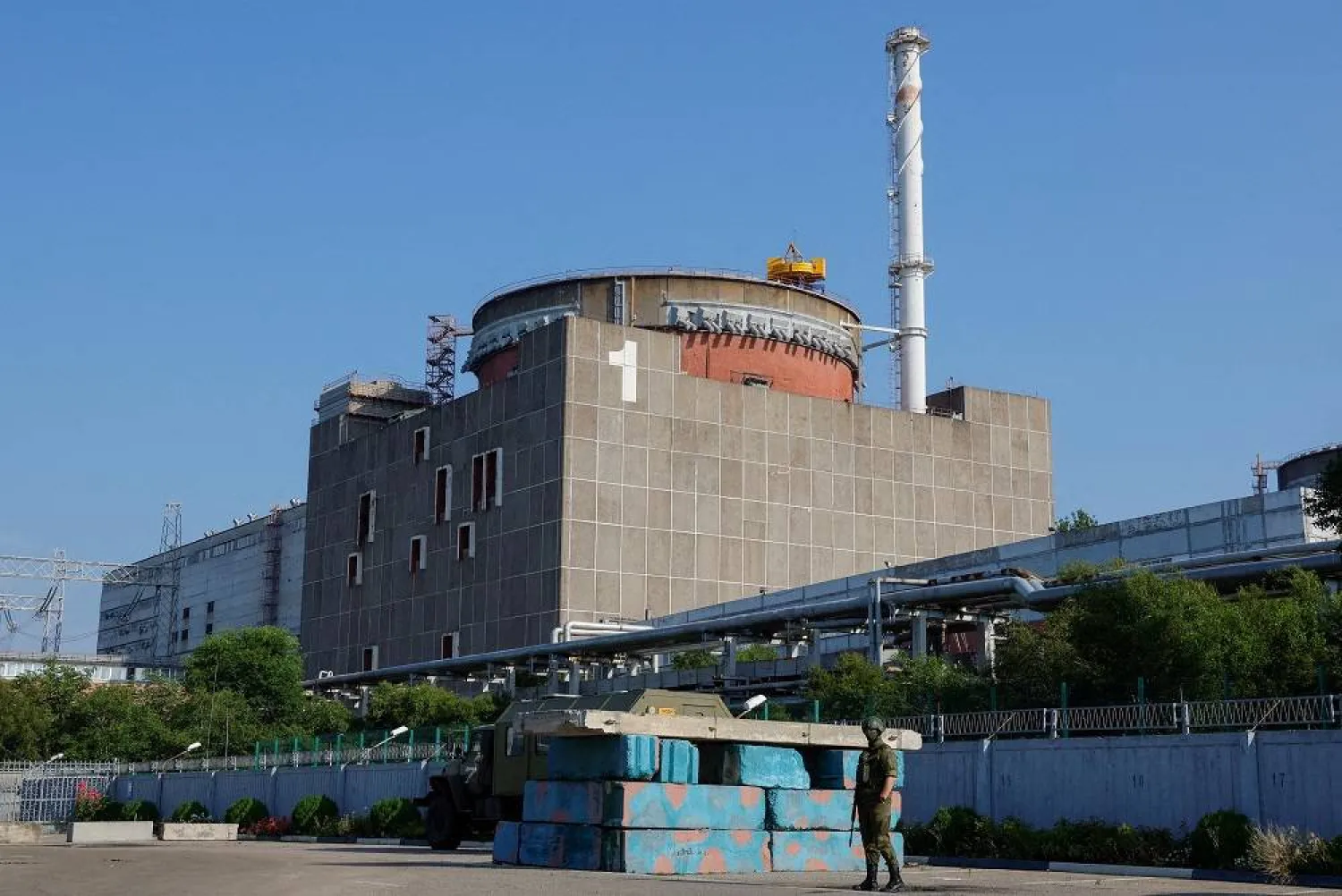
A Russian service member stands guard at a checkpoint near the Zaporizhzhia Nuclear Power Plant outside Enerhodar in the Zaporizhzhia region, Russian-controlled Ukraine, June 15, 2023. (Reuters)
TT

Ukraine, Russia Accuse Each Other of Planning to Attack Europe’s Biggest Nuclear Plant

A Russian service member stands guard at a checkpoint near the Zaporizhzhia Nuclear Power Plant outside Enerhodar in the Zaporizhzhia region, Russian-controlled Ukraine, June 15, 2023. (Reuters)

Ukraine and Russia accused each other Wednesday of planning to attack one of the world's largest nuclear power plants, but neither side provided evidence to support their claims of an imminent threat to the facility in southeastern Ukraine that is occupied by Russian troops.

The Zaporizhzhia Nuclear Power Plant has been a focus of concern since Moscow's forces took control of it and its staff in the early stages of the war. Russia and Ukraine have regularly traded blame over shelling near the plant that caused power outages. Over the last year, the UN's atomic watchdog repeatedly expressed alarm over the possibility of a radiation catastrophe like the one at Chernobyl after a reactor exploded in 1986.

The six reactors at Zaporizhzhia are shut down, but the plant still needs power and qualified staff to run crucial cooling systems and other safety features.

Ukraine has alleged more recently that Moscow might try to cause a deliberate leak in an attempt to derail Kyiv’s ongoing counteroffensive in the surrounding Zaporizhzhia region. Russia is suspected of blowing up a dam in southern Ukraine last month with a similar aim.

Citing the latest intelligence reports, Ukrainian President Volodymyr Zelenskyy alleged Tuesday night that Russian troops had placed "objects resembling explosives" on top of several of the plant's power units to "simulate" an attack from outside.

"Their detonation should not damage power units but may create a picture of shelling from Ukraine," according to a statement from the general staff of Ukraine’s armed forces.

The International Atomic Energy Agency has officials stationed at the Russian-held plant, which is still run by its Ukrainian staff. IAEA Director General Rafael Mariano Grossi said his agency's most recent inspection of the plant found no activity related to explosives, "but we remain extremely alert."

"As you know, there is a lot of combat. I have been there a few weeks ago, and there is contact there very close to the plant, so we cannot relax," Grossi said during a visit to Japan.

In Russia, Kremlin spokesman Dmitry Peskov raised the specter of a potentially "catastrophic" provocation by the Ukrainian army at the nuclear plant, which is Europe’s largest.

"The situation is quite tense. There is a great threat of sabotage by the Kyiv regime, which can be catastrophic in its consequences," Peskov said in response to a reporter’s question about the plant. He also claimed that the Kremlin was pursuing "all measures" to counter the alleged Ukrainian threat.

Grossi said he was aware of both Kyiv’s and Moscow’s claims and reiterated that "nuclear power plants should never, under any circumstances, be attacked."

"A nuclear power plant should not be used as a military base," he said.

A Russian attack on the plant would "probably not lead to the widespread dispersal of significant amounts of radiation" due to precautionary steps taken by the IAEA, according to the International Institute for Strategic Studies, a think tank.

"A blast at Zaporizhzhia would spread radiation and sow panic, but the actual off-site radiation risk would be relatively low,’’ the think tank said in a recent assessment, adding that wind might blow some radiation toward Russia.

The most likely scenarios are a Russian-engineered explosion that exposes one of the reactor cores and starts a fire that burns spent fuel, or a blast involving the dry spent fuel on site that would carry the radiation far afield via wind, the IISS said.

Neither of those scenarios would bring a disaster on the scale of Chernobyl or Fukushima, Japan’s tsunami-wrecked nuclear plant, it said.

Renat Karchaa, an adviser to Russian state nuclear company Rosenergoatom, said there was "no basis" for Zelenskyy's claims of a plot to simulate an explosion.

"Why would we need explosives there? This is nonsense" aimed at "maintaining tension around the Zaporizhzhia Nuclear Power Plant," Karchaa said.

Russian media on Tuesday cited Karchaa as saying that Ukraine’s military planned to strike the plant early Wednesday with ammunition laced with nuclear waste. As of Wednesday afternoon, there was no indication of such an attack.

Last week, Ukrainian emergency workers held a drill to prepare for a potential release of radiation from the plant. In case of a nuclear disaster at the plant, approximately 300,000 people would be evacuated from the areas closest to the facility, according to the country’s emergency services.

Ukrainian officials have said the shut-down reactors are protected by thick concrete containment domes.



US Military Strikes Another Alleged Drug Boat in Eastern Pacific, Killing 3

A shot of a boat targeted by a US raid in the Caribbean (archive - Reuters)
TT

US Military Strikes Another Alleged Drug Boat in Eastern Pacific, Killing 3

A shot of a boat targeted by a US raid in the Caribbean (archive - Reuters)

The US military said Friday that it has carried out another deadly strike on a vessel accused of trafficking drugs in the Eastern Pacific Ocean.

US Southern Command said on social media that the boat “was transiting along known narco-trafficking routes in the Eastern Pacific and was engaged in narco-trafficking operations.” It said the strike killed three people. A video linked to the post shows a boat floating in the water before bursting into flames.

Friday’s attack raises the death toll from the Trump administration’s strikes on alleged drug boats to at least 148 people in at least 43 attacks carried out since early September in the Caribbean Sea and eastern Pacific Ocean.

President Donald Trump has said the US is in “armed conflict” with cartels in Latin America and has justified the attacks as a necessary escalation to stem the flow of drugs. But his administration has offered little evidence to support its claims of killing “narcoterrorists.”

Critics have questioned the overall legality of the strikes as well as their effectiveness, in part because the fentanyl behind many fatal overdoses is typically trafficked to the US over land from Mexico.


Afghanistan Quake Causes No ‘Serious’ Damage, Injuries, Says Official

Afghan men prepare meals during the holy fasting month of Ramadan in Kabul, Afghanistan, 19 February 2026. (EPA)
TT

Afghanistan Quake Causes No ‘Serious’ Damage, Injuries, Says Official

Afghan men prepare meals during the holy fasting month of Ramadan in Kabul, Afghanistan, 19 February 2026. (EPA)

A 5.8-magnitude earthquake that rocked eastern Afghanistan including the capital Kabul has resulted in only minor damage and one reported injury, a disaster official told AFP on Saturday.

The quake hit on Friday just as people in the Muslim-majority country were sitting down to break their Ramadan fast.

The epicenter was near several remote villages around 130 kilometers (80 miles) northeast of Kabul, the United States Geological Survey said.

"There aren't any serious casualties or damages after yesterday's earthquake," said Mohammad Yousuf Hamad, spokesman for the National Disaster Management Authority.

He added that one person had sustained "a minor injury in Takhar", in Afghanistan's north, "and three houses had minor damage in Laghman" province.

Zilgay Talabi, a resident of Khenj district near the epicenter, said the tremor was "very strong, it went on for almost 30 seconds".

Earthquakes are common in Afghanistan, particularly along the Hindu Kush mountain range, near where the Eurasian and Indian tectonic plates meet.

In August last year, a shallow 6.0-magnitude quake in the country's east wiped out mountainside villages and killed more than 2,200 people.

Weeks later, a 6.3-magnitude quake in northern Afghanistan killed 27 people.

Large tremors in western Herat, near the Iranian border, in 2023, and in Nangarhar province in 2022, killed hundreds and destroyed thousands of homes.

Many homes in the predominantly rural country, which has been devastated by decades of war, are shoddily built.

Poor communication networks and infrastructure in mountainous Afghanistan have hampered disaster responses in the past, preventing authorities from reaching far-flung villages for hours or even days before they could assess the extent of the damage.


Serbia Urges Citizens to Quit Iran ‘As Soon as Possible’

People walk past an anti-US billboard in Tehran, Iran, January 26, 2026. Majid Asgaripour/WANA (West Asia News Agency) via Reuters
TT

Serbia Urges Citizens to Quit Iran ‘As Soon as Possible’

People walk past an anti-US billboard in Tehran, Iran, January 26, 2026. Majid Asgaripour/WANA (West Asia News Agency) via Reuters

Serbia has urged its citizens in Iran to leave the country "as soon as possible", after US President Donald Trump threatened military action over the country's nuclear program.

The Balkan nation had already invited Serbian nationals in mid-January to leave Iran and not to travel there, as the country's clerical authorities launched a bloody crackdown on a mass protest movement.

"Due to the deteriorating security situation, citizens of the Republic of Serbia are not recommended to travel to Iran in the coming period," the foreign ministry said in a statement on its website published overnight Friday to Saturday.

"All those who are in Iran are recommended to leave the country as soon as possible."

Iran said on Friday that it was hoping for a quick deal with the United States on Tehran's nuclear program, long a source of discord between the two foes.

But Trump, after ordering a major naval build-up in the Middle East aimed at heaping pressure on Tehran, said on Friday that he was "considering" a limited military strike if the negotiations proved unfruitful.