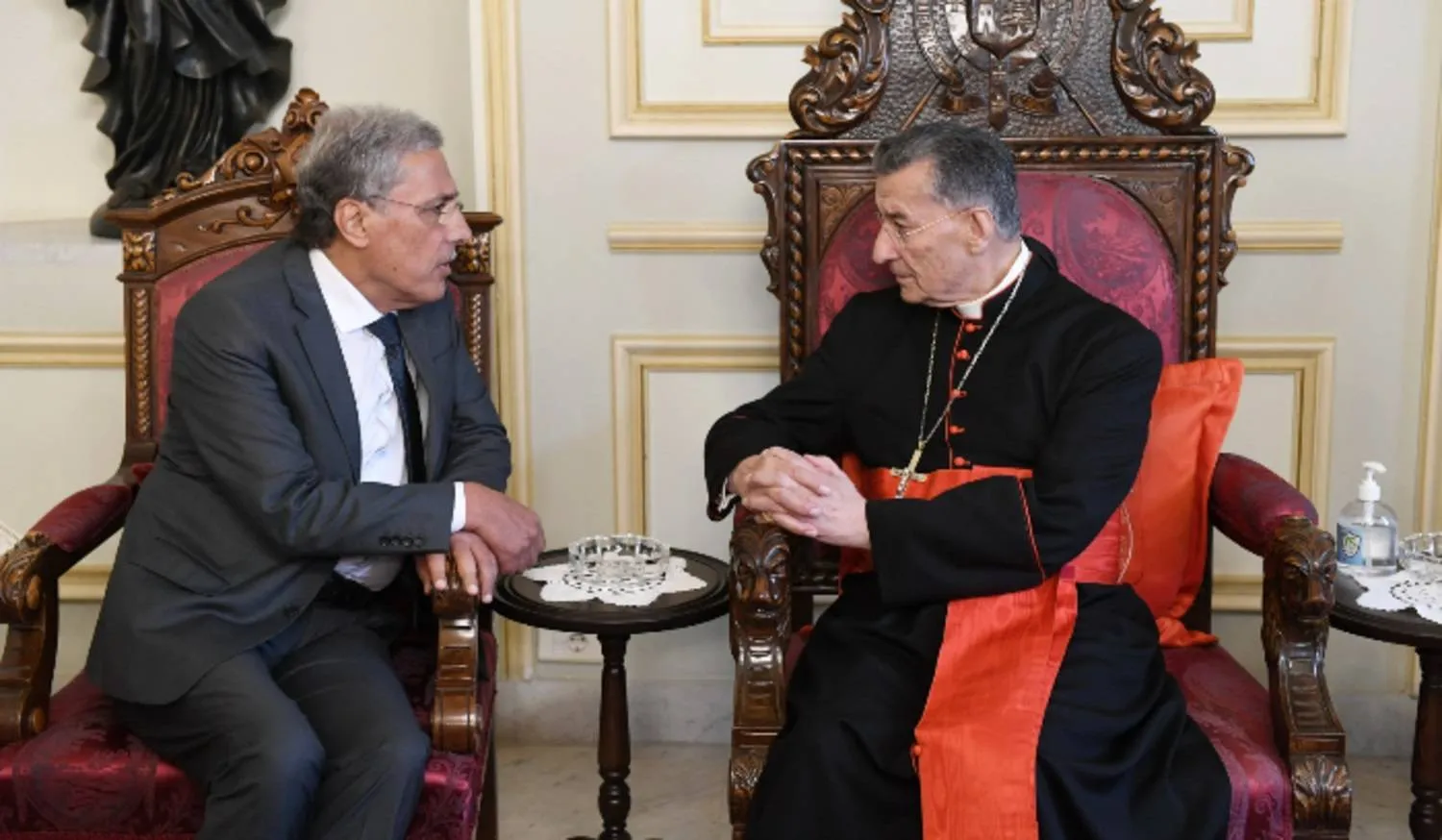
Rahi Doubts Loyalty of Lebanese Politicians towards their Country

Maronite Patriarch Bechara Rahi met Wednesday with Caretaker Minister of Justice, Henry Khoury (NNA)
TT

Rahi Doubts Loyalty of Lebanese Politicians towards their Country

Maronite Patriarch Bechara Rahi met Wednesday with Caretaker Minister of Justice, Henry Khoury (NNA)

Lebanese Maronite Patriarch Bechara Rahi expressed on Wednesday his doubts about the sincerity of Lebanon’s politicians toward their country, also accusing the ruling class of being “beholden to their own interests.”

The Patriarch was speaking on Wednesday at the launching ceremony of the document titled “A New Vision for Lebanon Tomorrow: A Secular, Decentralized, and Neutral State.”

Rahi reiterated his call for an international conference on Lebanon because “the Lebanese politicians escaped dialogue because they are beholden to their personal interests.”

He then expressed his doubts about the sincerity of politicians toward the country, saying “there is no salvation for Lebanon if we remain as we are. Lebanon is ill, and officials do not want to treat its illness or know its cause.”

Rahi added: “It is not the right of officials to devastate a country and its people by destroying the system and the constitution.”

For his part, Sheikh Sami Abdel Khalek representing Sheikh Akl of the Druze Community Sheikh Naim Hassan, said during the ceremony that the Lebanese must work for the interest of the country and not for the interest of the sect and the party.”

Meanwhile, Bishop Samir Mazloum expressed his regret that there are Lebanese politicians who assassinated the State in order to make profit.

Last November, Rahi urged to the United Nations to save Lebanon by holding an international conference – a call that was supported by the country’s opposition parties and rejected by Shiites.


EU Explores Deeper Syria Partnership, Flags Concern over Russia Role

Flags of the European Union and its member states fly in front of the building of the European Parliament in Strasbourg, France June 30, 2017. REUTERS/Arnd Wiegmann
TT

EU Explores Deeper Syria Partnership, Flags Concern over Russia Role

Flags of the European Union and its member states fly in front of the building of the European Parliament in Strasbourg, France June 30, 2017. REUTERS/Arnd Wiegmann

The European Union is weighing a broad upgrade in ties with Syria, including security sector reform, investment and a revival of a long-frozen trade accord, according to an EU document seen by Reuters, as the bloc seeks to draw Damascus closer to Europe and counter lingering Russian influence after Bashar al-Assad's overthrow.

The discussion paper, prepared by the bloc's diplomatic service ahead of a November 16 meeting of EU foreign ministers, sketches one of Brussels' most ambitious efforts yet to normalize ties with Syria, less than two years after Assad's fall ended decades of authoritarian rule and reshaped regional alliances.

The EU's diplomatic service said that while Syria's transition is ‌moving forward, "challenges remain ‌high and accelerated progress is needed" on issues such as economic recovery, ‌national ⁠reconciliation, and the ⁠reintegration of internally displaced people and refugees.

Alongside plans to support security-sector reform, including trilateral cooperation with Jordan on the training of Syrian police recruits, the EU is seeking to step up its engagement with the country to limit "the malign influence of Russian and other foreign actors on Syria", the discussion paper said.

Russia's intervention in Syria's civil war helped keep Assad in power for years and secured Moscow's strategic foothold on the Mediterranean. Since his overthrow, however, the Kremlin has been trying to secure ⁠a new deal with the current authorities to preserve access to the ‌Tartous naval facility and Hmeimim air base, assets that ‌underpin its military reach in the region.

The EU document said Moscow's influence had diminished post-Assad but its ‌continued military presence and economic leverage remained a concern.

OPENING THE DOOR WIDER TO INVESTMENT

Syria faces ‌enormous reconstruction needs after nearly 14 years of civil war that devastated infrastructure and crippled the economy. Its new authorities have sought foreign investment to rebuild the country and revive trade after years of international isolation.

Among the most striking proposals in the EU document is a plan to revive an association agreement initialed ‌in 2008 but never concluded, a move that would create a framework for free trade, political dialogue and broader cooperation between Brussels and Damascus.

EU ⁠diplomats would seek ⁠a fresh mandate from EU member countries to negotiate revisions to the pact. The document said the existing text could provide a basis for rapidly deepening ties.

On the economic front, the EU is seeking to reintegrate Syria into Euro-Mediterranean cooperation frameworks and global trade networks, with a focus on transport, energy and digital connectivity.

The bloc is encouraging the European Investment Bank to resume engagement with Syria and helping Damascus' efforts to become a shareholder in the European Bank for Reconstruction and Development, a step towards accessing reconstruction finance.

An EU-led coordination forum scheduled for November 17 in Damascus will focus on investment and private sector engagement, laying the groundwork for a possible EU-Syria investment conference in 2027, the document said.

The proposed steps follow the resumption of the EU's 1978 cooperation agreement with Syria and the first high-level political dialogue between Brussels and Damascus in May. The EU has committed 620 million euros ($718 million) in support for Syria in 2026 and 2027, covering humanitarian assistance and socio-economic recovery.


Iraq to Send Delegation to Lebanon over ex-MP Killing

People walk next to a building, where former Iraqi MP Ahmed al-Alwani was found strangled to death, in Beirut, Lebanon, November 11, 2026. REUTERS/Mohamed Azakir
TT

Iraq to Send Delegation to Lebanon over ex-MP Killing

People walk next to a building, where former Iraqi MP Ahmed al-Alwani was found strangled to death, in Beirut, Lebanon, November 11, 2026. REUTERS/Mohamed Azakir

Iraq will send a delegation to Lebanon to support the probe into the killing of a former lawmaker in Beirut, a security official told AFP on Wednesday.

Former Sunni Iraqi politician Ahmed al-Alwani was found strangled to death in a Beirut apartment on Monday night.

"A specialized security delegation will head to Lebanon to follow developments" in the case with the Lebanese security agencies, the official said.

Another Iraqi official said that the motives for the killing remained unclear.

A Lebanese judicial official told AFP that initial findings showed that three people were involved, including two foreign nationals who fled to Syria. Their identities have yet to be determined.

A third suspect, a Lebanese national, has been detained and is being interrogated.

The source added that Alwani was lured in a "highly calculated" operation, with the suspects renting an apartment for him and taking him there directly from the airport.

Alwani was sentenced to death in Iraq in 2014 for the murder of two soldiers, but was ultimately released from prison last year.

He came from a prominent Sunni tribe in the western Anbar province, and was a prominent supporter of a 2013 Sunni-led protest movement against the Shia-dominated government.

His arrest had further inflamed anger towards the government, which many Sunnis viewed as having marginalized their community.

Alwani arrived in Beirut on November 5, his media office said in a statement posted on his Facebook page.

It added that his last call with his team took place after he reached the apartment from the airport.

Iraqi President Nizar Amede, who met Lebanese Prime Minister Nawaf Salam in Türkiye, called on Wednesday for a swift investigation to determine the circumstances surrounding the killing and identify the perpetrators.


Ahmed al-Alwani: From Iraq's Protest Front Lines to a Violent Death in Beirut

Former Iraqi lawmaker Ahmed al-Alwani (X)
TT

Ahmed al-Alwani: From Iraq's Protest Front Lines to a Violent Death in Beirut

Former Iraqi lawmaker Ahmed al-Alwani (X)

Iraqi politician Ahmed al-Alwani, found dead in an apartment in Beirut on Tuesday, lived a political career shaped by the turmoil that engulfed Iraq after 2003.

From parliament, he rose to the forefront of protests against former Prime Minister Nouri al-Maliki, only to spend more than 11 years behind bars after a deadly raid on his home in Ramadi. His release in April 2025 marked a return to public life that ended with his killing in the Lebanese capital.

Al-Alwani belonged to the Albu Alwan tribe, one of the largest in Iraq's western Anbar province, which he represented in parliament. He was a member of the Iraqiya coalition led by former Prime Minister Iyad Allawi, held a doctorate in earth sciences from the University of Baghdad and chaired parliament's economic committee.

He emerged as a prominent political figure in late 2012, joining protests that erupted in Anbar before spreading to other predominantly Sunni provinces.

Centered on protest camps in Ramadi, Falluja and other Anbar cities, the demonstrations demanded an end to what protesters called the political marginalization and security targeting of Iraq's Sunni community. They also sought a review of government policies toward western Iraq.

A showdown with Maliki

Al-Alwani became one of the most outspoken champions of the protesters' demands, sharpening the confrontation with Maliki's government.

His support went well beyond the protest camps. Through speeches and public statements fiercely critical of Maliki, he became a leading figure in the political standoff between Baghdad and Sunni leaders in Anbar.

But government figures and Shi'ite political groups saw the sit-ins as a threat to political and security stability, accusing some participants of allowing armed groups to exploit the protest camps.

As tensions escalated, the protests became a major fault line in Iraq's deepening divisions, ahead of the security collapse across much of Anbar in 2014 and the rise of ISIS.

The defining turning point came on Dec. 28, 2013, when security forces raided al-Alwani's home in Ramadi and arrested him.

The raid sparked a deadly gunbattle between security personnel and al-Alwani's guards and relatives. His brother Ali and several guards were killed, along with an officer and other members of the security force.

Iraqi authorities said the force had been carrying out a judicial arrest warrant against his brother Ali when it came under fire, leaving security personnel dead and wounded.

Al-Alwani's arrest sparked political and legal objections, particularly because he was a sitting lawmaker protected by parliamentary immunity. It also deepened the confrontation between Baghdad and Anbar's protest movement.

The fallout was swift. The government ordered the Ramadi sit-in dismantled, armed clashes erupted across Anbar, and ISIS expanded into Falluja and other areas in early 2014.

Death sentences and more than a decade in prison

Al-Alwani faced a series of criminal charges stemming from the clashes during his arrest.

In November 2014, the Central Criminal Court sentenced him to death for killing two security personnel in the confrontation. He also received life sentences in separate cases involving injuries to other members of the security force.

He denied the charges.

Human rights organizations questioned the fairness of the proceedings, citing concerns over trial safeguards and his right to a defense. The Inter-Parliamentary Union, which monitored his case for years, considered the circumstances of his arrest a violation of parliamentary immunity.

Despite the death sentences, al-Alwani remained imprisoned for more than a decade until his case came under Iraq's general amnesty procedures.

On April 23, 2025, he walked free following a legal and tribal settlement. The family of one of the raid's victims withdrew its complaint and accepted financial compensation, clearing the way for his release under the general amnesty law.

A final trip to Beirut

Al-Alwani never returned to his former seat in parliament. Instead, he resumed political and social contacts, spending time in Ramadi before moving to Erbil, the capital of Iraq's Kurdistan region.

His reemergence and meetings with political and tribal figures raised fresh questions about his possible role in the next political phase, amid discussions over the future of Sunni-majority areas, including proposals for a federal region encompassing Anbar and other areas.

On Nov. 5, he traveled from Erbil to Beirut.

Lebanese media reported that he initially stayed at a hotel in the Hamra district before moving to an apartment in the Tariq al-Jadida neighborhood rented by other people.

After several days without contact, his body was found inside the apartment. Preliminary security and judicial reports indicated that he had been strangled.

His killing has thrust back into the spotlight a figure whose political rise was bound up with Iraq's fierce polarization after 2011, the protests and security clashes that followed, and the shifting balance of power in Anbar and beyond.

Whether his death in Beirut was connected to his political activities, or to his recent contacts and movements, remains an open question.