


For the Third Day in a Row, the Earth's Average Temperature Remained at a Record High

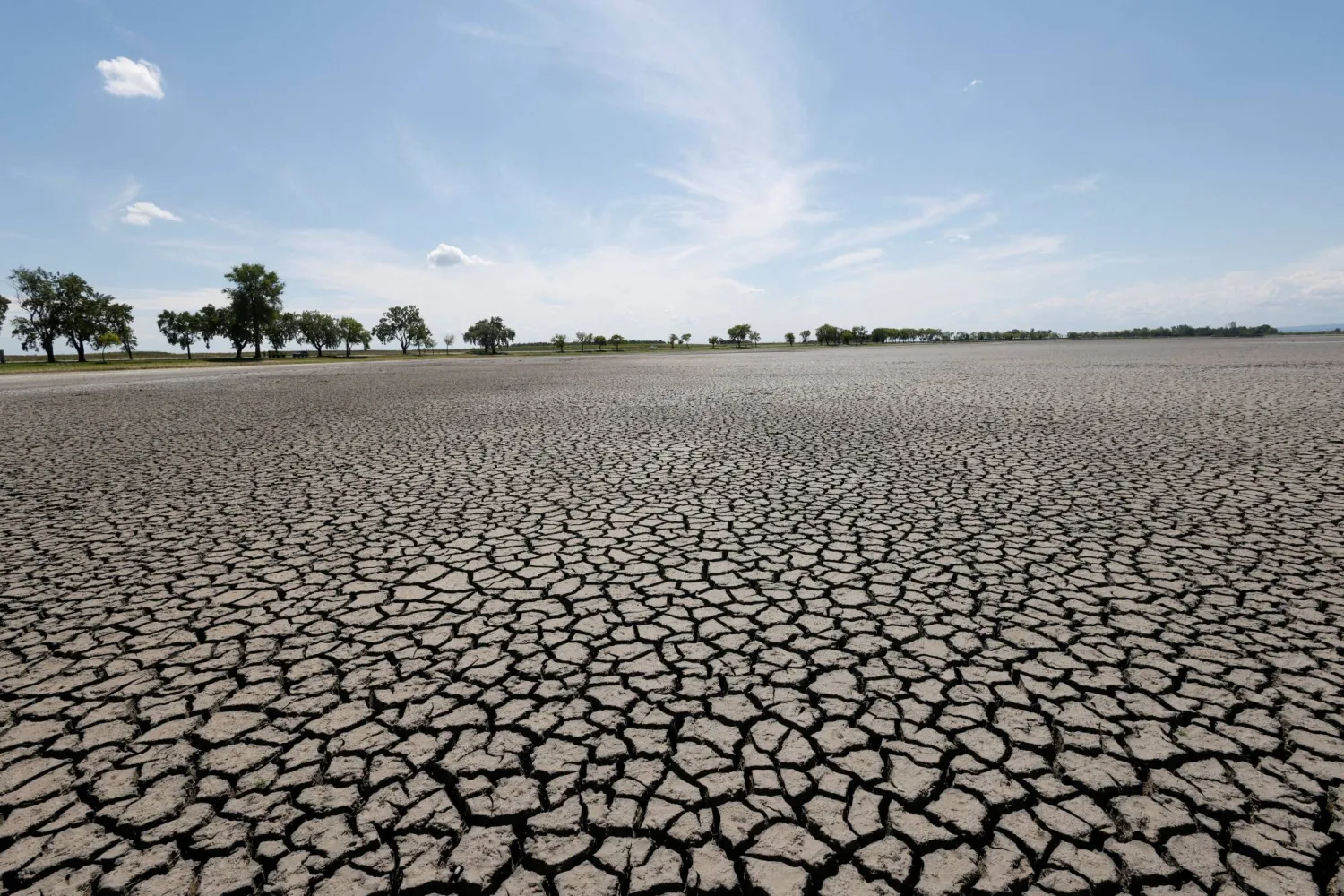
A general view shows almost dried up Lake Zicksee near Sankt Andrae, as another heatwave is predicted for parts of the country, in Austria, August 12, 2022. REUTERS/Leonhard Foeger/
TT

For the Third Day in a Row, the Earth's Average Temperature Remained at a Record High

A general view shows almost dried up Lake Zicksee near Sankt Andrae, as another heatwave is predicted for parts of the country, in Austria, August 12, 2022. REUTERS/Leonhard Foeger/

Earth’s average temperature remained at a record high Wednesday, after two days in which the planet reached unofficial records. It’s the latest marker in a series of climate-change-driven extremes.
The average global temperature was 17.18 Celsius (62.9 degrees Fahrenheit), according to the University of Maine’s Climate Reanalyzer, a tool that uses satellite data and computer simulations to measure the world’s condition. That matched a record set Tuesday of 17.18 Celsius (62.9 Fahrenheit), and came after a previous record of 17.01 Celsius (62.6 degrees Fahrenheit) was set Monday.
Scientists have warned for months that 2023 could see record heat as human-caused climate change, driven largely by the burning of fossil fuels like coal, natural gas and oil, warmed the atmosphere. They also noted that La Nina, the natural cooling of the ocean that had acted as a counter to that warming, was giving way to El Nino, the reverse phenomenon marked by warming oceans. The North Atlantic has seen record warmth this year.
“A record like this is another piece of evidence for the now massively supported proposition that global warming is pushing us into a hotter future,” said Stanford University climate scientist Chris Field, who was not part of the calculations.
University of Maine climate scientist Sean Birkle, creator of the Climate Reanalyzer, said the daily figures are unofficial but a useful snapshot of what’s happening in a warming world.
While the figures are not an official government record, “this is showing us an indication of where we are right now,” said National Oceanic and Atmospheric Administration chief scientist Sarah Kapnick. And NOAA indicated it will take the figures into consideration for its official record calculations.
Even though the dataset used for the unofficial record goes back only to 1979, Kapnick said that given other data, the world is likely seeing the hottest day in “several hundred years that we’ve experienced.”
Scientists generally use much longer measurements — months, years, decades — to track the Earth’s warming. But the daily highs are an indication that climate change is reaching uncharted territory.
On Wednesday, 38 million Americans were under some kind of heat alert, Kapnick said.
That included communities that aren't used to feeling such heat. In North Grenville, Ontario, the city turned ice hockey rinks into cooling centers as temperatures Wednesday hit 90 degrees Fahrenheit (32 degrees Celsius), with humidity making it feel like 100.4 degrees (38 degrees Celsius).
“I feel like we live in a tropical country right now,” city spokeswoman Jill Sturdy said. “It just kind of hits you. The air is so thick.”
With many places seeing temperatures near 100 degrees Fahrenheit (37.8 degrees Celsius), the average temperature records might not seem very hot. But Tuesday’s global high was nearly 1.8 degrees Fahrenheit (a full degree Celsius) higher than the 1979-2000 average, which already topped the 20th- and 19th-century averages.
High-temperature records were surpassed this week in Quebec and Peru. Beijing reported nine straight days last week when the temperature exceeded 35 degrees Celsius (95 degrees Fahrenheit), and ordered a stop to all outdoor work Wednesday as more high temperatures were forecast. Cities across the US from Medford, Oregon to Tampa, Florida have been hovering at all-time highs, said Zack Taylor, a meteorologist with the National Weather Service.
Alan Harris, director of emergency management for Seminole County, Florida, said the county has already surpassed last year for the number of days they’ve activated their extreme weather plan — something that happens when the heat index hits 108 Fahrenheit or greater.
“It’s just been kind of brutally hot for the last week, and now it looks like potentially for two weeks,” Harris said.
In the US, heat advisories include portions of western Oregon, inland far northern California, central New Mexico, Texas, Florida and the coastal Carolinas, according to the National Weather Service Weather Prediction Center. Excessive heat warnings are continuing across southern Arizona and California.



Saudi Post Issues Commemorative Stamp for Riyadh Air

Saudi Post Issues Commemorative Stamp for Riyadh Air
TT

Saudi Post Issues Commemorative Stamp for Riyadh Air

Saudi Post Issues Commemorative Stamp for Riyadh Air

Saudi Post, in collaboration with Riyadh Air, has launched a commemorative stamp set priced at SAR3 to celebrate the airline’s inaugural flights on October 26, 2025, coinciding with the start of its operational phase.

This issuance marks the beginning of operational activities for Riyadh Air as a new national carrier, aiming to serve over 100 destinations worldwide, SPA reported.

Saudi Post's stamps commemorate major national and international events, preserving important moments in Saudi history and appealing to collectors and historians alike.


Viking Dress, Bagpipes as Scotland Starts Hogmanay Party

Sparks fly at the festival, November, 2016. (AFP / Ye Aung Thu)
TT

Viking Dress, Bagpipes as Scotland Starts Hogmanay Party

Sparks fly at the festival, November, 2016. (AFP / Ye Aung Thu)

Thousands of people, some dressed as Vikings carrying flaming torches, marched through Scotland's capital of Edinburgh as a procession kicked off the country's world-famous New Year celebrations.

Around 15,000 participants, led by bagpipers, walked through the city's historic center late Monday as Hogmanay festivities returned after being cancelled last year due to bad weather.

Several thousand more watched as the procession wound its way along cobbled streets, marking the official start of four days of celebrations to welcome the arrival of 2026.

"It is something that we use to light up the dark Edinburgh nights," said Al Thomson, director of the Hogmanay festival.

"Its rituals go back to (a) kind of pagan festivals. It's just an amazing spectacle," he told AFP.

An estimated 100,000 people from dozens of countries are expected in Edinburgh for the New Year events, the centerpiece of which is a street party and fireworks display on December 31.

Last year, organizers cancelled the showpiece on public safety grounds due to heavy rain and strong winds.

"I've been planning it since two years and I'm glad I could make it this time," said Chaytan Mishra, who travelled from Bristol, in southwest England.

Hogmanay is the Scots term for New Year's Eve and is considered one of the most important holidays in the country, traditionally taking precedence over Christmas.


France Pushes Back Plastic Cup Ban by Four Years

(FILES) An illustration photograph taken in Paris, on July 31, 2019 shows disposable plastics cups. (Photo by JOEL SAGET / AFP)
TT

France Pushes Back Plastic Cup Ban by Four Years

(FILES) An illustration photograph taken in Paris, on July 31, 2019 shows disposable plastics cups. (Photo by JOEL SAGET / AFP)

The French government on Tuesday postponed a ban on plastic throwaway cups by four years to 2030 because of difficulties finding alternatives.

The ban was meant to start on January 1. But the ministry for ecological transition said the "technical feasibility of eliminating plastic from cups" following a review this year justified pushing back the deadline.

It said in an official decree that a new review would be carried out in 2028 of "progress made in replacing single-use plastic cups". It added that the ban would now start January 1, 2030, when companies would have 12 months to get rid of their stock.

France has gradually rolled out bans on single-use plastic products over the past decade as environmental campaigners have stepped up warnings about the impact on rivers and oceans.

A 2020 law set a deadline of 2040 to eliminate all single-use plastics. A ban on plastic bags for loads of less than 1.5 kilograms (3.3 pounds) of 30 fruit and vegetables was introduced in 2022 and has dramatically changed supermarket habits.

But the government's DGCCRF consumer protection agency said in a report released last year that almost a fifth of about 100 companies it checked in 2023 were breaching regulations on the production or use of single-use plastic items.

Its investigators said some marketed plastic-free products that in reality contained plastic, and some changed the name of the item in a bid to get around the ban.