


OIC Hails Adoption of Resolution on Acts of Religious Hatred at Human Rights Council

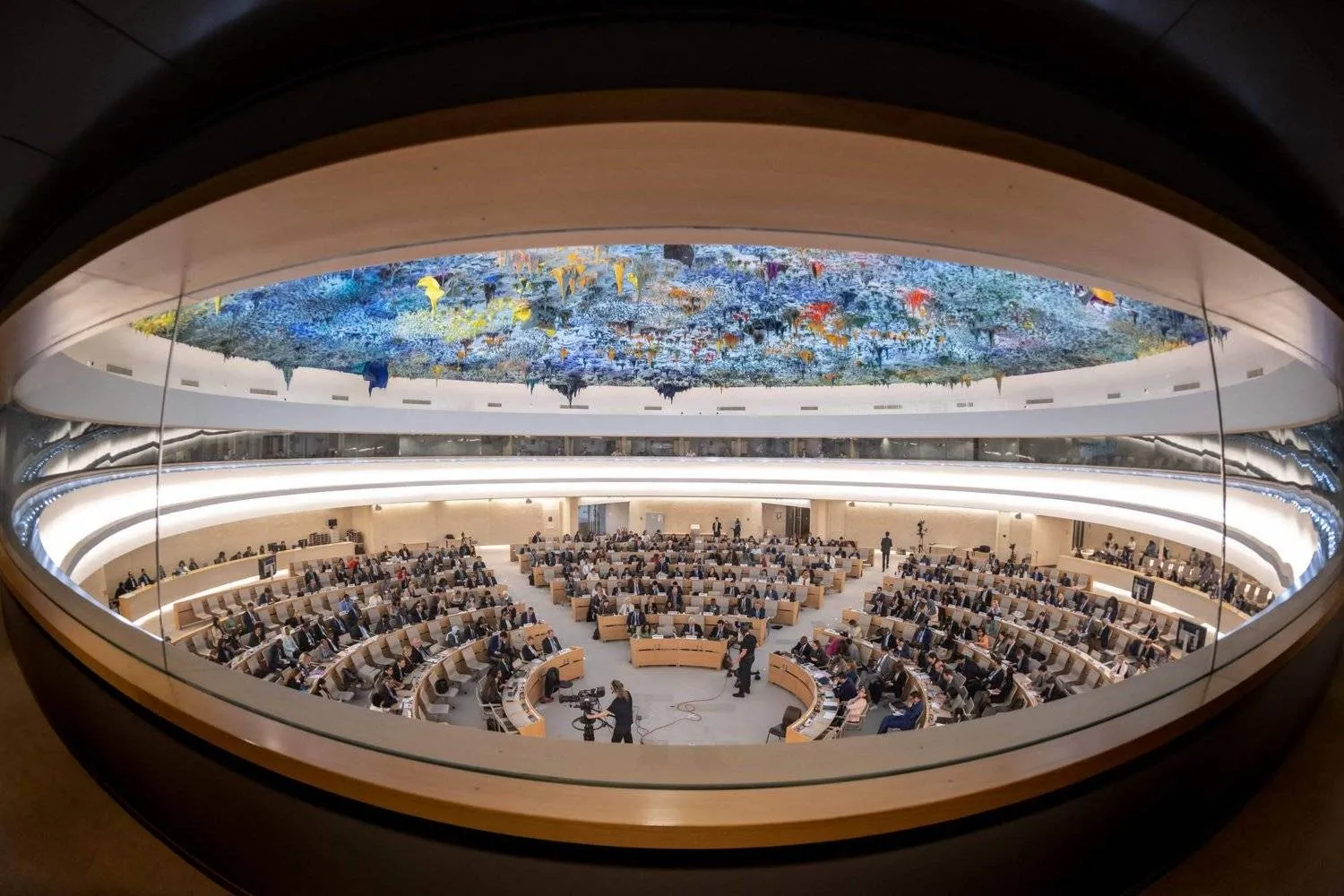
The UN Human Rights Council in session in Geneva. AFP
TT

OIC Hails Adoption of Resolution on Acts of Religious Hatred at Human Rights Council

The UN Human Rights Council in session in Geneva. AFP

The Organization of Islamic Cooperation (OIC) has hailed the adoption by the UN Human Rights Council of the resolution on "Countering religious hatred constituting incitement to discrimination, hostility or violence" as an important milestone towards strengthening collective efforts to reject religious intolerance and the desecration of holy books.

The resolution was adopted at the 53rd session of the Human Rights Council following a request by the OIC Group of countries in Geneva in response to a series of provocative acts of desecration of copies of the Quran in European and other countries.

The adopted resolution condemns the recent public and premeditated acts of desecration of the Quran, and it underscores the need to hold the perpetrators of these acts of religious hatred to account in line with the obligations of states arising from international human-rights law.

The resolution urges the UN High Commissioner for Human Rights to speak out against the advocacy of religious hatred. It requests the Human Rights Council to identify drivers and manifestations of religious hatred and to outline existing gaps in laws, policies, practices, and law enforcement that impede the prevention and prosecution of public and premeditated acts. It also asks the council to propose measures aimed at countering acts of religious hatred that hinder the full enjoyment of human rights and fundamental freedoms.

Through the resolution, states are encouraged to adopt national laws and policies to prevent and counter acts and advocacy of religious hatred.

The OIC has always urged the international community to resolutely tackle the repeated incidents of desecration of holy books and the rise of xenophobia, Islamophobia, racism, discrimination based on religion or belief, hate speech, and incitement to violence.

It has called for the condemnation and rejection of the abhorrent Islamophobic actions that incite hatred, exclusion, and racism and clearly undermine diverse communities' inter-religious harmony, dialogue, and peaceful coexistence. Such premeditated acts cannot be accepted under any justification nor conflated with the exercise of the right to freedom of expression or opinion.

The OIC said it strongly believes that the adoption of the historic resolution by the Human Rights Council will open a new era in terms of dialogue and collective efforts aimed at curbing manifestations of religious hatred and incitement to violence.

In these challenging times, there is an urgent need to unite in the upholding of the values of tolerance and peaceful coexistence among peoples and civilizations, it said.

Following the adoption of the resolution, OIC Secretary General Hissein Brahim Taha commended all the states that sponsored the draft resolution and those that have supported it. He also commended Saudi Arabia, the current Chair of the Islamic Summit and Chair of the OIC Executive Committee, for its commitment and initiative to convene an urgent meeting of the Executive committee on this matter, which led to the successful debate at the UN Human Rights Council.

He reiterated the OIC's call to the international community to stand firm against the manifestations of discrimination, intolerance, and incitement to hatred and to unite in upholding the values of tolerance and peaceful coexistence among peoples and civilizations.



Saudi Arabia Offers Condolences to Congo over Mine Collapse Victims

A general view of a portion of an open pit coltan mine in Rubaya on January 30, 2026. (AFP)
TT

Saudi Arabia Offers Condolences to Congo over Mine Collapse Victims

A general view of a portion of an open pit coltan mine in Rubaya on January 30, 2026. (AFP)

Saudi Arabia expressed on Monday its condolences to the families of the victims, and to the people and government of the Democratic Republic of Congo, following the collapse of a mineral mine in the city of Rubaya that claimed the lives of more than 226 workers.

The Kingdom conveyed its solidarity with Congo, its government, and its people during this ordeal.

Congo's government said on Sunday it feared "at least 200 dead" in a "massive" landslide that struck a militia-held mine in the country's east.

Since its resurgence in 2021, the M23 armed group has seized vast tracts of the DRC's resource-rich east, capturing the Rubaya mine in North Kivu province in April 2024 with Rwanda's help.

The mine produces 15 to 30 percent of the world's supply of coltan, a key component in the production of electronics such as laptops and mobile phones.

Thousands of artisanal miners work daily in precarious conditions in Rubaya's pits, most equipped with simple shovels and rubber boots.


Saudi Foreign Minister Holds Phone Call with Kuwaiti Counterpart

Saudi Minister of Foreign Affairs Prince Faisal bin Farhan bin Abdullah - SPA
TT

Saudi Foreign Minister Holds Phone Call with Kuwaiti Counterpart

Saudi Minister of Foreign Affairs Prince Faisal bin Farhan bin Abdullah - SPA

Saudi Minister of Foreign Affairs Prince Faisal bin Farhan bin Abdullah spoke via phone with Kuwait's Minister of Foreign Affairs Sheikh Jarrah Jaber Al-Ahmad Al-Sabah.

During the call, Prince Faisal congratulated Sheikh Jarrah on his appointment and wished him success, SPA reported.

He expressed hope for collaborative efforts to strengthen the close fraternal relations between Saudi Arabia and Kuwait, enhance bilateral cooperation, and support joint Gulf initiatives.

The conversation also covered several regional issues of mutual interest.


Cabinet Reshuffle in Kuwait Includes Ministers of Foreign Affairs, Finance and Information

The newly-appointed ministers. (KUNA)
TT

Cabinet Reshuffle in Kuwait Includes Ministers of Foreign Affairs, Finance and Information

The newly-appointed ministers. (KUNA)

Kuwait’s Emir Sheikh Meshal Al-Ahmad Al-Jaber Al-Sabah issued on Sunday an Emiri decree ordering a cabinet reshuffle affecting eight ministerial posts, most notably the ministries of Foreign Affairs, Finance and Information.

Under the decree, Osama Khaled Abdullah Boodai was appointed Minister of Commerce and Industry; Sheikh Jarrah Jaber Al-Ahmad Al-Sabah as Minister of Foreign Affairs; Abdullah Subaih Abdullah Buftain as Minister of Information and Culture; and Yaqoub Al-Sayyed Yousef Al-Sayyed Hashem Al-Refae as Minister of Finance.

The decree also amended the appointment of Omar Saud Abdulaziz Al-Omar, naming him Minister of State for Communications and Information Technology, and appointed four Ministers of State: Reem Ghazi Saud Al-Fulaij for Development and Sustainability; Tareq Hamad Nasser Al-Jalahma for Youth and Sports; and Abdulaziz Nasser Abdulaziz Al-Marzouq for Economic Affairs and Investment.

The newly appointed foreign minister, Sheikh Jarrah, was born on April 9, 1980. He had served as Deputy Foreign Minister with ministerial rank since June 2023. An Emiri decree issued in May 2023 appointed him Ambassador at the Ministry of Foreign Affairs’ General Diwan.

Sheikh Jarrah holds a bachelor’s degree in economics from the University of Delaware in the United States (2004). From 2020 to 2023, he worked in the office of the Minister of Foreign Affairs at the ministry’s General Diwan. He was also a member of Kuwait’s Permanent Mission to the United Nations in New York from 2017 to 2020.

Between 2014 and 2017, he served at Kuwait’s Embassy in Austria and the country’s Permanent Mission to the United Nations and international organizations in Vienna. From 2011 to 2014, he worked in the office of the First Deputy Prime Minister and Minister of Foreign Affairs at the General Diwan. He headed the Economic Department at the Diwan from 2005 to 2010 and worked in the International Organizations Department in 2005.

The new Minister of Information and Culture, Abdullah Buftain, is a well-known figure in Kuwaiti media circles. He served as deputy editor-in-chief of the English-language daily Kuwait Times, and has also worked in television as a presenter of political talk shows.