


Israel’s Governing Coalition Presses Ahead with Plan to Overhaul Courts, Protests Expected 

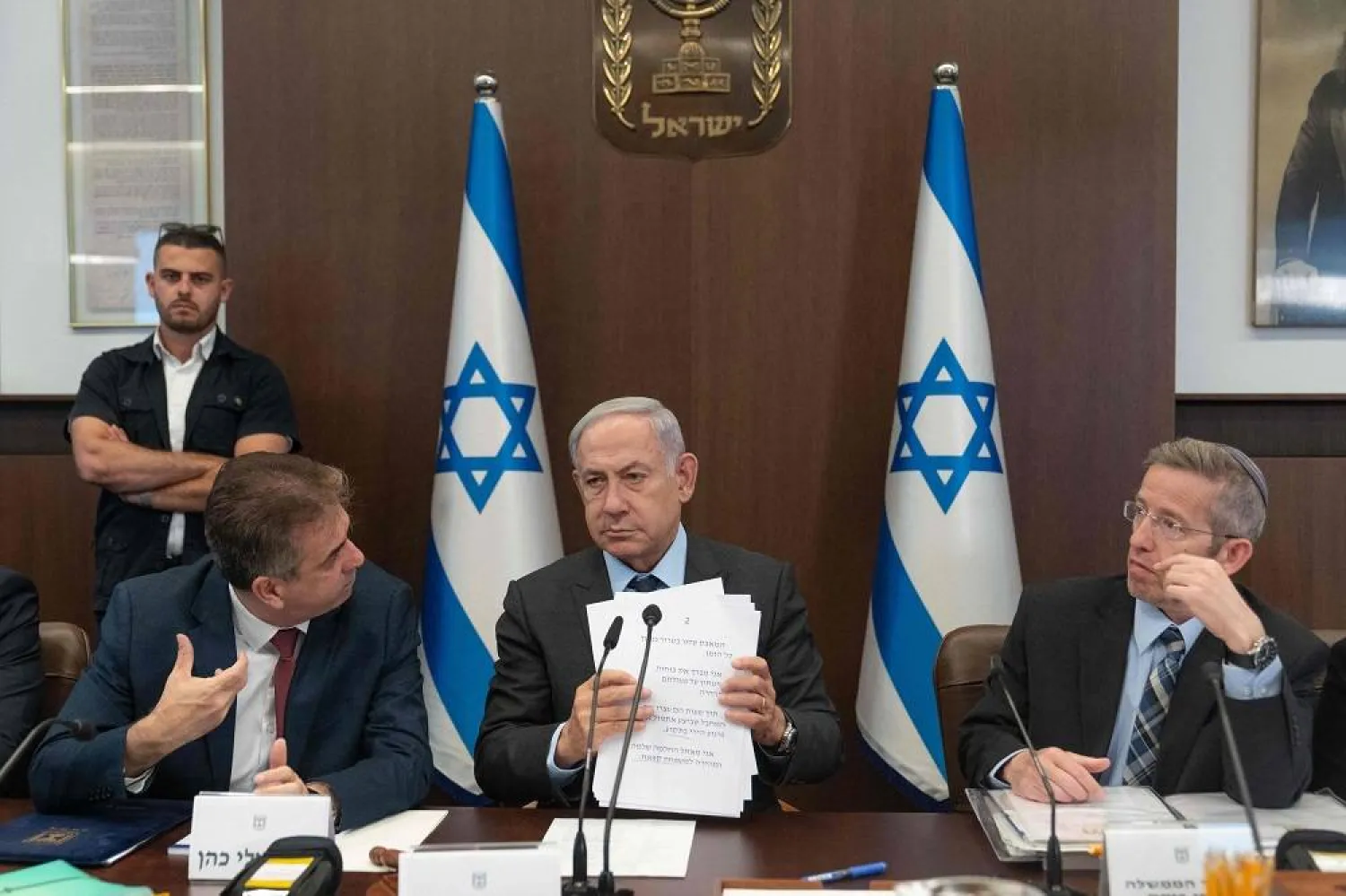
Israel's Prime Minister Benjamin Netanyahu (C) listens to Foreign Minister Eli Cohen (L), as cabinet secretary Yossi Fuchs (R) looks on during a weekly cabinet meeting at his office in Jerusalem, on July 17, 2023. (AFP)
TT

Israel’s Governing Coalition Presses Ahead with Plan to Overhaul Courts, Protests Expected 

Israel's Prime Minister Benjamin Netanyahu (C) listens to Foreign Minister Eli Cohen (L), as cabinet secretary Yossi Fuchs (R) looks on during a weekly cabinet meeting at his office in Jerusalem, on July 17, 2023. (AFP)

Israel's governing coalition pushed ahead on Monday with its contentious plan to overhaul the country's judiciary, despite growing opposition from within the country's military and a wave of mass protests expected this week.

A parliamentary committee was preparing a bill that would limit judicial oversight on some government decisions, legislation that has sparked intensifying criticism from military reservists in elite units, including the air force and cyberwarfare.

Many have warned they will not show up for duty if the overhaul moves ahead. Reservists, who make up the backbone of the country's mostly compulsory military, played a key role in prompting Prime Minister Benjamin Netanyahu to pause the overhaul plan earlier this year.

In response to the legislation, which is expected to go before a final parliamentary vote early next week, a large protest movement is expected to stage a "day of disruption" on Tuesday. These days of mass protest in the past have snarled traffic, choked the terminal at Israel's main international airport and descended into clashes between police and demonstrators.

The judicial overhaul, advanced by Netanyahu’s nationalist and religious government, has deeply divided Israel, plunging it into one of its worst domestic crises and even sparking concern from its most important ally, the US.

Netanyahu paused the overhaul in March, facing a wave of mass protests, labor strikes that halted outgoing flights and many other sectors and pledges by military reservists to not show up for duty if the legislation advanced. Similar pressures are reemerging as the government resumes legislating the overhaul.

The government says the plan is meant to rein in what it sees as an overly interventionist judicial system and restore power to elected officials. Critics say the plan would upend Israel’s delicate system of checks and balances and push the country toward autocracy. They also say Netanyahu has a conflict of interest by trying to shake up the justice system when he is on trial for corruption charges.

Speaking at a meeting of his Cabinet on Monday, a day after being discharged from hospital for a dizzy spell, Netanyahu defended the overhaul and the bill moving forward now, which would prevent Israel’s courts from scrutinizing the "reasonability" of decisions made by elected officials.

He also slammed the recent wave of opposition from within the military.

"In a democracy, the military is subordinate to the elected government and not the other way around," he said. "Insubordination is contrary to democracy and contrary to the law."

A rising tide of criticism from within the military earlier this year prompted the country's defense minister, Yoav Gallant, to oppose the overhaul. His dissension led to Netanyahu firing him, which sparked the mass protests that forced the Israeli leader to freeze the legal changes and reinstate Gallant.

The government is moving forward with the plan after talks to find a compromise with opposition political parties failed. The legislation's advance also comes despite warnings from across Israeli society that the overhaul would hurt the country's economy, its military capabilities and tear apart its delicate social fabric. Israel's currency, the shekel, has tumbled in value this year after the plan was unveiled.

The "reasonability standard" allows the court to review key government decisions in order to protect against improper appointments and potential corruption. It was used by the Supreme Court earlier this year to strike down the appointment of a Netanyahu ally as interior minister because of a past conviction for bribery and a 2021 plea deal for tax evasion.

The government says the standard is arbitrary and overused by the courts to cancel decisions made by elected officials.

Critics say removing the standard would allow the government to appoint unqualified cronies to important positions without without oversight. They also say that it could clear the way for Netanyahu to fire the current attorney general — seen by supporters as a bulwark against the overhaul plan — or appoint legal officials who could ease his way out of the corruption charges he is facing in an ongoing trial.



Top Trump Iran Negotiator Says Visits US Aircraft Carrier in Middle East

US Special Envoy Steve Witkoff delivers a press conference upon the signing of the declaration on deploying post-ceasefire force in Ukraine, during the so-called "Coalition of the Willing" summit, at the Elysee Palace in Paris, France, January 6, 2026. (Reuters)
TT

Top Trump Iran Negotiator Says Visits US Aircraft Carrier in Middle East

US Special Envoy Steve Witkoff delivers a press conference upon the signing of the declaration on deploying post-ceasefire force in Ukraine, during the so-called "Coalition of the Willing" summit, at the Elysee Palace in Paris, France, January 6, 2026. (Reuters)

US President Donald Trump's lead Iran negotiator Steve Witkoff on Saturday said he visited the USS Abraham Lincoln aircraft carrier currently in the Arabian Sea, with Washington and Tehran due to hold further talks soon.

"Today, Adm. Brad Cooper, Commander of US Naval Forces Central Command, Jared Kushner, and I met with the brave sailors and Marines aboard the USS Abraham Lincoln, her strike group, and Carrier Air Wing 9 who are keeping us safe and upholding President Trump's message of peace through strength," said Witkoff in a social media post.

Iranian Foreign Minister Abbas Araghchi said on Saturday he hoped talks with the United States would resume soon, while reiterating Tehran's red lines and warning against any American attack.


Israel’s Netanyahu Expected to Meet Trump in US on Wednesday and Discuss Iran

Israeli Prime Minister Benjamin Netanyahu delivers a speech during a special session to mark the 77th anniversary of the Knesset's establishment and the 60th anniversary of the dedication of the current building at the Knesset, the Israeli parliament, in Jerusalem, 02 February 2026. (EPA)
TT

Israel’s Netanyahu Expected to Meet Trump in US on Wednesday and Discuss Iran

Israeli Prime Minister Benjamin Netanyahu delivers a speech during a special session to mark the 77th anniversary of the Knesset's establishment and the 60th anniversary of the dedication of the current building at the Knesset, the Israeli parliament, in Jerusalem, 02 February 2026. (EPA)

Israeli Prime Minister Benjamin Netanyahu is expected to meet US President Donald Trump on Wednesday in Washington, where they will discuss negotiations with Iran, Netanyahu's office said on Saturday.

Iranian and US officials held indirect nuclear ‌talks in the ‌Omani capital ‌Muscat ⁠on Friday. ‌Both sides said more talks were expected to be held again soon.

A regional diplomat briefed by Tehran on the talks told Reuters Iran insisted ⁠on its "right to enrich uranium" ‌during the negotiations with ‍the US, ‍and that Tehran's missile capabilities ‍were not raised in the discussions.

Iranian officials have ruled out putting Iran's missiles - one of the largest such arsenals in the region - up ⁠for discussion, and have said Tehran wants recognition of its right to enrich uranium.

"The Prime Minister believes that any negotiations must include limiting ballistic missiles and halting support for the Iranian axis," Netanyahu's office said in a ‌statement.


Italy FM Rules Out Joining Trump’s ‘Board of Peace’

Italy's Minister for Foreign Affairs Antonio Tajani speaks to the press during the EPP Leaders’ meeting, in Zagreb, Croatia, 30 January 2026. (EPA)
TT

Italy FM Rules Out Joining Trump’s ‘Board of Peace’

Italy's Minister for Foreign Affairs Antonio Tajani speaks to the press during the EPP Leaders’ meeting, in Zagreb, Croatia, 30 January 2026. (EPA)

Italy will not take part in US President Donald Trump's "Board of Peace", Italian Foreign Minister Antonio Tajani said Saturday, citing "insurmountable" constitutional issues.

Trump launched his "Board of Peace" at the World Economic Forum in Davos in January and some 19 countries have signed its founding charter.

But Italy's constitution bars the country from joining an organization led by a single foreign leader.

Prime Minister Giorgia Meloni, a Trump ally, last month noted "constitutional problems" with joining, but suggested Trump could perhaps reopen the framework "to meet the needs not only of Italy, but also of other European countries".

Tajani appeared Saturday to rule that out.

"We cannot participate in the Board of Peace because there is a constitutional limit," he told the ANSA news agency.

"This is insurmountable from a legal standpoint," he said, the day after meeting US Secretary of State Marco Rubio and US Vice President JD Vance at the Olympics in Milan.

Although originally meant to oversee Gaza's rebuilding, the board's charter does not limit its role to the Palestinian territory and appears to want to rival the United Nations.