


India’s Yamuna River Laps Walls of Taj Mahal after Heavy Rain

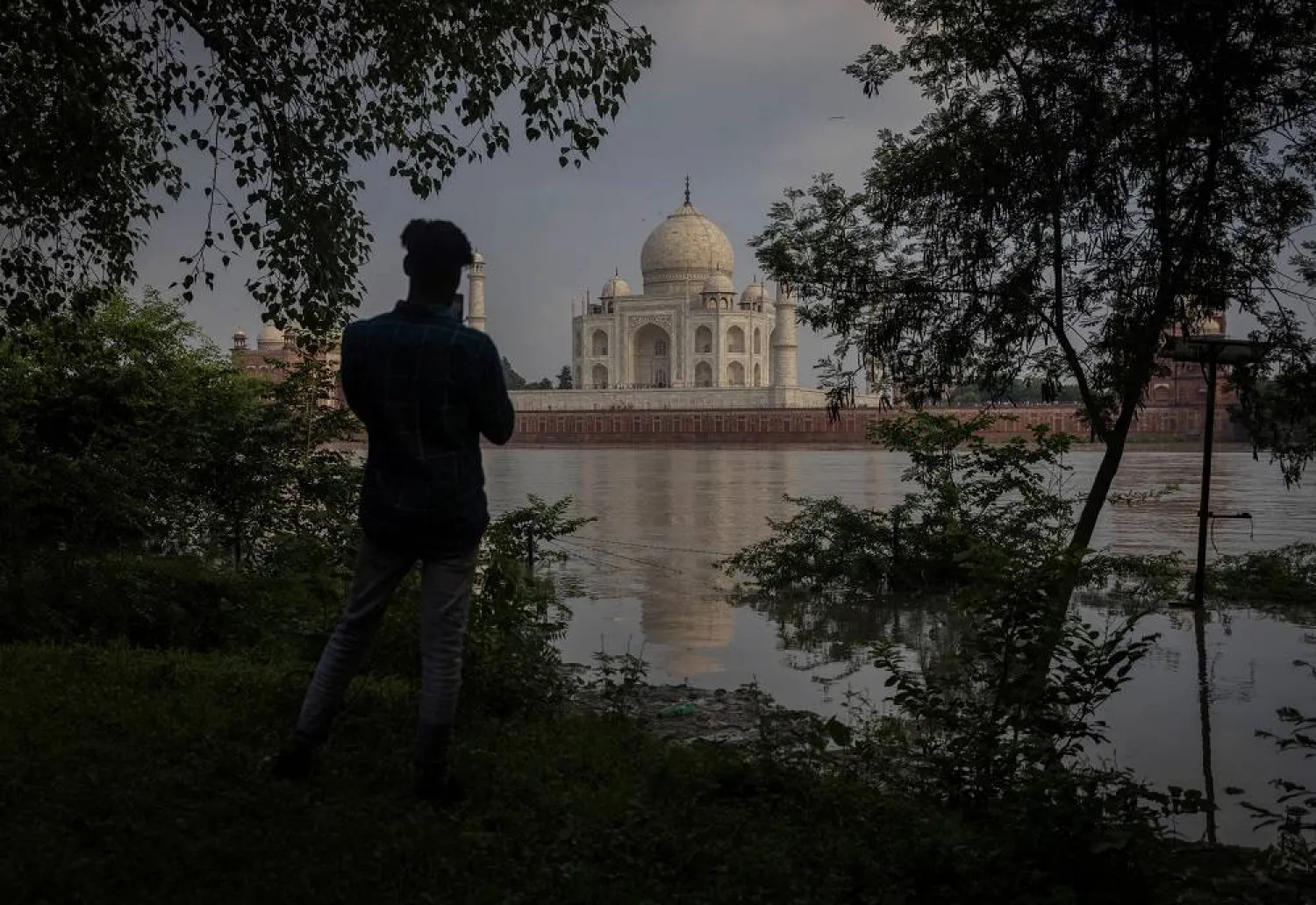
A man takes picture of historic Taj Mahal as the Yamuna River overflows following heavy rains, in Agra, India July 18, 2023. (Reuters)
TT

India’s Yamuna River Laps Walls of Taj Mahal after Heavy Rain

A man takes picture of historic Taj Mahal as the Yamuna River overflows following heavy rains, in Agra, India July 18, 2023. (Reuters)

A river that runs through the northern Indian state of Uttar Pradesh has risen to lap the compound walls of the iconic Taj Mahal in Agra city, causing concern about damage to the 17th-century white marble monument.

The water level of the Yamuna River has increased over the last few days after unusually heavy rain in northern India, including Uttar Pradesh, which has received 108% of its normal rainfall since the four-month monsoon season began on June 1.

According to India's Central Water Commission (CWC), the portion of the river flowing alongside the Taj Mahal rose to 152 meters (499 feet) late on Tuesday, well above the warning level for potential danger of 151.4 meters. The level considered dangerous is 152.4 meters.

Local media outlets reported that the last time the river reached the walls of the monument, built by Mughal Emperor Shah Jahan in memory of his queen Mumtaz Mahal, was 45 years ago, in 1978.

CWC data also indicates that its station near the monument recorded the river's highest flood level that year at 154.76 meters.

Visuals from the area on Tuesday showed the red sandstone boundary wall of the Taj Mahal surrounded by muddy water, with pieces of garbage floating in it, the mausoleum itself looming over the scene, untouched by the river.

Officials from the Archaeological Survey of India (ASI), which oversees the Taj Mahal along with several other monuments in the country, said there was "no serious concern" about the monument at present.

"If it rains more, or the water stays this high for some days, we will need to assess the situation again," said Raj Kumar Patel, superintendent archaeologist with ASI.

Several other monuments and gardens located in the vicinity of the Taj Mahal, closer to the banks of the Yamuna, however, "have been submerged" and damaged, he said.

These include the tomb of Itimad-ud-Daulah, often called "baby Taj", which dates back to the 1600s, and Mehtab Bagh, also from the same period, whose structure has been damaged and garden area - currently under water - completely destroyed.

Tourists from around the world continued to stream in through the gates of the Taj Mahal on Tuesday evening, undeterred by the rising water levels.

"It is crazy to see the water go up so much, but to see the Taj Mahal was beautiful," said Mathew Kreton, 20, a student from Lucerne, Switzerland.

Local residents were more concerned, fearing the river would eventually invade their homes.

"We have kept our belongings on top so that they do not float away. Along with that we are staying on alert," said Sundar Dubey, 49, who lives near the temple.



Jazan Cultural House Explores Symbolism of Saudi Flag

The evening featured a critical reading on the symbolism of the Saudi flag and its ties to national identity and core values
TT

Jazan Cultural House Explores Symbolism of Saudi Flag

The evening featured a critical reading on the symbolism of the Saudi flag and its ties to national identity and core values

The Jazan Cultural House hosted a cultural evening on the Saudi flag, in collaboration with the Cultural Café, a literary partner of the Literature, Publishing, and Translation Commission.

The evening featured a critical reading on the symbolism of the Saudi flag and its ties to national identity and core values. Speakers discussed its historical and cultural significance as a symbol of unity and sovereignty, reflecting themes of faith, strength, and national cohesion.

The reading also explored the flag's role in fostering a sense of belonging and national pride, as well as various interpretations of its significance in cultural and intellectual discourse.


Prince Mohammed bin Salman Project Restores Historic Al-Qalaah Mosque in Riyadh Region

The mosque is a prime example of traditional Najdi architecture - SPA
TT

Prince Mohammed bin Salman Project Restores Historic Al-Qalaah Mosque in Riyadh Region

The mosque is a prime example of traditional Najdi architecture - SPA

The Prince Mohammed bin Salman Project for the Development of Historical Mosques continues its mission to preserve the Kingdom’s architectural heritage by restoring Al-Qalaah Mosque in Hawtat Bani Tamim, Riyadh Region. Built in 1250 AH (1834 CE), this historic landmark is situated within the fortress of Second Saudi State founder Imam Turki bin Abdullah.

The mosque is a prime example of traditional Najdi architecture, featuring stone foundations, mud walls constructed using molded brick techniques, and a roof of tamarisk trunks and palm fronds supported by stone-bead cylindrical columns, SPA reported.

Through the current renovation, the mosque’s area has expanded from 608.68 to 625.78 square meters while maintaining a capacity for 180 worshippers. Executed by specialized Saudi firms under expert engineering supervision, the project balances traditional standards with modern sustainability to ensure the mosque remains a living testament to Islamic and national history.

This initiative aligns with Vision 2030 objectives to rehabilitate historical sites for worship, highlight cultural heritage, and preserve the Kingdom’s authentic architectural identity for future generations.


UNESCO Fears for Fate of Historical Sites during Iran War

Debris at the historical monument Golestan Palace after it was damaged in an Israeli and US strike, amid the US-Israeli conflict with Iran, in Tehran, Iran, March 3, 2026. Majid Asgaripour/WANA (West Asia News Agency) via REUTERS/File Photo
TT

UNESCO Fears for Fate of Historical Sites during Iran War

Debris at the historical monument Golestan Palace after it was damaged in an Israeli and US strike, amid the US-Israeli conflict with Iran, in Tehran, Iran, March 3, 2026. Majid Asgaripour/WANA (West Asia News Agency) via REUTERS/File Photo

UNESCO said it is deeply concerned about the fate of world heritage sites in Iran and across the region, after Tehran's Golestan palace, often compared to Versailles, and a historic mosque and palace in Isfahan were damaged in the war.

The United Nations' cultural agency on Wednesday urged all parties to protect the region's outstanding cultural sites, saying four of Iran's 29 world heritage sites had been damaged since the start of the US and Israeli war with Iran.

"UNESCO is deeply concerned by the first impact that the hostilities are already having on many world heritage sites," Lazare Eloundou Assomo, director of the World Heritage Centre, told Reuters, adding he was also concerned for sites in Israel, Lebanon and across the Middle East.

Tehran's Golestan palace, damaged in US–Israeli strikes, is testimony to the grandeur of Iran's civilization in the 19th century, he said.

The palace was chosen as the Persian royal residence and seat of power by the Qajar family and shows the introduction of European styles in Persian arts, according to the UNESCO website. The last Shah of Iran, Mohammad Reza Pahlavi, held a coronation ceremony there in 1969.

"We sometimes even compare it with the Versailles Palace in France, for instance, and it has suffered, unfortunately, some damage. We don't know the extent for the moment. But clearly, with the images that we have been able to receive, we can confirm ... it has been affected," Eloundou Assomo said.

Photos of the interior of the palace have shown piles of smashed glass and shards of wood on the floor, and shattered woodwork.

Isfahan was one of Central Asia's most important cities and a key point on the Silk Road trading route. Its Masjed-e Jame (Jameh Mosque) is more than 1,000 years old and shows the development of Islamic art through 12 centuries.

Buildings close to the buffer zone of the prehistoric sites of the Khorramabad Valley have also been damaged, UNESCO said.

UNESCO has shared coordinates of key cultural sites to all parties, Eloundou Assomo said, and was monitoring damage.

"We are calling for the protection of all sites of cultural significance ... everything that tells the history of all the civilisations of the 18 countries in the region," he said.