


Sudan Drivers Sit Idle as War Shuts Down Transportation

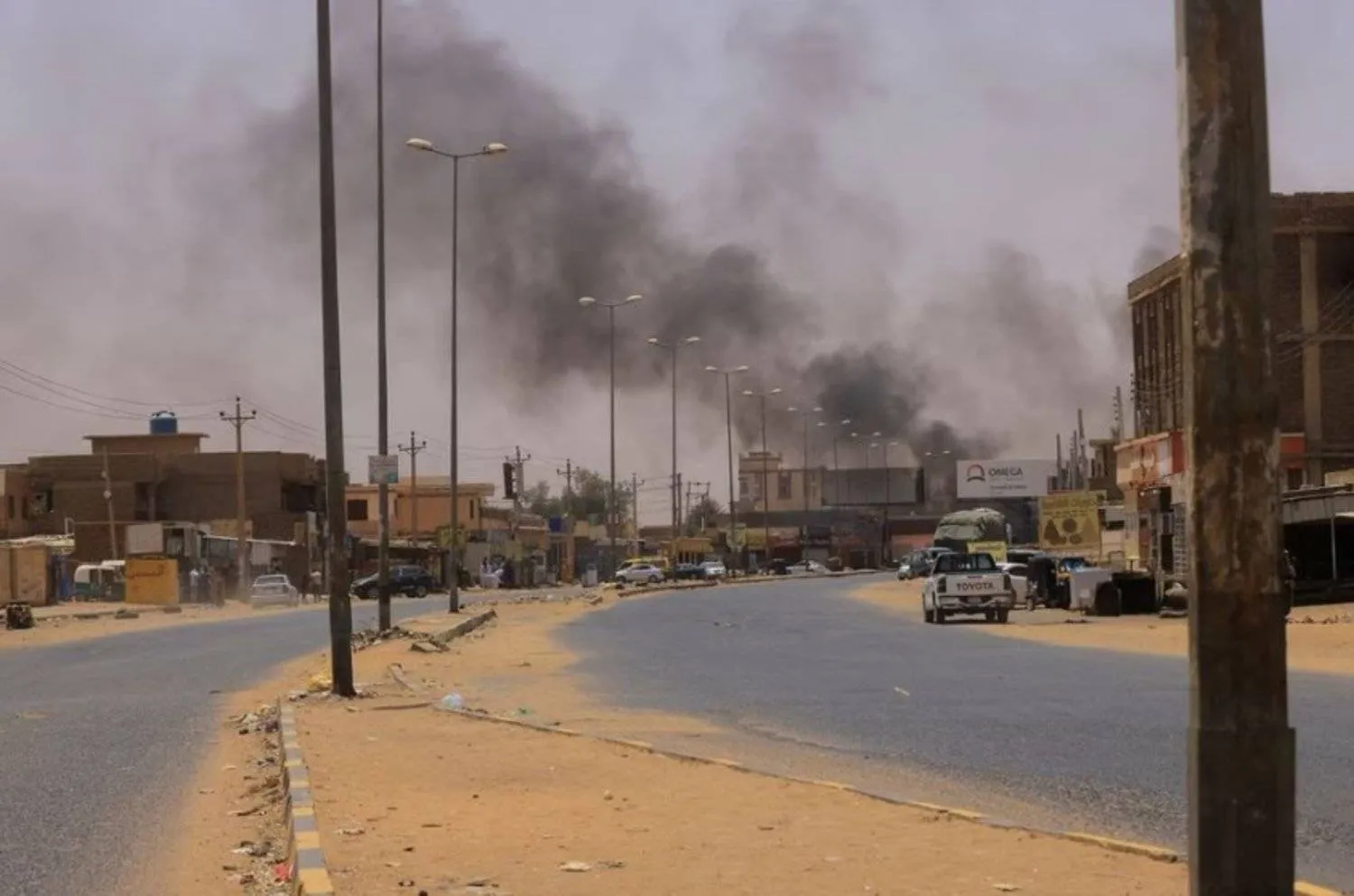
Smoke rises in Omdurman, near Halfaya Bridge, during clashes between the Rapid Support Forces and the army as seen from Khartoum North, Sudan April 15, 2023. REUTERS/Mohamed Nureldin Abdallah
TT

Sudan Drivers Sit Idle as War Shuts Down Transportation

Smoke rises in Omdurman, near Halfaya Bridge, during clashes between the Rapid Support Forces and the army as seen from Khartoum North, Sudan April 15, 2023. REUTERS/Mohamed Nureldin Abdallah

Mahana Abdelrahman used to criss-cross Sudan in his truck, delivering shipments across the vast country, but three months of brutal war have drastically reduced road transportation, grinding business to a halt.

Now, the 45-year-old driver chain-smokes and sips coffee at a cafe on the outskirts of Wad Madani, a city that has welcomed him and many others who fled the war-weary capital Khartoum, some 160 kilometres (100 miles) to the north.

In 20 years of working as a lorry driver, usually carrying goods from Red Sea ports, Abdelrahman has "never seen anything like this war", he told AFP.

The fighting, which erupted on April 15 when a power struggle between rival generals spilled into all-out war, has killed thousands and displaced millions.

"I used to drive across the country four times a month, now I've been here for three weeks and there's nothing to carry anywhere," Abdelrahman lamented.

Around him, lines of parked lorries in their hundreds stretched as far as the eye can see, while drivers were playing cards and drinking tea in the small road-side cafes of Al-Jazirah state.

Hundreds of thousands of displaced Khartoum residents have found safety in Al-Jazirah, but -- like in other parts of the country -- still face dire shortages of food, medicine and other supplies.

With air strikes, artillery blasts and countless checkpoints around Khartoum, road traffic across the country has dropped by 90 percent since fighting began, according to a report by Sudan's national chamber of transport seen by AFP.

This has had a serious effect on commercial activity.

According to figures from Sudan's ports authority, total exports since January amounted to $282 million. That figure stood at $2.5 billion for the first half of 2021.

Driver Mohamed al-Tijani said that even when there is cargo to shuttle, the journey has become far longer than it used to be.

With fuel costs soaring, up to 20 times pre-war prices, travel has also become more expensive.

To avoid the violence and the checkpoints set up by both army and the paramilitary Rapid Support Forces, drivers try to bypass Khartoum entirely, "making our journey to the ports at least 400 kilometres longer", 50-year-old Tijani told AFP.

Million remain trapped in the inaccessible capital, often without the means to support themselves as factories were shelled, warehouses looted and markets ransacked.

In the early days of the fighting, passenger buses would travel in convoys, carrying terrified Sudanese fleeing the fledgling violence. Now, they have stopped moving in and out of Khartoum.

Before the war, "around 70 percent of bus travel used to be between Khartoum and the other states" in the country, driver Hussein Abdelqader told AFP.

He said his business, which relied on Sudan's heavily centralised road network, has plummeted.

Another driver, Moataz Omar, used to transport families from Khartoum to Sudan's border with Egypt -- a 1,000-kilometre journey -- in the first weeks of the war.

"But as the fighting got worse, it became impossible to enter Khartoum," he told AFP.

The already gruelling trip between the Egyptian border and Al-Jazirah's makeshift transport hub has more than doubled, Omar said.

Drivers "now have to head east to Red Sea state, and then through Kassala to Gedaref," on the southeastern border with Ethiopia, before heading back up north, in a 2,600-kilometre loop nearly impossible to find passengers for.

"I've stopped making the trips north," he said.

As the war shows no signs of abating, the drivers -- like much of Sudan's population -- fear for their livelihood.

"We're afraid we're going to lose our jobs," said Tijani. "The companies aren't going to pay our salaries if they're not making money."

Some buses still make the costly and meandering trips around the Sudan. The country's trains, however, all sit collecting dust.

Passenger and freight cars, which used to travel between the capital and Atbara in the north as well as Wad Madani in the south, stopped in their tracks with the first blasts in Khartoum.

They have not moved since.

A railway official said trains carrying cargo from sea ports have also stopped.

The tracks which traverse Khartoum North "have become a battlefield themselves," he told AFP, requesting anonymity as he was not authorised to speak to the media.

It was not just the railway that has been affected.

Khartoum North has become a shell of its former self -- a ghost town with no water or electricity, most of its residents escaped south to Wad Madani, or north to Egypt.



Israel Demolishes Home of Palestinian Accused of Attack

A picture taken on September 30, 2025 shows the demolished house of Yahya Abu Ghaliyeh, a Palestinian from a Bedouin village near the town of Al-Eizariya, also known as Bethany, east of Jerusalem. (AFP)
TT

Israel Demolishes Home of Palestinian Accused of Attack

A picture taken on September 30, 2025 shows the demolished house of Yahya Abu Ghaliyeh, a Palestinian from a Bedouin village near the town of Al-Eizariya, also known as Bethany, east of Jerusalem. (AFP)

The Israeli army demolished on Wednesday the home of a Palestinian accused of carrying out a stabbing and shooting attack that killed an Israeli earlier this year, the military said, AFP reported.

On July 10, two attackers killed 22-year-old Shalev Zvuluny in a shopping area near Jerusalem, before the Israeli army shot them dead.

On Wednesday, Israeli army bulldozers entered the village of Bazzaryah in the occupied West Bank, destroying the family home of one of the attackers after it had been evacuated.

Israeli forces "demolished the home of the terrorist who carried out the shooting and stabbing attack at the Gush junction, during which Shalev Zvuluny... was murdered", the army said in a statement.

Hazem Yassine, head of the Bazzaryah municipal council, denounced what he called a "heinous crime".

He told AFP that Israeli forces had sealed off the village's entrances since dawn in preparation for the demolition.

"Schools were closed as a precaution," he said, adding that the assailant's family had moved out around a month ago after being notified of the decision to demolish the house.

An AFP photographer saw children climbing on piles of rubble after the demolition, waving the Palestinian flag.

Israel, whose army has occupied the West Bank since 1967, regularly demolishes the homes of Palestinians accused of carrying out deadly attacks against Israelis.

The government defends the deterrent effect of these demolitions, but critics denounce the practice as a form of collective punishment that leaves families homeless.

Violence in the West Bank surged during the war in Gaza, which erupted on October 7, 2023 with Hamas's attack on Israel.

Since then, Israeli soldiers or settlers have killed more than a thousand Palestinians in the West Bank, many of them militants but also including civilians, according to an AFP tally based on Palestinian Authority data.

At the same time, according to official Israeli figures, at least 44 Israelis, including civilians and soldiers, have been killed in Palestinian attacks or during Israeli military raids in the area.


A Blast in Gaza Wounds Soldier and Israel Accuses Hamas of Ceasefire Violation

A woman sits next to her tent on an alley of a makeshift tent camp for displaced Palestinians in Deir al-Balah, central Gaza Strip, Tuesday, Dec. 23, 2025. (AP Photo/Abdel Kareem Hana)
TT

A Blast in Gaza Wounds Soldier and Israel Accuses Hamas of Ceasefire Violation

A woman sits next to her tent on an alley of a makeshift tent camp for displaced Palestinians in Deir al-Balah, central Gaza Strip, Tuesday, Dec. 23, 2025. (AP Photo/Abdel Kareem Hana)

An explosive device detonated in Gaza on Wednesday, injuring one Israeli soldier and prompting Israel to accuse Hamas of violating the US-backed ceasefire. It was the latest incident to threaten the tenuous truce that has held since Oct. 10 as each side accuses the other of violations.

The blast came as Hamas met with Turkish officials in Ankara to discuss the second stage of the ceasefire. Though the agreement has mostly held, its progress has slowed, The AP news reported.

All but one of the 251 hostages taken in the Hamas-led attack on Oct. 7, 2023, that sparked the war have been released, alive or dead, in exchange for Palestinian prisoners and detainees. The ceasefire's second phase has even bigger challenges: the deployment of an international stabilization force, a technocratic governing body for Gaza, the disarmament of Hamas and further Israeli troop withdrawals from the territory.

Israel vows to ‘respond accordingly’ Israel's military said the explosive detonated beneath a military vehicle as soldiers were “dismantling” militant infrastructure in the southern city of Rafah. The lightly injured soldier was taken to a hospital, the military said.

Prime Minister Benjamin Netanyahu in a statement called the incident a violation of the ceasefire and said Israel would "respond accordingly.”

Israel previously launched strikes in Gaza in response to alleged ceasefire violations. On Oct. 19, Israel said two soldiers were killed by Hamas fire and it responded with a series of strikes that killed over 40 Palestinians, according to local health officials.

Hamas accuses Israel of violating the ceasefire by not allowing enough aid into the territory and continuing to strike civilians. Palestinian health officials say over 370 Palestinians have been killed by Israeli fire since the truce.

On Friday, Israeli troops fired over the ceasefire line in northern Gaza, killing at least five Palestinians, including a baby, according to a local hospital that received the casualties.

Turkish Foreign Minister Hakan Fidan met with a Hamas delegation led by Khalil al-Haya to discuss the ceasefire's second phase, according to ministry officials.

Fidan reaffirmed Türkiye's efforts to defend the rights of Palestinians and outlined ongoing efforts to address shelter and other humanitarian needs in Gaza, the officials said.

The Hamas delegation said they had fulfilled the ceasefire’s conditions but that Israel’s continued attacks were blocking progress toward the next stage. They also asserted that 60% of the trucks allowed into Gaza were carrying commercial goods rather than aid.

According to the officials, the meeting also discussed reconciliation efforts between the Palestinian factions and the situation in the Israeli-occupied West Bank, stressing that Israel’s actions there were “unacceptable.”


Algeria Passes Law Declaring French Colonisation a Crime

Members of the committee drafting the law criminalizing colonialism (File Photo/ Algerian Parliament)
TT

Algeria Passes Law Declaring French Colonisation a Crime

Members of the committee drafting the law criminalizing colonialism (File Photo/ Algerian Parliament)

Algeria's parliament unanimously approved on Wednesday a law declaring France's colonisation of the country a crime, and demanding an apology and reparations.

Standing in the chamber, lawmakers wearing scarves in the colors of the national flag chanted "long live Algeria" as they applauded the passage of the bill, which states that France holds "legal responsibility for its colonial past in Algeria and the tragedies it caused".

The vote comes as the two countries are embroiled in a major diplomatic crisis, and analysts say that while Algeria's move is largely symbolic, it is still politically significant, AFP reported.

Parliament speaker Brahim Boughali told the APS state news agency before the vote that it would send "a clear message, both internally and externally, that Algeria's national memory is neither erasable nor negotiable".

The legislation lists the "crimes of French colonisation", including nuclear tests, extrajudicial killings, "physical and psychological torture", and the "systematic plundering of resources".

It states that "full and fair compensation for all material and moral damages caused by French colonisation is an inalienable right of the Algerian state and people".

France's rule over Algeria from 1830 until 1962 remains a sore spot in relations between the two countries.

The period was marked by mass killings and large-scale deportations, all the way up to the bloody war of independence from 1954-1962.

Algeria says the war killed 1.5 million people, while French historians put the death toll lower at 500,000 in total, 400,000 of them Algerian.

French President Emmanuel Macron has previously acknowledged the colonisation of Algeria as a "crime against humanity", but has stopped short of offering an apology.

Asked last week about the vote, French foreign ministry spokesman Pascal Confavreux said he would not comment on "political debates taking place in foreign countries".

Hosni Kitouni, a researcher in colonial history at the University of Exeter in the UK, said that "legally, this law has no international scope and therefore is not binding for France".

But "its political and symbolic significance is important: it marks a rupture in the relationship with France in terms of memory," he said.