


Sudan Conflict Brings New Atrocities to Darfur

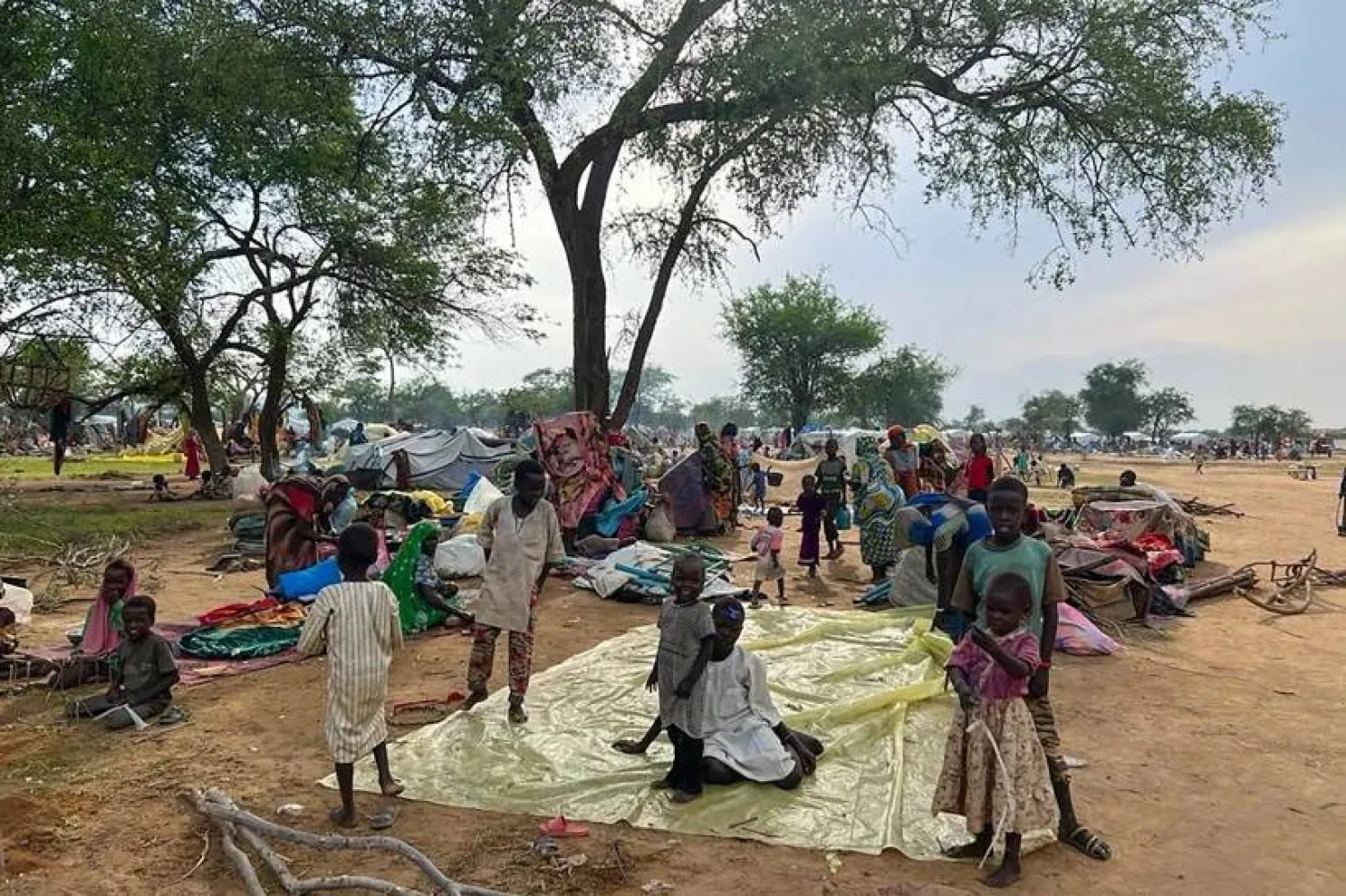
File - Sudanese refugees who fled the conflict in Sudan gather Monday, July 10, 2023, at the Zabout refugee Camp in Goz Beida, Chad. (Pierre Honnorat/WFP via AP, File)
TT

Sudan Conflict Brings New Atrocities to Darfur

File - Sudanese refugees who fled the conflict in Sudan gather Monday, July 10, 2023, at the Zabout refugee Camp in Goz Beida, Chad. (Pierre Honnorat/WFP via AP, File)

Amna al-Nour narrowly escaped death twice. The first was when militias torched her family’s home in Sudan’s Darfur region. The second was two months later when paramilitary fighters stopped her and others trying to escape as they tried to reach the border with neighboring Chad, according to a report by The Associated Press.

“They massacred us like sheep,” the 32-year-old teacher said of the attack in late April on her home city Geneina. “They want to uproot us all.”

Al-Nour and her three children now live in a school-turned-refugee housing inside Chad, among more than 260,000 Sudanese, mostly women and children, who have fled what survivors and rights groups say is a new explosion of atrocities in the large western region of Sudan.

Two decades ago, Darfur became synonymous with genocide and war crimes, particularly by the notorious Janjaweed.

Fears are mounting that that legacy is returning with reports of widespread killings, rapes and destruction of villages in Darfur amid a nationwide power struggle between Sudan’s military and the Rapid Support Forces.

“This spiraling violence bears terrifying similarity with the war crimes and crimes against humanity perpetrated in Darfur since 2003,” said Tigere Chagutah, a regional director with Amnesty International. “Even those seeking safety are not being spared.”

Fighting erupted in the capital, Khartoum, in mid-April between the military and the RSF after years of growing tensions. It spread to other parts of the country, but in Darfur it took on a different form -– brutal attacks by the RSF and its allied militias on civilians, survivors and rights workers say.

During the second week of fighting in Khartoum, the RSF and militias stormed Geneina, the capital of West Darfur state, located near the Chad border. In that and two other assaults since, the fighters went on a rampage of burning and killing that reduced large parts of the city of more than half a million people to wreckage, according to videos shared by activists.

“What happened in Geneina is indescribable,” said Sultan Saad Abdel-Rahman Bahr, the leader of the Dar Masalit sultanate, which represents Darfur’s Masalit ethnic community. “Everywhere (in the city) there was a massacre. All was planned and systemic.”

The sultanate said in a report that more than 5,000 people were killed and 8,000 others were wounded in Geneina alone in attacks until June 12 by members wearing the RSF and the militias costumes.

The report detailed three main waves of attacks on Geneina and surrounding areas in April, May, and June, which it said aimed at “ethnically cleansing and committing genocide against African civilians.”

The RSF was born out of the Janjaweed militias that during the conflict in the 2000s were accused of mass killings, rapes and other atrocities against Darfur’s African communities. Former President Omar al-Bashir later formed the RSF out of Janjaweed fighters and put it under the command of Gen. Mohammed Hamdan Dagalo, who hails from Darfur’s Arab Rizeigat tribe.

The RSF didn’t respond to repeated requests by The Associated Press for comment on the allegations concerning the recent violence, including rapes.

In interviews with the AP, more than three dozen people and activists gave similar descriptions of waves of attacks by the RSF on Geneina and other towns in West Darfur. Fighters stormed houses, driving out residents, taking men away and burning their homes, they said.

In some cases, they would kill the men and rape women and often shot people fleeing in the streets, al-Nour and other survivors said. Almost all interviewees said the military and other groups in the region failed to provide protection to civilians.

“They were looking for men. They want to eliminate us,” said Malek Harun, a 62-year-old farmer who survived an attack in May on his village of Misterei, near Geneina. He said gunmen attacked the village from all directions. They looted homes and detained or killed the men.

His wife was killed when she was shot by fighters firing in the village market, he said. He buried her in his home’s yard. Arab neighbors then helped him escape and he arrived in Chad on June 5.

On July 13, the UN Human Rights Office said a mass grave was found outside Geneina with at least 87 bodies, citing credible information. The international group Human Rights Watch said it also documented atrocities including summary executions and mass graves in Misterei.

The Sudanese Unit for Combating Violence against Women, a government organization, said it documented 46 rape cases in Darfur, including 21 in Geneina and 25 in Nyala, the capital of South Darfur, as well as 51 in Khartoum.

The true number of cases of sexual violence are likely in the thousands, said Sulima Ishaq Sharif, head of the unit.

“There is an emerging pattern of large-scale targeted attacks against civilians based on their ethnic identities,” said Volker Perthes, the UN envoy in Sudan. The International Criminal Court’s prosecutor, Karim Khan, told the UN Security Council last week they were investigating alleged new war crimes and crimes against humanity in Darfur.

Al-Nour, whose husband was killed in a bout of tribal clashes in early 2020, said assailants stormed her district of Jamarek in Geneina in late April and burned down dozens of houses, including hers. “They forced people to get out of their homes, then shot at them,” she said, speaking by phone from the Chadian border town of Adre.

She and her children — aged 4, 7 and 10 — escaped with the aid of Arab neighbors. They kept moving from town to town amid clashes.

In mid-June, she and a group of 40 men, women, and children started on foot down the 20-kilometer (12-mile) highway to the border, planning to escape to Chad. They were soon stopped at an RSF checkpoint, she said.

Holding the group at gunpoint, the fighters asked about their ethnicity. Two of the 14 men in the group were Arab, with fairer skin. The fighters abused and beat the others, who had Masalit accents.

“You want to escape? You will die here,” one fighter told the Masalit. They whipped everyone in the group, men and women. They beat the men to the ground with rifle butts and clicked the triggers of their guns to frighten them. One man was shot in the head and died immediately, al-Nour said.

They took away the remaining men along with four women in their 20s, she said. She does not know what happened to them but fears the women were raped. They allowed the rest of the women and children to continue their trip.

Other refugees in Adre reported similar violence on the road to the border.

“It was a relief to reach Chad,” said Mohammed Harun, a refugee from Misterei who arrived in Adre in early June, “but the wounds (from the war) will last forever.”



Paris Urges Baghdad to Avoid Being Dragged in Regional Escalation

 Iraqi Foreign Minister Fuad Hussein (R) shake hands as he receives French Foreign Minister Jean-Noel Barrot (L) upon his arrival for an official visit to Baghdad on February 5, 2026. (AFP)
Iraqi Foreign Minister Fuad Hussein (R) shake hands as he receives French Foreign Minister Jean-Noel Barrot (L) upon his arrival for an official visit to Baghdad on February 5, 2026. (AFP)
TT

Paris Urges Baghdad to Avoid Being Dragged in Regional Escalation

 Iraqi Foreign Minister Fuad Hussein (R) shake hands as he receives French Foreign Minister Jean-Noel Barrot (L) upon his arrival for an official visit to Baghdad on February 5, 2026. (AFP)
Iraqi Foreign Minister Fuad Hussein (R) shake hands as he receives French Foreign Minister Jean-Noel Barrot (L) upon his arrival for an official visit to Baghdad on February 5, 2026. (AFP)

French diplomatic sources said Paris has warned of the risks posed by the involvement of Iraqi armed factions in any potential regional escalation, stressing that Iraq should not be drawn into conflicts that do not serve its national interests at a time of mounting regional tensions.

The sources told Asharq Al-Awsat on Friday that the warning was among the messages delivered by French Foreign Minister Jean-Noel Barrot during his visit to Baghdad on Thursday, where he held talks with Prime Minister Mohammed Shia al-Sudani and Foreign Minister Fuad Hussein. The trip marked Barrot’s second official visit to Iraq in less than a year.

According to the sources, the French minister underscored that the stability and security achieved in Iraq “with great patience and effort” should not be jeopardized under any circumstances.

He cautioned that the involvement of non-state armed groups in regional confrontations could undermine Iraq’s recovery and threaten the security of both the country and the wider region.

The stance echoed remarks Barrot made to news agencies in Baghdad on Thursday, in which he said France’s priority in the region remains the fight against ISIS and preventing its resurgence.

Any security deterioration, whether in Iraq or in camps and prisons in northeastern Syria, would benefit the group, he warned.

Barrot said France is working with its partners to ensure continued security at these sites, adding that a collapse there “would not serve anyone’s interests.”

He praised Iraq’s efforts to receive detainees linked to ISIS, calling it a crucial step in international efforts to address one of the most sensitive post-conflict files.

For his part, Hussein reiterated Baghdad’s commitment to continued cooperation with the international coalition against terrorism, emphasizing Iraq’s determination to safeguard internal stability and steer clear of regional power struggles.

Iraqi foreign policy is based on balance and building relations with all partners to shield the country from regional tensions, he stressed.

The talks also addressed Iran, amid fears of escalation and its potential repercussions for Iraq.

Barrot urged the need for Tehran to respond to a US proposal for negotiations and to make substantive concessions on its nuclear program, ballistic arsenal, and destabilizing regional activities, while ending repressive policies.

Iraq, he said, must stay out of any regional confrontation.

Paris and Baghdad are also aligned on Syria, supporting a peaceful, inclusive political transition involving all components of Syrian society, alongside continued efforts to combat ISIS and prevent its return to liberated areas, he added.

French sources said Paris’ core message was to shield Iraq from being pulled into any regional escalation and to preserve its stability.


Damascus Moves to Implement SDF Deal amid Regional and International Backing

Fighters from the Syrian Democratic Forces welcome a convoy of the Syrian Ministry of Interior heading to Qamishli in northeastern Syria. (AP)
TT

Damascus Moves to Implement SDF Deal amid Regional and International Backing

Fighters from the Syrian Democratic Forces welcome a convoy of the Syrian Ministry of Interior heading to Qamishli in northeastern Syria. (AP)

Damascus is pressing ahead with steps to implement its agreement with the Syrian Democratic Forces (SDF) on the gradual integration of its fighters, redeployment in northeastern Syria, and the return of key facilities to state control.

The deal is receiving regional and international support and is being framed as an opportunity to integrate Syria’s Kurds into state institutions and help build a “new Syria.”

On Friday, a delegation from the Syrian Ministry of Defense was in Hasakah to discuss practical measures for incorporating SDF personnel into the national military, said the ministry’s Media and Communications Directorate.

The move is in line with the agreement announced on Jan. 29 between the Syrian government and the SDF. The accord includes a ceasefire, the gradual integration of Kurdish military and administrative structures into state institutions, and the restoration of government control over vital installations in the province.

Interior Ministry spokesman Nour al-Din al-Baba said the deployment of Internal Security Forces in Qamishli, in northeastern Syria, is proceeding under a clear timeline and operational plan to complete the agreement’s implementation.

This includes taking over and managing strategic facilities such as border crossings, Qamishli International Airport, and oil fields, with the aim of reactivating them “in service of the Syrian people,” he said in statements carried by state television Al-Ikhbariya.

Al-Baba added that the deployment is being carried out “in coordination with the other side in the city,” referring to the SDF, following a similar security deployment in Hasakah.

The agreement is also expected to address the issue of foreign fighters and to integrate the local Kurdish internal security force, known as the Asayish, into the Interior Ministry.

Al-Baba stressed that the ministry welcomes “all Syrian national cadres who serve the people.”

French support

French diplomatic sources told Asharq Al-Awsat that French Foreign Minister Jean-Noel Barrot informed SDF commander Mazloum Abdi that Paris wants to the January 29 agreement implemented “clause by clause” over the long term.

Barrot, who visited Iraq, Syria and Lebanon this week, described the deal as a “historic opportunity” for Syria’s Kurds to take part in building a new Syria alongside other components of society, the sources said.

The FM also discussed developments in Syria with leaders of Iraq’s Kurdistan Region, acknowledging their role in securing the ceasefire between Damascus and the SDF and agreeing to maintain close coordination to ensure the agreement’s success.

On Friday, Kurdistan Democratic Party leader Masoud Barzani met with Abdi and urged both the Syrian government and SDF to commit to the agreement.

A statement from Barzani’s office said the talks focused on conditions in northeastern Syria and underlined coordination among all parties to safeguard Kurdish rights within the country’s constitutional framework.


Axios: US Plans Meeting for Gaza 'Board of Peace' in Washington on Feb 19

Trump and leaders and representatives of the countries participating in the signing of the founding charter of the “Peace Council” in Davos (AFP - Archive)
TT

Axios: US Plans Meeting for Gaza 'Board of Peace' in Washington on Feb 19

Trump and leaders and representatives of the countries participating in the signing of the founding charter of the “Peace Council” in Davos (AFP - Archive)

The White House is planning the first leaders meeting for President Donald Trump's so-called "Board of Peace" in relation to Gaza on February 19, Axios reported on Friday, citing a US official and diplomats from four countries that are on the board.

The plans for the meeting, which would also be a fundraising conference for Gaza reconstruction, are in early stages and could still change, Axios reported.

The meeting is planned to be held at the US Institute of Peace in Washington, the report added, noting that Israeli Prime ‌Minister Benjamin Netanyahu ‌is scheduled to meet Trump at the ‌White ⁠House on ‌February 18, a day before the planned meeting.

The White House and the US State Department did not respond to requests for comment.

In late January, Trump launched the board that he will chair and which he says will aim to resolve global conflicts, leading to many experts being concerned that such a board could undermine the United Nations, Reuters said.

Governments around ⁠the world have reacted cautiously to Trump's invitation to join that initiative. While some ‌of Washington's Middle Eastern allies have joined, many ‍of its traditional Western allies have ‍thus far stayed away.

A UN Security Council resolution, adopted in ‍mid-November, authorized the board and countries working with it to establish an international stabilization force in Gaza, where a fragile ceasefire began in October under a Trump plan on which Israel and Palestinian militant group Hamas signed off.

Under Trump's Gaza plan revealed late last year, the board was meant to supervise Gaza's temporary governance. Trump thereafter said ⁠it would be expanded to tackle global conflicts.

Many rights experts say that Trump overseeing a board to supervise a foreign territory's affairs resembled a colonial structure and have criticized the board for not including a Palestinian.

The fragile ceasefire in Gaza has been repeatedly violated, with over 550 Palestinians and four Israeli soldiers reported killed since the truce began in October.

Israel's assault on Gaza since late 2023 has killed over 71,000 Palestinians, caused a hunger crisis and internally displaced Gaza's entire population.

Multiple rights experts, scholars and a UN inquiry say it amounts to genocide. Israel calls its actions self-defense after Hamas-led ‌militants killed 1,200 people and took over 250 hostages in a late 2023 attack.