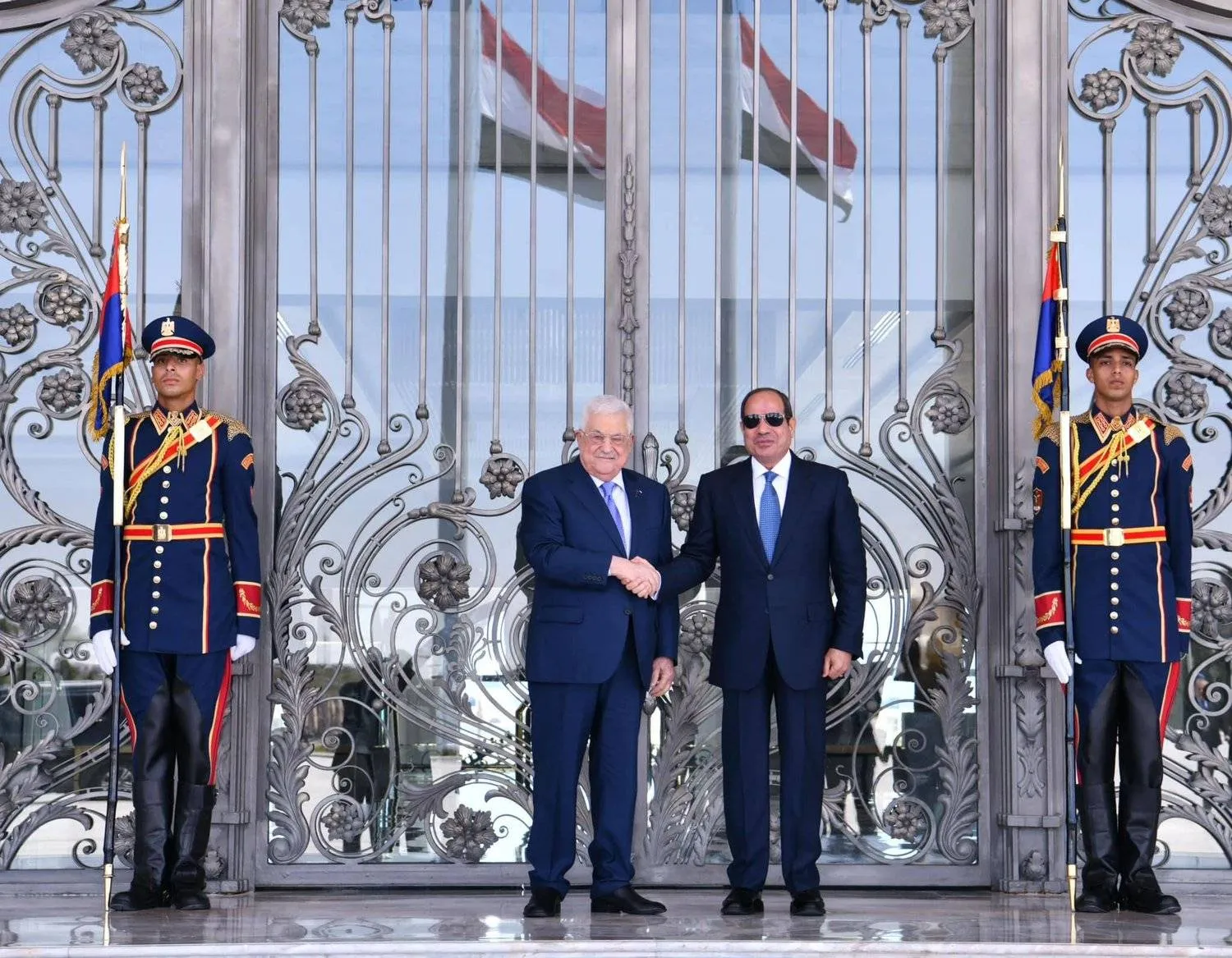

Egyptian President Abdel-Fattah al-Sisi and his Palestinian counterpart Mahmoud Abbas discussed on Monday the latest Palestinian developments amid the continued Israeli escalation in the occupied territories.
They met in Egypt’s coastal resort city of el-Alamein. Abbas was on a three-day visit to Egypt where Palestinian factions were gathered for dialogue on various issues to end the division and restore Palestinian national unity.
Sisi reiterated Cairo’s firm historic position in support of the Palestinian people.
Sisi and Abbas stressed the importance of preserving the legitimate rights of the Palestinian people, continuing efforts toward achieving lasting, just and comprehensive peace based on the two-state solution, and establishing an independent and sovereign Palestinian State according to the June 1967 borders.
Abbas praised Egypt’s continuous sponsorship of reconciliation efforts, and its important role in achieving Palestinian national unity.
On Sunday, the Palestinian president chaired in el-Alamein a meeting of the general secretaries of Palestinian factions, with the participation of 11 delegations representing the majority of the factions. Some factions were absent, most notably the Islamic Jihad.
The main groups, Hamas and Fatah, have been split since 2007 and repeated reconciliation attempts have failed.
On Monday, reactions to the results of the meeting varied and the statements delivered by faction leaders were characterized by a “cautious optimism.”
Some observers told Asharq Al-Awsat that the meeting was “a step on the road to reconciliation,” while others said it “did not meet their expectations” in light of the great challenges facing the Palestinians.
Abbas said the meeting was a “first and significant step” in efforts to end the long-running division.
Fatah and Palestinian Liberation Organization member Azzam al-Ahmed said the factions have some reservations over the political activity of the PLO.
In television remarks after the el-Alamein meeting, he said: “The weapons of the resistance are not up for debate.”
“The shape of the struggle is not determined by one faction alone, but rather by all of them,” he added.
He praised the agreement that was reached between the factions on the majority of the efforts needed to confront Israel.
Hamas leader Ismail Hanieh said the factions presented a “vision to draft a national plan to confront Israeli plots.”
“The resistance is comprehensive, and it is the strategic choice to complete the liberation,” he declared.
Israel, he continued, “cannot be friend or ally or neighbor”.
He added that it was necessary for the secretary generals of the Palestinian factions to meet regularly.
Jihad Al-Harazin, a Fatah official who is also a professor of law and political science at Al-Quds University, said the el-Alamein meeting could be a new hope to revive the reconciliation and confront the current Israeli government’s aggressive policies.
In remarks to the Asharq Al-Awsat, he said the meeting was “very necessary” and the agreement to form a follow-up committee over the dialogue throws the ball in the court of the leaders of the factions, especially Hamas, which is largely responsible for the persistence of the division for over 16 years.
Samir Ghattas, head of the Middle East Forum for Political and Strategic Studies, was disappointed with the meeting, saying it was “the shortest in the history of Palestinian group meetings.”
He told Asharq Al-Awsat that it did not yield results that rise up to the challenges facing the Palestinians against Israel and in ending the internal division.
The factions only made do with forming a follow-up committee, he lamented.