

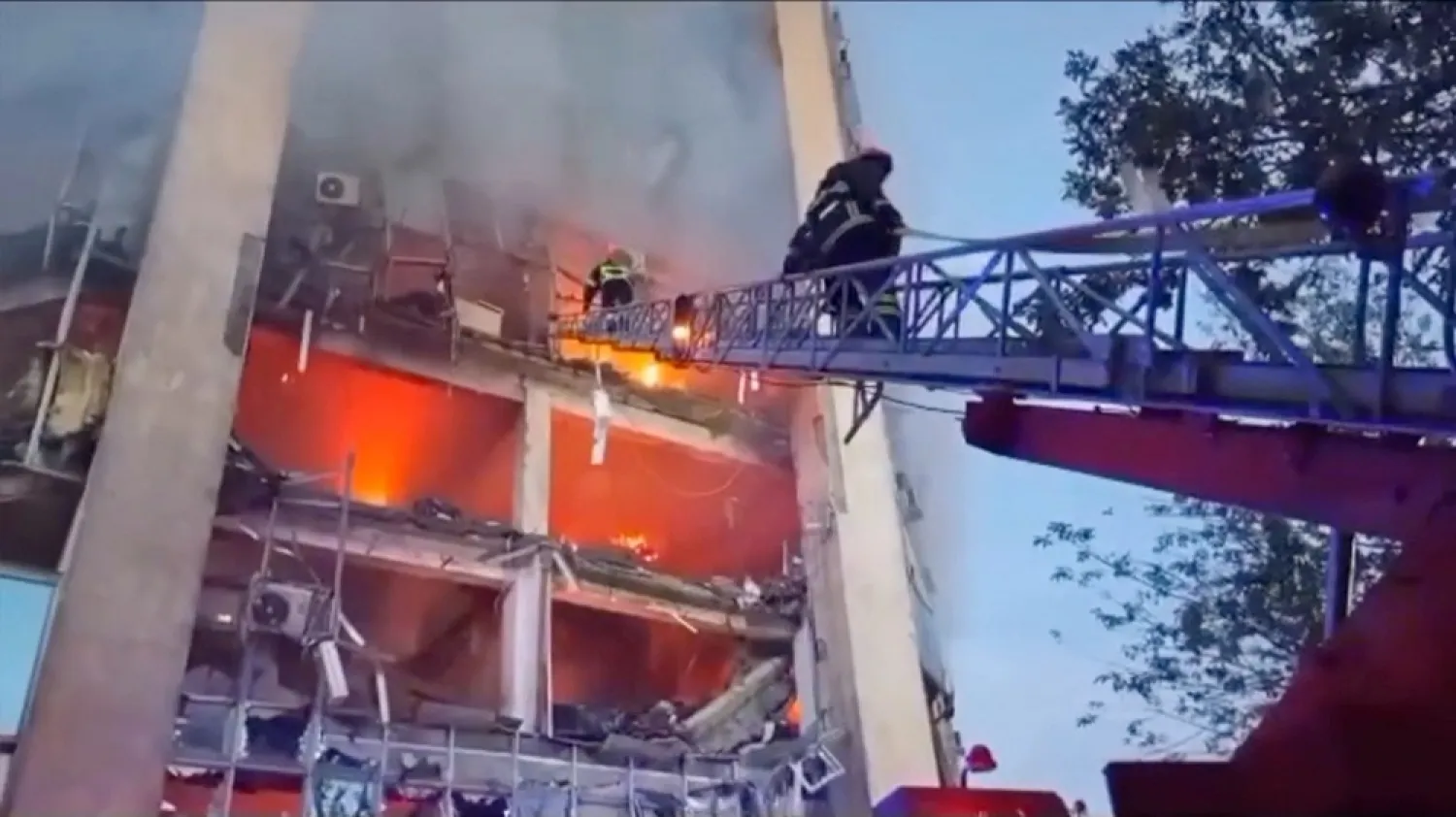

Russia Hits Ukraine Grain Export Route Near Romania

Firefighters work at a damaged property, following a Russian drone attack, amid Russia's attack on Ukraine, at Izmail, Odesa region, Ukraine, August 2, 2023, in this screen grab obtained from a handout video. (Ukraine's Operational Command 'South' /Handout via Reuters)
TT

Russia Hits Ukraine Grain Export Route Near Romania

Firefighters work at a damaged property, following a Russian drone attack, amid Russia's attack on Ukraine, at Izmail, Odesa region, Ukraine, August 2, 2023, in this screen grab obtained from a handout video. (Ukraine's Operational Command 'South' /Handout via Reuters)

Russian drones on Wednesday damaged infrastructure at a Ukrainian port on the Danube, as Moscow targeted facilities vital for grain shipments from Ukraine following the collapse of a key export arrangement.

Türkiye, which along with the United Nations brokered the deal to allow Ukrainian grain through the Black Sea, urged Russia after the port strike not to take steps that would escalate tensions.

Russia struck a grain elevator in the port of Izmail which sits just across the Danube River from Romania, damaging silos, warehouses and administrative buildings, Kyiv said.

Izmail is now the main export route for Ukrainian agricultural products via Romania, following Russia's withdrawal last month from the Black Sea grain agreement.

The deal had allowed around 33 million tons of grain to leave Ukrainian ports, easing fears of global food shortages after the start of the conflict.

Russia has been pounding the seaports in the Odesa region that were key for the grain exports granted safe passage under the deal.

"No steps should be taken that will escalate tensions in the Russia-Ukraine war," Turkish President Recep Tayyip Erdogan told Russian leader Vladimir Putin in a phone call.

Erdogan emphasized to Putin the significance of a grain deal that he called a "bridge for peace", the Turkish leader's office said.

'Unacceptable'

Failure to re-establish the grain deal "will not benefit anyone" and nations in need will suffer the most, Erdogan said.

In the same call, Putin asked Erdogan to aid Russia export its grain to African countries vulnerable to food shortages.

"The mood for cooperation with Türkiye and other interested states on this issue was expressed," the Kremlin said in statement.

But Paris accused Moscow of "pursuing its own interest at the expense of the most vulnerable", putting global food security at risk with the strikes on grain infrastructure.  

With the Black Sea route effectively blocked, the formerly obscure ports of Izmail and Reni on the Danube have become crucial to global food supplies.  

But the transit hubs are struggling to process all the arriving grain, causing massive bottlenecks, and have been targeted by Russia.  

The overnight strike damaged nearly 40,000 tons of grain destined for Africa, China, and Israel, Ukraine's Infrastructure Minister Oleksandr Kubrakov said.  

Romanian President Klaus Iohannis said that Russia's repeated attacks on Ukraine's infrastructure along the river were "unacceptable".

Ukraine needed "more air defense" to repel Russian attacks, the head of Ukraine's presidential office, Andriy Yermak, said Wednesday on Telegram.  

In Kyiv, more than 10 Russian drones were downed during an overnight strike that left several floors of a glass high-rise damaged, the city's military administration said.  

"Groups of drones entered Kyiv simultaneously from several directions," said Sergiy Popko, head of the administration.  

Popko said Russia had used a barrage of Iranian-made drones, with debris hitting several areas.  

Naval drills  

In the Golosiivsky district, "parts of a drone fell on a playground" and a fire broke out in a non-residential building, he said, adding that emergency services were on the scene.  

Kyiv's Mayor Vitali Klitschko had said earlier that the attack on the capital had damaged several areas, including the busy Solomyansky district.  

The attacks came a day after Russia said it downed a wave of Ukrainian drones targeting Moscow and vessels in the Black Sea.  

A skyscraper in Moscow's business district housing government offices was struck for the second time in a few days.  

Russia also said Wednesday it had launched naval drills on the Baltic Sea, involving 30 warships and boats, amid rising tensions with European countries over the Ukraine conflict.  

During the drills, the navy will practice how to protect sea lanes, transport troops and military cargo, and defend the coastline, the defense ministry said.



Iranian Discontent Heightens Cross-Border Threat to Syria, Experts Say

Photos released by Syrian media showing drugs seized in Serghaya.
TT

Iranian Discontent Heightens Cross-Border Threat to Syria, Experts Say

Photos released by Syrian media showing drugs seized in Serghaya.

Syrian authorities' announcement late Friday that they had foiled a major drug-smuggling operation from Lebanon in the Serghaya area of rural Damascus drew attention for one particular reason: the operation was handled by Defense Ministry troops rather than internal security forces, security expert Diaa Qaddour told Asharq Al-Awsat.

Another military analyst linked the growing tensions along Syria's borders with Lebanon and Iraq to Iran's dissatisfaction with the Syrian government.

The Defense Ministry's Media and Communications Department said border guards had intercepted an attempt to smuggle narcotics into Syria from Lebanon near Serghaya, along the border in the Damascus countryside.

The smugglers opened fire on the patrol, prompting troops to return fire and forcing the gunmen to retreat into Lebanese territory, the ministry said.

According to Syria's Internal Security Forces, the authorities seized 280 kilograms of hashish and 28,000 Captagon pills.

The incident followed extensive raids carried out by the Lebanese Army on November 4 in the rugged outskirts of Arsal, which led to the arrest of suspected smugglers and the interception of vehicles attempting to cross the border illegally.

It also came days after Syrian authorities arrested members of a cell allegedly plotting an attack on the Homs oil refinery. Damascus accused the cell of having ties to Lebanon's Hezbollah, an allegation the group denied.

Speaking to Asharq Al-Awsat, Qaddour accused Hezbollah of stepping up what he described as terrorist activities inside Syria, including attacks targeting sensitive sites.

He warned that the border region had become extremely volatile, with tensions liable to escalate at any moment, requiring Syrian security forces to remain on constant alert.

Damascus has been working to strengthen security cooperation with neighboring countries in an effort to close illegal border crossings and dismantle cross-border smuggling networks.

Security coordination topped the agenda during Iraqi Prime Minister Ali Al-Zaidi's visit to Damascus on October 28, when he led a high-level ministerial delegation.

Border control was also a priority in talks between the Syrian government and a Lebanese delegation headed by Deputy Prime Minister Tarek Mitri, which visited Damascus on November 2.

Since the start of the country's liberation, Damascus has sought to reassure its neighbors by tightening border controls and reopening crossings in ways that benefit both sides economically.

Military affairs analyst Rashid Hourani described the approach as "border-crossing diplomacy."

Speaking to Asharq Al-Awsat, Hourani said Damascus had sought to resolve its disputes with neighboring countries by securing its borders and ensuring they posed no threat to Syria or its neighbors.

But developments along the Syrian-Lebanese and Syrian-Iraqi borders, he argued, point to growing Iranian frustration with Damascus.

He attributed Tehran's displeasure partly to Syria's success in tightening border security and partly to recent discussions about its possible participation in the Makkah Agreement, alongside an announcement that Damascus would provide Saudi Arabia with military expertise to confront the Houthis, Iran's ally in Yemen.

"Iran therefore sought to cause trouble for Syria and instructed Hezbollah, whose regional influence has diminished, to stir up tensions along the Syrian border," Hourani said.

He argued that a similar dynamic was at play along the Iraqi border, where Iranian-backed militias exert considerable influence over decision-making within the country's military and security institutions.

Securing Syria's borders remains one of the most pressing security challenges facing Damascus.

Qaddour assessed the threat entering Syria across its borders as "moderate to high in the near term," although he said it could still be contained if current security efforts were sustained.

He identified the border with Lebanon as particularly vulnerable because of its rugged terrain and numerous illegal crossings.

The Iraqi border, by contrast, has seen substantial fortification through the construction of walls and trenches, while active security coordination with Jordan has helped authorities intercept major smuggling shipments.

Hourani also pointed to Syria and Jordan's participation in an anti-ISIS alliance established in March 2025 alongside Turkey, Iraq and Lebanon.

He said their membership in the coalition made it likely that the two countries would overcome the fallout from a Jordanian military operation in Syria's Daraa Governorate, where an operational error resulted in civilian casualties.

Meanwhile, recent developments have underscored the growing security threat along the Syrian-Lebanese border, with successive operations exposing what analysts describe as coordinated attempts to destabilize Syria.

Qaddour said drug trafficking remained the most serious threat, with evidence pointing to longstanding links between smuggling networks, elements of Syria's former regime and Hezbollah.

He also warned of an increasingly troubling development: smuggling cartels resorting to armed resistance against security forces.

The latest incident, in which smugglers exchanged fire with Syrian troops before fleeing into Lebanon, illustrated the growing danger, he said.

Qaddour argued that the situation demanded more than routine security coordination.

He called for tighter joint control over illegal crossings, expanded intelligence sharing and a systematic crackdown on cross-border criminal networks.

He also raised the possibility of urgent operations at particularly vulnerable points along the Lebanese border, warning that failure to close these security gaps could turn them into a persistent source of instability for both countries.


5 People Were Killed, More than a Dozen Injured in Krakow Shooting

This photo taken on November 5, 2026 shows a view of the Palace of Culture and Science (C) among Warsaw's skyscrapers at sunset. (Photo by Sergei GAPON / AFP)
TT

5 People Were Killed, More than a Dozen Injured in Krakow Shooting

This photo taken on November 5, 2026 shows a view of the Palace of Culture and Science (C) among Warsaw's skyscrapers at sunset. (Photo by Sergei GAPON / AFP)

Up to 5 people were killed and more than a dozen injured in Krakow shooting; perpetrator shot by officers, Polish police say.

A shooter opened fire in a market square in the Polish city of Krakow Saturday, leaving people dead and injured, authorities said.

The shooting occurred in the Main Square in Krakow, the municipal government said on X. A spokesperson for the local firefighters told Polsat News that the perpetrator fired a gun from a passing car.

Polish Prime Minister Donald Tusk, in a post on X, said police are investigating the attack. Other details were not immediately available.

Krakow is the second-largest city in Poland and roughly 250 kilometers (155 miles) from the capital, Warsaw.


US Treasury Sanctions Canadian Money Services Firms Over Iran-Related Transactions

FILE PHOTO: The US Department of the Treasury Building in Washington, D.C., U.S., July 11, 2026. REUTERS/Daniel Heuer/File Photo/File Photo
TT

US Treasury Sanctions Canadian Money Services Firms Over Iran-Related Transactions

FILE PHOTO: The US Department of the Treasury Building in Washington, D.C., U.S., July 11, 2026. REUTERS/Daniel Heuer/File Photo/File Photo

The United States on Friday announced a new round of sanctions targeting networks and entities connected to Iran, according to a notification published on the US Department of the Treasury’s website.

“Today, as part of Operation Economic Outcast, the Department of the Treasury’s Office of Foreign Assets Control (OFAC) designated eight money services businesses based in Canada that enable the Iranian regime, sanctioned entities associated with the regime, and other illicit actors that move assets into and out of Iran,” it wrote.

The sanctions effectively cut the firms off from the dollar-based financial system, blocking any assets that the firms may have in the United States and prohibiting any transactions with US persons or entities.

The actions are the latest ⁠in a series of Treasury moves against firms outside the United States that it says help Iran get around US sanctions, as Washington keeps up pressure on Tehran.

“Canada cannot be a safe haven for illicit financial facilitators that provide sanctions evasion services to the Iranian regime and its proxies,” said Secretary of the Treasury Scott Bessent. “Treasury will pursue and disrupt the Iranian regime’s financial channels anywhere in the world.”

The Treasury identified the designated businesses in Ontario and British Columbia as Diverse Trade ⁠Inc doing business as Million Exchange, 1380079 BC Limited, Top PC Technician Inc, NIA Nations Currency Ltd, 2397639 Ontario Ltd doing business as Farah Exchange, CCC Inc and B Galaxy Inc and Darvish Exchange.

Separately, the Treasury said its Financial Crimes Enforcement Network division ⁠issued an order that also cuts off virtual currency exchanger MEXC Global from the US financial system over transactions that it says are linked to sanctions evasion by Iran, North ⁠Korea and Russia.

FinCEN, the Treasury's anti-money laundering unit, said that the order prevents US financial institutions from processing fund transfers involving Seychelles-incorporated MEXC Global, which it ⁠says has facilitated at least $16 billion in illicit transactions linked to Iran, North Korea and Russia as well as transactions with other sanctioned actors.