Israel Prepares for Possible Third Intifada in the West Bankhttps://english.aawsat.com/arab-world/4473006-israel-prepares-possible-third-intifada-west-bank
Israel Prepares for Possible Third Intifada in the West Bank
Palestinian security forces during a visit by President Mahmoud Abbas to the Jenin refugee camp on July 12. (AFP)
TT
TT
Israel Prepares for Possible Third Intifada in the West Bank
Palestinian security forces during a visit by President Mahmoud Abbas to the Jenin refugee camp on July 12. (AFP)
Israel’s security establishment is preparing for the possibility of a third intifada (uprising), a more likely scenario in the post-President Mahmoud Abbas era.
Israel's Ynet reported that the recent operation in Jenin and its refugee camp served as a miniature representation of a broader military conflict that could unfold in the West Bank, involving tens of thousands of armed militants, with an abundant supply of ammunition smuggled from Israel or across the Jordanian border, and lacking no financial resources.
According to the website, this is the scenario outlined by Israeli intelligence officers for the situation in the West Bank.
This scenario gained more prominence in the past week as Israeli security received another reminder of the escalating situation in the West Bank, following three attacks occurring within a single day, including two shooting incidents.
The report said it is the Israeli army that bears the cost of this situation, including reduced training for regular brigades, increased activation of reserve soldiers for operational duties, and incurring costs amounting to hundreds of millions of shekels.
In the span of a year and a half, only 13 battalions have been involved in current security missions in the West Bank.
Since the surge in attacks began, the number of battalions has increased by an average of 25.
This figure still stands at approximately a quarter of the battalions that operated in the West Bank during the peak of the second uprising nearly two decades ago.
This gap in the number of soldiers deployed in the field can largely be attributed to advanced technologies and artificial intelligence, which were not available 20 years ago.
Furthermore, Ynet revealed that the Israeli army command in the West Bank has recently renewed its operational plans for any anticipated escalation.
These new offensive plans are based on precise intelligence information prepared by the Israeli Military Intelligence Directorate, which believes that every household in Palestinian cities and villages contains some form of weaponry.
It asserts that an unprecedented and substantial quantity of arms, previously absent in the West Bank, is now present.
Sources to Asharq Al-Awsat: Hamas Held Secret Meeting with French Lawmakers, Diplomatshttps://english.aawsat.com/arab-world/5287008-sources-asharq-al-awsat-hamas-held-secret-meeting-french-lawmakers-diplomats
This photograph shows the Statue de la Reublique with the Palestinian flag in support of the Palestinians in Gaza, at Place de la Reublique in Paris on June 13, 2025. (AFP)
Sources to Asharq Al-Awsat: Hamas Held Secret Meeting with French Lawmakers, Diplomats
This photograph shows the Statue de la Reublique with the Palestinian flag in support of the Palestinians in Gaza, at Place de la Reublique in Paris on June 13, 2025. (AFP)
Three Palestinian sources told Asharq Al-Awsat that senior leaders of Hamas’ political bureau recently held a highly confidential meeting with a French delegation that included current and former diplomats, as well as members of parliament from both parties within France’s governing coalition and the opposition.
Two of the sources — one affiliated with a Palestinian civil society organization involved in programs with France and other European countries, and another linked to a Palestinian faction close to Hamas — said the meeting took place “recently” in an unspecified country in the region. Both declined to identify the location but described the gathering as “extremely secret.”
According to the sources, several governments, Palestinian factions, and mediators involved in Gaza ceasefire efforts, including Egypt, Qatar, and Türkiye, were informed of the meeting shortly before or soon after it occurred. One source said Hamas informed a number of parties that the meeting was taking place, without disclosing details.
Two Hamas officials confirmed to Asharq Al-Awsat that the meeting had occurred but declined further comment.
The meeting is notable because it appears to be the first known encounter between European officials and Hamas leaders since the group’s October 7, 2023, attack on Israel.
Since then, Hamas representatives have met US officials and presidential envoys as part of ceasefire negotiations that resulted in the release of hostages held by the group. Those contacts were publicly praised at the time by President Donald Trump, despite Washington’s designation of Hamas as a terrorist organization since 1997.
France does not formally designate Hamas as a terrorist organization under its national legal framework, although French authorities prosecute individuals accused of financing the group. Following the October 7 attack, debate intensified in Paris over calls to formally classify Hamas as a terrorist organization.
The European Union has listed Hamas and its military wing, the Izz ad-Din al-Qassam Brigades, on its terrorist sanctions list since 2001. In May, the EU imposed additional sanctions on Hamas and the Palestinian Islamic Jihad movement.
The reported meeting also comes amid nearly two years of strained relations between Paris and Tel Aviv, as well as growing tensions between French President Emmanuel Macron and Israeli Prime Minister Benjamin Netanyahu over Israel’s military campaigns in Gaza and Lebanon and its strikes in Syria.
After France recognized the State of Palestine, Netanyahu accused Macron in August of “fueling antisemitism,” prompting a sharp response from the Elysee Palace, which described the remarks as “base” and founded on falsehoods.
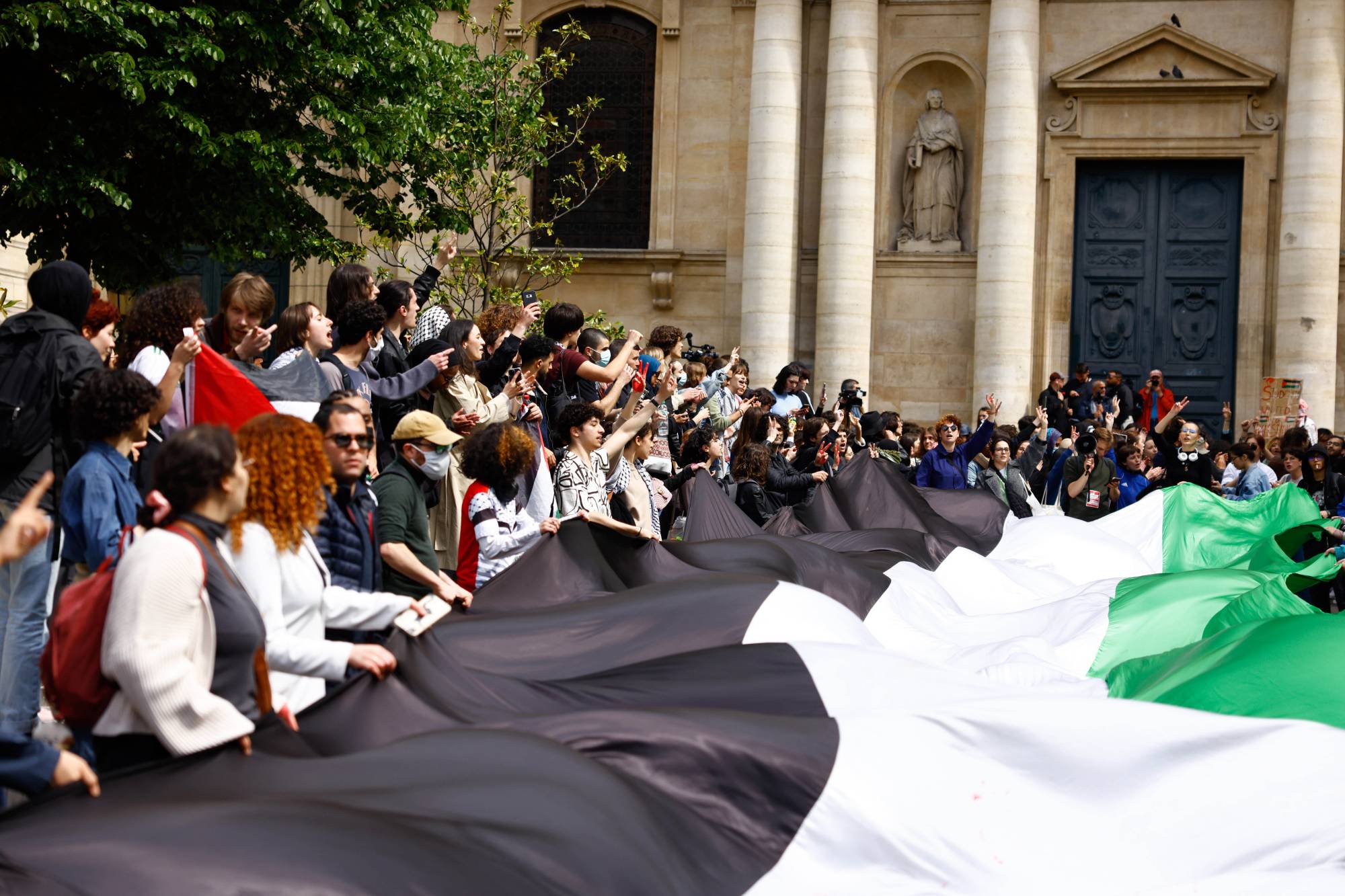
Pro-Palestinian demonstrators carry a huge Palestinian flag as they gather outside the Sorbonne University, where they tried to set up a protest camp before being evacuated by police in Paris, France, 29 April 2024. (EPA)
Issues discussed
A source from Palestinian civil society said the talks focused broadly on the Palestinian situation, including efforts to reorganize Palestinian internal affairs, improve national reconciliation, and advance a political process aimed at ending the conflict with Israel.
According to the source, discussions also touched on supporting Palestinians’ right to establish an independent state based on the June 4, 1967, borders.
France has been a leading advocate of the two-state solution and, alongside Saudi Arabia, has spearheaded international efforts that helped generate a wave of diplomatic recognition for a Palestinian state and broader support within the United Nations.
The disclosure of the meeting comes as Hamas is engaged in difficult negotiations over the future of its weapons arsenal.
The group has linked any discussion of disarmament to a clearly defined political process that guarantees Palestinian self-determination and the establishment of a sovereign state.
A history of contacts
The reported meeting is not unprecedented. In 2008, Hamas disclosed that it had held discussions with several European officials, including French representatives.
Then-French Foreign Minister Bernard Kouchner acknowledged such contacts but emphasized that France would not establish formal relations with Hamas unless it recognized Israel and renounced violence.
At the time, Hamas spokesman Sami Abu Zuhri said European interlocutors were seeking to understand the movement’s positions on political developments and the prospects for a Palestinian state.
Those contacts coincided with Hamas’ gradual adoption of a position accepting a Palestinian state within the 1967 borders as an interim solution, while stopping short of recognizing Israel and insisting on the right of return for Palestinian refugees and East Jerusalem as the capital of a future Palestinian state.
In 2009, then-Hamas political bureau chief Khaled Meshaal met two French lawmakers in Damascus.
A further shift came in 2017, when Hamas elected a new leadership headed by Ismail Haniyeh and revised its political document to accept a Palestinian state within the 1967 borders.
The movement also expanded outreach to Russia, Iran, Arab and Islamic countries, and European states, while expressing openness to dialogue with a broad range of international actors, including the United States.
More recently, Hamas has sought through international law firms and legal initiatives to challenge its designation as a terrorist organization in several European countries, particularly Britain.
Supporting those efforts was a document signed by Moussa Abu Marzouk, a member of Hamas’ political bureau and head of its international relations office, arguing that Hamas is a national liberation movement, not an antisemitic organization, and does not pose a threat to Western countries.
Lebanon's Berri to Asharq Al-Awsat: We Are in Constant Contact with Aoun, Salam Despite Difference in Ideashttps://english.aawsat.com/arab-world/5286987-lebanons-berri-asharq-al-awsat-we-are-constant-contact-aoun-salam-despite
Lebanon's Berri to Asharq Al-Awsat: We Are in Constant Contact with Aoun, Salam Despite Difference in Ideas
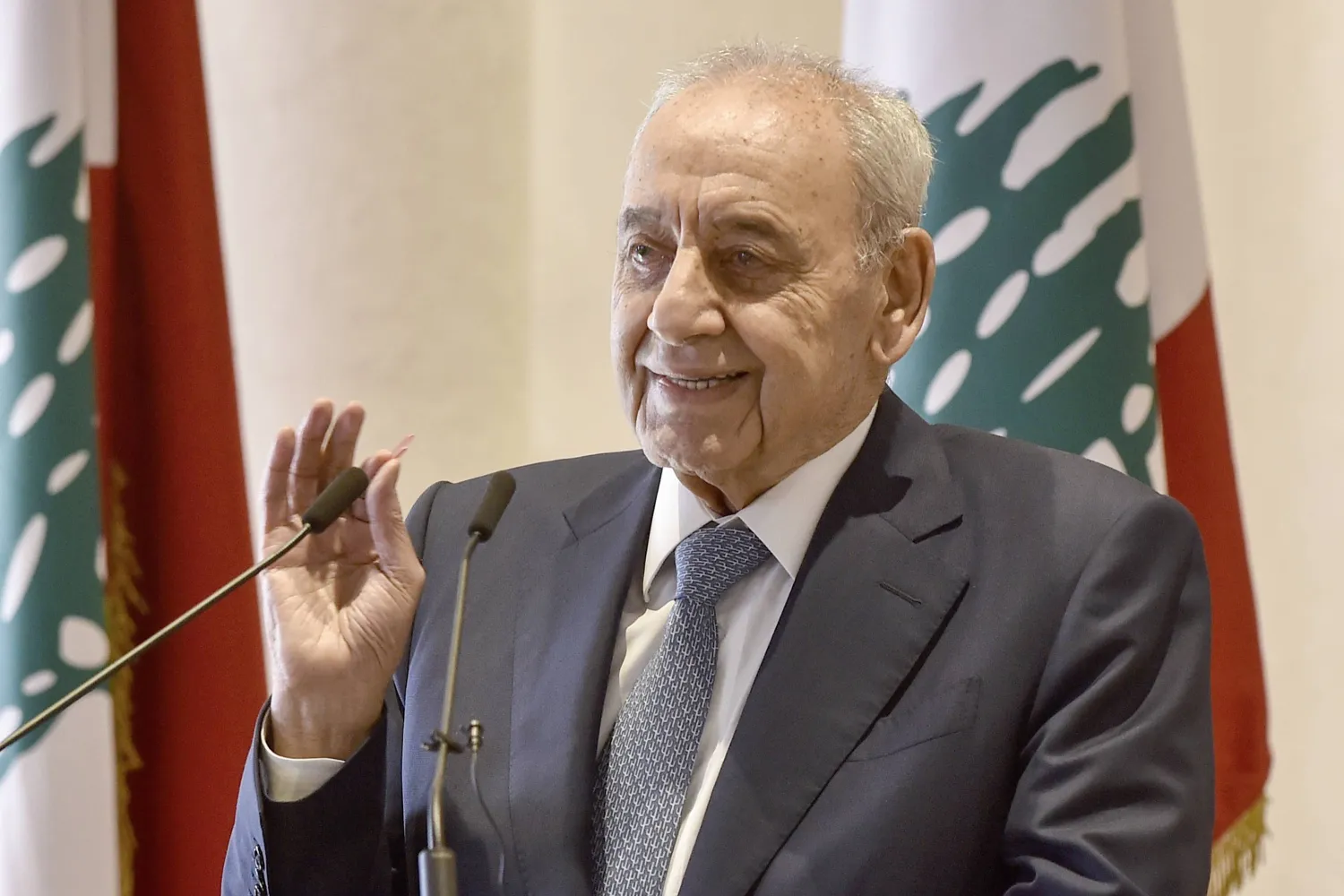
01 October 2020, Lebanon, Beirut: Speaker of the Lebanese parliament Nabih Berri speaks during a press conference in Beirut. (Lebanese Parliament/dpa)
Lebanese parliament Speaker Nabih Berri stressed on Sunday that he was in “constant” contact with President Joseph Aoun and Prime Minister Nawaf Salam “despite differences in ideas.”
In remarks to Asharq Al-Awsat, he said: “I don't think we have a problem as long as we are united in demanding that Israel first withdraw from the South and then that the army be deployed there and that the people are allowed to return to their homes.”
The demands also include the release of detainees held by Israel and coming up with a plan, with Arab and international backing, to rebuild what Israel destroyed during the war, he added.
Berri made his remarks on the eve of the launch of the fifth round of US-sponsored Lebanese-Israeli military and political negotiations.
The speaker expressed his “satisfaction” with the efforts that have led to a ceasefire in the fighting between Israel and Hezbollah. Berri is a close ally to the Iran-backed group.
He hoped the ceasefire will last, saying that that hinges on Israel respecting it, which will in turn lead Hezbollah to respect it as well “because it is unjust to negotiate under fire.”
Berri revealed that Israel had requested the ceasefire through the “mechanism” committee that is responsible for overseeing the implementation of the 2024 truce between Israel and Hezbollah.
He noted that Israel came under American pressure to agree to a ceasefire following “two bloody days in the South that claimed dozens of civilian lives.”
He stressed that Hezbollah is “committed to the ceasefire,” accusing Israel of violating it.
“We hope that the ceasefire, with US pressure, will stand. We welcome any effort to pressure Israel to cease its hostile war against Lebanon,” he continued.
Moreover, the speaker expressed his rejection of “pilot zones” in the South, saying that reaching an agreement over their geographic borders could take years.
Israel and Lebanon agreed to move quickly towards establishing “pilot zones” in which the Lebanese Armed Forces would exercise exclusive control “to the exclusion of all non-state actors”.
Berri said that Lebanon “has not interest in wasting time that would allow Israel to continue its hostile activities. The solution lies in adopting a timetable for its withdrawal from the entire South in exchange for the deployment of the Lebanese army.”
“This remains the shortest path towards the South’s liberation from occupation instead of remaining bogged down by talks over the ‘pilot zones’,” he added.
Syria President Denies Wanting to Intervene in Lebanon After Trump Remarkshttps://english.aawsat.com/arab-world/5286980-syria-president-denies-wanting-intervene-lebanon-after-trump-remarks
Syria President Denies Wanting to Intervene in Lebanon After Trump Remarks
Syrian President Ahmed al-Sharaa. (AFP file)
Syrian President Ahmed al-Sharaa denied on Sunday that his country sought to intervene militarily in Lebanon where Israel and Hezbollah are at war, after US President Donald Trump repeatedly suggested Damascus could get involved.
"We are looking for economic channels between Lebanon and Syria, not military ones," Sharaa said in an interview broadcast on television channel Al Mashhad.
On Sunday, Trump told Fox News he was "disappointed Israel can't put Hezbollah away", adding in reference to the fight against the militant group: "I'm close to giving it over to Syria."
Hezbollah drew Lebanon into the Middle East war on March 2 with rocket fire at Israel to avenge the killing of its backer Iran's supreme leader in US-Israeli strikes days earlier.
Israel responded with airstrikes and a ground invasion.
An Iran-US deal signed this week on ending the regional conflict includes Lebanon, where fighting has paused since Saturday evening.
At the G7 summit in France this week, Trump also said "if Israel can't do the job (against Hezbollah) without killing everyone else, then he (Sharaa) will do the job. Syria will do the job."
- Syria 'greatly concerned' -
Sharaa said in Sunday's interview that "we proposed with the United States that the war must stop," adding that "there must be various solutions, including economic, political and social, and the re-establishment of relations and the vital economic lifeline between Syria and Lebanon."
"And alongside this, some security measures that respond firstly to Syrian and Lebanese concerns, and also Israeli concerns," he added.
Hezbollah fought alongside longtime Syrian ruler Bashar al-Assad in his country's civil war, making Sharaa and the new authorities who toppled the former leader in 2024 deeply hostile to the group.
Syria had dominated its neighbor for decades following its military intervention in Lebanon's 1975-1990 civil war, withdrawing only in 2005, making any new military involvement a fraught proposition.
Syria offers "many tools for having a positive impact within Lebanon, but this also depends primarily on Lebanon's agreement", Sharaa said.
"Syria is greatly concerned with Lebanon's domestic situation because Lebanon's security and stability are part of Syria's security and stability," he added.
Responding to a question about whether he would sit at the table with Hezbollah, Sharaa said that "if this serves Lebanon's interests and safeguards Syria's interests, why not?"
Earlier this month, Trump also told US broadcaster NBC that "I'd like to see a more surgical attack on Hezbollah... And we can help them with that, or we can recommend Syria," he said, adding that Sharaa "would love to help".
لم تشترك بعد
انشئ حساباً خاصاً بك لتحصل على أخبار مخصصة لك ولتتمتع بخاصية حفظ المقالات وتتلقى نشراتنا البريدية المتنوعة