


US Vows to Keep Syria’s Chemical Weapons Program in UN Spotlight Over Russian and Chinese Opposition 

Linda Thomas-Greenfield, United States ambassador to the United Nations speaks during the UN Security Council meeting to discuss the maintenance of peace and security of Ukraine, Friday, July 21, 2023, at United Nations headquarters. (AP)
TT

US Vows to Keep Syria’s Chemical Weapons Program in UN Spotlight Over Russian and Chinese Opposition 

Linda Thomas-Greenfield, United States ambassador to the United Nations speaks during the UN Security Council meeting to discuss the maintenance of peace and security of Ukraine, Friday, July 21, 2023, at United Nations headquarters. (AP)

The United States and its allies vowed Tuesday to keep Syria’s failure to account for its chemical weapons program in the spotlight at the UN Security Council every month despite opposition from Russia and China.

US Ambassador Linda Thomas-Greenfield told the council Syrian President Bashar Assad’s government “has repeatedly lied to the international community” and to investigators from the international chemical weapons watchdog, which has confirmed that it used these banned weapons on at least nine occasions.

She said the Biden administration will continue to demand a full accounting from Syria as it pledged after joining the Chemical Weapons Convention in September 2013, when it was pressed by its close ally Russia following a deadly chemical weapons attack in the Damascus suburb of Ghouta, which the West blamed on Damascus.

For the first time, Russia and China refused to speak at the monthly meeting on the Syria chemical weapons issue, saying they are repetitive and should be cut back.

Syria’s minister counsellor Alhakan Dandy did speak, saying his country was surprised at this month's meeting “given that there have been no developments that would require it,” other than what he called continuous attempts by the United States “to exploit the chemical weapons file to serve their agenda of hostility against Syria.”

He repeated Syria’s condemnation of the use of chemical weapons and called claims it used such weapons in Ghouta, where more than 1,400 people were killed, “lies.” He also insisted the Syrian military doesn't possess any chemical weapons.

Dandy said Syria has cooperated with the Organization for the Prohibition of Chemical Weapons, which monitors implementation of the Chemical Weapons Convention. But he also accused its investigators of being politicized and “using unprofessional working methods and double standards.”

UN deputy disarmament chief Adedeji Ebo told the council, however, that Syria has failed again to provide the OPCW with a full accounting of its program, citing “gaps, inconsistencies and discrepancies” in its declaration.

He singled out unanswered questions about activities at Syria’s Scientific Studies and Research Center “and the declaration of quantities of nerve agents produced at one chemical weapons production facility that was declared by the Syrian Arab Republic as never having been used to produce chemical weapons.”

Ebo reiterated the UN's repeated call on Syria “to respond with urgency” to all OPCW questions.

Syrian representatives did meet a delegation from the OPCW’s technical secretariat in Beirut on June 22 and 23, and Ebo said Syria committed to present proposals for better implementing its obligations. He said the OPCW is waiting to hear from Damascus about resuming consultations.

Thomas-Greenfield expressed regret that two permanent council members, which she didn’t name, didn’t speak. Russia and China were the only countries to remain silent.

“The Assad regime is betting that this council will simply move on,” she said. “It is hoping we will change the subject.”

“We must not succumb to fatigue or, worse, indifference. The Assad regime used weapons of mass destruction against its own people. ... And we will not move on, and the regime will not escape accountability,” the US ambassador said.

There was widespread support from other council members that Syria must answer all questions from the OPCW, although the United Arab Emirates, the Arab representative on the council, said the council should discuss the Syria chemical weapons issue every three months, not every month.


Syria Drafts Law to Protect Victims’ Rights from Assad Era

Monday’s demonstration outside the Palace of Justice in Damascus called for criminalizing symbols of the Assad era (Facebook). 
TT

Syria Drafts Law to Protect Victims’ Rights from Assad Era

Monday’s demonstration outside the Palace of Justice in Damascus called for criminalizing symbols of the Assad era (Facebook). 

Syria’s Ministry of Justice has completed a draft law aimed at protecting the rights of victims of the Assad era, preserving the historical record, safeguarding the collective memory of future generations, and preventing the recurrence of abuses.

Justice Minister Mazhar al-Wais said Tuesday that the bill will be submitted to parliament as soon as it convenes to complete the constitutional process and secure final approval.

His remarks came a day after demonstrators gathered outside the Palace of Justice in central Damascus, calling for enforcement of Article 49 of Syria’s constitutional declaration. The provision criminalizes glorifying the former Assad regime and its symbols, as well as denying, praising, justifying, or minimizing its crimes.

Recent weeks have also seen protests in several parts of the country accompanied by violence and vandalism targeting supporters of the former regime and remnants of its security and military apparatus, raising concerns about social stability.

Al-Wais stressed that denying or justifying crimes committed by the former regime, or glorifying those responsible, violates the constitutional declaration because it undermines victims’ rights and Syria’s national memory. He said these principles form part of the country’s transitional justice framework.

He added that the Public Prosecution is pursuing such violations under existing law and urged the public to report acts or statements that breach the constitutional declaration so legal action can be taken.

According to legal sources, launching transitional justice proceedings before enacting a dedicated transitional justice law has created a gap between Syrians’ expectations for comprehensive accountability and current prosecutions conducted under the penal code.

Mohammed Suleiman Dahla, head of the Damascus Bar Association, told Asharq Al-Awsat that ongoing cases classify abuses as war crimes and crimes against humanity under international criminal and humanitarian law while simultaneously prosecuting them under the Syrian Penal Code.

He said the forthcoming transitional justice law — expected before the current trials conclude — would become the governing legislation, particularly regarding sentencing. Specialized judicial chambers handling such crimes have already begun operating in Damascus within the regular court system, from the Public Prosecution through investigative bodies to the criminal court, with plans to expand them to other provinces.

Dahla stressed that transitional justice legislation is essential for social recovery, institutional reform, closing the chapter on the past, preventing future abuses, and preserving historical memory. He also called for reviewing laws that helped the former regime consolidate control over the state, society, and the economy.


Israeli Troops Face Resistance from Residents as they Push into a Town in Syria

A man rides a motorcycle in the village of Abdin, Daraa province, Syria, Monday, June 29, 2026. (AP Photo/Omar Sanadiki)
TT

Israeli Troops Face Resistance from Residents as they Push into a Town in Syria

A man rides a motorcycle in the village of Abdin, Daraa province, Syria, Monday, June 29, 2026. (AP Photo/Omar Sanadiki)

As Israeli troops and vehicles entered the town of Abdin in southern Syria, residents blocked the roads with rocks, and some young men and boys threw stones to push back the military patrol.

Tensions in this part of the country created by a buffer zone occupied by Israeli forces have flared into violence in recent days, leaving residents anxious that more escalation is coming. Residents of Abdin, located near a UN-patrolled buffer zone now controlled by Israeli troops, tried to resist against a military incursion Sunday, The Associated Press reported.

Residents said Israeli troops fired warnings shots at walls and between the angry protesters, before firing artillery rounds at the village. No one was harmed in the exchange, but most residents fled, and most were still too afraid to return on Monday. Many fear that there will now be more intense incursions and raids following the skirmish.

“They come into the village regularly, every few days,” said resident Mohammad al-Hassan, standing not far from a group of children looking at an exploded shell. “They come in armored 4x4 vehicles, they roam around the village and search some houses, they knock on doors and if people don’t answer the door they break it down and enter the houses. Women and children start screaming, it’s a terrifying thing, them coming here.”

Israel says it needs buffer zones to prevent attacks

Israel seized control of a UN-patrolled buffer zone in southern Syria in December 2024, following the ouster of former Syrian President Bashar Assad in an insurgent offensive. Israeli officials initially described the move as temporary to protect their borders from militant groups, but more recently top Israeli officials have said they plan to occupy the buffer zone in Syria indefinitely.

The Israeli military presence in southern Syria is part of a shift to a more aggressive strategy by Israel after the deadly October 2023 Hamas-led attacks in southern Israel. The Israeli military took over large portions of Gaza as part of a broad invasion, and later seized control of chunks of Lebanon — where the Hezbollah militant group has fired missiles and drones across the border — and Syria. Israel calls these areas “buffer zones” and says they are needed to prevent future attacks by militant groups.

There have been no cross-border attacks from Syria into Israel since Assad’s ouster, except for two rockets from a little-known militant group. But Israel's military incursions into southwestern Syrian towns have sometimes sparked resistance by residents that has spiraled into deadly clashes.

Syrian officials condemn Israeli incursions

Syria’s interim president, Ahmad al-Sharaa, has called on Israel to withdraw from the area that the UN says is 235 square kilometers (91 square miles). The Syrian government also condemned the Israeli incursion and shelling in Abdin.

The clashes in Abdin were the second outbreak of violence in less than 24 hours. Earlier on Sunday, the Israeli military announced that it had killed armed men in southern Syria without giving details.

An Israeli military official said Monday that Israeli soldiers had killed two militants who were planning on attacking Israeli troops. The official who spoke on condition of anonymity under military briefing rules did not specify where in Syria the incident took place.

The mayor of the Syrian village of Hadar said two unknown people driving a pickup truck just south of the village were killed in an attack, and that their bodies were taken by the Israeli military.

“There was the sound of an explosion when it happened,” Imad Hassoun told The Associated Press. “They weren't from Hadar. If they were, we would immediately know.”

Regarding the incident in Abdin, the Israeli official said armed militants opened fired against one of the Israeli military’s strongholds but nobody was harmed in the attack, without giving further details.

Residents fear increasing instability

People in Abdin were initially hopeful that US-mediated talks between Israel and Syria in France aimed at reaching a security agreement would diffuse tensions, but the talks appear to have stalled.

Fearing the unstable security situation and struggling to cope with a lack of jobs and services, many residents who have lived in these towns are leaving elsewhere. The closest government security checkpoint to Abdin is some 10 kilometers (6 miles) away, and those who choose to stay are struggling with water and electricity shortages.

Sobhi al-Tawlbi, 66, says farmers have struggled to access their yield and sources of water.

“We need the government to support us a little so we can remain steadfast in our villages,” he said, asking for the international community to put pressure on Israel to stop its military incursions.

Syrians living in that broader border area have maintained that they are not a threat to anyone and want a stable life, following over 13 years of civil war that decimated Syria.

“Why are they bothering us? We are living here peacefully in this border area,” said al-Hassan.


US Imposes Broadest Sanctions Yet on Hezbollah’s Financial Institutions

Debris lies at the site of a damaged branch of Al-Qard Al-Hassan, a financial institution linked to Lebanon's Hezbollah, in the aftermath of Israeli airstrikes that hit several branches of the institution, amid the ongoing hostilities between Hezbollah and Israeli forces, in Beirut suburbs, Lebanon, October 21, 2024. (Reuters)
TT

US Imposes Broadest Sanctions Yet on Hezbollah’s Financial Institutions

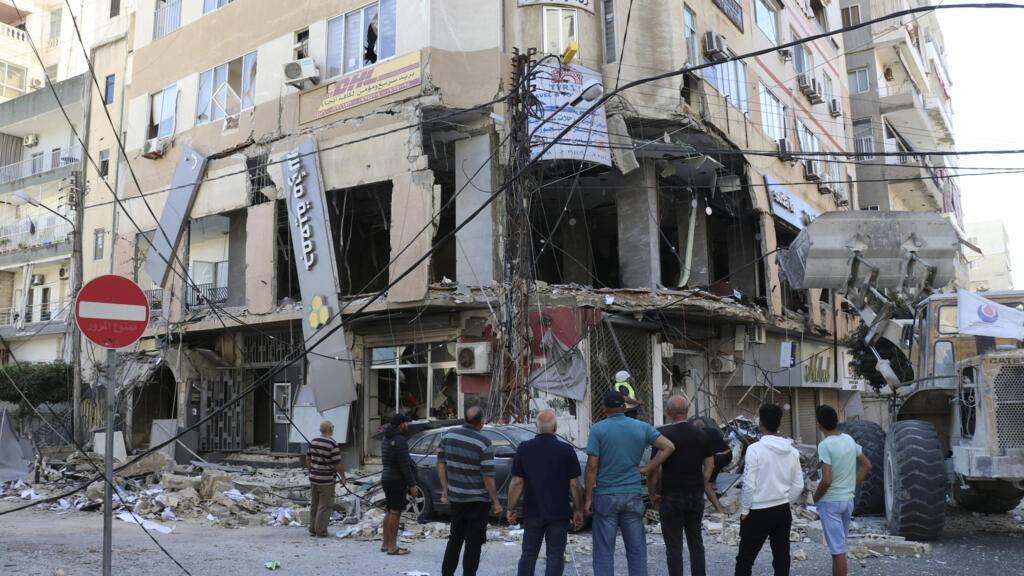
Debris lies at the site of a damaged branch of Al-Qard Al-Hassan, a financial institution linked to Lebanon's Hezbollah, in the aftermath of Israeli airstrikes that hit several branches of the institution, amid the ongoing hostilities between Hezbollah and Israeli forces, in Beirut suburbs, Lebanon, October 21, 2024. (Reuters)

The US Treasury announced on Tuesday that it was imposing sanctions on five financial entities and 16 individuals related to Hezbollah’s financial operations in the latest escalation aimed at curbing the Iran-backed group’s sources of funding.

The targets include major Hezbollah institutions Al-Qard Al-Hassan and Bayt al-Mal, as well as their senior leaders. “These coordinated actions underscore Terrorist Financing Targeting Center (TFTC) members’ shared commitment to disrupting Hezbollah’s ability to exploit the international financial system. All targets announced today were previously designated by the United States,” said a Treasury statement.

The networks designated on Tuesday “threaten regional stability, international security, mutual interests, and global trade. By restricting Hezbollah's access to funding, TFTC members are working to protect the integrity of the international financial system, support the Lebanese people, and counter terror networks,” it added.

“Al-Qard Al-Hassan masquerades as a non-governmental organization (NGO) under the cover of a Ministry of Interior-granted NGO license. However, it provides financial services similar to a bank, far beyond anything disclosed in its original registration documents, and in practice illicitly moves funds through shell accounts and facilitators,” it continued.

“Hezbollah uses Al-Qard Al-Hassan to facilitate its destabilizing militant activities, undermining the Lebanese people’s ability to rebuild while enabling the group’s own interests,” it stressed.

“By hoarding hard currency that is desperately needed by the Lebanese economy, Al-Qard Al-Hassan allows Hezbollah to build its own support base and compromise the stability of the Lebanese state.”

“Bayt al-Mal functions as Hezbollah’s unofficial treasury, holding and investing its assets and serving as intermediaries between the terrorist group and mainstream banks,” added the statement.

“Bayt al-Mal operates under the direct supervision of the Hezbollah Secretary-General. As one of Hezbollah's main financial bodies, Bayt al-Mal serves as a bank, creditor, and investment arm for Hezbollah.”

The sanctions were issued after Lebanon and Israel reached last week a “framework agreement”, with US mediation, aimed at restoring Lebanon’s sovereignty and disarming Hezbollah and dismantling its infrastructure.

American administration officials had said that protecting the agreement demands not only security arrangements on the ground, but increasing pressure on networks that use civilian fronts to try to empower Hezbollah or obstruct the implementation of the agreement.

People inspect the damage at the site of an overnight Israeli airstrike that targeted a branch of the Al-Qard Al-Hassan in the southern city of Tyre on October 21, 2024. (AFP)

Commenting on the new sanctions, an official source in the administration told Asharq Al-Awsat that they send a strong message to Hezbollah that the time of benefitting from unofficial funding is over.

They also send a message to Lebanese authorities that any leniency in dealing with illicit financial networks will be met with even stronger US pressure, it added.

The targeted individuals include Ibrahim Ali Daher, “the Chief of Hezbollah’s Central Finance Unit, which oversees Hezbollah’s overall budget and spending, including the group’s funding of its terrorist operations inside and outside Lebanon.”

The Central Finance unit receives Hezbollah’s worldwide income and is responsible for managing and auditing the budgets of all Hezbollah units and departments, including coordinating the payment of all Hezbollah members, said the Treasury.

Daher and the Central Finance Unit operate within the group’s Executive Council and with direction from the Hezbollah Secretary-General on where to distribute funds. In this capacity, Daher has been a key figure in Hezbollah's financial infrastructure for well over a decade and a half.

Adel Mohamad Mansour is the Executive Director of Al-Qard Al-Hassan, a position that he has held for years. In addition to his role within Al-Qard Al-Hassan, Mansour has used his personal bank accounts to conduct transactions with various Hezbollah institutions.

Ahmad Mohamad Yazbeck is Al-Qard Al-Hassan's financial director. Yazbeck, along with Abbas Hassan Gharib, Mustafa Habib Harb, Ezzat Youssef Akar, and Hasan Chehadeh Othman have maintained joint bank accounts in Lebanese banks that has allowed them to transfer more than $500 million within the formal financial system for over a decade, despite existing sanctions against Al-Qard Al-Hassan.

Other targeted individuals include Samer Hasan Fawaz, Ali Mohamad Karnib, Abbas Hassan Gharib, Mustafa Habib Harb, Ezzat Youssef Akar, Hasan Chehadeh Othman, Nehme Ahmad Jamil, Issa Hussein Kassir, Ali Ahmad Krisht, Wahid Mahmud Subayti, Mohammed Suleiman Badir and Imad Mohamad Bezz. They were designated for their various roles in Al-Qard Al-Hassan.

Naser Hasan Neser, who managed Auditors for Accounting and Auditing, was also targeted for reporting to senior Hezbollah Executive Council and Central Finance Unit officials, including Daher, about the activities of Auditors.
