


Thinking of Buying a New Pair of Jeans? Breaking Down the Cost over Time Might Help You Decide

Jake Welch stands in open-air shopping center, Wednesday, Aug. 2, 2023, in Salt Lake City. (AP Photo/Rick Bowmer)
TT

Thinking of Buying a New Pair of Jeans? Breaking Down the Cost over Time Might Help You Decide

Jake Welch stands in open-air shopping center, Wednesday, Aug. 2, 2023, in Salt Lake City. (AP Photo/Rick Bowmer)

For Jake Welch, getting dressed is one big math problem.
The 36-year-old brand director for an advertising firm calculates the cost-per-wear of his wardrobe by highlighting 200 items in a spreadsheet — excluding underwear and socks — and meticulously listing the price he paid for each of them as well as how many times he's worn it. He updates the spreadsheet every night on his computer to determine whether his purchases were worth it — or not, The Associated Press said.
Lots of people thought Welch was weird when he started doing this 12 years ago, opting to ditch the cheapest items on the sales rack in favor of maximizing the value of his purchases over the span of their lifecycles. But with inflation still a nagging problem, more shoppers are coming around to his way of thinking.
“I was actually onto something versus being a little looney," said Welch of Erda, Utah, who presented his findings last month at a company meeting.
Retailers are taking note of this mindset and shifting their marketing strategy in some cases. Gap’s Old Navy is offering shoppers a full refund for uniforms purchased during the upcoming back-to-school season if the clothes don’t hold up for a year. Retailers like Kohl’s and online shirt retailer Untuckit have recently revamped their marketing campaigns — particularly for the fall — to focus on durability and versatility. American Eagle is touting the “longevity of your most-loved jeans” made of recycled cotton and polyester in an email campaign to customers.
That means a $200 classic sweater may end up being a better deal if you plan to wear it every week in comparison to a hot pink dress picked up for $40 that might be worn only once a month.
"Cost-per-wear is another way that they think about how to combat some of the inflation,” said Christie Raymond, Kohl’s chief marketing officer. "Is this item going to last? Is it going to really be versatile? For back to school, for example, can my child wear it in a number of different ways?"
Some shoppers are also looking to be more eco-friendly by buying clothes that don’t end up in a landfill after being worn a few times.
Still, the cost-per-wear calculation may only make sense for those consumers who can afford to prioritize quality and versatility over price. Neil Saunders, managing director of GlobalData Retail, notes that shoppers with tighter budgets will look at price and may not care whether something will last just as long as it looks good for now.
Indeed, fast-fashion purveyors are still faring well in the face of inflation. Chinese e-commerce retailer Temu, known for deep discounts and coupons, has continued its meteoric rise in the US, adding nearly 10 million new daily users since the turn of the year, according to market intelligence firm GWS. Meanwhile, Shein, the ultra-low-price, fast-fashion juggernaut founded in China, has been increasing its daily users from 3.1 million to 4.9 million daily users over the past year, according to GWS.
But there’s a growing backlash to the cheap stuff.
Rohan Deuskar, founder and CEO of Stylitics, a retail technology firm that powers personalized styling, outfitting and bundling suggestions for 150 retailers online, said he started seeing the trend this past holiday shopping season. He noted the average order was going up, particularly for holiday dresses, while shoppers were buying fewer items. And shoppers were also spending more time engaging with the virtual models that showed different ways to wear the item.
“Shoppers are being more considerate about every purchase and being willing to spend only if they get value — and that no longer just means cheap,“ Deuskar said. ”We’re reaching a little bit of an oversaturation of buying a bunch of stuff. ”
According to market research firm Circana’s Retail Tracking Service, higher prices are outpacing lower prices over the past 12-month period ending in June. Women’s dresses priced $200 and above grew about twice as fast as those priced under $50. Sales of men’s jeans that were less than $30 declined, while higher price brands drove growth. Sales of women’s jeans priced $150 and above increased by 7%. And while the market for women’s active pants declined 20%, women’s active pants priced between $125 to $150 increased 19%, according to Circana.
Saunders notes that “price and quality aren't always linked." In fact, some retailers may be using any excuse to sell higher price goods. There's also the timeliness of the fashion item to consider. Shoppers may think about longevity when they look for a coat but not for a skirt or a top.
“People like to refresh or their tastes change,” he said.
And cost-per-wear calculations don't factor in weight loss or gain, Saunders added.
Welch said his wardrobe consists of mostly blacks, greys and blues and items that can carry through multiple seasons. Higher inflation has helped him better separate his needs and wants.
“I ask myself a little bit harder: ‘Is it something that I absolutely need?’” he said. “Consulting my spreadsheet, how many golf shorts do I really have?”
Welch noted that his formal wear and suits along with dress shirts are among the items that rank the highest in cost-per-wear. He chose a charcoal suit — not a tan version — for his wedding in 2018 that he bought for $480 at Bonobos. He has worn it 44 times, resulting in a cost-per-wear of $10.91. Not too bad but ideally he likes to get it down to 50 cents per wear, like the athletic shorts he bought at Outdoor Voices for $20 and has worn 434 times, according to his spreadsheet he shared.
Kohl's said its marketing campaigns are showing different ways that items can be worn. For example, on the department store's Instagram account, it pairs a white T-shirt and denim shirts in different ways, including a beachy take and a more stylish approach with hoop earrings. Untuckit's fall campaign, “Made for the next journey,” focuses on the different ways customers can wear the shirt or the jacket — taking it from the office to night time events.
As for Welch, he said his wife is now staying away from fast-fashion and focusing on quality, though she's not embracing the spreadsheets. And he's delighted that his two girls, ages 3 and seven months, fit with the new math.
“With my first daughter, the cost for use on her dresses and stuff like that have decreased with having another girl, ” he said. “So if we have a boy, great. But if we have another girl, that's just even more savings."


Pieter Mulier Named Creative Director of Versace

(FILES) Pieter Mulier attends the 2025 CFDA Awards at The American Museum of Natural History on November 03, 2025 in New York City. (Photo by Dimitrios Kambouris / GETTY IMAGES NORTH AMERICA / AFP)
TT

Pieter Mulier Named Creative Director of Versace

(FILES) Pieter Mulier attends the 2025 CFDA Awards at The American Museum of Natural History on November 03, 2025 in New York City. (Photo by Dimitrios Kambouris / GETTY IMAGES NORTH AMERICA / AFP)

Belgian fashion designer Pieter Mulier has been named the new creative director of the Milan fashion house Versace starting July 1, according to an announcement on Thursday from the Prada Group, which owns Versace.

Mulier is currently creative director of the French fashion house Alaïa, and was previously the right-hand man of fellow Belgian designer and Prada co-creative director Raf Simons at Calvin Klein, Jil Sander and Dior.

In his new role, Mulier will report to Versace executive chairman Lorenzo Bertelli, the designated successor to manage the family-run Prada Group. Bertelli is the son of Miuccia Prada and Prada Group chairman Patrizio Bertelli.

“We believe that he can truly unlock Versace’s full potential and that he will be able to engage in a fruitful dialogue,’’ The Associated Press quoted Lorenzo Bertelli as saying of Mulier in a statement.

Mulier takes over from Dario Vitale, who departed in December after previewing just one collection during his short-lived Versace stint.

Mulier was honored last fall by supermodel and longtime Alaïa muse Naomi Campbell at the Council of Fashion Designers of America for his work paying tribute to brand founder Azzedine Alaïa. Mulier took the creative helm in 2021, after Alaïa’s death.


Ralph Lauren’s Margin Caution Eclipses Stronger‑than‑expected Quarterly Results

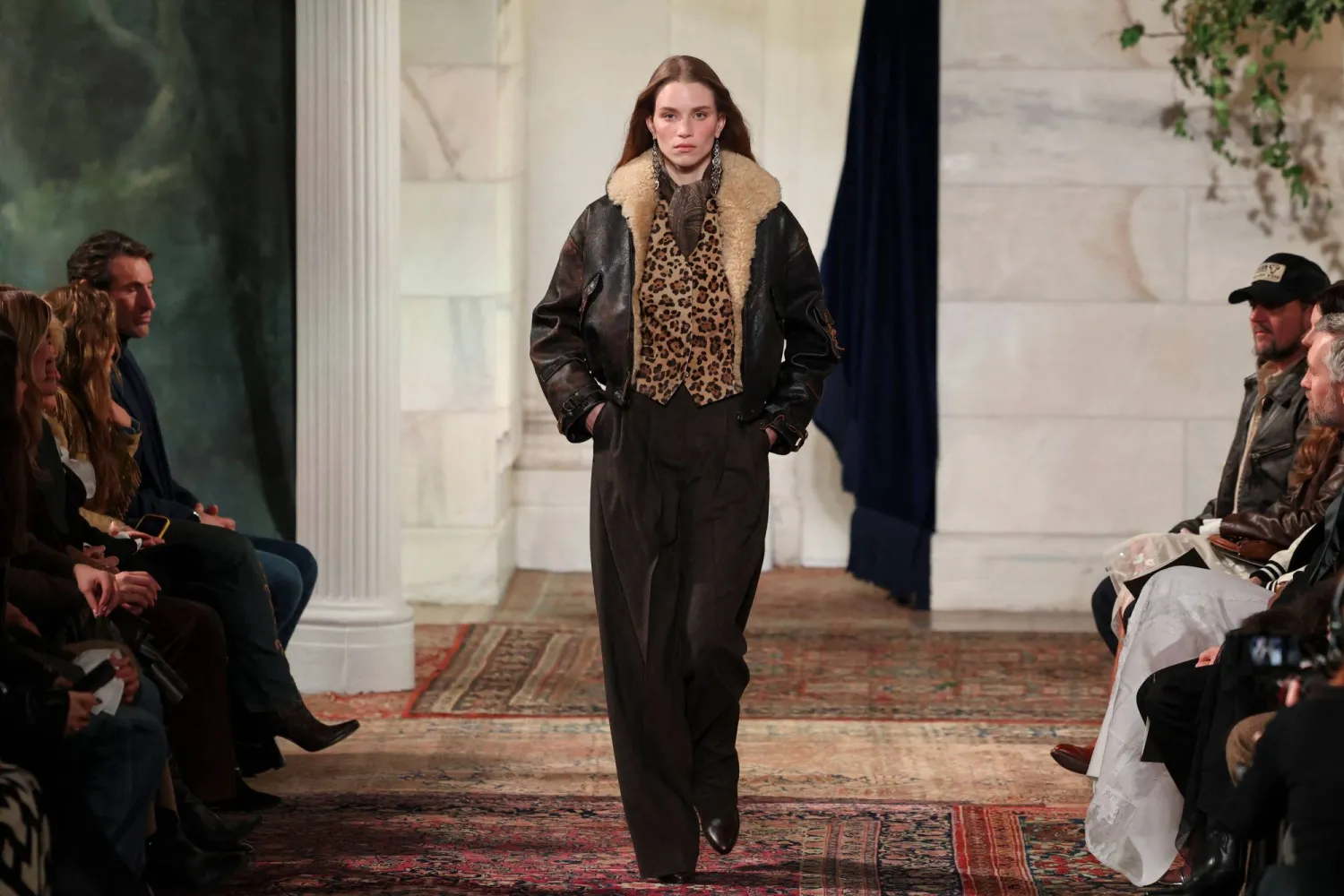
Guests wait after viewing the latest Ralph Lauren collection in New York City, US, April 17, 2025. REUTERS/Caitlin Ochs/File photo
TT

Ralph Lauren’s Margin Caution Eclipses Stronger‑than‑expected Quarterly Results

Guests wait after viewing the latest Ralph Lauren collection in New York City, US, April 17, 2025. REUTERS/Caitlin Ochs/File photo

Ralph Lauren posted third-quarter results above Wall Street estimates on Thursday, but the luxury retailer's warning of margin pressure tied to US tariffs sent its shares down nearly 6.4% in premarket trading.

The company expects fourth-quarter margins, its smallest revenue period, to shrink about 80 to 120 basis points due to higher tariff pressure and marketing spend.

Ralph Lauren, which sources its products from regions such as China, India and Vietnam, has relied on raising prices and reallocating production to regions with lower duty exposure to offset US tariff pressures, Reuters reported.

"Ralph Lauren has been able to raise prices for some time now. There is some limit on how long it can continue to do this. I think (the company's) gross margins are near peak levels," Morningstar analyst David Swartz said.

The company, which sells $148 striped linen shirts and $498 leather handbags, has tightened inventory, lifted full-price sales and refreshed core styles, boosting its appeal among wealthier and younger customers, including Gen Z.

Higher-income households are still splurging on luxury items, travel and restaurant meals, while lower- and middle-income consumers are strained by higher costs for rents and food as well as a softer job market.

The New York City-based company saw quarterly operating costs jump 12% year-on-year as it ramped up brand building efforts through sports-focused brand campaigns such as Wimbledon and the US Open tennis championship.

The luxury retailer said revenue in the quarter ended December 27 rose 12% to $2.41 billion, above analysts' estimates of a 7.9% rise to $2.31 billion, according to data compiled by LSEG.

It earned $6.22 per share, excluding items, compared to expectations of $5.81, aided by a 220 basis points increase in margins and an 18% rise in average unit retail across its direct-to-consumer channel.

Ralph Lauren now expects fiscal 2026 revenue to rise in the high single to low double digits on a constant currency basis, up from its prior forecast of a 5% to 7% growth.


Saudi Fashion Commission, Kering Launch 'Kering Generation Award X MENA'

This year's award builds on the strong success of the 2025 award, which attracted more than 500 applications, shortlisted 21 finalists, and recognized three winners. SPA
TT

Saudi Fashion Commission, Kering Launch 'Kering Generation Award X MENA'

This year's award builds on the strong success of the 2025 award, which attracted more than 500 applications, shortlisted 21 finalists, and recognized three winners. SPA

Saudi Arabia’s Fashion Commission and global luxury group Kering have launched the "Kering Generation Award X MENA" across the Middle East and North Africa (MENA) for 2026.

The announcement was made on Tuesday during the opening of the RLC Global Forum, hosted at the French Embassy in Riyadh.

This year's award builds on the strong success of the 2025 award, which attracted more than 500 applications, shortlisted 21 finalists, and recognized three winners.

Participants benefited from mentorship programs, workshops, and opportunities to strengthen their global presence. Building on this momentum, the 2026 program seeks to expand its impact across the MENA region.

The 2026 award focuses on four key areas of sustainable fashion: innovation in regenerative materials and clean production, circular design and sustainable business models, nature conservation and animal welfare, and consumer awareness and cultural engagement.

The program targets startups across the MENA region that operate in, or positively influence, the sustainable fashion sector, provided they demonstrate innovation capabilities and the ability to deliver measurable sustainability outcomes.