


Trump, Advisers Charged in Georgia for 2020 Election Overthrow Scheme

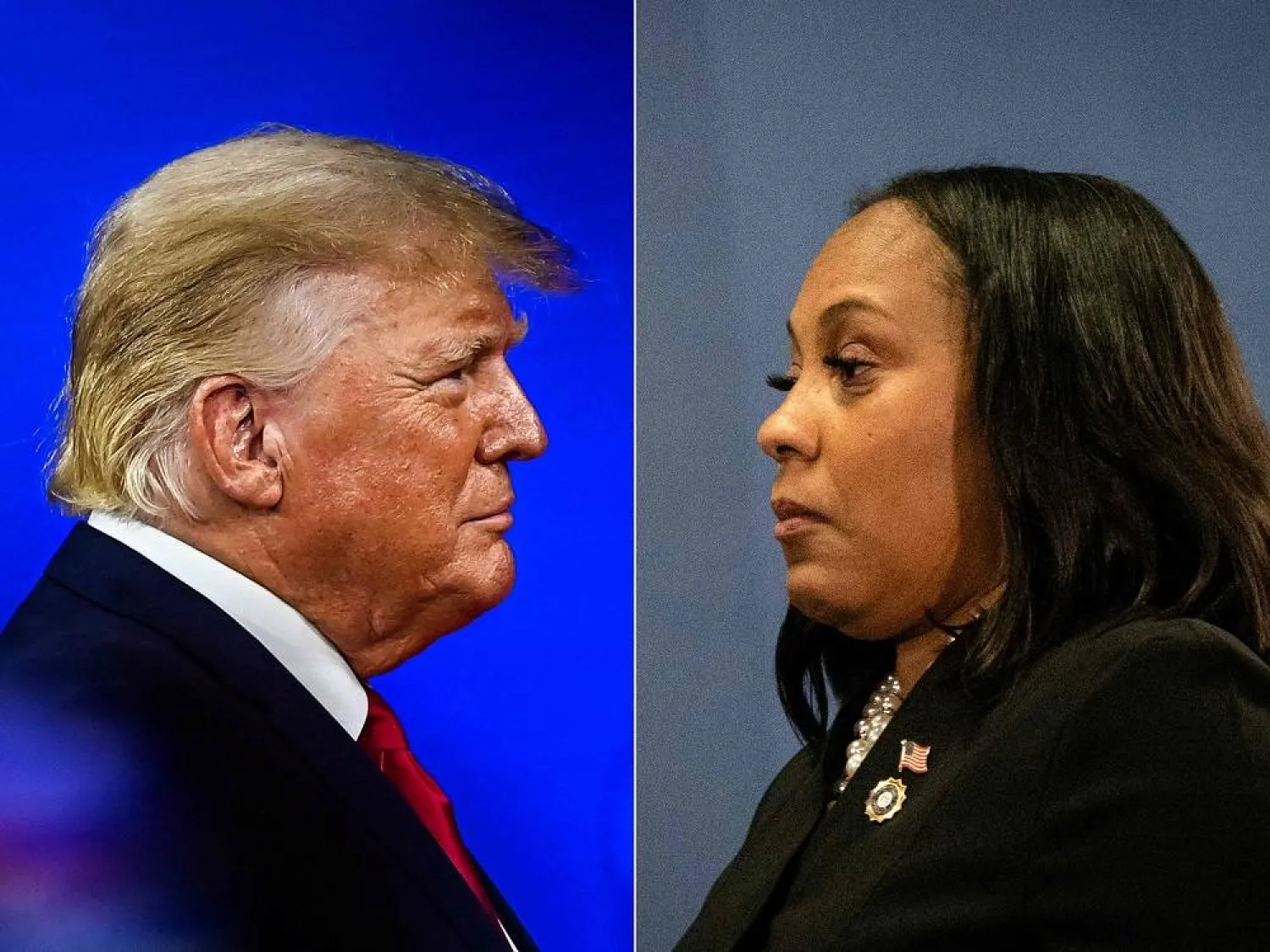
This combination of pictures created on August 14, 2023, shows Former US President Donald Trump in Orlando, Florida, on February 26, 2022, and Fulton County District Attorney Fani Willis on August 14, 2023, in Atlanta, Georgia. (AFP)
TT

Trump, Advisers Charged in Georgia for 2020 Election Overthrow Scheme

This combination of pictures created on August 14, 2023, shows Former US President Donald Trump in Orlando, Florida, on February 26, 2022, and Fulton County District Attorney Fani Willis on August 14, 2023, in Atlanta, Georgia. (AFP)

Former US President Donald Trump was hit with a fourth set of criminal charges when a Georgia grand jury issued a sweeping indictment accusing him of trying to overturn his 2020 election loss to Democrat Joe Biden.

The charges, brought late on Monday by Fulton County District Attorney Fani Willis, add to the legal woes facing Trump, the front-runner in the race for the Republican nomination for the 2024 presidential election.

The sprawling 98-page indictment listed 19 defendants and 41 criminal counts in all. All of the defendants were charged with racketeering, which is used to target members of organized crime groups and carries a penalty of up to 20 years in prison.

Mark Meadows, Trump's former White House chief of staff, and lawyers Rudy Giuliani and John Eastman were among those charged.

"Rather than abide by Georgia's legal process for election challenges, the defendants engaged in a criminal, racketeering enterprise to overturn Georgia's presidential election result," Willis said at a press conference.

Trump and the other defendants have until noon EDT (1600 GMT) on Friday, Aug. 25, to surrender voluntarily, rather than face arrest, Willis said. She said she intends to try all 19 defendants together.

The 13 felony charges against Trump matched those listed on a document that was briefly posted on the court website earlier in the day and reported by Reuters before it disappeared.

Lawyers for those named either declined to comment or did not immediately respond to a request for comment.

In a Jan. 2, 2021, phone call, Trump urged Georgia's top election official, Brad Raffensperger, to "find" enough votes to reverse his narrow loss in the state. Raffensperger declined to do so.

Trump's supporters stormed the US Capitol four days later in an unsuccessful attempt to prevent lawmakers from certifying Biden's victory.

The indictment cites a number of crimes that Trump or his associates allegedly committed from before the Nov. 3, 2020, election until September 2022, including falsely testifying to lawmakers that election fraud had occurred and urging state officials to alter the results.

It says the defendants tried to subvert the US electoral process by submitting false slates of electors, people who make up the Electoral College that elects the president and vice president.

Breaching voting machines, harassing election workers

It alleges that defendants breached voting equipment in a rural Georgia county, including personal voter information and images of ballots.

Prosecutors also said the defendants harassed an election worker who became the focus of conspiracy theories.

The indictment reaches across state lines, saying that Giuliani, Meadows and others called officials in Arizona, Pennsylvania and elsewhere to urge them to change the outcome in those states.

The indictment mentions 30 other co-conspirators, though they were not named or charged.

Trump has denied any wrongdoing. In a statement before the indictment was released, his campaign accused Willis, an elected Democrat, of being a "rabid partisan" who was trying to undermine his reelection bid.

"It is a dangerous effort by the ruling class to suppress the choice of the people," the statement said.

Trump has already pleaded not guilty in three criminal cases.

He faces a New York state trial in March 2024 involving a hush money payment to a porn star, and a federal trial beginning in May in Florida for allegedly mishandling federal classified documents. In both cases Trump pleaded not guilty.

A third indictment, in Washington federal court, accuses him of illegally seeking to overturn his 2020 election defeat. Trump denies wrongdoing in this case as well, and a trial date has yet to be set.

Georgia, once reliably Republican, has emerged as one of a handful of politically competitive states that can determine the outcome of presidential elections.

Trump persists in falsely claiming he won the November 2020 election although dozens of court cases and state probes have found no evidence to support his claim.

Not hurting his campaign

Strategists said that while the indictments could bolster Republican support for Trump, they may hurt him in the November 2024 general election, when he will have to win over more independent-minded voters.

In a July Reuters/Ipsos poll, 37% of independents said the criminal cases made them less likely to vote for him.

Willis's investigation drew on testimony from Trump advisers including Giuliani, who urged state lawmakers in December 2020 not to certify the election, and Republican state officials like Raffensperger and Governor Brian Kemp, who refused to echo Trump's false election claims.

While many Republican officials have echoed Trump's false election claims, Kemp and Raffensperger have refused to do so.

Raffensperger has said there was no factual basis for Trump's objections, while Kemp certified the election results despite pressure from within his party.

Trump has been mired in legal trouble since leaving office.

Apart from the criminal cases, a New York jury in May found him liable for sexually abusing and defaming the writer E. Jean Carroll and awarded her $5 million in a civil case. A second defamation lawsuit scheduled for January seeks $10 million in damages. Trump denies wrongdoing.

Trump is due to face trial in October in a civil case in New York that accuses him and his family business of fraud to obtain better terms from lenders and insurers.

Trump's company was fined $1.6 million after being convicted of tax fraud in a New York court in December.


Trump Says Nations Doing Business with Iran Face 25% Tariff on US Trade

US President Donald Trump speaks with members of the media aboard Air Force One en route from Florida to Joint Base Andrews, Maryland, US, January 11, 2026. REUTERS/Nathan Howard
TT

Trump Says Nations Doing Business with Iran Face 25% Tariff on US Trade

US President Donald Trump speaks with members of the media aboard Air Force One en route from Florida to Joint Base Andrews, Maryland, US, January 11, 2026. REUTERS/Nathan Howard

President Donald Trump said on Monday any country that does business with Iran will face a tariff rate of 25% on any trade with the US, as Washington weighs a response to the situation in Iran which is seeing its biggest anti-government protests in years.

"Effective immediately, any Country doing business with the Islamic Republic of Iran will pay a Tariff of 25% on any and all business being done with the United States of America," Trump said in a post on Truth Social. Tariffs are paid by US importers of goods from those countries. Iran, a member of the OPEC oil producing group, has been heavily sanctioned by Washington for years. It exports much of its oil to China, with Türkiye, Iraq, and India among its other top trading partners.

"This Order is final ‌and ⁠conclusive," Trump said ‌without providing any further detail.

There was no official documentation from the White House of the policy on its website, nor information about the legal authority Trump would use to impose the tariffs, or whether they would be aimed at all of Iran's trading partners. The White House did not respond to a request for comment.

The Chinese embassy in Washington criticized Trump's approach, saying China will take "all necessary measures" to safeguard its interests and opposed "any illicit unilateral sanctions and long-arm jurisdiction."

"China's position against the indiscriminate imposition of tariffs is consistent and clear. Tariff wars and trade wars have no winners, and ⁠coercion and pressure cannot solve problems," a spokesperson of the Chinese embassy in Washington said on X.

Japan and South Korea, which agreed on trade ‌deals with the US last year, said on Tuesday they are ‍closely monitoring the development.

"We ... plan to take any necessary ‍measures once the specific actions of the US government become clear," South Korea's trade ministry said in a ‍statement.

Japan’s Deputy Chief Cabinet Secretary Masanao Ozaki told reporters that Tokyo will "carefully examine the specific content of any measures as they become clear, as well as their potential impact on Japan, and will respond appropriately."

Iran, which had a 12-day war with US ally Israel last year and whose nuclear facilities the US military bombed in June, is seeing its biggest anti-government demonstrations in years. Trump has said the US may meet Iranian officials and that he was in contact with Iran's opposition, while piling pressure on its leaders, including threatening military action.

Tehran said ⁠on Monday it was keeping communication channels with Washington open as Trump considered how to respond to the situation in Iran, which has posed one of the gravest tests of clerical rule in the country since the Iranian Revolution in 1979.

Demonstrations evolved from complaints about dire economic hardships to defiant calls for the fall of the deeply entrenched clerical establishment. US-based rights group HRANA said it had verified the deaths of 599 people - 510 protesters and 89 security personnel - since the protests began on December 28.

While air strikes were one of many alternatives open to Trump, "diplomacy is always the first option for the president," White House press secretary Karoline Leavitt said on Monday.

During the course of his second term in office, Trump has often threatened and imposed tariffs on other countries over their ties with US adversaries and over trade policies that he has described as unfair to Washington.

Trump's trade policy is under legal pressure as ‌the US Supreme Court is considering striking down a broad swathe of Trump's existing tariffs.

Iran exported products to 147 trading partners in 2022, according to World Bank's most recent data.


Iran Summons French, German, Italian, UK Envoys Over Support for Protests

 Cars burn in a street during a protest over the collapse of the currency's value, in Tehran, Iran, January 8, 2026. Stringer/WANA (West Asia News Agency) via Reuters
Cars burn in a street during a protest over the collapse of the currency's value, in Tehran, Iran, January 8, 2026. Stringer/WANA (West Asia News Agency) via Reuters
TT

Iran Summons French, German, Italian, UK Envoys Over Support for Protests

 Cars burn in a street during a protest over the collapse of the currency's value, in Tehran, Iran, January 8, 2026. Stringer/WANA (West Asia News Agency) via Reuters
Cars burn in a street during a protest over the collapse of the currency's value, in Tehran, Iran, January 8, 2026. Stringer/WANA (West Asia News Agency) via Reuters

Iran on Monday summoned diplomats in Tehran representing France, Germany, Italy and the UK to object to what it described as support by those countries for the protests that have shaken the country, its foreign ministry said.

The diplomats were shown a video of the damage caused by "rioters" and told their governments should "withdraw official statements supporting the protesters", the ministry said in a statement quoted by state television.

In Paris, the French foreign ministry confirmed that "European ambassadors" had been summoned by Iran.


Iran’s Traders, Frustrated by Economic Losses, Turn Against Clerics

 Cars burn in a street during a protest over the collapse of the currency's value, in Tehran, Iran, January 8, 2026. Stringer/WANA (West Asia News Agency) via Reuters
Cars burn in a street during a protest over the collapse of the currency's value, in Tehran, Iran, January 8, 2026. Stringer/WANA (West Asia News Agency) via Reuters
TT

Iran’s Traders, Frustrated by Economic Losses, Turn Against Clerics

 Cars burn in a street during a protest over the collapse of the currency's value, in Tehran, Iran, January 8, 2026. Stringer/WANA (West Asia News Agency) via Reuters
Cars burn in a street during a protest over the collapse of the currency's value, in Tehran, Iran, January 8, 2026. Stringer/WANA (West Asia News Agency) via Reuters

Iran's bazaar merchants, the trader class who were the financial backbone of the 1979 revolution, have turned against the clerics they helped bring to power, fueling unrest over an economy that has morphed into full-blown anti-government protests.

Frustration among bazaar merchants, from small-scale shopkeepers to large wholesale traders, has grown as their political and economic clout in Iran has diminished over the decades while the elite Revolutionary Guards have tightened their grip on the economy, building sprawling and tightly held networks of power.

"We are struggling. We cannot import goods because of US sanctions and because only the Guards or those linked to them control the economy. They only think about their own benefits," said a trader at Tehran’s centuries-old Grand Bazaar, speaking on condition of anonymity.

The wave of protests that has engulfed the country, posing one of the toughest challenges ever to the clerical leadership, erupted in late December in Tehran's Grand Bazaar, where hundreds of shopkeepers denounced the sharp fall in the rial currency.

The demonstrations quickly swelled and turned political, challenging the Islamic Republic's legitimacy. Protesters burned images of Supreme Leader Ali Khamenei and chanted "Death ‌to the dictator" - ‌undeterred by security forces armed with tear gas, batons, and, in many cases, live ammunition.

Iran’s ‌rulers, ⁠while acknowledging economic difficulties, have ‌blamed their longtime foes the US and Israel for fomenting the unrest. They appear intent on holding onto power at any cost, backed by a security apparatus refined over decades of suppressing ethnic revolts, student movements, and protests over economic hardship and social freedoms.

A combination of international sanctions and the Guards' sprawling economic empire has limited the government's ability to ease the dire economic situation.

Tehran-based analyst Saeed Laylaz said the government has lost control over the situation.

"What is striking is that the unrest began in the bazaar. For merchants, the core issue isn’t inflation - it’s price volatility, which leaves them unable to decide whether to buy or sell," he said.

Economic disparities between ordinary Iranians and the clerical and security elite, along with economic mismanagement and state corruption - ⁠reported even by state media - have fanned discontent at a time when inflation is pushing the price of many goods beyond the means of most people.

Iran's rial currency has lost nearly ‌half its value against the dollar in 2025, with official inflation reaching 42.5% in December.

CONTROL ‍OF SECTORS FROM OIL TO CONSTRUCTION

Created by the republic's ‍late founder Khomeini, the Guards first secured an economic foothold after the Iran-Iraq war in the 1980s, when clerical rulers allowed them ‍to invest in leading Iranian industries.

Their influence expanded exponentially over decades, benefiting from Khamenei's full backing and from opportunities created by Western sanctions, which effectively excluded Iran from the global financial and trading system.

The Guards now control vast sectors of the economy, from oil to transportation, communications, and construction.

Another trader said the crisis was not over, as the Guards have long proved adept at defending their economic interests.

"The government wants to resolve the problem, but it lacks the means and power in this system. The economy is not controlled by the government," said the trader, a 62-year-old carpet seller in Tehran.

All aspects of the country's sanctions-hit oil business have come under the growing influence of the ⁠Guards - from the shadow fleet of tankers that secretly ship sanctioned crude, to logistics and front companies selling the oil, mostly to China.

"No one knows how much of the oil money that the Guards get from selling Iran’s oil returns to the country ... they are too powerful to be questioned about it,” said a senior Iranian official, who asked not to be named.

During his 2013–2021 presidency, pragmatist Hassan Rouhani repeatedly clashed with the Guards, accusing them publicly of resisting budget cuts, while his attempts to curb their commercial networks and assets were largely frustrated.

THE ESTABLISHMENT RELIES ON THE GUARDS TO END UNREST

Even as it has relinquished economic power, the clerical establishment has relied on its loyal forces - the Guards and its affiliated Basij paramilitary - to violently crush ethnic uprisings, student unrest, and protests over economic hardship, preserving the political order.

"Given the sensitive circumstances when the country faces foreign threats, Khamenei cannot upset the Guards by curbing their economic influence. The establishment needs them to quell the protests and confront foreign threats," said an insider, close to Rouhani.

US-based rights group HRANA said it had verified the deaths of 544 people - 496 protesters and 48 security personnel - with 10,681 people arrested since ‌the protests began on December 28 and spread around the country. Reuters was unable to independently verify the tallies.

The authorities have not given numbers of casualties, but officials say many members of the security forces have been killed by "terrorists and rioters" linked to foreign foes, including the US States and Israel.