Suez Canal Ship Traffic Unaffected after Tanker Collision

A view of the BW Lesmes tanker at Freeport, Texas, US, August 3, 2023, in this picture obtained by Reuters. Glenn Travis/via REUTERS
TT

Suez Canal Ship Traffic Unaffected after Tanker Collision

A view of the BW Lesmes tanker at Freeport, Texas, US, August 3, 2023, in this picture obtained by Reuters. Glenn Travis/via REUTERS

Shipping traffic was flowing normally on Egypt's Suez Canal on Wednesday, two shipping sources based in the country said, after two tankers that collided earlier were separated.

The two tankers, the Singapore-flagged liquefied natural gas (LNG) carrier BW Lesmes and the Cayman Islands-flagged oil products tanker Burri, briefly collided in the canal, ship tracking company MarineTraffic said early on Wednesday citing eyewitnesses.

The sources did not provide any further details on the incident.

However, in a post on X, the social media platform formerly known as Twitter, Egypt's AlQahera News cited Suez Canal Authority Chairman Osama Rabie as saying that a ship that broke down in the navigation course was starting to be towed, without giving more details.

As of 5 a.m. (0200 GMT), the BW Lesmes was facing north but being towed to the south by two tugboats, according to ship tracking data on Refinitiv Eikon. Meanwhile, the Burri was moored and pointing south about 12 km from the southern end of the canal, the data showed.

According to Reuters, a time lapse of the tracking map shared by MarineTraffic showed the Burri turning sideways and colliding with an already sideways BW Lesmes at 2040 GMT before backing up and pointing straight.
BW Group and TMS Tankers, which manages the Burri, did not immediately respond to requests for comment.

A person who answered the phone at the Suez Canal Authority's operations room when contacted by Reuters said he could not provide any information on the tankers. He did not give his name when asked.

The Authority has not yet issued an official statement.

The Suez Canal is one of the world's busiest waterways and the shortest shipping route between Europe and Asia.

About 12% of the world's trade moves through the canal. During strong winds in 2021, a huge container ship, the Ever Given, became jammed across it, halting traffic in both directions for six days and disrupting global trade.


Lebanon Seeks UNIFIL Mandate Extension amid Lack of Agreement on Alternative

Jordan’s King Abdullah II, French President Emmanuel Macron and Lebanese President Joseph Aoun pose for a photo before an Aqaba Process meeting in support of the Lebanese Armed Forces at Les Invalides in Paris. (AFP)
TT

Lebanon Seeks UNIFIL Mandate Extension amid Lack of Agreement on Alternative

Jordan’s King Abdullah II, French President Emmanuel Macron and Lebanese President Joseph Aoun pose for a photo before an Aqaba Process meeting in support of the Lebanese Armed Forces at Les Invalides in Paris. (AFP)

Lebanon is intensifying international and Arab diplomatic efforts to avert a security vacuum in the south when the mandate of the United Nations Interim Force in Lebanon (UNIFIL), tasked by the UN Security Council with implementing Resolution 1701, expires at the end of the year.

President Joseph Aoun raised the issue at a summit with French President Emmanuel Macron and Jordan’s King Abdullah II on the sidelines of a preparatory conference in Paris to support the Lebanese Army and Internal Security Forces.

The matter is also expected to top Prime Minister Nawaf Salam’s agenda during his meetings in New York, where he is leading Lebanon’s delegation to the 81st UN General Assembly, and later in Washington, where he is due to meet US Secretary of State Marco Rubio.

Lebanon is placing importance on peace talks in New York and on a meeting with Rubio to prevent a security vacuum in the south if UNIFIL withdraws, amid a lack of agreement on an international body to replace it.

UNIFIL commander Major General Diodato Abagnara warned of the issue, questioning which authority would take over from the mission, saying that “more than half of our positions in southern Lebanon are under Israeli control.”

A ministerial source said Aoun raised concerns about a potential vacuum during his talks with Macron and King Abdullah.

The source told Asharq Al-Awsat that both leaders shared those concerns and promised to contact US President Donald Trump to seek his approval, at Aoun’s request, for extending UNIFIL’s mandate by six months to a year.

Such an extension, the source added, could help activate the “framework agreement” and expand “pilot zones” where the Lebanese Army could deploy with UNIFIL support.

Macron and King Abdullah are also counting on Trump’s commitment to help Lebanon implement the agreement under UNIFIL supervision or that of any UN force that might replace it, according to the source.

European Union countries understand Lebanon’s concerns and are working to formulate a proposal before the end of October that would preserve an international presence in the south to accompany a phased Israeli withdrawal if efforts to persuade Trump to extend UNIFIL’s mandate fail.

The source stressed that any replacement should operate under UN auspices rather than leave the international presence limited to the US-dominated “Mechanism” committee, from which Washington has excluded France.

A European official was quoted as saying that Lebanon should not be left alone in calling for an international force to replace UNIFIL and that European countries would support efforts to prevent a vacuum, including during meetings on the sidelines of the UN General Assembly.

Lebanon is also insisting that Israel evacuate the Ali al-Taher hills and hand them over to the Lebanese Army, alongside the establishment of a monitoring post there with a predominantly US presence.

Israel has refused to hand the area to the army and wants the Lebanese request placed on the agenda of an eighth round of negotiations, which Rome would host for a third time. No date has yet been set.

The ministerial source said Washington, as sponsor of the framework agreement, is responsible for setting up the date. The United States is currently pressing Israel to agree to expand the “pilot zones,” he added.

But US Ambassador to Israel Mike Huckabee’s statement that Israeli forces would remain in the south until the Lebanese Army becomes strong offered little grounds for optimism, the source said. Israel has continued targeting areas retaken in the south, preventing the Lebanese Army from deploying there, and has yet to agree to a verification mechanism to ensure areas are free of Hezbollah weapons and fighters.

A Western diplomat said Lebanon’s friends, particularly several European countries, have begun questioning why Trump has not followed through on commitments he made to Aoun during their Washington summit.

Concerns over a possible UN vacuum in the south are expected to feature prominently in Arab and European discussions with Trump and senior US officials.

The diplomat said Lebanon’s allies had little choice but to support Aoun and Salam’s government in strengthening the state’s position vis-à-vis Hezbollah, questioning what the seventh round of negotiations had achieved.

He argued that Lebanon could not afford to postpone implementation of the framework agreement until after Israel’s Knesset elections.

The ministerial source accused Israeli Prime Minister Benjamin Netanyahu of continuing to bulldoze towns and systematically destroy homes on the pretext of eliminating remaining Hezbollah military infrastructure. He said Netanyahu was primarily seeking to push Lebanon into abandoning the negotiations and boycotting the eighth round unless Israeli attacks ceased.

Aoun, however, remains committed to negotiations and will not be drawn into what the source described as Netanyahu’s strategy. In the source’s view, Netanyahu accepted the framework agreement under US pressure but has avoided implementing it ahead of the Israeli elections.

The source also pointed to parliament’s third renewal of confidence in Salam’s government as evidence that a majority of lawmakers remained committed to the framework agreement and to the principle that weapons should be held exclusively by the state.

He nevertheless warned that Lebanon’s worsening cost-of-living crisis could put the government at odds with much of the population unless it finds ways to ease pressure on low-income households — something that would require financial assistance from Arab and international partners.

Hezbollah, meanwhile, continues to insist on retaining its weapons and rejects the framework agreement. The group was surprised by the renewed confidence vote in Salam’s government, particularly after Free Patriotic Movement leader MP Gebran Bassil unexpectedly proposed it at the end of parliament’s questioning of the government.

Hezbollah left the chamber before voting began.

The group has also rejected local and Arab mediation efforts urging it to hand over an initial batch of offensive weapons as long as it stays committed not to respond to Israeli attacks.

The source underlined that such a move would open the way for Hezbollah to join the state project rather than remain isolated, particularly as it bets on an Iranian-US memorandum of understanding whose implementation reached an impasse, compounded by Washington’s refusal to link Lebanon to the Iranian track.



Iraq Court Delays Ruling on Dissolving Kurdistan Parliament, Government

Barzani announces the start of the new school year (Kurdistan Regional Government)
TT

Iraq Court Delays Ruling on Dissolving Kurdistan Parliament, Government

Barzani announces the start of the new school year (Kurdistan Regional Government)

Iraq’s Federal Supreme Court on Sunday postponed consideration of two lawsuits challenging the continued legitimacy of the Kurdistan Region’s parliament and government, setting Oct. 26 as a new date for a ruling.

The cases seek the dissolution of the regional parliament and an end to the government’s full powers following nearly two years of political deadlock that has prevented the legislature elected in October 2024 from functioning normally.

Meanwhile, Kurdistan Region Prime Minister Masrour Barzani, speaking at a ceremony marking the start of the 2026-2027 school year in Erbil on Sunday, called for the rule of law to prevail throughout Iraq.

“All weapons outside the authority of the state, the government and legitimate institutions must be disarmed,” Barzani said.

Armed factions have made their own disarmament conditional on the decision also applying to the Kurdish Peshmerga and on the force being placed under the orders of Iraq’s commander-in-chief rather than the regional government.

Kurdish authorities reject that demand, citing Article 121(5) of Iraq’s constitution, which grants the regional government responsibility for establishing and organizing internal security forces, including police, security services and regional guards.

Barzani also urged members of the Kurdistan Parliament to “end their boycott of sessions and fulfill their national and oversight duties,” stressing that reactivating parliament was the “first and essential step” toward forming a new regional government.

Political deadlock

The Kurdistan Region has been mired in political paralysis since its October 2024 parliamentary elections. The new legislature has met only once, in January 2025, and has failed to elect a permanent speaker or pave the way for the formation of a new government.

The Kurdistan Democratic Party (KDP), led by Masoud Barzani, won 39 of the 100 seats, while the Patriotic Union of Kurdistan (PUK), headed by Bafel Talabani, secured 23. The New Generation Movement came third with 15 seats.

Deep disagreements between the KDP and PUK over the composition of the government and distribution of senior posts have stalled the process.

Former regional lawmaker Ali Hama Salih filed the two lawsuits with the Federal Supreme Court.

The first challenges the constitutionality of allowing the current parliament to continue after it failed to perform its legislative duties following its inaugural January 2025 session.

The second seeks to strip the Kurdistan Regional Government of its full governing mandate and reduce it to caretaker status, barring it from making strategic decisions or entering into long-term contracts and legal commitments.

Court weighs cases

Commenting on the postponement, Kurdish writer and adviser Kifah Mahmoud said the Federal Supreme Court appeared to want more time to examine the situation and consult the parties to the cases.

Mahmoud told Asharq Al-Awsat that governments normally assume caretaker status once a parliament’s term ends, but argued that Kurdistan’s circumstances were different because the current government had continued implementing strategic road, water and electricity projects despite financial difficulties.

He attributed part of the political impasse to one party seeking greater gains than its parliamentary representation warranted, an apparent reference to the PUK.

Mahmoud nevertheless described negotiations between the KDP and PUK as “positive,” saying they could lead to a coalition government.

KDP spokesman Mahmoud Mohammed separately confirmed that his party was holding “serious and intensive” talks with political forces to resolve outstanding issues.

He said meetings between the KDP and PUK would continue away from media spotlight in an effort to reactivate parliament and move ahead with forming a new Kurdistan Regional Government.

The resumption of parliamentary activity, he added, would depend on the outcome of those talks.


Yemeni Army Repels Houthi Attempts to Advance West of Taiz

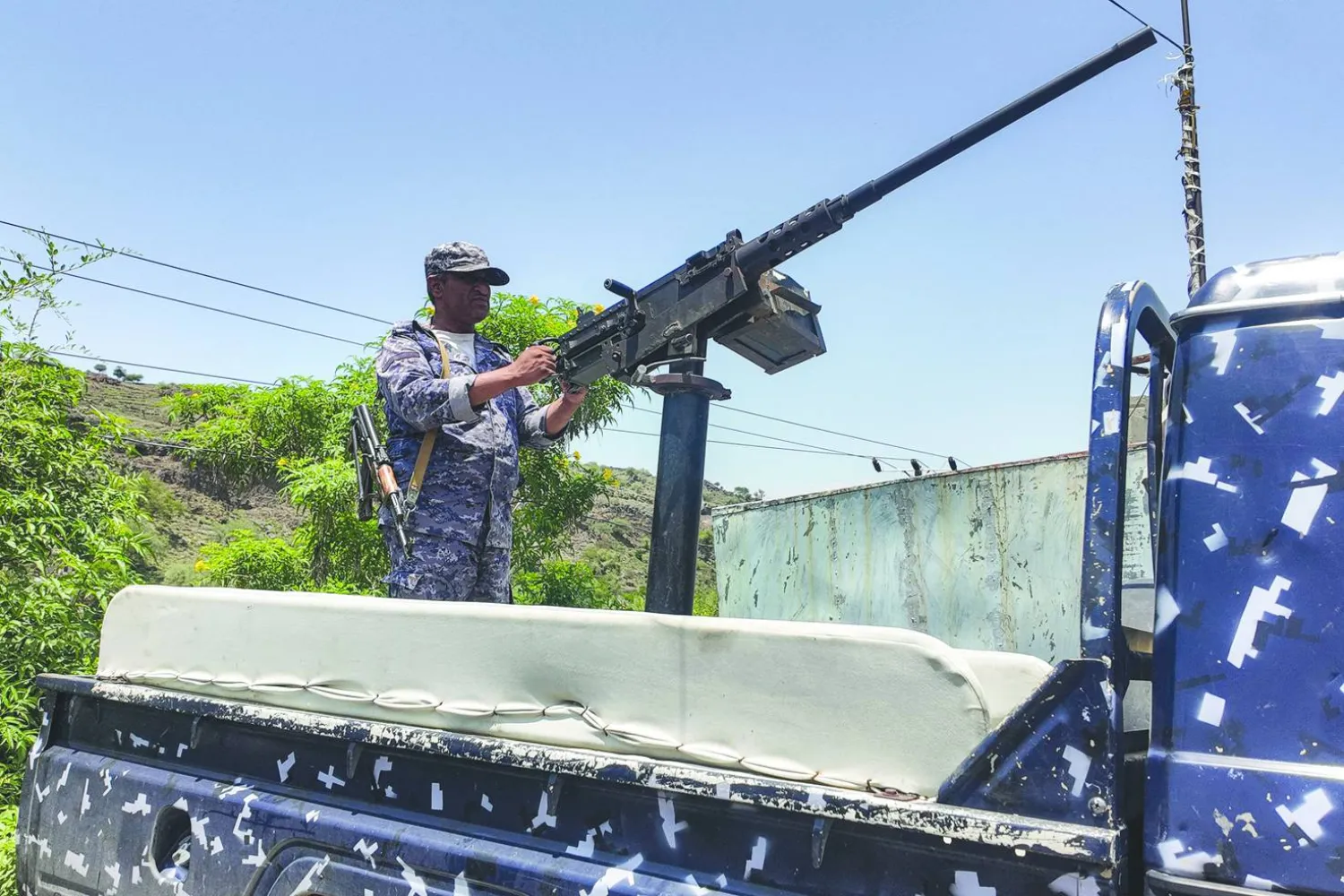
A member of the Saudi-backed Yemeni government forces, including National Army and Taiz Axis forces, mans a turret mounted on the back of a pickup truck at a checkpoint along the Kadha frontline west of Taiz in western Yemen on September 13, 2026. (Photo by AFP)
TT

Yemeni Army Repels Houthi Attempts to Advance West of Taiz

A member of the Saudi-backed Yemeni government forces, including National Army and Taiz Axis forces, mans a turret mounted on the back of a pickup truck at a checkpoint along the Kadha frontline west of Taiz in western Yemen on September 13, 2026. (Photo by AFP)

Yemeni government forces recaptured the strategic Mount Numan in western Taiz province early Sunday as fierce fighting continued with the Iran-aligned Houthis along a chain of highlands southwest of the province.

Government forces are seeking to prevent further Houthi advances toward mountains overlooking Bab al-Mandeb and the only remaining overland route linking Taiz city to Al-Turbah, then Lahj and Aden.

Military and local sources reported that forces from the Taiz Axis Forces secured Mount Numan, west of Jabal Habashi, in the early hours of Sunday after clashes with the Houthis. Retaking the position reconnects the Bani Bakari and al-Kadha fronts and secures the Bani Bakari-Al-Ashruh-Al-Bireen road, they added.

Control of the mountain leaves remaining Houthi positions in Al-Sharajah exposed to fire and gives government forces high ground in an area connected to routes leading toward the western coast.

The advance comes as the Houthis seek to consolidate gains from their latest offensive along the western coast. The group seized Hays, al-Khokha and Mokha about 10 days ago before advancing to Bab al-Mandeb, Mayyun Island and several other Yemeni islands in the southern Red Sea, according to field reports from the area.

Fighting in western and southwestern Taiz is concentrated on highlands controlling routes between the interior and the coast, particularly Rasn, Numan, Jardad, al-Kadha and Al-Wazi’iyah. The Houthis are seeking higher ground to protect recently captured coastal areas, secure supply lines and facilitate the southward movement of their forces.

The front is particularly important for Taiz city. Field sources reported that the group is seeking to move closer to the road that still provides the city with an overland connection to Al-Turbah, Lahj and Aden, potentially allowing it to pressure the route and threaten one of the most important remaining lines of movement and supply for government forces and residents.

In southwestern Taiz, government forces and allied tribesmen repelled heavy Houthi attacks in Al-Damdam, Sharirah and Al-Wazi’iyah, while other attempts to advance toward Mount Rasn failed, according to the sources.

They noted that control lines around Mount Jardad in Bani Omar have remained unchanged since the failure of an initial Houthi assault. The group later sent reinforcements and launched an attack toward Rasn, but government forces and local fighters repelled it after hours of clashes.

Houthis Seek to Secure Gains

The battles are part of broader Houthi efforts to secure their newly established control over the western coast and Bab al-Mandeb by advancing from coastal areas toward the eastern highlands overlooking them.

AFP reported Saturday, citing two Houthi military sources, that experts from Iran’s Revolutionary Guards had visited the Bab al-Mandeb area, Mokha port and airport, and the Jabal al-Nar camp east of the city.

The sources reported that the experts oversaw tunnel excavation in hills overlooking Mokha and Bab al-Mandeb and discussed installing radars near Mokha and on Zuqar Island in the southern Red Sea.

They arrived from Hodeidah and made separate visits Thursday and Friday, while Yemeni government sources told AFP that fighting had intensified around the Kahbub mountains overlooking Bab al-Mandeb.

Mounting Casualties

Military sources told AFP Saturday that at least 48 people were killed in 24 hours of fighting between government forces and the Houthis along the Taiz-Lahj border, including 17 government troops and 31 Houthi fighters, according to accounts from the two sides.

The government-aligned Tur al-Bahah Military Axis also announced that 13 of its soldiers had been killed over the previous two days on fronts between Lahj and Taiz.

The Houthis, meanwhile, held funerals Saturday for about 75 members, including around 25 who held senior military ranks, from 10 Yemeni provinces.

Fighting also continued on other fronts. Giants Brigades forces targeted Houthi gatherings and vehicles on the Al-Bayda front, while government artillery struck Houthi positions and vehicles on the western front of Marib province.

In Marib, air and ground strikes continued against Houthi concentrations at the Umm Rish camp and Aqabat Mala’a. Government forces reported foiling three infiltration attempts and repelling a Houthi attack, while military media reported that 12 members of the group were killed.