


High Ranking Arab-Israeli Official Dies as Crime Wave Toll Nears 160

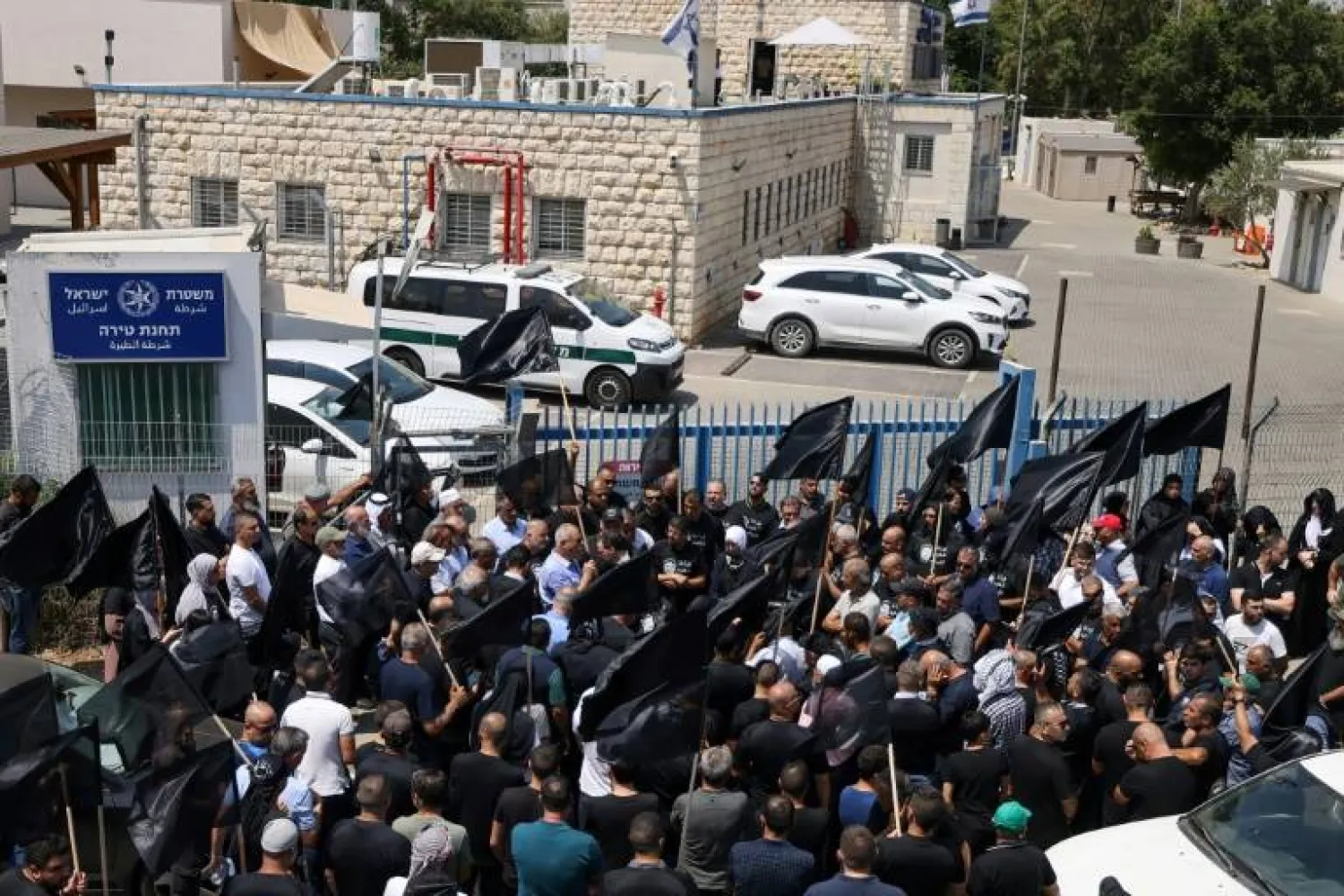
Arab Israelis protest outside a police station during the funeral for the director-general of Tira city, the latest victim of a crime wave in the Arab-Israeli community - AFP
TT

High Ranking Arab-Israeli Official Dies as Crime Wave Toll Nears 160

Arab Israelis protest outside a police station during the funeral for the director-general of Tira city, the latest victim of a crime wave in the Arab-Israeli community - AFP

A high-ranking civil servant buried Wednesday in Israel is the latest victim of a crime wave that has killed almost 160 members of Israel's Arab minority this year.

Abdelrahman Kashua, who held the post of director-general in Tira city, just north of Tel Aviv, was gunned down at a gas station on Monday, police said.

Mourners carrying black flags gathered outside a police station in protest as part of the funeral procession.

Kashua is among 156 Arab-Israelis killed so far this year, according to the Abraham Initiatives which promotes coexistence between Arabs and Jews.

Arab Israelis have long complained of discrimination and police inaction against crime that disproportionately affects their communities.

Experts say Arab gangs have amassed large quantities of illegal weapons over the past two decades and are involved in drug and other crimes.

Prime Minister Benjamin Netanyahu on Tuesday condemned Kashua's killing as a "red line" and vowed to use all means "in order to defeat this crime" wave.

But just hours after his remarks, four more Arab men were murdered in the northern town of Abu Snan, AFP reported.

One of the victims, Ghazi Saab, had written on Facebook about his plans to stand in municipal elections later this year, and said "we can no longer remain silent."

"Crime and acts of violence in our villages have crossed all limits," he wrote in July.

"I appeal to all to not deal in violence. There is no reason to kill."

A leading Arab politician, Mansour Abbas, on Wednesday called for greater support for his community.

"Our demand is only one, that the state of Israel carries out its duty to protect the lives of Arab citizens," he said at Kashua's funeral.

Abbas made history in 2021 when his Raam movement became the first Arab party to join a governing coalition, pressing while in power for funds to tackle crime.

Arab Israelis, descendants of Palestinians who stayed on their land after Israel's creation in 1948, make up about 21 percent of the population and many identify as Palestinian.

Earlier this month Netanyahu blamed "out-of-control criminal organizations" for the violence, which has led to other protests by Arab Israelis this year.

In early June, the prime minister said he was "determined to stop this chain of murders" and would see that happen by not only reinforcing police but also "with the help of the Shin Bet", the internal security agency.



South Lebanon Children Return to School Destroyed by Israel Strike

Displaced children play during an activity organized by the NGO Save the Children at a school turned into a shelter for displaced families in Tyre, southern Lebanon, August 27, 2026. (Reuters)
TT

South Lebanon Children Return to School Destroyed by Israel Strike

Displaced children play during an activity organized by the NGO Save the Children at a school turned into a shelter for displaced families in Tyre, southern Lebanon, August 27, 2026. (Reuters)

In southern Lebanon, eight-year-old Yara Ajami started the academic year this week in a doorless, windowless classroom after her school was destroyed by an Israeli strike.

Well known in the area for its excellence, Ajami's elementary school in Burj Qalaway was struck by Israel in May.

"We are happy to be back (to school), but we were happier before. We used to draw, play, but now there are no desks or chairs," the young girl with braided hair said as she climbed a bare concrete staircase.

Rather than go to their old school building, Ajami and the other students returning to classes after the summer break on Monday were diverted to a nearby structure still under construction that was being built to house preschoolers.

The sun shone through unglazed windows into unfinished classrooms as children followed their lessons, while outside clumps of twisted rebar jutted from the ground like dead bushes where walls used to stand.

The students come from areas heavily hit by Israeli attacks and most were displaced during the war, with some -- like Ajami -- returning to find their homes damaged or destroyed.

- 'Sadness in their eyes' -

"There is sadness in their eyes, each one of them has a story," school principal May Mehdi told AFP from the courtyard.

"But I am happy they are here," she said, showing on her phone what the school, her pride, once looked like.

Mehdi does not have an office in the current building, which does not even have a teacher's lounge.

Around 250 students are registered in the 24-classroom school, which used to have at least 600 school-goers before the start of the latest war in March, when Hezbollah attacked Israel in support of Tehran, following US-Israeli attacks on Iran.

Israel responded with major airstrikes and a ground invasion that killed more than 4,300 people, including 261 children according to Lebanese authorities.

More than a million people were displaced, but more than 800,000 returned since June, when a US-Iran memorandum of understanding and a Lebanon-Israel framework agreement significantly reduced the violence.

In some schools in the south that have been converted into shelters, displaced people and students now share the space, with floors reserved for each group.

The Israeli army has repeatedly accused Hezbollah of using civilian buildings, including schools, to launch attacks or hide weapons.

Rights groups, however, have accused Israel of possible war crimes in its war with Hezbollah.

Lebanese authorities accuse Israel of systematically destroying villages in the south, including homes, schools, places of worship and water and electricity infrastructure.

- 'Destruction, insecurity, displacement' -

Many of Burj Qalaway's children were unable to start the school year, being still displaced or fearing to return to the town, less than a kilometre (mile) away from Israeli troops occupying a swathe of the south.

On Thursday, an Israeli strike hit Qantara, a nearby village.

Earlier this month, UNICEF said that nearly 100,000 students in Lebanon were unable to return to their schools for the academic year due to "damage, destruction, insecurity, or displacement".

The UNICEF report also stated that 436 schools were damaged by the war, while 37 were completely destroyed.

The Burj Qalaway school previously boasted a laboratory, a computer room, and an interactive room.

Government-funded prefabricated units are being installed on the school premises where rubble has not yet been cleared.

- 'Make my father proud' -

Teacher Hoda Najdi gave her class while emphasizing to her students the importance of continuing their education and achieving good results despite the difficult circumstances.

"My home was destroyed and so was my school... (but) the students give us the strength and will to continue," the 42-year-old told AFP.

Student Mohammed Mozannar, who was displaced from one place to another in Beirut during the war, said he was "very happy to be back to make up for" the lost year.

"I had no books, no phone and no internet" to follow lessons online, he said.

"I now want to make my father proud."

But the return to school also brought back painful memories for some, like 14-year-old Rawan Fakih.

"I remembered the activities we used to do, I remembered how stressful exams were... and I remembered my friend who was killed" by an Israeli strike, she said.


Gasoline Shipped to Syria Begins Moving by Road to Iraq, Syrian Official Says

FILE - This file photo released on April 7, 2019, by the Syrian official news agency SANA, shows a worker filling a pickup at a gas station, in Homs, Syria. (SANA via AP, File)
TT

Gasoline Shipped to Syria Begins Moving by Road to Iraq, Syrian Official Says

FILE - This file photo released on April 7, 2019, by the Syrian official news agency SANA, shows a worker filling a pickup at a gas station, in Homs, Syria. (SANA via AP, File)

Gasoline shipped to Syria has begun moving by road to Iraq, a senior Syrian oil official told Reuters, establishing a two-way energy corridor through a route Baghdad has used to export fuel since disruption to shipping through the Strait of Hormuz.

Iraq began using the Syrian route after the Iran war cut off the Strait of Hormuz, its main Gulf trade route. Baghdad has said it plans to develop alternative routes through Syria even if traffic through Hormuz normalizes.

Transport of fuel oil had so far been from Iraq to Syrian ports before establishment of the return leg.

The first cargo to Iraq, about 32,800 metric tons of gasoline aboard the Marshall Islands-flagged tanker Avanti, was unloaded into storage tanks at Syria's Baniyas refinery before being loaded onto trucks this week, said Tareq Shallash, director of the Refining Directorate at state-owned Syrian Petroleum Company (SPC).

Shallash said 77 tanker trucks have already left Baniyas for the Iraqi border and loading was continuing, adding that further shipments were expected.

The gasoline was neither produced in Syria nor drawn from stocks intended for the Syrian market, he said.

The operation is being carried out under a transit contract between SPC and Qatar's UCC Holding, which Shallash said was the supplier and was overseeing transportation.

"A contract was signed between SOMO and the Qatari company to supply Iraq with improved gasoline through the port of Banias by road tankers, and the supplies have in fact been delivered on a regular basis," Iraqi oil ministry spokesperson Saleem al-Rikabi told Reuters on Friday when asked for comment.

Another Marshall Islands-flagged tanker, Gaita, loaded gasoline at the Port of Houston before sailing to Baniyas for discharge, LSEG shipping data showed.


Yemen's Message to the World: Implement Your Decisions and Stop Arming the Houthis

Yemen’s Vice President Abdullah Abdulkader Al Alimi-Bawazir walks to the podium to address the 81st United Nations General Assembly at UN headquarters in New York City, US, September 24, 2026. REUTERS/Eduardo Munoz
TT

Yemen's Message to the World: Implement Your Decisions and Stop Arming the Houthis

Yemen’s Vice President Abdullah Abdulkader Al Alimi-Bawazir walks to the podium to address the 81st United Nations General Assembly at UN headquarters in New York City, US, September 24, 2026. REUTERS/Eduardo Munoz

Yemeni Presidential Leadership Council member Abdullah Al-Alimi called on the international community to move from a policy of "crisis management" to a strategic partnership with Yemen, stressing that Yemenis are not asking the world to fight their battle on their behalf, but to implement its own decisions, stop the flow of weapons and technology to the Houthis, and support the capabilities of the Yemeni state and its economy.

Speaking on behalf of Yemen at the 81st session of the United Nations General Assembly in New York, Al-Alimi said the Yemeni government is capable of ending the Houthi threat and protecting the country's ports and territorial waters. He called on the international community to fulfill its responsibilities toward Yemen, the region, and international peace and security.

Al-Alimi placed the call for an international partnership at the center of his message, stressing that international resolutions alone cannot create peace unless there is the will to implement them. He said peace "is not a wish to be hoped for," but requires firm resolve and action to deter those who threaten the security and stability of states.

He criticized what he described as the absence of an effective and decisive international position toward the Houthis, saying this had contributed to the group's expanding influence and threat. He also linked the continuation of the crisis to Iranian support, which he said the Houthis receive in the form of weapons, expertise, and military technology.

He said Yemenis have endured 12 years of war, displacement, poverty, child recruitment, landmines, and the seizure of rights, freedoms, and public resources. He said the government had dealt responsibly with international and regional initiatives and made concessions for the sake of peace, while the Houthis, according to his account, responded to those efforts with intransigence and used periods of truce to strengthen their military arsenal.

Global Threat

The Yemeni Presidential Leadership Council member devoted a significant part of his speech to the security of the Red Sea and Bab el-Mandeb, stressing that the Houthis' use of maritime security as a means of exerting pressure is not a threat to Yemen alone, but affects the global economy.

Al-Alimi said securing the sea begins with addressing the source of the threat on land, warning that protecting ships does not eliminate the threat as long as an armed group outside the authority of the state remains on the shores of the maritime routes.

He directly linked restoring state authority with the security of Bab el-Mandeb, saying the two issues are "one issue, not two," and that supporting the Yemeni government and strengthening its economic, security, and military capabilities represents an investment in the future of global security and safety.

He also hailed Saudi Arabia's initiative to establish a multinational maritime defense coalition, saying it reflects, according to his speech, a shared responsibility to protect maritime navigation, deter threats, and combat smuggling.

Restoring the State

The Yemeni Presidential Leadership Council member said his government remains committed to peace, but will not accept an armed coup becoming a fait accompli, stressing that "peace requires actions from the Houthis, not words."

He said the Yemen issue is not only about how to end the war, but also about what kind of Yemen will be built afterward. He spoke of a secure, stable, and prosperous state that rebuilds its economy, provides education, employment, and security, and becomes a partner to its neighbors and a bridge for trade and cooperation between the Arabian Peninsula, the Horn of Africa, and the wider world.

Addressing Yemenis in areas under Houthi control, he stressed that the government's fight is not against citizens, regions, or sects, but against an "armed coup that has seized the state and its institutions." He said restoring the state is not a victory for one Yemeni side over another, but the restoration of the right of all Yemenis to their state and institutions.