


Meta Faces Backlash over Canada News Block as Wildfires Rage

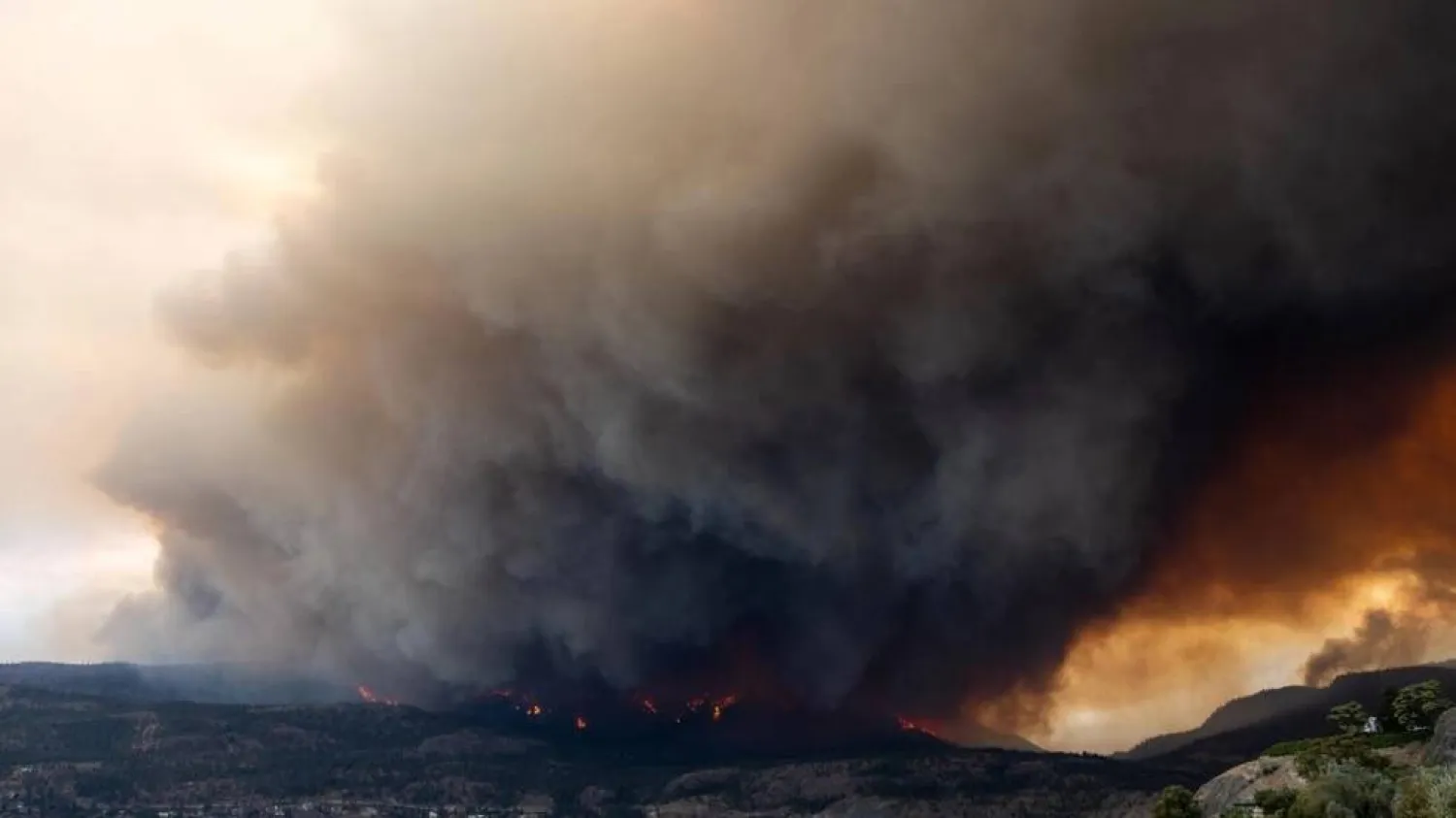
Meta is facing a backlash in Canada over its decision to block news sharing on its Facebook platform despite an ongoing wildfire crisis. Darren HULL / AFP/File
TT

Meta Faces Backlash over Canada News Block as Wildfires Rage

Meta is facing a backlash in Canada over its decision to block news sharing on its Facebook platform despite an ongoing wildfire crisis. Darren HULL / AFP/File

Meta is being accused of endangering lives by blocking news links in Canada at a crucial moment, when thousands have fled their homes and are desperate for wildfire updates that once would have been shared widely on Facebook.

The situation "is dangerous," said Kelsey Worth, 35, one of nearly 20,000 residents of Yellowknife and thousands more in small towns ordered to evacuate the Northwest Territories as wildfires advanced.

She described to AFP how "insanely difficult" it has been for herself and other evacuees to find verifiable information about the fires blazing across the near-Arctic territory and other parts of Canada.

"Nobody's able to know what's true or not," she said.

"And when you're in an emergency situation, time is of the essence," she said, explaining that many Canadians until now have relied on social media for news.

Meta on August 1 started blocking the distribution of news links and articles on its Facebook and Instagram platforms in response to a recent law requiring digital giants to pay publishers for news content.

The company has been in a virtual showdown with Ottawa over the bill passed in June, but which only takes effect next year.

Building on similar legislation introduced in Australia, the bill aims to support a struggling Canadian news sector that has seen a flight of advertising dollars and hundreds of publications closed in the last decade.

It requires companies like Meta and Google to make fair commercial deals with Canadian outlets for the news and information -- estimated in a report to parliament to be worth Can$330 million (US$250 million) per year -- that is shared on their platforms, or face binding arbitration.

But Meta has said the bill is flawed and insisted that news outlets share content on its Facebook and Instagram platforms to attract readers, benefiting them and not the Silicon Valley firm.

Profits over safety
Canadian Prime Minister Justin Trudeau this week assailed Meta, telling reporters it was "inconceivable that a company like Facebook is choosing to put corporate profits ahead of (safety)... and keeping Canadians informed about things like wildfires."

Almost 80 percent of all online advertising revenues in Canada go to Meta and Google, which has expressed its own reservations about the new law.
Ollie Williams, director of Cabin Radio in the far north, called Meta's move to block news sharing "stupid and dangerous."

He suggested in an interview with AFP that "Meta could lift the ban temporarily in the interests of preservation of life and suffer no financial penalty because the legislation has not taken effect yet."

Nicolas Servel, over at Radio Taiga, a French-language station in Yellowknife, noted that some had found ways of circumventing Meta's block.

They "found other ways to share" information, he said, such as taking screen shots of news articles and sharing them from personal -- rather than corporate -- social media accounts.

'Life and death'
Several large newspapers in Canada such as The Globe and Mail and the Toronto Star have launched campaigns to try to attract readers directly to their sites.

But for many smaller news outlets, workarounds have proven challenging as social media platforms have become entrenched.

Public broadcaster CBC in a letter this week pressed Meta to reverse course.

"Time is of the essence," wrote CBC president Catherine Tait. "I urge you to consider taking the much-needed humanitarian action and immediately lift your ban on vital Canadian news and information to communities dealing with this wildfire emergency."

As more than 1,000 wildfires burn across Canada, she said, "The need for reliable, trusted, and up-to-date information can literally be the difference between life and death."

Meta -- which did not respond to AFP requests for comment -- rejected CBC's suggestion. Instead it urged Canadians to use the "Safety Check" function on Facebook to let others know if they are safe or not.

Patrick White, a professor at the University of Quebec in Montreal, said Meta has shown itself to be a "bad corporate citizen."

"It's a matter of public safety," he said, adding that he remains optimistic Ottawa will eventually reach a deal with Meta and other digital giants that addresses their concerns.




NextEra Expands Google Cloud Partnership, Secures Clean Energy Contracts with Meta

Electric power transmission pylon miniatures and Nextera Energy logo are seen in this illustration taken, December 9, 2022. REUTERS/Dado Ruvic/Illustration
TT

NextEra Expands Google Cloud Partnership, Secures Clean Energy Contracts with Meta

Electric power transmission pylon miniatures and Nextera Energy logo are seen in this illustration taken, December 9, 2022. REUTERS/Dado Ruvic/Illustration

NextEra Energy expanded its partnership with Alphabet's Google Cloud to scale up data center capacity, while securing over 2.5 gigawatts of clean energy contracts from Meta across the US, the company said on Monday.

Shares of NextEra were up 2.7% in premarket trading.

Under the expanded deal with Google Cloud, the companies will develop multiple new gigawatt-scale (GW) data centre campuses, each with accompanying generation and capacity, Reuters reported.

NextEra and Google Cloud plan to launch an AI-powered product by mid-2026 to predict equipment issues, optimize crew scheduling and boost grid reliability amid storms, aging assets, and rising demand.

The deal comes as US electricity demand grows due to rapid AI adoption, prompting cloud companies and utilities to secure land, grid connections and new generation to support large data center loads.

In October, the company had partnered with Google to restart an Iowa nuclear power plant shut down five years ago.

The technology industry's quest for massive amounts of electricity for AI processing has renewed interest in the country's nuclear reactors.

NextEra said it had signed 11 power purchase agreements and two energy storage agreements with Meta, totaling over 2.5 GW of clean energy contracts. The projects are scheduled to come online between 2026 and 2028.

The utility also reached an agreement with WPPI Energy to continue supplying 168 megawatts of the output from the Point Beach Nuclear Plant in Two Rivers into the 2050s.

Separately, NextEra forecast higher adjusted profit in 2026 as well as the current-year as it continues to benefit from the surge in power demand.

NextEra now expects adjusted earnings for 2025 of between $3.62 and $3.70 per share, compared with its prior view of between $3.45 and $3.70 per share.

For 2026, it expects adjusted profit between $3.92 and $4.02 per share, compared with its prior view of between $3.63 and $4.00 per share.


Albudaiwi: GCC States Pledge Active Role in Global Digital Security, Stability 

Secretary-General of the GCC Jasem Albudaiwi speaks at the Doha Forum on Sunday. (GCC)
TT

Albudaiwi: GCC States Pledge Active Role in Global Digital Security, Stability 

Secretary-General of the GCC Jasem Albudaiwi speaks at the Doha Forum on Sunday. (GCC)

The Gulf Cooperation Council (GCC) will remain a proactive and effective partner in supporting international efforts to achieve global and comprehensive digital security, contributing to the enhancement of security and stability in cyberspace, according to Secretary-General of the GCC Jasem Albudaiwi.

He made these remarks during his participation in the roundtable event organized by the Digital Cooperation Organization (DCO) at the 23rd Doha Forum on Sunday.

He highlighted the world's increasing reliance on digital infrastructures that underpin modern economies, essential services, and communications.

He cautioned that any disruption to these systems could lead to instability and the disruption of vital services. This reality mandates that the international community strengthen solidarity and build common frameworks to maintain international digital legitimacy during cyber crises.

He reaffirmed the GCC's commitment, noting that the member states have taken significant strides through the Unified Gulf Strategy for Cybersecurity. This includes massive investments in cloud infrastructure, the development of human capital, the organization of joint cyber exercises that simulate real-world risks, and the development of digital platforms for early warning and coordination during cyber incidents.

He underlined the importance of mutual support between nations when essential digital systems collapse, achieved through technical and operational cooperation frameworks, joint incident response mechanisms, and the temporary utilization of digital infrastructure from neighboring countries when necessary, while strictly respecting national sovereignty and systemic privacy.

Albudaiwi emphasized that several digital sectors must receive stringent international protection to prevent escalation and protect civilian lives, specifically mentioning energy and fuel control systems, telecommunications networks, submarine cables, healthcare and emergency systems, financial networks and digital payment systems, government services, and logistics and transportation networks.


Meta Reportedly Delays Release of Phoenix Mixed-reality Glasses to 2027

FILE PHOTO: The logo of Meta is seen at Porte de Versailles exhibition center in Paris, France, June 11, 2025. REUTERS/Gonzalo Fuentes/File Photo
TT

Meta Reportedly Delays Release of Phoenix Mixed-reality Glasses to 2027

FILE PHOTO: The logo of Meta is seen at Porte de Versailles exhibition center in Paris, France, June 11, 2025. REUTERS/Gonzalo Fuentes/File Photo

Meta is delaying the release of its Phoenix mixed-reality glasses until 2027, aiming to get the details right, Business Insider reported on Friday, citing an internal memo.

The delay from an initially planned release in the second half of 2026 is because the company wants a fully polished device, the report said.

Meta did not immediately respond to a Reuters request for comment on the report.

Meta executives Gabriel Aul and Ryan Cairns said moving the release date back is "going to give us a lot more breathing room to get the details right," the report added.

The goggles, previously code-named Puffin, weigh around 100 grams (3.5 ounces) and have lower-resolution displays and weaker computing performance than high-end headsets like Apple’s Vision Pro, the Information reported in July.

Mixed reality merges augmented and virtual reality and allows real-world and digital objects to interact.

Meta is expected to make budget cuts of up to 30% for its metaverse initiative, Bloomberg News reported on Thursday.

The metaverse group sits within Reality Labs, which produces the company's Quest mixed-reality headsets, smart glasses made with EssilorLuxottica's Ray-Ban and upcoming augmented-reality glasses.