
European Diplomat Held in Iran for More than 500 Days

Johan Floderus.
Johan Floderus.
TT

European Diplomat Held in Iran for More than 500 Days

Johan Floderus.
Johan Floderus.

Sweden and the European Union Commission on Monday said a Swedish national is being detained in Iran - the latest known case of a foreign national being held in Iran amid political tensions with the West.

The New York Times earlier on Monday reported that a Swedish citizen, who according to the paper has been working for the European Union's diplomatic corps, had been imprisoned in Iran for more than 500 days.

“A Swedish citizen – a man in his thirties – was detained in Iran in April 2022,” the foreign ministry in Stockholm said, adding: “The Ministry for Foreign Affairs and the Embassy of Sweden in Tehran are working very intensively on the case and are maintaining close contact with the EU.”

A spokesperson for the European Commission on Monday also confirmed a Swedish national being held in Iran, but declined to give further details.

The New York Times said the case of the Swedish man, Johan Floderus, kept under wraps for more than a year, has become part of Iran’s “hostage diplomacy” as Tehran seeks concessions from the West.

Iran's Revolutionary Guards Corps (IRGC) has been scooping up tens of dual Iranian nationals and foreigners on spurious charges. Activists accuse Iran of seeking to trade them for Iranians held in Europe or the United States, or to use them as leverage to extract money and other concessions.

Last month, the United States concluded a deal with Iran to free five Americans held there in exchange for $6 billion in withheld Iranian oil revenues as well as the release of Iranian prisoners in America.

On August 10, Iran moved four American prisoners from Tehran's Evin prison to an undisclosed house and placed them on house arrest.

They joined a fifth American who had already been moved in recent weeks to house arrest, possibly a step toward their eventual freedom in a prisoner swap.

Last May, Iran released a Belgian aid worker, Olivier Vandecasteele, who was imprisoned in Tehran on espionage charges for 455 days.

Still, the case of Floderus stands out because of the prisoner’s background as a European official. The New York Times said the Swedish diplomat, 33, has held several positions in the European Union’s institutions, coming up through its civil service training program. He was even featured in an advertising campaign to attract young Swedes to European Union careers.

The newspaper also said Floderus visited Iran last spring on what people familiar with the case described as a private tourist trip with several Swedish friends. As he prepared to leave Tehran on April 17, 2022, he was detained at the airport.

In July last year, the Iranian government released a statement announcing that it had apprehended a Swedish national for espionage.

Floderus is now being held in the notorious Evin prison in the Iranian capital.

The New York Times spoke to six people with firsthand knowledge of the case. All requested anonymity, fearing a backlash for speaking about it. They denied that Floderus had been involved in espionage.

Neither Sweden nor the EU identified the man.

“In our assessment it would complicate the handling of the case if the ministry were to publicly discuss its actions. In light of this, we see no reason to confirm any names,” the Swedish foreign ministry said, according to Reuters.

The New York Times said Floderus most recently served as an aide to the European commissioner for migration, Ylva Johansson, starting in 2019. In 2021, he joined the European External Action Service, the bloc’s diplomatic corps.

He had visited Iran previously, without incident, on official European Union business, when he worked for the bloc’s development program, people familiar with his background said.

Floderus was a member of the Afghanistan delegation for the diplomatic corps, but never made it to Kabul because of the Taliban takeover in August 2021. He did his job from headquarters in Brussels, where he had lived for several years, people familiar with his background said.

The European External Action Service said that it was “following very closely the case of a Swedish national detained in Iran” but did not acknowledge that the person in question worked for the service or that Floderus had previously visited Iran on official EU business.

“This case has also to be seen in the context of the growing number of arbitrary detentions involving EU citizens,” said Nabila Massrali, a spokeswoman for the bloc’s diplomatic body. “We have used and will continue to use every opportunity to raise the issue with the Iranian authorities to obtain the release of all arbitrarily detained EU citizens.”


US Treasury Sanctions Canadian Money Services Firms Over Iran-Related Transactions

FILE PHOTO: The US Department of the Treasury Building in Washington, D.C., U.S., July 11, 2026. REUTERS/Daniel Heuer/File Photo/File Photo
TT

US Treasury Sanctions Canadian Money Services Firms Over Iran-Related Transactions

FILE PHOTO: The US Department of the Treasury Building in Washington, D.C., U.S., July 11, 2026. REUTERS/Daniel Heuer/File Photo/File Photo

The United States on Friday announced a new round of sanctions targeting networks and entities connected to Iran, according to a notification published on the US Department of the Treasury’s website.

“Today, as part of Operation Economic Outcast, the Department of the Treasury’s Office of Foreign Assets Control (OFAC) designated eight money services businesses based in Canada that enable the Iranian regime, sanctioned entities associated with the regime, and other illicit actors that move assets into and out of Iran,” it wrote.

The sanctions effectively cut the firms off from the dollar-based financial system, blocking any assets that the firms may have in the United States and prohibiting any transactions with US persons or entities.

The actions are the latest ⁠in a series of Treasury moves against firms outside the United States that it says help Iran get around US sanctions, as Washington keeps up pressure on Tehran.

“Canada cannot be a safe haven for illicit financial facilitators that provide sanctions evasion services to the Iranian regime and its proxies,” said Secretary of the Treasury Scott Bessent. “Treasury will pursue and disrupt the Iranian regime’s financial channels anywhere in the world.”

The Treasury identified the designated businesses in Ontario and British Columbia as Diverse Trade ⁠Inc doing business as Million Exchange, 1380079 BC Limited, Top PC Technician Inc, NIA Nations Currency Ltd, 2397639 Ontario Ltd doing business as Farah Exchange, CCC Inc and B Galaxy Inc and Darvish Exchange.

Separately, the Treasury said its Financial Crimes Enforcement Network division ⁠issued an order that also cuts off virtual currency exchanger MEXC Global from the US financial system over transactions that it says are linked to sanctions evasion by Iran, North ⁠Korea and Russia.

FinCEN, the Treasury's anti-money laundering unit, said that the order prevents US financial institutions from processing fund transfers involving Seychelles-incorporated MEXC Global, which it ⁠says has facilitated at least $16 billion in illicit transactions linked to Iran, North Korea and Russia as well as transactions with other sanctioned actors.


Washington Offers $20 Million Reward for Information on Iran's Nuclear Program

The Iranian president visiting a centrifuge facility as part of Iran's nuclear program (Archive - Iranian Presidency)
TT

Washington Offers $20 Million Reward for Information on Iran's Nuclear Program

The Iranian president visiting a centrifuge facility as part of Iran's nuclear program (Archive - Iranian Presidency)

Washington is offering a $20 million reward “and possible relocation” for information about Iran’s nuclear program, the US military said Friday, as President Donald Trump reiterated Tehran wants to make a deal to end the war.

The US Department of State’s Rewards for Justice program said in an announcement posted to X that the “government remains committed to countering any attempt by Iran to develop a nuclear weapons program.”

The State Department agency said it was seeking information on “nuclear scientists and staff, nuclear program-related technologies, and capabilities, associated organizations and personnel.”

“If you have information on Iran’s nuclear program, assets, or associated individuals, send it to us via Signal or our Tor-based tip line. You may be eligible for a reward and relocation,” it added.

Anticipating Trump’s Decision

The announcement came a day after Trump said he would decide “soon” on whether to resume the war on Iran following a meeting with his top national security advisers.

“I would rather not destroy the rest of the country if possible, but maybe I will have to. You'll know soon enough,” Trump told reporters in the Oval Office.

US-Iran negotiations remain deadlocked over Iran's stockpile of near-weapons-grade uranium. Trump has said Iran must give up the stockpile, which he has referred to as “nuclear dust.” But Iranian officials have been adamant that they will not ship the uranium outside the country.

Earlier on Friday, two Middle East government officials told AP that Iran was reviewing proposals presented by Qatar to address differences with Washington over Tehran's nuclear program.

The Qatari draft involves lifting the US blockade on Iran's ports and releasing some of Tehran's frozen funds in exchange for allowing International Atomic Energy Agency inspectors to visit sites bombed by the US and Israel, according to regional officials cited by AP.

Mohsen Rezaei, secretary of Iran's Supreme National Security Council, said on Thursday that the Strait of Hormuz would not reopen to Washington and no negotiations would take place until Tehran’s “seven conditions” were met.

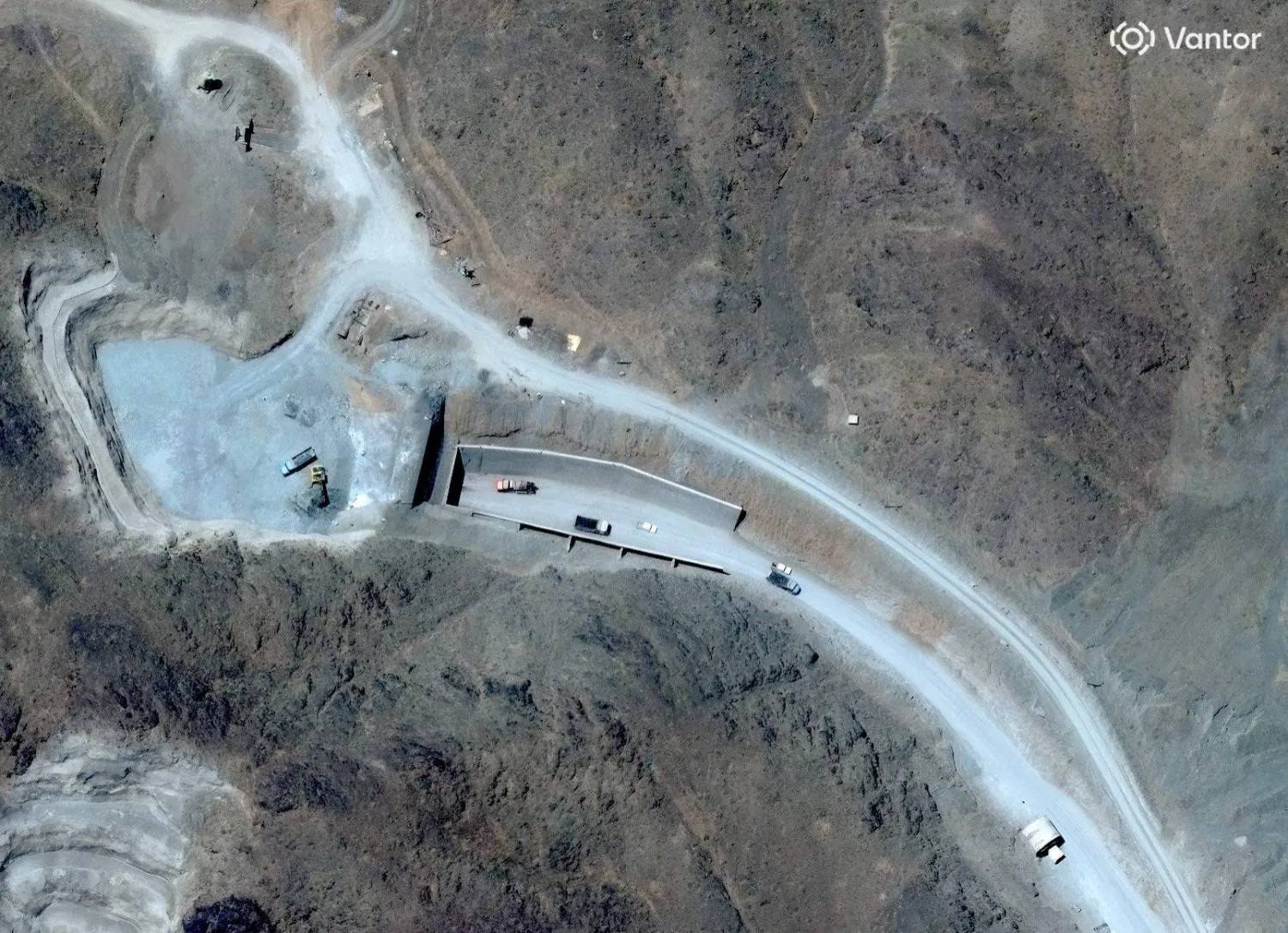
SATELLITE VIEW shows vehicles at an entrance to Pickaxe Mountain tunnels, near Natanz nuclear facility, in Iran, June 21. (VANTOR/HANDOUT VIA REUTERS)

Reviewing Nuclear Doctrine

In Iran, calls are growing for a reassessment of the country’s nuclear doctrine and a withdrawal from the Treaty on the Non-Proliferation of Nuclear Weapons (NPT).

Despite those demands, Rezaei said earlier this month that Iran has made no official decision to change its nuclear doctrine.

“So far, no official decision has been made by the government or the Supreme National Security Council to change the nuclear doctrine,” Rezaei said, according to remarks carried by the semi-official Tasnim News Agency.

Last week, Mohammad-Javad Haj-Ali-Akbari, Tehran’s interim Friday prayer leader, called for a revision of Iran’s nuclear doctrine and a move toward acquiring nuclear weapons. He claimed that the issue has now become a “national demand.”

Few days later, Nasrollah Pejmanfar, head of the Iranian parliament’s Article 90 Commission, called for Iran to seriously consider withdrawing from the Nuclear Non-Proliferation Treaty, intensifying the debate over Tehran’s nuclear policy amid escalating tensions with Western powers.

On Thursday, Iranian lawmaker Mohammad Taghi Naghdali said that public demands had shifted from nuclear energy to nuclear warheads, calling on parliament to prioritize Iran's withdrawal from the Nuclear Non-Proliferation Treaty.

The New York Times wrote on Thursday that senior Iranian officials and clerics are also debating whether Iran should withdraw from the NPT, which prohibits the development of a nuclear weapon.

Iran’s Leader Mojtaba Khamenei has not taken a clear public position on the issue. His father, former Leader Ali Khamenei had stated that nuclear weapons are forbidden.

Late last month, International Atomic Energy Agency chief Rafael Grossi said there were no signs of suspicious activity at Iranian nuclear sites bombed by the United States in June.

“We do not see anything that would give rise to hypotheses of any substantive work going on there,” Grossi said in New York.

Grossi told reporters that inspectors had no access to the two sites stricken in June, but confirmed that some inspection was under way.

“We are trying to build it back, and we are inspecting in Iran,” he said.

On Friday, a BBC report said Iran appears to be undertaking significant new construction near at least two of its major missile sites and repairing bases damaged by months of US and Israeli air strikes, according to analysis of satellite images.

It said evidence of digging and new buildings are visible in satellite imagery taken in November at the Garmdareh military base in Karaj near the capital Tehran and the Shahroud base in the north, analysts at British intelligence company MAIAR, who reviewed the photos, told BBC Verify.


Army Spokesman: Iranian Forces 'Stronger' Than at Beginning of War

Iranian Army spokesman Mohammad Akraminia (Daneshjoo file photo)
TT

Army Spokesman: Iranian Forces 'Stronger' Than at Beginning of War

Iranian Army spokesman Mohammad Akraminia (Daneshjoo file photo)

Iran's military is "stronger" and more motivated than it was when the United States and Israel started the war in February, Iranian state media reported on Saturday, citing an army spokesman.

"Today, the Islamic Republic's armed forces... having gained experience from direct confrontation with the United States and the Israeli regime, are on higher alert and are stronger than they were at the beginning of the war," Mohammad Akraminia said, according to the state news agency IRNA.

"They now possess greater motivation, commitment, and self-confidence."

The war, which began when the United States and Israel carried out a massive wave of strikes in late February, has been deadlocked for months.

Tehran has sought to limit traffic through the Strait of Hormuz, which normally carries about one-fifth of global oil consumption.

According to AFP, Akraminia said that Iranian armed forces retained control over the strategic waterway and that it would remain closed until the United States accepted Tehran's demands.

"Under the order of the Supreme Leader, the response of the armed forces will be immediate, effective, and without geographical limitations," he added.

US President Donald Trump this week confirmed new strikes on Iran, after American media reported attacks on Iran's Qeshm Island in the Strait of Hormuz.

On Saturday, the local Tasnim news agency reported that two missiles had struck Qeshm, adding that there was no official information so far on the damage.

Iranian state television reported two explosions on the island.

The Iranian army said early Saturday that its air defenses had "struck and destroyed" a US drone that was flying over the island, according to state media. It did not say whether the island was attacked.