


Russia Says Ruling Party Wins Most Votes in Ukrainian Regions It Controls

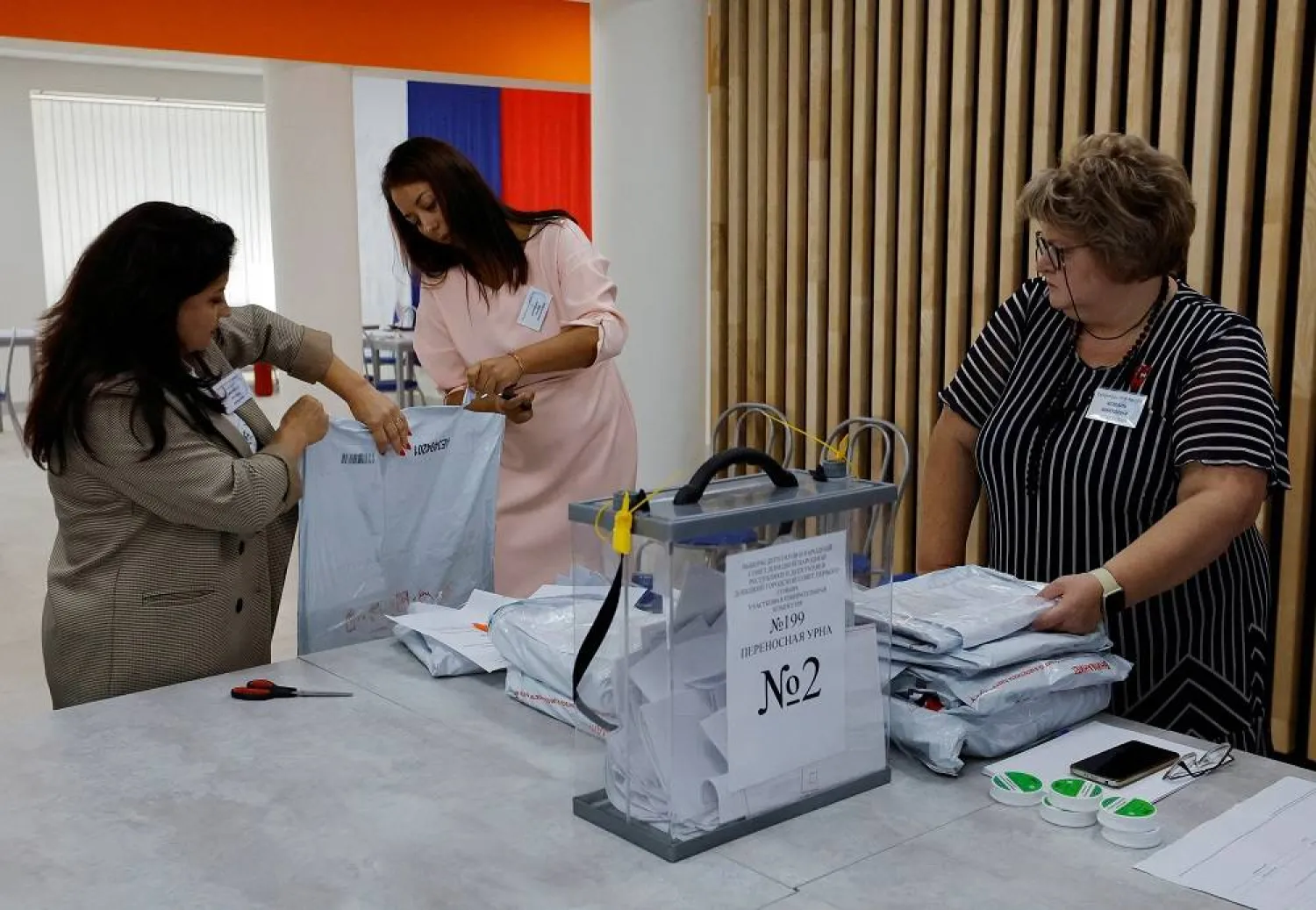
Members of an electoral commission prepare ballots for counting at a polling station during local elections held by the Russian-installed authorities in the course of Russia-Ukraine conflict in Donetsk, Russian-controlled Ukraine, September 10, 2023. (Reuters)
TT

Russia Says Ruling Party Wins Most Votes in Ukrainian Regions It Controls

Members of an electoral commission prepare ballots for counting at a polling station during local elections held by the Russian-installed authorities in the course of Russia-Ukraine conflict in Donetsk, Russian-controlled Ukraine, September 10, 2023. (Reuters)

Russia’s Central Election Commission said Monday that the country’s ruling party won the most votes in elections held in occupied Ukrainian regions, as Kyiv and the West denounced the ballots as a sham.

The votes were held as Russian authorities attempt to tighten their grip on territories Moscow illegally annexed a year ago and still does not fully control.

Voting for Russia-installed legislatures began last week. According to the Central Election Commission, lawmakers from the ruling party, United Russia, came out on top in the four Ukrainian regions Moscow annexed in 2022 — Donetsk, Kherson, Luhansk and Zaporizhzhia — and on the Crimean Peninsula, which the Kremlin annexed in 2014.

Western countries have denounced the elections as a violation of international law. “We strongly reject this further futile attempt by Russia to legitimize or normalize its illegal military control and attempted annexation of parts of Ukrainian territories,” the European Commission said Monday in a statement, promising “consequences” for Russia's leadership.

On Friday, Ukraine's Foreign Ministry urged other countries not to recognize the results of what it called “fake elections.”

The votes in the Ukrainian regions were timed to coincide with nationwide elections for local legislatures and governors across 16 Russian regions. There were also multiple votes for city and municipal councils across the country and races for a few vacant seats in the State Duma, Russia’s lower house of parliament.

In Moscow, United Russia received the most votes, returning Sergei Sobyanin as mayor. He won against candidates from other Kremlin-backed parties with more than 76% of the vote, according to the election commission.

Russia’s Central Election Commission head Ella Pamfilova said the turnout, averaging 43.5%, was the highest since 2017. The figure includes Russia and the occupied Ukrainian regions.

In one of the annexed Ukrainian regions, Russian state media reported turnout was even higher. Marina Zakharova, the Russia-installed chair of the Kherson election commission, said Sunday that 65.36% of Kherson residents cast ballots in the election.

The Kherson region is not under complete Russian control, and local residents and Ukrainian activists have alleged that Russian poll workers make house calls accompanied by armed soldiers in both provinces, detaining those who refuse to vote and pressuring them into writing “explanatory statements” that could be used as grounds for a criminal case.

Ukraine's armed forces suggested in a statement Sunday that Moscow could use the votes to identify men who could potentially be recruited into the Russian army.

On Sunday, Russian electoral officials reported attempts to sabotage voting in the occupied regions, where guerrilla forces loyal to Kyiv had previously killed pro-Moscow officials, blown up bridges and helped the Ukrainian military by identifying key targets.

A drone strike destroyed one polling station in the Zaporizhzhia region hours before it opened Sunday, Russia’s Central Election Commission deputy chair Nikolai Bulaev told reporters. He said no staff were at the station at the time of the attack.

A Russian-appointed official in the neighboring Kherson region said a live grenade was discovered Saturday near a polling station there. According to Zakharova, the Russia-installed election official, the grenade was hidden in bushes outside the station, and voting had to be halted while emergency services disposed of it.

Denis Pushilin, the acting head of the Russian-occupied part of the Donetsk region, also said in a statement Sunday that polling station staff there had been “wounded and injured,” without giving details.

Moscow has partially occupied Kherson and Zaporizhzhia since early in the war in Ukraine, while parts of Donetsk and Luhansk regions were overrun by Russian-backed separatists in 2014. Ukrainian forces have since retaken Kherson’s namesake local capital and are pressing a counteroffensive in Zaporizhzhia that has been making slow progress.

There are hardly any exciting races, political analyst Abbas Gallyamov noted before polls closed, mainly because “the most important issue in Russian politics — the issue of war and peace — is not on the agenda at all.”

“The voter sees that it’s not interesting,” Gallyamov, who once worked as a speechwriter for Russian President Vladimir Putin, told The Associated Press in an interview.

He said no one wants to campaign in favor of the war because it is not popular and it would affect their poll ratings. At the same time, it's impossible to campaign against the war because “you will be barred from running, thrown in jail and named the enemy of the country. So all candidates avoid this issue."

“The voters feel that the elections are not about what is actually real and important. ... These are empty elections,” Gallyamov said.



Top Trump Iran Negotiator Says Visits US Aircraft Carrier in Middle East

US Special Envoy Steve Witkoff delivers a press conference upon the signing of the declaration on deploying post-ceasefire force in Ukraine, during the so-called "Coalition of the Willing" summit, at the Elysee Palace in Paris, France, January 6, 2026. (Reuters)
TT

Top Trump Iran Negotiator Says Visits US Aircraft Carrier in Middle East

US Special Envoy Steve Witkoff delivers a press conference upon the signing of the declaration on deploying post-ceasefire force in Ukraine, during the so-called "Coalition of the Willing" summit, at the Elysee Palace in Paris, France, January 6, 2026. (Reuters)

US President Donald Trump's lead Iran negotiator Steve Witkoff on Saturday said he visited the USS Abraham Lincoln aircraft carrier currently in the Arabian Sea, with Washington and Tehran due to hold further talks soon.

"Today, Adm. Brad Cooper, Commander of US Naval Forces Central Command, Jared Kushner, and I met with the brave sailors and Marines aboard the USS Abraham Lincoln, her strike group, and Carrier Air Wing 9 who are keeping us safe and upholding President Trump's message of peace through strength," said Witkoff in a social media post.

Iranian Foreign Minister Abbas Araghchi said on Saturday he hoped talks with the United States would resume soon, while reiterating Tehran's red lines and warning against any American attack.


Israel’s Netanyahu Expected to Meet Trump in US on Wednesday and Discuss Iran

Israeli Prime Minister Benjamin Netanyahu delivers a speech during a special session to mark the 77th anniversary of the Knesset's establishment and the 60th anniversary of the dedication of the current building at the Knesset, the Israeli parliament, in Jerusalem, 02 February 2026. (EPA)
TT

Israel’s Netanyahu Expected to Meet Trump in US on Wednesday and Discuss Iran

Israeli Prime Minister Benjamin Netanyahu delivers a speech during a special session to mark the 77th anniversary of the Knesset's establishment and the 60th anniversary of the dedication of the current building at the Knesset, the Israeli parliament, in Jerusalem, 02 February 2026. (EPA)

Israeli Prime Minister Benjamin Netanyahu is expected to meet US President Donald Trump on Wednesday in Washington, where they will discuss negotiations with Iran, Netanyahu's office said on Saturday.

Iranian and US officials held indirect nuclear ‌talks in the ‌Omani capital ‌Muscat ⁠on Friday. ‌Both sides said more talks were expected to be held again soon.

A regional diplomat briefed by Tehran on the talks told Reuters Iran insisted ⁠on its "right to enrich uranium" ‌during the negotiations with ‍the US, ‍and that Tehran's missile capabilities ‍were not raised in the discussions.

Iranian officials have ruled out putting Iran's missiles - one of the largest such arsenals in the region - up ⁠for discussion, and have said Tehran wants recognition of its right to enrich uranium.

"The Prime Minister believes that any negotiations must include limiting ballistic missiles and halting support for the Iranian axis," Netanyahu's office said in a ‌statement.


Italy FM Rules Out Joining Trump’s ‘Board of Peace’

Italy's Minister for Foreign Affairs Antonio Tajani speaks to the press during the EPP Leaders’ meeting, in Zagreb, Croatia, 30 January 2026. (EPA)
TT

Italy FM Rules Out Joining Trump’s ‘Board of Peace’

Italy's Minister for Foreign Affairs Antonio Tajani speaks to the press during the EPP Leaders’ meeting, in Zagreb, Croatia, 30 January 2026. (EPA)

Italy will not take part in US President Donald Trump's "Board of Peace", Italian Foreign Minister Antonio Tajani said Saturday, citing "insurmountable" constitutional issues.

Trump launched his "Board of Peace" at the World Economic Forum in Davos in January and some 19 countries have signed its founding charter.

But Italy's constitution bars the country from joining an organization led by a single foreign leader.

Prime Minister Giorgia Meloni, a Trump ally, last month noted "constitutional problems" with joining, but suggested Trump could perhaps reopen the framework "to meet the needs not only of Italy, but also of other European countries".

Tajani appeared Saturday to rule that out.

"We cannot participate in the Board of Peace because there is a constitutional limit," he told the ANSA news agency.

"This is insurmountable from a legal standpoint," he said, the day after meeting US Secretary of State Marco Rubio and US Vice President JD Vance at the Olympics in Milan.

Although originally meant to oversee Gaza's rebuilding, the board's charter does not limit its role to the Palestinian territory and appears to want to rival the United Nations.