Putin and North Korea’s Kim Discuss Military Matters, Ukraine War and Satellites

In this pool photo distributed by Sputnik agency, Russia's President Vladimir Putin (Centre L) shakes hands with North Korea's leader Kim Jong Un (2nd R) during their meeting at the Vostochny Cosmodrome in Amur region on September 13, 2023. (AFP)
TT

Putin and North Korea’s Kim Discuss Military Matters, Ukraine War and Satellites

In this pool photo distributed by Sputnik agency, Russia's President Vladimir Putin (Centre L) shakes hands with North Korea's leader Kim Jong Un (2nd R) during their meeting at the Vostochny Cosmodrome in Amur region on September 13, 2023. (AFP)

North Korean leader Kim Jong Un and Russian President Vladimir Putin met for a rare summit on Wednesday at which they discussed military matters, the war in Ukraine and possible Russian help for the secretive Communist state's satellite program.

Putin showed Kim around Russia's most advanced space rocket launch site in Russia's Far East and discussed the possibility of sending a North Korean cosmonaut into space. Kim, who arrived by train from North Korea, asked detailed questions about rockets as Putin showed him around the Vostochny Cosmodrome.

After the tour, Putin, 70, and Kim, 39, held talks for several hours with their ministers and then discussed world affairs and possible areas of cooperation one-on-one, followed by an opulent lunch of Russian "pelmeni" dumplings stuffed with Kamchatka crab and then sturgeon with mushrooms and potatoes.

Kim raised a toast to Putin's health, to the victory of "great Russia" and to Korean-Russian friendship, predicting victory for Moscow in its "sacred fight" with the West in the Ukraine war.

"I firmly believe that the heroic Russian army and people will brilliantly inherit their victories and traditions and vigorously demonstrate their noble dignity and honor on the two fronts of military operations and building a powerful nation," Kim told Putin.

"The Russian army and people will certainly win a great victory in the sacred struggle for the punishment of a great evil that claims hegemony and feeds an expansionist illusion," Kim added, raising his glass.

US and South Korean officials have expressed concern that Kim could provide weapons and ammunition to Russia, which has expended vast stocks in more than 18 months of war in Ukraine. Moscow and Pyongyang have denied such intentions.

Putin gave numerous hints that military cooperation was discussed but disclosed few details. Defense Minister Sergei Shoigu attended the talks. The Kremlin said sensitive discussions between neighbors were a private matter.

When asked by Russian media, who were given significant access at the summit, if Russia would help Kim build satellites, Putin said: "That's why we came here."

For Russia, the summit was an opportunity to needle the United States, the big power supporter of Ukraine, though it was unclear just how far Putin was prepared to go in fulfilling any North Korean wish lists for technology.

Putin said Kim now planned to visit military and civilian aviation factories in the Russian city of Komsomolsk-on-Amur and to inspect Russia's Pacific fleet in Vladivostok.

Russian Foreign Minister Sergei Lavrov will visit Pyongyang for more talks next month, the Kremlin said.

'Comrades'

Putin and Kim called each other "comrades" at lunch and Putin repeatedly reminded Kim that it was the Soviet Union that backed North Korea - and was first to recognize it just over 75 years to the day since it was established.

Amid the Ukraine war, which has become a grinding artillery war of attrition, the United States and Kyiv's other allies are watching to see if Kim's visit paves the way for a supply of artillery shells to Russia.

Britain on Wednesday urged North Korea to end arms talks with Russia and said Kim's visit showed how isolated Moscow has become on the world stage.

Russia has joined China in opposing new sanctions on North Korea, blocking a US-led push and publicly splitting the UN Security Council for the first time since it started punishing Pyongyang in 2006.

Asked about military cooperation, Putin said Russia complied with international rules but that there were opportunities to explore.

The choice to meet at Vostochny Cosmodrome - a symbol of Russia's ambitions as a space power - was notable, as North Korea has twice failed to launch reconnaissance satellites in the past four months.

After showing Kim around a building where the Angara, Russia's new 42.7-meter space launch rocket, is assembled, Putin said Kim had shown a "great interest in rocket engineering" during the visit.

Ahead of his meeting with Putin, Kim signed the visitor book in Korean: "The glory to Russia, which gave birth to the first space conquerors, will be immortal."

Ballistic missiles

As Kim was making his way through the forests of Russia by train, North Korea launched two short-range ballistic missiles from an area near the capital, Pyongyang, into the sea off its east coast.

It was the first such launch by the North while Kim was abroad, analysts said, demonstrating an increased level of delegation and more refined control systems for the country's nuclear and missile programs.

Kim had previously made just seven trips abroad in his 12 years in power, all in 2018 and 2019. He also briefly stepped across the inter-Korean border twice.

The make-up of Kim's delegation to Russia, with the notable presence of Munitions Industry Department Director Jo Chun Ryong, suggested an agenda heavy on defense industry cooperation, analysts said.

"In Korea, there is a proverb: good clothes are those that are new, but old friends are best friends. And our people say: an old friend is better than two new ones," Putin told Kim.

"This folk wisdom is fully applicable to modern relations between our countries."


Iran’s Revolutionary Guards Unveil Underground ‘Missile City’

An image broadcast by Iranian state television on Tuesday shows missiles ready for launch at an underground missile facility at an undisclosed location.
TT

Iran’s Revolutionary Guards Unveil Underground ‘Missile City’

An image broadcast by Iranian state television on Tuesday shows missiles ready for launch at an underground missile facility at an undisclosed location.

Iran’s Armed Forces Chief of Staff Maj. Gen. Ali Abdollahi declared that Iran would “certainly” destroy Israel during an inspection of a strategic missile facility belonging to the Iranian Revolutionary Guard Corps (IRGC).

Iranian state television aired footage of the visit on Tuesday, hours after US President Donald Trump described Iran as “effectively finished militarily” and days after the IRGC announced it had lifted its 2,000-kilometer limit on ballistic missile ranges.

Accompanied by IRGC Aerospace Force Commander Brig. Gen. Majid Mousavi, Abdollahi toured the underground complex, which state-run news agencies described as a new “missile city.”

State television reported the unveiling of new weapons, including a “surprise” missile, without disclosing its name, range or specifications. Iranian media revealed neither the facility’s location nor the date of the visit.

IRGC spokesman Hossein Mohebbi had announced on Saturday that a new underground complex would soon be unveiled.

The footage showed ballistic missiles inside tunnels, warheads, mobile launchers and storage facilities for missiles and drones.

Abdollahi and Mousavi addressed officers whose faces were concealed. No other officials appeared in the footage.

State television claimed the facility housed liquid- and solid-fueled ballistic missiles and cruise missiles that had penetrated Israeli and American air defenses during the “last two wars,” striking every target designated by Iran’s operations command.

‘We will certainly destroy them’

Addressing the officers, Abdollahi praised their work as “extraordinary.”

Referring to Israeli Prime Minister Benjamin Netanyahu, he declared: “Netanyahu recently said, ‘Either we destroy Iran or they destroy us.’ ... Clearly, we will certainly destroy them.”

“They came with everything they had but failed to achieve their objective,” he added, describing Israel and the United States as the clear losers in the war.

“If the enemy makes a foolish move, our response will extend beyond the region,” he warned, promising further “surprises” in the next war.

Mousavi described capabilities inherited from previous missile commanders as a reliable defensive force serving Iran and implementing the supreme leader’s directives.

“We now have a credible level of readiness to confront any threat, both within and beyond the region,” he declared.

“If necessary, we will bring all enemy capabilities, inside and outside the region, under fire and leave them with nothing but defeat.”

He promised additional weapons and equipment as preparations progressed, pledging that his forces would serve the Iranian regime on every battlefield, as during the war that began last February and the 12-day war in June 2025.

Beyond the 2,000-kilometer limit

A state television correspondent reported that a “new defensive doctrine” had taken effect following Supreme Leader Mojtaba Khamenei’s order to respond to threats of any scale or type with an “immediate and effective response without geographical restrictions.”

The broadcaster presented the inspection as an implementation of that directive.

Its correspondent interpreted Abdollahi’s remarks as confirmation that missile-range restrictions had been lifted and claimed upgraded warheads were substantially more destructive.

The report provided neither technical specifications nor evidence supporting claims that the missiles could penetrate air defenses.

Khamenei issued the directives on October 31 during his first publicly announced meeting with senior military commanders since taking office.

Participants included Abdollahi, Iranian Army Commander Amir Hatami and IRGC Commander Ahmad Vahidi.

Khamenei also ordered an updated target list covering US and Israeli “material and non-material” assets.

On Saturday, Mohebbi confirmed the removal of the 2,000-kilometer ceiling.

“That restriction has been lifted for us,” he declared, without specifying a new range or whether Iran possessed missiles exceeding the previous limit. He promised to demonstrate those capabilities “in practice.”


Thune, Jordan Emerge as Republican Minority Leaders for Next US Congress

US Rep. Jim Jordan (R-OH) speaks during a press conference after House Republicans elected new leadership for the upcoming session of Congress at the US Capitol on November 10, 2026 in Washington, DC. (Getty Images/AFP)
TT

Thune, Jordan Emerge as Republican Minority Leaders for Next US Congress

US Rep. Jim Jordan (R-OH) speaks during a press conference after House Republicans elected new leadership for the upcoming session of Congress at the US Capitol on November 10, 2026 in Washington, DC. (Getty Images/AFP)

Republicans chose US Senate Majority Leader John Thune and House Judiciary Committee Chairman Jim Jordan on Tuesday to lead them against a Democratic-controlled Congress that will take power in January for the final two years of Donald Trump's presidency.

A week after Republicans lost their majority in a stinging midterm election defeat, Senate Republicans chose Thune by acclamation at a closed-door meeting for the task of trying to thwart Democratic initiatives that do not meet with their approval, including by wielding the Senate filibuster.

"We're not going to be running this place next year," Thune told reporters. "But you can be assured we will ‌be very, very active ‌in asserting conservative priorities in all of the legislating ... that goes on ‌here."

Jordan's ⁠election as House ⁠minority leader elevates a combative Trump ally to the forefront of the party’s fight to defend the US president’s agenda in the lower chamber. Jordan defeated House Majority Leader Steve Scalise in a secret ballot. House Speaker Mike Johnson opted not to stand for the leadership position.

The House and Senate leadership elections will help to determine what role Republicans intend to play as the minority party in Congress during the final two years of Trump's presidency.

Democrats will need Republican support to move major initiatives in the 100-member Senate, where ⁠the filibuster rule requires 60 votes for most legislation. Their majorities in ‌both chambers also fall well short of the two-thirds of votes ‌needed to override presidential vetoes.

Thune, 65, a South Dakota Republican known for his consensus-building leadership style, is respected ‌by Republicans and Democrats alike. But he has run afoul of Trump's MAGA supporters who say he ‌did not move aggressively enough to enact Trump's policies on immigration and election reform.

After the midterm elections, Thune vowed that Republicans would work with Trump to block "Democrat extremism" and work against any attempt by Democrats to unwind Republican achievements, including border security and judicial appointments.

Jordan, 62, was first elected in 2006 to represent a deeply conservative rural ‌district in northern Ohio and was a founder of the House Freedom Caucus, a group that former Republican House Speaker John Boehner labeled "legislative terrorists."

Before ⁠entering politics, Jordan honed ⁠his pugilistic style during a career as a high school and university champion wrestler, and later as a wrestling coach at Ohio State University.

That past threatened his political career in 2018 when former students accused him of turning a blind eye to rampant sexual abuse of college wrestlers by the wrestling team's doctor, when Jordan was an assistant coach.

Jordan denied all allegations, and a university investigation found no hard evidence that he knew of the abuse. But former wrestlers said the doctor's abuse was well-known and the report itself found that students had complained about the doctor's voyeurism in front of coaching staff.

Jordan has often referred to his wrestling background in terms of his reputation as a fighter in Congress.

He is known for his aggressive style of questioning in committee hearings.

"I look at it like a wrestling match," Jordan told the New York Times in an April 2023 interview, explaining how he prepares for hearings. "I'm going to try to get as ready as I can. You can't just wing it."


US Charges 3 Men with Plotting Terror Attacks, Including Planned Assault on UK Air Base

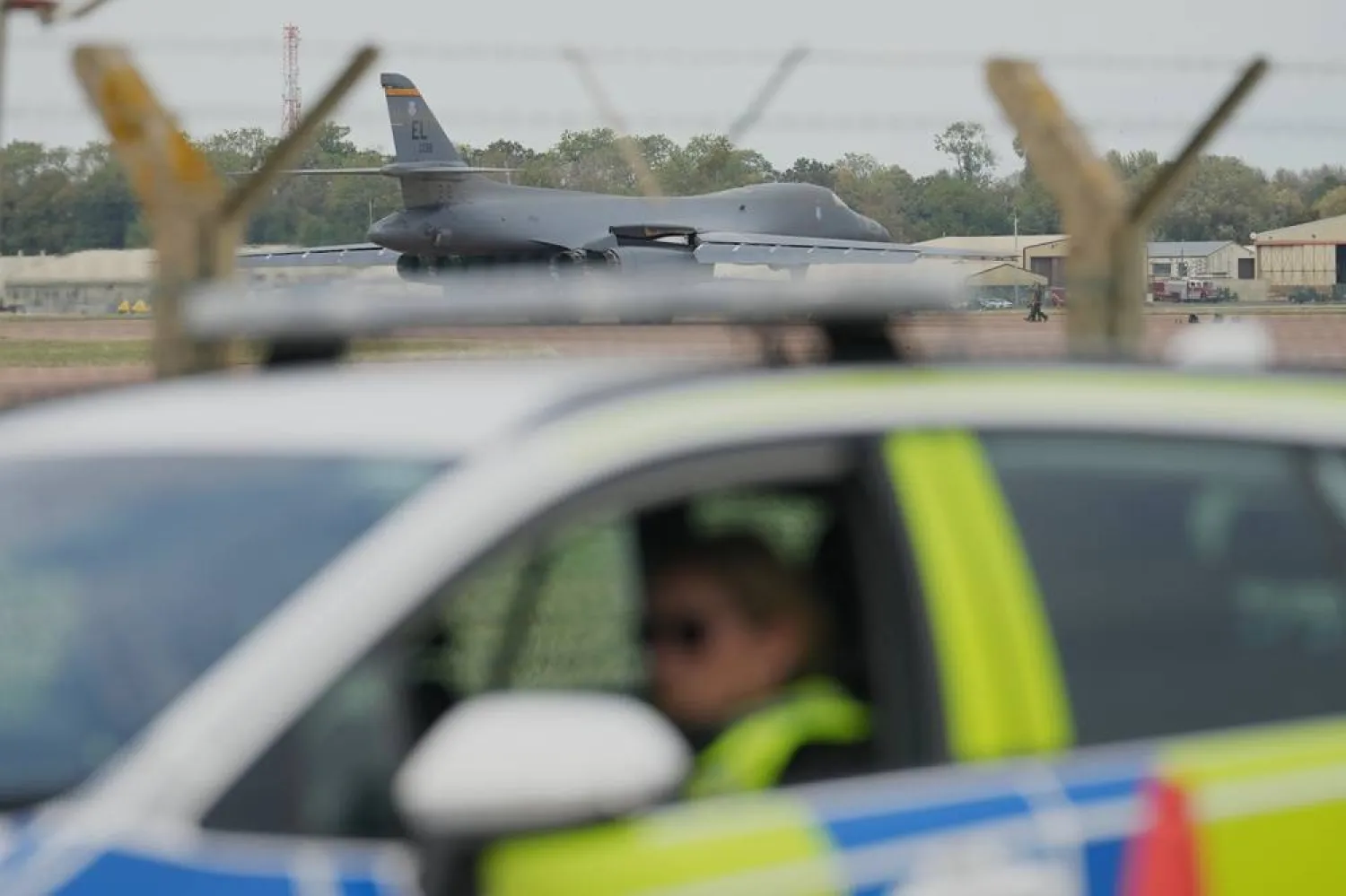
A B1 bomber prepares to take off as police officers guard a checkpoint near RAF Fairford air base, in Fairford, England, Sept. 29, 2026. (AP)
TT

US Charges 3 Men with Plotting Terror Attacks, Including Planned Assault on UK Air Base

A B1 bomber prepares to take off as police officers guard a checkpoint near RAF Fairford air base, in Fairford, England, Sept. 29, 2026. (AP)

A man jailed on terrorism charges in New York was able to pass secret messages to Iranian operatives planning an attack on a British air base used by the US Air Force, according to an indictment unsealed Tuesday.

The new indictment offers fresh insight into an episode shrouded in mystery since Sept. 27, when a group of men were detained on suspected explosives and terrorism offenses after three suspicious vans were spotted traveling toward a British air base where US bombers were stationed.

The new charges accuse Mohammad Baqer Saad Dawood al-Saadi, a dual Iranian-Iraqi national jailed at the Metropolitan Detention Center in Brooklyn, of a role in plotting to attack the Royal Air Force Base in Fairford, in western England, even though he'd been arrested last spring.

According to prosecutors, al-Saadi used coded language in phone and video calls to his mother and sister in Iraq to pass messages encouraging associates to carry out the air base bombing.

Two other men have been charged in the case, which accuses Iran-backed operatives of plotting nearly 20 terror strikes on Jewish communities in Europe and the US

Neither of those men, Mohsen Mohajeri, an Iranian national, and Mohammad Ali al-Hassani, an Iraqi national, are in US custody.

‘Campaign of terror’

“These defendants helped orchestrate a campaign of terror on behalf of terrorist organizations affiliated with Iran that targeted Jewish communities in Europe and the United States, and the British military base, RAF Fairford, housing American service members,” said Manhattan US Attorney Jamie McDonald. "The threat presented by Iran and Iran-backed terrorist groups to America and our allies is not hypothetical — it is very real.”

Attorney General Todd Blanche said: “Anyone who plans a terrorist plot on a military base housing American service members will be prosecuted by the United States government.”

Seven men arrested in the United Kingdom in connection with the incident at the RAF base in Fairford were all released on bail, but two were subsequently re-arrested on suspicion of assisting Iran’s intelligence service and were charged under the National Security Act, British authorities said.

British authorities linked the incident to Tehran, and though Iran denied involvement, the arrests prompted the US to withdraw its bombers that had been stationed there. The bombers were redeployed to the United States.

RAF Fairford, 100 miles (160 kilometers) west of London, has been used by American bombers during decades of conflicts in the Middle East.

Coded messages

US prosecutors said in the indictment that while speaking to his family from the Brooklyn jail, al-Saadi told them he owed money to Mohajeri and directed them to pass messages to him about “work," a term al-Saadi used to describe terrorist activity.

“What are they doing about all our old work?” al-Saadi asked his sister on a July 30 call, according to the indictment. It said he asked her whether it had been canceled or just put on pause, to which she responded that “it isn’t canceled."

On a Sept. 24 call, al-Saadi asked about al-Hassani, whom he was told had been transferred to the “International Section,” and instructed his family to “give him money so we can do it,” it said.

Since his May arrest, al-Saadi had been held in solitary confinement. The Justice Department said he was dangerous because of his desire to attack US and Israeli interests.

New charges come amid court battle over al-Saadi's phone access

Al-Saadi was permitted phone and video calls with his family, but each call was monitored and recorded by the FBI, according to court filings.

In September, al-Saadi’s lawyer complained that some of his calls were repeatedly interrupted and cut off without explanation. Citing concerns that he was using coded language, including “work” and “a job,” the government later said it was limiting him just to a single hourlong call each month.

Still, from June through September, al-Saadi participated in nine phone or video teleconference calls from jail, according to a court filing by prosecutors. In one, al-Saadi's mother told him to stop talking about a topic because “they may end the call,” according to a court filing that said the FBI then terminated the call.

The indictment alleged the three men conspired together to use a network of contacts in the United Kingdom to commit terror attacks on behalf of an Iran-aligned terrorist network, which included the Iranian Revolutionary Guard Corps and Kataib Hezbollah.

In one instance in mid-April, the indictment said, al-Saadi, al-Hassani and Mohajeri directed an individual to carry out an arson attack on a Jewish charity organization in London in real time as they watched it on video that was projected from a laptop computer onto a large screen. The next day, they directed another attack on a synagogue in London, with al-Hassani directing the individual to “light it up like a Christmas tree,” the indictment said.

In June, al-Saadi pleaded not guilty to charges that he plotted at least 18 attacks in Europe in retaliation for the US and Israel’s war with Iran. He called himself a “prisoner of war.” He has been held without bail since. His lawyers did not immediately respond to requests for comment Tuesday.

Both Kataib Hezbollah and Iran’s Revolutionary Guard Corps have been designated by the US government as foreign terrorist organizations. US prosecutors say al-Saadi was a Kataib Hezbollah commander.